Microsoft Hiring Process: AI Agent Blueprint | Hyring
The Microsoft hiring process handles all the recruitment for about 228,000 people working in 190 different countries. It seems like they bring in around 40,000 to 50,000 new recruits from outside each year, combining the ones replacing leavers and the extra for growth. That is a lot to manage. Engineering jobs, plus cloud and AI ones take up the biggest chunk of whatever positions are open at any time. I might be oversimplifying, but it feels like those areas drive most of the demand.
This blueprint lays out spots in the whole recruitment process where Hyring's AI agents could pick up some of that manual screening work Microsoft does. It covers the outputs those agents would churn out for the hiring teams to use. And then there are the KPIs to track how well the whole model performs, keeping it measurable somehow.

This article presents a planning framework showing where AI can reduce manual effort across the hiring funnel.
The Blueprint
A hiring model earns trust when someone on the team can point to a metric that changed this week. If nobody can, it is a deck sitting in a shared drive.
This blueprint targets the Microsoft recruitment process at a scale where tens of thousands of applications arrive monthly across engineering, sales, and operations roles. Four components hold it together:
- A funnel map shaped around high-volume, multi-geography hiring workflows.
- A phased deployment plan built for a four-week pilot.
- A KPI scoreboard with risk flags attached to each metric.
- An ROI module with transparent math and a disclaimer on projections.
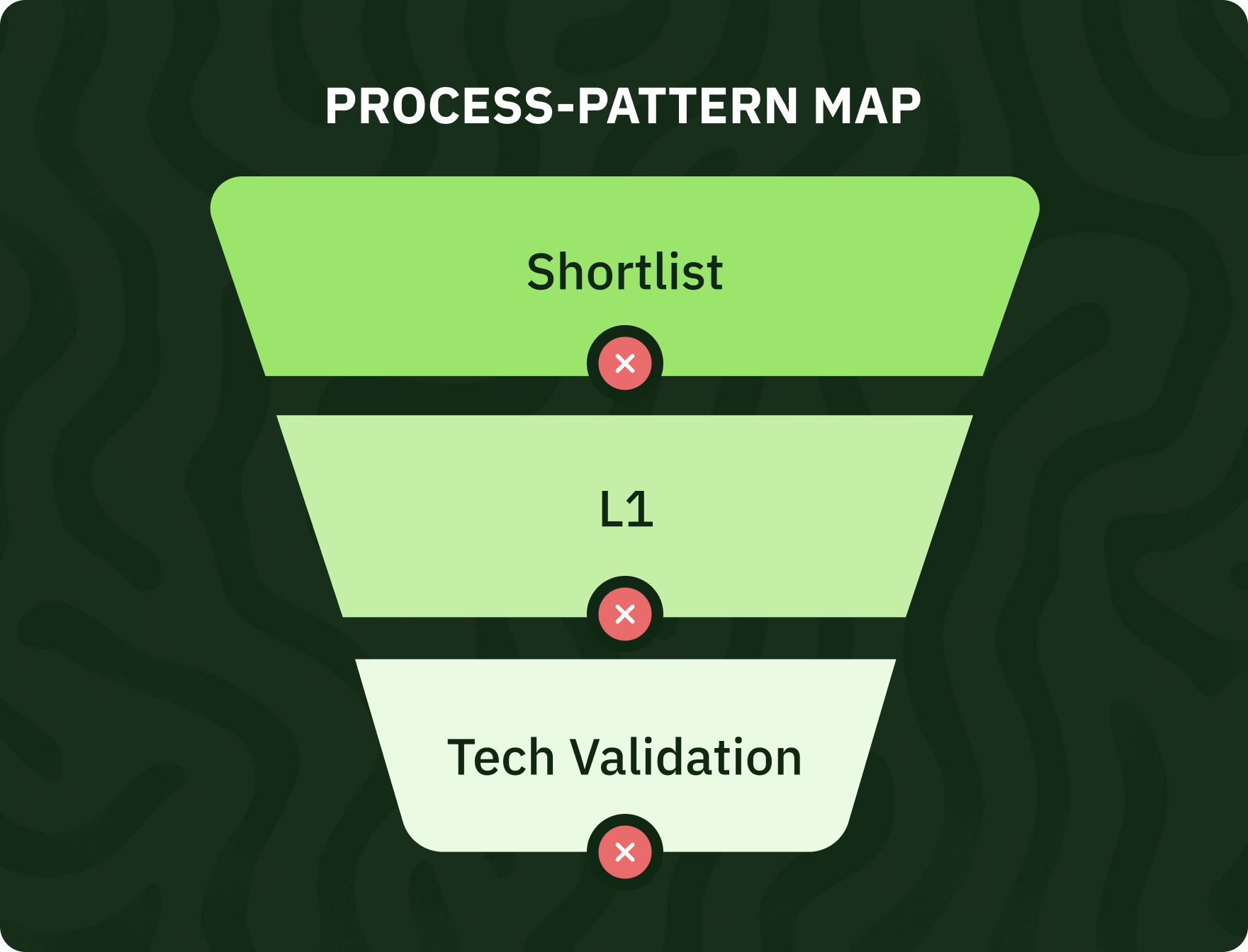
Microsoft runs a multi-loop interview process that varies by organisation. Azure engineering teams use coding interviews and system design rounds. Sales roles go through behavioural panels. Research positions involve presentation-based evaluations. The common thread is that every loop starts with resume screening, recruiter phone calls, and initial technical or competency checks.
Those first three stages carry the heaviest manual load per hire, and they follow predictable patterns. That is where automation earns its keep without displacing human judgment.
Current State
Microsoft closed calendar year 2024 with approximately 228,000 full-time employees, per its Q2 FY25 earnings release filed in January 2025. The company added roughly 2,000 net new headcount in the second half of 2024 after a period of tighter workforce management following the January 2023 reduction of 10,000 roles in the Microsoft hiring process.
Voluntary attrition at Microsoft is not disclosed as a standalone figure, but industry analysts and Glassdoor reviews place it in the range of 8% to 12% depending on the business unit. At a 228,000-person workforce, even 10% annual attrition means roughly 22,800 positions that need backfilling before any growth hiring begins.
The hiring surrounding growth has concentrated around three major departments - Azure cloud infrastructure, the Copilot and AI platform organisation, and security. Satya Nadella noted during the Q2 FY25 earnings call that Microsoft would continue to invest in AI infrastructure talent "ahead of revenue."
Media reporting from mid-2024 through early 2025 placed the active open requisition count at 10,000 to 15,000 roles at any given moment on Microsoft's careers page.
When replacement demand (~22,800) and growth hiring are combined, a reasonable estimate is 40,000 to 50,000 external hires annually. At an application-to-hire ratio that software companies of Microsoft's brand power typically see (15:1 to 25:1 per role, based on Lever and Greenhouse benchmark reports), that generates somewhere between 600,000 and 1,250,000 applications per year landing on recruiter desks. This is a huge ask and a task.
~228000
40k-50k
10k-15k
Concerns of the Microsoft Hiring Process
When your funnel processes north of 600,000 applications per year, a slowdown at any single stage cascades forward (and multiplies too). A two-day lag in resume shortlisting pushes phone screening back a week.
A week's delay at phone screening means engineering panels sit idle or, worse, get pulled into back-to-back interview days that crater their delivery schedules.
Recruiter phone screens for 40,000+ hires consume an enormous time budget
The Microsoft hiring process includes a recruiter call before any candidate enters the technical interview loop. At 20 to 30 minutes per call and a conversion ratio where roughly three phone screens produce one loop invite, the math adds up quickly. For 45,000 hires at a 3:1 screen-to-loop ratio, that is 135,000 phone screens per year.
At 25 minutes each, the annual cost is roughly 56,000 person-hours of recruiter time on calls where the questions (availability, salary expectations, visa status, role understanding, career motivations) repeat identically.
The multi-round interview loop ties up senior engineers for days
Microsoft's engineering interview loop typically involves four to five interviewers across a full day, sometimes split over two days for senior roles.
An interviewer preparing, conducting, and writing up a 45-minute session spends approximately 90 minutes total. Multiply that by four panellists per loop and 20,000+ engineering hires, and the engineering organisation absorbs well over 100,000 interview hours annually.
Google, Meta, Amazon, and now OpenAI and Anthropic are competing for the same candidates. Every hour an engineer spends interviewing is an hour not spent on the product.
Candidate drop-off between stages is invisible and expensive
Candidates with competing offers from Google, Amazon, or fast-moving startups rarely send a formal withdrawal. They stop responding.
Microsoft's interview process, when it stretches beyond two weeks from first contact to offer, loses candidates silently. Internal recruiter discussions on Blind app have cited 20% to 30% loop no-show rates for mid-level engineering roles during peak hiring seasons, though Microsoft does not publish this figure officially.
Remote interview integrity depends on interviewer's vigilance, which fades
Since the shift to remote-first interviewing in 2020, Microsoft has conducted most initial rounds over Teams.
Detecting tab-switching, secondary audio sources, or someone reading from a hidden prompt during a live video call depends entirely on the interviewer's attention (which is definitely archaic and almost dinosaur-meme worthy as of 2026).
By the fourth or fifth interview of the day, that attention is diminished. No systematic proctoring layer exists at the recruiter-screen or early-technical-screen level for most organisations within Microsoft.
Hyring AI Agents
Hyring's agents operate at stages where manual repetition consumes time without requiring creative or relational human judgment. The rule is simple: if a stage runs on a repeatable rubric with a scored or binary output, the agent handles it. If the decision requires nuance, culture-fit reading, or negotiation, a human handles it.
Human sign-off at every advancement decision is non-negotiable.
The AI Resume Screener
Instantly parse and rank resumes based on job-fit signals and technical requirements.
- Rapid high-volume parsing
- Objective skill ranking
- Bias-reduced shortlisting
The AI Phone Screener
Automated L1 verification calls to ensure basic qualifications and interest levels.
- 24/7 automated screening
- Consistent evaluation metrics
- Instant shortlist generation
The AI Coding Interviewer
Technical assessment with live coding environments and real-time logic evaluation.
- Real-time code analysis
- Plagiarism detection
- Automated logical scoring
English Proficiency Test
Standardized evaluation of communication skills, fluency, and professional vocabulary.
- Automated fluency scoring
- Grammar and clarity analysis
- CEFR aligned reporting
Funnel-to-agent
| HIRING STAGE | HYRING PRODUCT | WHAT IT DOES | OUTPUT (WHAT THE TEAM SEES) |
|---|---|---|---|
| SHORTLIST | AI resume screener | Ranks candidates by role-fit signals parsed from resumes against the job description. | Ranked shortlist with match-score breakdown. |
| RECRUITER SCREEN | AI phone screener | Conducts first-round phone conversations covering availability, motivation, and role understanding. | Call summary, competency score, advance/hold recommendation. |
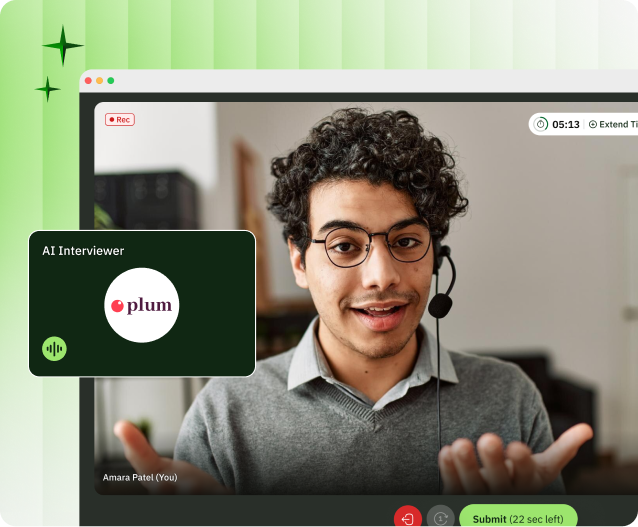
| STRUCTURED INTERVIEW | AI video interviewer | Runs video-based structured interviews and generates scored candidate reports. | Interview recording, transcript, rubric scores, integrity flags. |
| TECH VALIDATION | AI coding interviewer | Administers live coding problems for engineering roles with automated evaluation. | Code quality report, problem-solving score, plagiarism check. |
| COMMUNICATION CHECK | English proficiency test | Tests spoken English where roles require client-facing or cross-team communication. | CEFR-benchmarked level with skill-area breakdown. |
HYRING PRODUCT
AI resume screener
WHAT IT DOES
Ranks candidates by role-fit signals parsed from resumes against the job description.
OUTPUT (WHAT THE TEAM SEES)
Ranked shortlist with match-score breakdown.
HYRING PRODUCT
AI phone screener
WHAT IT DOES
Conducts first-round phone conversations covering availability, motivation, and role understanding.
OUTPUT (WHAT THE TEAM SEES)
Call summary, competency score, advance/hold recommendation.
HYRING PRODUCT
AI video interviewer
WHAT IT DOES
Runs video-based structured interviews and generates scored candidate reports.
OUTPUT (WHAT THE TEAM SEES)
Interview recording, transcript, rubric scores, integrity flags.
HYRING PRODUCT
AI coding interviewer
WHAT IT DOES
Administers live coding problems for engineering roles with automated evaluation.
OUTPUT (WHAT THE TEAM SEES)
Code quality report, problem-solving score, plagiarism check.
HYRING PRODUCT
English proficiency test
WHAT IT DOES
Tests spoken English where roles require client-facing or cross-team communication.
OUTPUT (WHAT THE TEAM SEES)
CEFR-benchmarked level with skill-area breakdown.
KPI Scoreboard — Microsoft Hiring Model
Time to Screen
Definition: Elapsed hours from receiving the application to L1 decision.
Risk indicator: Getting this below 48 hours is a clear win, but watching the panel-stage rejection rate is crucial. If it spikes, the early filter may be trading speed for accuracy.
Screening Throughput
Definition: Number of initial screens completed per recruiter per week.
Risk indicator: If throughput climbs while the next-stage advance rate falls, the intake net is set too wide. Narrow the criteria before pushing more volume through.
Interview Completion Rate
Definition: Percentage of candidates who receive a loop invite and finish all rounds.
Risk indicator: Below 55% completion at Microsoft's scale usually points to scheduling friction, unclear prep instructions, or assessment windows that exceed 60 minutes. A balance is required.
Early Stage Drop-offs
Definition: The funnel step where candidates go silent.
Risk indicator: Heavy drop-off at the assessment stage (rather than scheduling) suggests the test feels inordinately long or difficult for the role's seniority level. Senior candidates abandon faster than new grads.
Panel Hours per Hire
Definition: Total human interviewer hours consumed per finalised hire.
Risk indicator: Cross-reference this with 90-day attrition. If panel hours drop and early attrition rises, the AI filter may be too aggressive on soft-skill signals that panellists would have caught.
Pass-through Rate
Definition: Percentage of candidates advancing from one stage to the next.
Risk indicator: A 15-point variance in pass-through between two offices hiring for the same role means the rubric needs a geography-based (local) calibration, not a single global threshold.
Shortlist-to-Offer Ratio
Definition: How many shortlisted candidates does it take to produce one accepted offer?
Risk indicator: Moving from 10:1 to 5:1 is strong. Moving from 10:1 to 2:1 suggests the model is pruning candidates who would have succeeded in the role.
Integrity Flag Rate
Definition: Percentage of AI-conducted interviews triggering fraud or cheating alerts.
Risk indicator: A baseline of 3% to 5% is normal. A sudden spike above 9-10% from a single location or source warrants a manual review before drawing conclusions about that candidate pool.
Time to First Touch
Definition: Lag between application submission and first outreach.
Risk indicator: Automating the first touch is straightforward. The harder question is whether touches two and three (assessment link, status update) also arrive on schedule. Fast first contact followed by silence for a week creates worse candidate perception than a consistently moderate pace.
SLA adherence
Definition: Percentage of candidates receiving status updates within a given number of days.
Risk indicator: Rising SLA adherence paired with declining offer acceptance may indicate that the updates are too generic. Candidates want progress information, not just template confirmations.
Model ROI for High-Volume Scenario
Every number in this section is an illustrative estimate or forecast. The math uses publicly reported Microsoft hiring process workforce data, but internal cost structures vary by organization and geography. Treat this as a starting framework, not a given.
Annual Savings Potential
$4.8M+
in recruiter hours, panel time, and coordination overhead.
Reduction in Time-to-Hire
58%
faster for roles where AI agents handle top-of-funnel screening.
Faster Interview Process
48%
acceleration in early-stage scheduling and evaluation velocity.
5-Year ROI Projection
~210%
(Year-1, phased deployment). At full 810,000 application volume, annual savings reach ~$4.8M, delivering payback in under 2 weeks per hiring cycle.
Note: ROI figures below are an illustrative model of potential savings in this specific scenario. Actual results vary by internal workflow costs.
Hours Saved Annually
Three stages absorb the bulk of manual effort in the Microsoft recruitment process: resume screening, recruiter phone screens, and early technical panels.
- Resume screening: 810,000 applications at an average of 8 minutes per resume equals roughly 106,600 person-hours. With AI resume screening, recruiter time shifts to reviewing AI-generated shortlists. Estimated remaining effort: approximately 12,000 person-hours for shortlist review and exception handling.
- Recruiter phone screens: 135,000 candidates reach the phone screen stage. At 25 minutes per call, that is 56,250 person-hours. AI phone screening handles the calls and produces scored summaries. Remaining recruiter effort for review: approximately 5,400 person-hours.
- Early technical panels: 60,000 candidates reach technical evaluation. At 45 minutes per candidate with an average of 1.5 panellists, that is 67,500 person-hours. AI coding and video screening can reduce the number of candidates reaching live panels by roughly 50%, recovering an estimated 33,750 person-hours.
Total estimated hours recovered annually: ~179,267.
Manual vs AI-Assisted Hiring Effort
Source: Hyring hiring model (Illustrative)
Current State Costing vs. Target State with AI
At Microsoft's estimated 18:1 application-to-hire ratio, efficiency gains at the top of the funnel compound at every stage below.
| Metric | Current Manual Process | Target with Hyring AI Agents |
|---|---|---|
| L1 Screening Cost | ~$5.6M manual hiring cost (recruiter, coordinator, infrastructure). | ~$340K AI-assisted cost (~$1 per AI screen + recruiter review). |
| Engineering Panel Load | Heavy: Engineers conduct 4–6 interviews/day across time zones | Lighter: Panels see AI-screened candidates only (~2/day) |
| Interview Scalability | Hiring limited by calendars, time zones, and Teams slots. | AI assessments run asynchronously with automated proctoring. |
| Fake Candidate Detection | Interview evaluation varies due to fatigue and back-to-back sessions. | Automated proctoring monitors identity, voice, screen activity, and gaze. |
| Funnel Completion Rate | ~25% of shortlisted candidates receive offers. | >65% projected progression, driven by faster scheduling and updates. |
Where the $4.8M+ Savings Come From
The biggest cost recovery is not in the recruiting department. It sits in engineering productivity margins and candidate acquisition overhead.
- L1 volume handled by AI agents: At 810,000 applications and the combined screen time across resume and phone stages, the manual cost approaches $5.6M in loaded recruiter hours. AI phone and video agents conducting 90% of those screens at ~$1 each bring the cost to approximately $540K. Net recovery: ~$5.0M in recruiter time, though a conservative figure accounting for overlap and transition costs is closer to $3.2M.
- Engineering hours returned to product work: Microsoft bills internal engineering time differently than a services firm, but the opportunity cost is real. Senior and mid-level engineers in the US carry fully loaded costs of $85 to $120 per hour. Recovering 33,750 panel hours at a midpoint of $95/hr translates to roughly $3.2M in engineering capacity restored. Using a conservative discount for partial recovery: ~$1.1M.
- Scheduling and coordination overhead reduced: Multi-timezone loop coordination (slot management, candidate communication, rescheduling, and no-show follow-ups) absorbs an estimated 15,000 coordinator hours per year at Microsoft's scale. Self-scheduling through AI assessment links eliminates roughly 55% of that workload. Estimated recovery: ~$260K.
- Re-screening and integrity investigation costs avoided: Manual fraud detection catches problems late, sometimes after a candidate has progressed two or three stages. Automated proctoring at the first AI interview stage catches integrity issues earlier. Estimated savings from avoided wasted downstream effort: ~$190K annually.
Total estimated annual savings: ~$4.8M (rounded conservatively).
Where the Savings Come From
Source: Hyring hiring model (Illustrative)
Cumulative Savings vs Cost
Platform investment loads in the first two months. Savings accumulate with each hiring cycle. In this model, break-even arrives around month five. That timeline compresses further if intern and contractor hiring volumes run through the same Hyring deployment, since marginal cost per additional AI interview is near-zero once the platform is configured.
What makes the Microsoft hiring model particularly responsive to AI deployment is the nature of the first three funnel stages. They process enormous volumes, they follow consistent rubrics, and they produce scored outputs. These stages do not require creative evaluation or relationship-based negotiation. They require consistency in speed across geographies and time zones.
Cumulative Savings vs Investment (12-month model)
Month
Source: Hyring hiring model (Illustrative)
Microsoft Hiring Process Plan
Deploying across 810,000 annual applications on day one would break any system and any team's confidence in it. Staged rollout protects existing workflows, produces comparison data, and lets hiring panels build trust in AI outputs before they depend on them.
Week 2
Activate the AI Phone Screener and AI Video Interviewer for the two pilot roles only. Run them alongside the existing manual process for 72 hours. Compare outputs daily of score distributions, time-to-decision, and candidate completion rates. Surface discrepancies between AI recommendations and manual decisions immediately, so rubrics can be calibrated before volume increases.
Week 3
Add the AI Coding Interviewer for the engineering track. Add the English Proficiency Test for any sales or customer-facing role where cross-region communication is a first-year requirement.
Begin monitoring integrity flag rates and compare them against whatever baseline exists from manual fraud detection (even an informal one). Flag rate spikes from a specific source or geography should trigger a threshold review, not automatic candidate rejection.
Week 4
Aggregate results from both pilots. Key review questions can be - Did pass-through rates improve without panel satisfaction declining? Did candidate NPS hold steady or improve? Did time-to-offer compress perceptibly? Adjust question banks, scoring weights, and flag sensitivity based on data. Expand to the next batch of requisitions only after two consecutive review cycles show stable SLAs.
Frequently Asked Questions
How does this hiring model handle Microsoft's global, multi-timezone hiring volume?
Every candidate in a batch receives their assessment link simultaneously, regardless of location. Hyring's AI agents run sessions concurrently across time zones, so a 10,000-application intake across Redmond, Hyderabad, and Dublin clears L1 in days rather than the two to three weeks manual scheduling would require.
What does the first-round automated agent produce for the Microsoft interview process?
A per-candidate report with a competency score breakdown, response summary, flagged areas for deeper probing, and an advance-or-hold recommendation. Recruiters review it in roughly 90 seconds instead of spending 25 minutes on a phone call collecting the same information.
How does the system prevent interview cheating?
The AI video interviewer tracks signals simultaneously - tab switches, secondary faces, voice mismatches, gaze anomalies, lip-sync gaps, and clipboard activity. These feed into a composite integrity score. No single flag triggers automatic rejection. The recruiter sees which signals are fired and decides next steps.
Do automated interviews hurt candidate experience?
Candidates select their own assessment window, avoid scheduling back-and-forth, and receive status updates faster because scoring completes immediately after the session. Feedback from deployed instances shows completion satisfaction holds steady or only improves.
Can the coding validation be customized for different Microsoft engineering roles?
The coding interview platform supports Java, Python, C++, C#, JavaScript, SQL, and other language environments with configurable difficulty per role profile.
An Azure backend engineer and a Microsoft 365 frontend developer see entirely different problem sets without requiring separate platform instances.
How do human technical panels fit into this workflow?
Panels step in at the final stage only. By that point, candidates have cleared resume screening, phone or video assessment, coding validation, and language evaluation. Engineers spend their loop time on system design depth and team-fit signals rather than re-checking baseline qualifications.