Mercor VS Hyring
Mercor
vsHyring
A Detailed Comparison
Written on: 03 Feb 2026
Last updated: 03 Feb 2026

Written by
Team Hyring

Fact Checked by
Adithyan RK


Table of Contents
1.An Overview
2.Why Hiring Teams Migrate From Mercor To Hyring
3.Mercor vs Hyring: Metrics Comparison
4.Ecosystem: Products & Hiring Workflow
5.Hyring Review
6.Hyring Workflow
7.Brief
8.Mercor Review
9.Mercor Workflow
10.Bottom Line
11.Snapshot of Features - Hyring vs Mercor
12.Mercor vs Hyring: A Detailed Features Comparison
•Conversational AI Interviewing
•Candidate Authenticity & Proctoring
•Scoring, Fairness & Bias Reduction
•Assessment Types & Role Coverage
•Scheduling & Automation
•Reporting & Hiring Analytics
•Global Hiring & Accessibility
•The Human Touch: Mercor vs Hyring
13.UI UX Experience
14.Security & Compliance
15.Cost & Pricing Structure
16.Client Testimonials
17.Conclusion: Which is the Best AI Interviewer - Mercor vs Hyring?
18.Frequently Asked Questions
An Overview
Most hiring teams are facing the same reality: applications are up, and the capacity of hiring teams is limited, while the expectations for fairness and documentation are rising.
Hyring is more concerned with what happens after a candidate is in the funnel. It is very much focused on interviews, evaluations, and structured reporting. The tool is built to help the hiring team evaluate candidates in a consistent and defensible way.
Mercor is more concerned with who is actually in the funnel in the first place. It uses AI models to evaluate resumes, profiles, and past data to rank and match candidates to open positions.
Why Hiring Teams Migrate From Mercor To Hyring
Mercor works well for teams that mainly need faster shortlists. For startups and growing companies, being able to quickly identify strong profiles can remove a major bottleneck.
However, as teams scale, the nature of the problem often changes.
Recruiters begin to care less about how quickly they can generate a shortlist and more about how confidently they can justify hiring decisions. Questions around interview quality, candidate integrity, and internal alignment become more important.
Many teams that move from Mercor to Hyring describe a similar experience. They found that while Mercor helped them find candidates faster, it did not give them enough structure once interviews began.
Hyring’s workflow-centric design — moving systematically from interview to report to shortlist — appeals to teams that want fewer subjective decisions and more consistent processes.
Mercor vs Hyring: Metrics Comparison
 Trustpilot Score
 Capterra – Ease of UseCapterra – Customer ServiceCapterra – FeaturesCapterra – Value for MoneyCapterra Rating (overall)
Ratings change over time. Review live pages for the latest updates.
Ecosystem: Products & Hiring Workflow
This section explains how Mercor and Hyring could fit into your hiring process. It will help you pick the best AI recruiting tool based on whether you want to focus on skill alignment or high-volume hiring.
Hyring Review
Product Ecosystem
Hyring is an AI recruitment platform that uses AI to screen candidates early in the hiring process. It assesses candidates, creates detailed reports, and focuses on interview integrity.

AI Video Interviewer
Conducts video interviews, records them, and creates reports to evaluate candidates.

AI Phone Screener

AI Coding Interviewer

AI Resume Scanner

English Proficiency Test
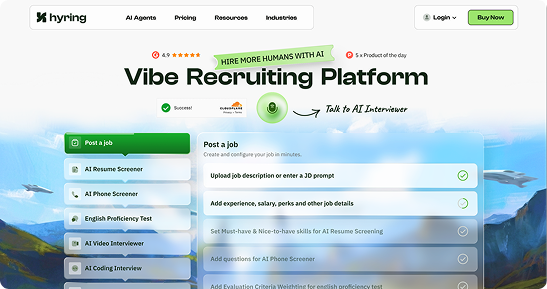
These tools help recruiters quickly filter and assess candidates while ensuring the right people are selected.
Hyring Workflow
Hyring streamlines early hiring using AI to evaluate candidates based on set criteria.
Brief
Hyring is an AI recruitment tool that helps hiring teams work quickly and accurately. It helps recruiters save time on early-stage evaluations, especially for high-volume job openings. Several users on G2 and Capterra say it makes hiring easier while keeping the candidate experience in mind.
- Easy to use
- AI coding interviews for tech jobs
- English Proficiency Test for workplace communication
- Resume and phone screening reduce recruiter effort
- Strong anti-cheating measures
- Flexible plans for all team sizes
- Lack of identity checks can be a concern
- AI interviews can feel impersonal to candidates
TAKEAWAY
Hyring makes it easier to evaluate candidates quickly by automating early steps and providing clear reports with scores, helping recruiters make fast decisions.
Mercor Review
Product Ecosystem
Mercor is a platform that uses AI to check candidates' skills and match them with jobs. It does this through its AI recruitment process that interviews and tests candidates, then shows hiring teams the best candidates for quick hiring.
AI Matching
Looks at resumes to decide which candidate is best suited for a given role.
AI Interview
Assessments
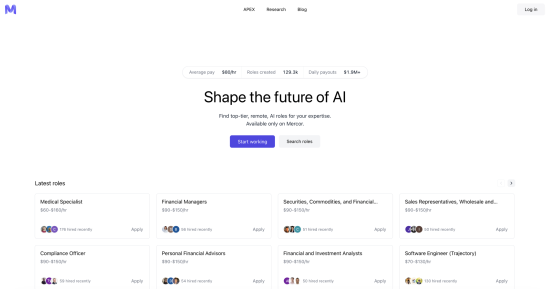
These tools reduce the need for a recruitment team and help save time on early screening by making evaluations standard and speeding up the process from shortlist to offer.
Mercor Workflow
Mercor simplifies hiring by using AI interviews and tests to find and show prequalified candidates to hiring teams.
Brief
Mercor is a platform that uses AI recruitment software to check candidates' skills through AI interviews and tests, then recommends said talent to hiring teams. It works well for high-volume niche roles and doesn't require any human interference.
- Good at evaluating skills: AI interviews are specific and evaluated consistently
- Quick matching can speed up hiring
- Feedback is constantly taken and implemented
- Good for niche high-volume hiring
- Proctoring doesn't seem to be strong
- Can be very impersonal as there is no human touch
- May not work well for standard roles
TAKEAWAY
Mercor works best when you want to quickly find candidates based on their skills, allowing managers to spend less time screening and more time making decisions from a strong candidate list.
Bottom Line
Hyring automates early-stage hiring, using resumes and interviews, providing strong reports and anti-cheating measures.
Mercor focuses on skills vetting and matching candidates through AI interviews and assessments, quickly showing prequalified candidates and enabling faster hiring.

Hyring is great for multi-type screening and detailed reports.

Mercor is best for skills vetting and matching with prequalified lists.
Both tools help reduce the workload for recruiters by automating early evaluations and speeding up the shortlisting process.
Snapshot of Features - Hyring vs Mercor
Conversational AI interviewing
(adaptive follow-ups)
Limited public data
Dynamic follow-up questions
Limited public data
Asynchronous video interviews
Limited public data
Phone-based screening
Not publicly documented
Candidate authenticity & proctoring
Limited public data
Identity verification / liveness checks
Limited public data
Role-specific interview templates
Limited public data
Technical & coding assessments
Limited public data
High-volume automation
Structured scoring & rubrics
Limited public data
Hiring analytics & reports
Limited public data
ATS integrations & APIs
Multilingual support
Limited public data
Enterprise security
(SOC2 / ISO)
SOC2
(public)
Live human support & onboarding
Limited public data
Free trial
Not publicly disclosed
As audited on 03 Feb 2026.
Mercor vs Hyring: A Detailed Features Comparison

Conversational AI Interviewing
Hyring
Hyring conducts human-like conversational AI interviews that resemble a traditional interview. Hyring also offers resume checking and AI phone screening, making it easier for companies to choose candidates.
Mercor
Mercor has one-way AI video interviews where candidates are judged based on their resume and the job description. Responses are then recorded, transcribed, and evaluated by AI.
 WHO WINS
Both platforms use AI, but Hyring’s interviews feel more human, especially with their lifelike AI-twin feature.
Candidate Authenticity & Proctoring
Hyring
Hyring is designed keeping integrity at its core. The platform actively strives to mitigate any kind of malpractice during interviews. The platform looks for cheating by monitoring lip sync issues, detecting tab-switches, and provides results with recordings on the final report.
Mercor
Mercor asks candidates to use their camera and microphone throughout the interview, but does not explain how the platform prevents cheating, like looking for tab-switching or tracking eye-gaze.
WHO WINSIf preventing malpractice is important, Hyring’s methods are foolproof and transparent when compared to Mercor.
Scoring, Fairness & Bias Reduction
Hyring
Hyring gives detailed reports to recruiters that include skills like communication, confidence, and technical ability. The platform aims to be fair and gives transparent scores to assist managers in making the final hiring decision.
Mercor
Mercor’s AI recruiter judges candidates by looking at interview transcripts related to their resume and the job description. While it is known that they use AI for scoring, the parameters are unknown.
WHO WINSBoth platforms use AI for scoring, but Hyring’s reports are more transparent and actionable than Mercor's, making it better among Mercor alternatives.
Assessment Types & Role Coverage
Hyring
Hyring covers everything needed for early-stage hiring. It conducts resume screening, phone screening, live coding assessments, and video interviews. The platform is designed to accommodate any role, from software engineers to sales.
Mercor
Mercor uses AI interviews along with online written tests or MCQ’s to evaluate candidates. The primary focus is to streamline the entire hiring process, using AI for the entire process.
WHO WINSHyring is a one-stop solution for a recruiter looking to hire for a variety of roles. Mercor can only be used for niche roles.
Scheduling & Automation
Hyring
Hyring’s AI makes it easy to conduct interviews with many candidates at the same time without managing calendars. Hyring’s AI phone screener also has a follow-up option when candidates do not respond to the call.
Mercor
Mercor allows candidates to start their interview process directly from its dashboard. Since AI is conducting the interview, there is no calendar coordination required. This means multiple interviews for the same job can happen at once, speeding up the hiring process.
WHO WINSIf managing high volume is a concern for you, you cannot go wrong with Hyring. It has a feature to upload candidates in bulk, automate scheduling and follow-ups, making the hiring process organized and quick.
Reporting & Hiring Analytics
Hyring
Hyring gives recruits a very comprehensive report for every candidate. This report includes candidate scores, video recordings, transcripts, conversational insights, and proctoring results. Candidate's performances are broken down by skill, making it easy for hiring managers to decide.
Mercor
With Mercor, recruiters can easily watch interview recordings along with transcriptions and AI evaluations. No other metric is mentioned.
WHO WINSFor a more hire-ready report, Hyring is the better option. It gives a transparent report with a quick summary and skill breakdown, making judgment simple. Mercor focuses more on analysis, giving recruiters only recordings and transcriptions.
Global Hiring & Accessibility
Hyring
Hyring is built around international hiring. Candidates can interview in 10+ languages while companies get reports in English. If knowing English is a requirement, Hyring offers an English Proficiency Test (EPT) to test workplace communications.
Mercor
Mercor lets candidates apply for jobs on their portal and attend AI interviews from anywhere in the world. This makes it easy for companies to scout global talent. However, it does not bridge the linguistic gap and conducts interviews only in English.
WHO WINSBoth platforms help with global hiring, but Hyring aims to be the better alternative to Mercor here, as it has the linguistic tools to support it with 10+ languages. This helps companies manage a more diverse talent pool.
The Human Touch: Mercor vs Hyring
Hyring
Hyring integrates humans mainly at review and decision stages. AI handles screening, but recruiters remain responsible for outcomes.
Mercor
Mercor automates discovery more heavily. Human involvement increases later.
WHO WINSBoth models respect human judgment, but at different points in the funnel.
UI UX Experience
Both Mercor and Hyring are built with the intention of reducing recruiter effort, but they approach user experience from very different directions.
Hyring
Hyring is designed around a clear, repeatable workflow. From job creation to interview setup and report review, most actions follow a predictable path. This makes it easier for new recruiters to get started quickly and for teams to maintain consistency across roles. The interface focuses on clarity rather than customization, showing recruiters only what they need at each stage,Dashboards, interview builders, and reports are structured in a similar way across campaigns. This reduces confusion and makes collaboration easier between recruiters and hiring managers. For high-volume teams, this consistency becomes a major advantage.
Mercor
Mercor’s interface is lighter and more sourcing-focused. Recruiters spend most of their time reviewing candidate profiles, rankings, and recommendations generated by its matching system. This makes the platform feel fast and simple during early screening.,Once interviews begin, users often move to external tools when using Mercor. This can fragment the experience, especially in larger hiring programs. Hyring’s one size fits all mantra, is more suitable for integrated experience, and also is compatible with external tools. So win-win.
WHO WINSBoth models respect human judgment, but at different points in the funnel.
Recruiter Experience
Hyring
Hyring emphasizes speed and reliability. Recruiters can configure roles quickly, reuse templates, and launch campaigns with minimal setup. Bulk invitations, report exports, and ATS handoffs are easy to access.
Mercor
Mercor’s recruiter experience is centered on shortlisting and profile evaluation. It works well for discovery, but offers fewer native tools for managing interview workflows.
Candidate Experience
Hyring
Hyring provides a guided and predictable interview journey. Instructions are clear, and candidates know what to expect. Proctoring is transparent, which helps build trust.
Mercor
Mercor’s candidate experience depends more on employer setup. Since interviews often happen externally, the journey can feel less unified.
WHO WINSOverall, Hyring offers more consistency, while Mercor offers more flexibility.
Security & Compliance
Security and compliance are critical when handling resumes, interview recordings, and assessment data. Both Mercor and Hyring operate within enterprise security standards, but they emphasize different areas.
Hyring
Hyring positions security as part of its core hiring infrastructure. Public documentation highlights encrypted storage, controlled access, and secure handling of interview data. Recordings, transcripts, and reports are accessible only to authorized users.
Mercor
Mercor also emphasizes platform-level security, particularly for resume and profile data used in matching. Public materials reference standard compliance frameworks, though fewer interview-specific practices are documented.
Data Protection
Hyring
Hyring encrypts candidate data in transit and at rest and applies role-based access controls. Retention policies are aligned with hiring workflows, and privacy requests are supported.
Mercor
Mercor maintains secure cloud infrastructure and access controls focused mainly on sourcing and profile data.
Compliance & Certifications
Hyring
Hyring publicly documents SOC 2 Type II and ISO 27001 compliance. These certifications are important for organizations with audit or regulatory requirements.
Mercor
Mercor publicly lists SOC 2 compliance, with fewer publicly available details on additional certifications.
Candidate Privacy
Hyring
Hyring informs candidates about recordings and monitoring during interviews. Privacy practices are integrated into the workflow.
Mercor
Mercor provides privacy information through legal documentation, and practices may vary depending on the employer's setup.
WHO WINSBoth platforms follow industry norms, but Hyring places more visible focus on interview data protection.
Cost & Pricing Structure
Hyring uses a usage-based pricing model tied to interview volume. Companies pay based on how many interviews they conduct rather than fixed monthly licenses. This allows costs to scale with actual hiring activity.
Because pricing is linked to usage, recruiters and finance teams can estimate cost per interview and cost per hire more easily.
Mercor follows a customized pricing model. Costs are usually determined based on deployment scope, usage, and integrations.
Public information suggests pricing typically starts in the $1–$5 range per interview at higher volumes.,This transparency makes budgeting simpler, particularly for seasonal or campaign-based hiring.
Public per-interview rates are not available.
Pricing model
Hyring uses a usage-based pricing model tied to interview volume. Companies pay based on how many interviews they conduct rather than fixed monthly licenses. This allows costs to scale with actual hiring activity.
Because pricing is linked to usage, recruiters and finance teams can estimate cost per interview and cost per hire more easily.
Mercor follows a customized pricing model. Costs are usually determined based on deployment scope, usage, and integrations.
Transparency
Public information suggests pricing typically starts in the $1–$5 range per interview at higher volumes.,This transparency makes budgeting simpler, particularly for seasonal or campaign-based hiring.
Public per-interview rates are not available.
You can further look at Hyring's pricing structure and even request a consultation and avail special offers at Hyring Subscription Plans. Price-wise, Hyring at first glance seems to be more value for money as a Mercor alternative.
Client testimonials
We cut phone screens by 60% after rolling out structured AI screening. Recruiters could focus on higher-value interviews.
Mid-market
Tech recruiter

Conclusion: Which is the Best AI Interviewer - Mercor vs Hyring?
Mercor and Hyring both bring real value to modern hiring, but they focus on different parts of the process.
Mercor works best at the top of the funnel. It helps teams find and rank candidates quickly using AI matching and skill-based assessments. For companies that mainly want faster shortlists, Mercor can be a helpful starting point.
Hyring, however, is built for what matters most: interviewing and evaluation.
Its conversational AI interviews, built-in proctoring, structured scoring, and detailed reports give recruiters a clear and reliable view of every candidate. Instead of just ranking applicants, Hyring explains performance across communication, technical ability, and integrity. This makes hiring decisions easier, fairer, and more defensible.
As hiring scales, this structure becomes critical. Teams need consistency, transparency, and confidence in their process. Hyring delivers all three.
In the Mercor vs Hyring comparo we can conclude Mercor supports fast discovery, Hyring supports better hiring.
For organizations that care about interview quality, compliance, and long-term hiring outcomes, Hyring is the stronger choice—and the better AI interviewer.
Why Hyring is stronger for traditional recruiting teams
Structured AI interviews, built-in proctoring, role-based scoring, and detailed reports that make hiring decisions easier, fairer, and more defensible at scale.
Choose Hyring if
You need structured interviews, compliance-ready reports, and full visibility into candidate performance across communication, technical ability, and integrity.
Where Mercor is strong
AI-powered talent matching and curated candidate shortlists - ideal for teams that prioritise faster top-of-funnel discovery over deep interview evaluation.
Choose Mercor if
Your primary need is fast sourcing and AI-ranked shortlists, and you're comfortable with lighter evaluation depth at the interview stage.
Disclaimer: Information is based on publicly available sources and may change.
Frequently Asked Questions
Hyring and Mercor both use AI in hiring, but they focus on different stages of the recruitment process.
Hyring is designed as an <a href="https://hyring.com/blog/5-ways-ai-interviewing-software-streamlines-hr-tasks/" target="_blank" rel="noopener noreferrer" class="text-blue-700">AI interviewing and screening platform</a>. It conducts structured interviews, coding assessments, English proficiency tests, and generates standardized evaluation reports.
Mercor focuses more on talent sourcing and candidate matching. It emphasizes AI-powered vetting, marketplace-style hiring, and curated candidate pools, particularly for technical and freelance roles.
In simple terms, Hyring specializes in interviewing and evaluation, while Mercor emphasizes talent discovery and placement.
No. Neither platform replaces human recruiters.
Both Hyring and Mercor automate parts of the hiring funnel, such as screening, evaluation, and candidate shortlisting. However, relationship management, cultural assessment, negotiation, and final hiring decisions remain human responsibilities.
These platforms are designed to improve recruiter efficiency, not eliminate the recruiter role.
Yes. Both platforms support integration with existing hiring systems.
Hyring provides APIs and integrations that allow interview reports, scores, and candidate data to flow into ATS platforms such as Greenhouse, Workday, Lever, iCIMS, Workable, Ashby, and others. It also supports Slack and WhatsApp integration.
Mercor primarily operates within its own hiring ecosystem but supports data exports and integration workflows for employer systems.
Hyring generally offers deeper ATS integration for structured recruiting environments.
Sourcing is primarily performed through LinkedIn Recruiter rather than through either platform.
Both Hyring and Mercor allow recruiters to import candidates sourced from LinkedIn into their systems for screening and evaluation.
Mercor also maintains its own talent network, reducing dependence on external sourcing channels. Hyring relies more on recruiter-driven sourcing.
In practice, LinkedIn remains the primary sourcing layer for both platforms.
Yes, but with different levels of standardization.
Hyring supports 10+ interview languages, including English, Hindi, Spanish, Mandarin, Korean, Japanese, German, French, Russian, and Portuguese. It also offers language proficiency assessments.
Mercor supports global hiring and multilingual candidates, but language evaluation depends more on role configuration and reviewer judgment.
For organizations that require standardized multilingual assessment, Hyring offers more structured coverage.
For software engineering roles, both platforms are strong.
Hyring offers AI coding interviews, plagiarism checks, and structured technical reports. Mercor emphasizes pre-vetted engineering talent and technical screening within its marketplace.
For sales and customer-facing roles, Hyring has an advantage due to its English Proficiency Test and behavioral interviews. Mercor focuses more on technical and freelance hiring.
Hyring offers broader role coverage across technical and non-technical roles.
Both platforms provide reliable technical assessments, but through different models.
Hyring emphasizes job-specific, rubric-based coding interviews supported by transcripts and automated analysis.
Mercor combines automated screening with curated technical evaluation and marketplace vetting.
Hyring's approach provides more standardized, auditable technical reports, while Mercor emphasizes talent curation and placement readiness.
Both platforms support high-volume hiring, but in different ways.
Hyring is designed for large-scale screening campaigns. It supports bulk invitations, asynchronous interviews, automated follow-ups, and centralized reporting.
Mercor focuses more on curated candidate pools rather than mass application processing. It is better suited for targeted hiring rather than large applicant funnels.
For enterprise-scale hiring, Hyring generally scales more predictably.
Hyring offers more comprehensive built-in proctoring.
It monitors tab switching, multiple faces and voices, eye-gaze patterns, lip movement, and behavioral anomalies. These signals are documented in candidate reports.
Mercor does not publicly document comparable native proctoring systems and relies more on vetting processes and reviewer oversight.
For remote interview integrity, Hyring provides stronger technical controls.
Both platforms provide structured reports, but with different emphases.
Mercor provides candidate profiles, vetting summaries, and placement readiness indicators.
Hyring delivers detailed reports that include scores, full recordings, transcripts, skill ratings, confidence indicators, and proctoring evidence.
Hyring's reports are designed to support hiring-manager decision-making in regulated or high-stakes environments.
Both platforms support asynchronous and live interview workflows.
Mercor primarily focuses on asynchronous vetting and marketplace-style evaluations, with live interviews coordinated as needed.
Hyring offers asynchronous AI interviews, AI-powered conversational interviews, and integrations for live interviews.
Hyring provides greater automation across both formats.
Mercor offers support primarily through account managers and platform assistance for hiring partners.
Hyring provides a dedicated help center, onboarding support, and interview workflow assistance.
Zoho-like enterprise support structures are stronger on Hyring's side for large recruiting teams, while Mercor emphasizes relationship-based support.
Public data on candidate preference is limited.
Mercor candidates often value its curated hiring model and placement opportunities. Hyring candidates often rate its interview clarity and transparency positively on review platforms.
Candidate experience depends heavily on employer communication and role context.
Mercor reports include candidate profiles, vetting outcomes, technical assessments, and placement recommendations.
Hyring reports include scores, full recordings, transcripts, competency ratings, confidence indicators, and timestamped integrity signals.
Hyring's reports are designed to mirror how experienced hiring managers evaluate candidates.
Hyring is better positioned to detect AI-assisted and physical cheating.
It monitors eye-gaze, lip movement, tab switching, multiple faces and voices, screen activity, and behavioral anomalies.
Mercor relies more on human review and vetting processes and does not publicly document equivalent technical detection systems.
Hyring's integrated monitoring provides stronger visibility into AI-assisted misconduct.
Compare with other platforms