CEO & Founder OKR Examples That Align the Entire Company Around What Matters
CEO & Founder OKR Examples That Align the Entire Company Around What Matters
Stop setting vague company goals that nobody remembers by Q2. Discover battle-tested OKR frameworks that help CEOs and founders translate vision into measurable outcomes — from revenue targets and fundraising milestones to team building and market positioning.
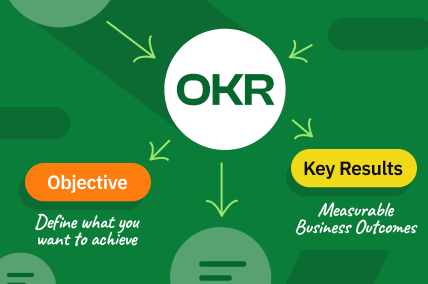
What Are OKRs for CEOs & Founders?
OKRs (Objectives and Key Results) give CEOs and founders a structured way to translate company vision into quarterly priorities that the entire organization can rally around. Unlike annual strategic plans that gather dust, founder-level OKRs create a living framework where every team can see how their daily work connects to the company's most important goals — whether that is reaching product-market fit, scaling revenue, or preparing for a fundraise.
For founders, the discipline of OKRs is especially powerful because it forces ruthless prioritization. Early-stage companies face infinite possibilities and limited resources. A well-crafted set of 2-3 CEO-level OKRs signals to the entire organization what matters most this quarter — and equally important, what does not. This clarity eliminates the context-switching and strategic drift that kills startups faster than any competitor.
Whether you are a solo founder trying to reach your first $1M ARR, a Series B CEO scaling from 50 to 200 people, or an enterprise leader driving transformation across thousands of employees, the examples below are designed to match your stage, your challenges, and your ambition. Each objective is outcome-oriented, each key result is measurable, and every example reflects the real decisions CEOs face.
Interactive OKR Examples
Define and communicate a 3-year company vision that 90% of employees can articulate
Create a compelling, specific vision for where the company is heading and ensure every team member understands it well enough to explain it in their own words.
Achieve product-market fit validated by 40% of users saying they would be very disappointed without the product
Reach the Sean Ellis benchmark for product-market fit by iterating on the core product experience based on user feedback and usage data.
Complete the digital transformation strategy delivering 30% efficiency gains across 4 business units
Drive enterprise-wide digital transformation by deploying modern tools and processes that measurably improve operational efficiency across all major business units.
Pivot the business model from services to SaaS and acquire first 100 paying customers
Execute the strategic shift from a consulting-driven revenue model to a scalable SaaS product by converting existing clients and acquiring net-new subscribers.
Establish the company as the category leader in our space by earning recognition from 3 major analyst firms
Build category credibility by systematically engaging with industry analysts, participating in evaluations, and earning placements that signal market leadership to enterprise buyers.
Launch international expansion into 3 new markets generating $2M in first-year revenue
Execute the global expansion strategy by entering three new geographic markets with localized products, local teams, and market-specific go-to-market plans.
Validate a second product line achieving $50K MRR within 90 days of launch
Expand the product portfolio by launching a complementary product that serves the existing customer base's adjacent needs and validates a new revenue stream.
Execute a platform strategy consolidating 3 point products into a unified suite with 80% customer migration
Transform the multi-product portfolio into an integrated platform experience that increases switching costs, improves cross-sell, and simplifies the customer journey.
Architect a 5-year AI transformation roadmap and deliver the first 3 AI-powered features generating $10M in new revenue
Position the company at the forefront of AI adoption by defining a comprehensive AI strategy and shipping initial AI features that demonstrate tangible customer value and revenue potential.
Position the company for an IPO by achieving $100M ARR with 25%+ growth rate and positive unit economics
Hit the key financial and operational milestones required for a successful public offering by scaling revenue while improving efficiency metrics that public market investors demand.
Execute a strategic acquisition integrating a 50-person company to accelerate entry into the $2B adjacent market
Identify, acquire, and integrate a complementary company that brings technology, talent, and market access needed to capture a significant adjacent market opportunity.
Lead a company-wide restructuring that reduces operating costs by 20% while maintaining revenue growth above 15%
Navigate a strategic restructuring that right-sizes the organization for sustainable growth by cutting costs in non-core areas while protecting and accelerating investment in the highest-ROI business lines.
Build Your Own OKR
Select a focus area for your OKR:
#RecruitingPartner
Join as freelance recruiter.
Get clients, AI tools & 65% of commissions


OKR Scoring Calculator
Use Google's 0.0 to 1.0 scoring scale to evaluate your CEO & founder OKRs at the end of each quarter. A score of 0.7-1.0 means the key result was delivered, 0.3-0.7 means meaningful progress was made, and 0.0-0.3 signals a miss that needs root cause analysis. The sweet spot is landing between 0.6 and 0.7 on average — if you consistently score 1.0, your OKRs are not ambitious enough.
Overall Score
Top 5 OKR Mistakes CEO & Founder Teams Make
Don't do this:
Company OKR: Engineering ships 3 features, Sales closes $2M, Marketing generates 500 leads
Do this instead:
Company OKR: Achieve $5M ARR with 120% NRR by delivering a product experience that mid-market teams cannot live without
CEO-level OKRs should represent cross-functional outcomes that require multiple teams to collaborate, not a stapled list of department targets. When company OKRs are just aggregated department goals, nobody owns the outcome that actually matters — the customer and business result that emerges when all teams execute together.
Don't do this:
Objective: Attend 5 conferences, publish 10 blog posts, and meet 20 investors this quarter
Do this instead:
Objective: Build a pipeline of 50 enterprise prospects and 5 investor relationships that position the company for Series A
Activities are not objectives. A CEO who attends 5 conferences but generates zero pipeline has failed. CEO OKRs should focus on the business outcomes that founder activities are supposed to produce. The conferences and blog posts are tactics that support the real goal — building relationships and pipeline.
Don't do this:
Objective: Grow revenue to $10M (only visible in the CEO's personal dashboard)
Do this instead:
Objective: Grow revenue to $10M with every department publishing their contribution — engineering on feature delivery, sales on pipeline, CS on retention
OKRs only work when they are transparent and cascaded. If the CEO's OKRs live in a private document that the team never sees, they cannot align their work to what matters. The entire point of CEO-level OKRs is to create shared context so every team member can connect their daily work to the company's most important outcomes.
Don't do this:
Q1 OKR changes 3 times: first product-led growth, then enterprise sales, then international expansion
Do this instead:
Q1 OKR: Validate the product-led growth motion (committed for the full quarter with monthly check-ins to assess progress)
Founders often suffer from shiny object syndrome — each new opportunity feels more urgent than the last. But OKRs require commitment. Changing direction monthly means no initiative gets enough time to produce results. Commit to your OKRs for the full quarter and use weekly check-ins to adjust tactics, not strategy.
Don't do this:
All 3 company OKRs focus exclusively on revenue targets for Q3
Do this instead:
1 revenue OKR, 1 team/culture OKR, and 1 product/infrastructure OKR ensuring the foundation supports the growth
Revenue is the scoreboard, not the game plan. A company that hits $10M ARR but loses its top 5 engineers, ships an unreliable product, or burns out the team will not hit $20M. CEO OKRs should balance growth ambition with the organizational health, product quality, and team development that make growth sustainable.
OKRs vs KPIs for CEO & Founder: What's the Difference?
| Dimension | OKR | KPI | CEO & Founder Example |
|---|---|---|---|
| Purpose | Drive the company's most ambitious strategic priorities for the quarter | Monitor the ongoing health of the business across all functions | OKR: Achieve product-market fit with 40% 'very disappointed' score. KPI: Track monthly NPS and churn rate. |
| Time Horizon | Quarterly, with annual themes that guide quarterly objective selection | Ongoing, measured weekly or monthly against established thresholds | OKR: Reach $5M ARR by end of Q2. KPI: Monthly recurring revenue tracked in real-time dashboard. |
| Ambition Level | Stretch goals that push the company beyond what feels comfortable | Realistic targets that the business is expected to achieve consistently | OKR: Grow revenue 50% in one quarter (ambitious stretch). KPI: Monthly revenue must not drop below $300K. |
| Scope | 2-3 company-level priorities that everything else supports | 20-30 metrics covering finance, product, sales, engineering, and operations | OKR: 2 company objectives cascading to 6-8 team OKRs. KPI: Executive dashboard with 25 real-time metrics. |
| Ownership | CEO owns company OKRs with cross-functional teams owning key results | Department heads own their functional KPIs individually | OKR: CEO owns 'reach $5M ARR' with Sales owning pipeline KR and Product owning activation KR. KPI: CFO owns revenue tracking. |
| Flexibility | Fixed objectives with tactical flexibility on how to achieve them | Fixed thresholds that trigger investigation when breached | OKR: Keep the objective but pivot from outbound to product-led approach mid-quarter. KPI: Churn alert fires if it exceeds 5%. |
| Measurement | Scored 0.0-1.0 at quarter end with 0.6-0.7 as the target sweet spot | Binary (met/missed) or continuous (trending up/down) measurement | OKR: Score 0.7 on 'build world-class team' = strong quarter. KPI: Attrition either stays below 15% threshold or it doesn't. |
| Alignment | Cascades from company vision to CEO OKRs to department OKRs to individual OKRs | Often measured independently within each department without explicit linkage | OKR: Company vision cascades to CEO's 3 priorities to 10 team OKRs. KPI: Each department tracks metrics in their own dashboard. |
Purpose
OKR: Achieve product-market fit with 40% 'very disappointed' score. KPI: Track monthly NPS and churn rate.
Time Horizon
OKR: Reach $5M ARR by end of Q2. KPI: Monthly recurring revenue tracked in real-time dashboard.
Ambition Level
OKR: Grow revenue 50% in one quarter (ambitious stretch). KPI: Monthly revenue must not drop below $300K.
Scope
OKR: 2 company objectives cascading to 6-8 team OKRs. KPI: Executive dashboard with 25 real-time metrics.
Ownership
OKR: CEO owns 'reach $5M ARR' with Sales owning pipeline KR and Product owning activation KR. KPI: CFO owns revenue tracking.
Flexibility
OKR: Keep the objective but pivot from outbound to product-led approach mid-quarter. KPI: Churn alert fires if it exceeds 5%.
Measurement
OKR: Score 0.7 on 'build world-class team' = strong quarter. KPI: Attrition either stays below 15% threshold or it doesn't.
Alignment
OKR: Company vision cascades to CEO's 3 priorities to 10 team OKRs. KPI: Each department tracks metrics in their own dashboard.
How to Track CEO & Founder OKRs Effectively
Weekly Check-in
A focused 30-minute leadership team sync to review key result progress, identify blockers, and make tactical decisions. The CEO should use this meeting to remove obstacles and reinforce priorities, not to micromanage execution.
- •Score each company-level key result on the 0.0-1.0 scale with data from the past week
- •Identify the single biggest blocker threatening any key result and assign a DRI to resolve it within 48 hours
- •Confirm that this week's top priorities across all departments align with the company OKRs
- •Share one customer or market signal that reinforces or challenges the current OKR direction
Monthly Review
A deeper strategic review where the CEO and leadership team assess whether the company is on track to deliver the quarterly OKRs, identify trends, and make any necessary tactical pivots.
- •Review month-over-month progress on each key result and project the quarter-end score at current velocity
- •Discuss whether any objectives need tactical adjustment based on new market data or competitive moves
- •Assess resource allocation and determine if any team needs additional support to hit their contributing OKRs
- •Update the board on OKR progress and flag any items that may require board input or approval
Quarterly Retrospective
A comprehensive review where the CEO and leadership team score all OKRs, conduct a strategic retrospective, extract lessons, and design the next quarter's company-level OKRs based on what was learned.
- •Final-score every key result and present results transparently to the entire company in an all-hands
- •Conduct a leadership team retrospective identifying what worked, what did not, and what was learned
- •Evaluate whether the company's strategic direction needs adjustment based on quarter results and market changes
- •Draft and finalize next quarter's company OKRs with input from all department heads before cascading
Frequently Asked Questions About CEO & Founder OKRs
How many OKRs should a CEO set per quarter?
Should CEO OKRs be the same as company OKRs?
How do founder OKRs change as the company scales?
Should fundraising be an OKR or a separate initiative?
How do you cascade CEO OKRs to department teams?
What happens when the CEO's OKR conflicts with a department's existing priorities?
How do you score CEO OKRs when outcomes depend on market conditions beyond your control?
Should the board see the CEO's OKR scores?

Adithyan RK is the Co-Founder and CEO of Hyring, an AI-native recruitment platform that has run over 900,000 AI interviews for companies ranging from early-stage startups to the Fortune 500. He has spent 18 years building technology businesses, starting with a digital consultancy in 2008 and a staff augmentation firm in 2017, before founding Hyring in 2022 to rebuild hiring around evidence instead of guesswork.
Expertise

Surya N is the Co-Founder and CTO of Hyring, where he architected the AI interviewing engine that has now conducted over 900,000 interviews for companies ranging from early-stage startups to the Fortune 500. A mechanical engineer who moved into artificial intelligence, he spent 6 years building AI applications inside a technology consultancy before co-founding Hyring, and wrote the first version of its AI interviewer from scratch: a system that listens, adapts its questioning in real time, and flags fraud rather than following a fixed script.
Expertise
Need the Right People to Hit These OKRs?
CEO-level OKRs require an exceptional team to execute. Hyring helps you find, assess, and hire the senior leaders and critical talent who turn ambitious objectives into measurable results — so your vision becomes reality.
See How Hyring Works