SaaS Company OKR Examples That Drive Sustainable Recurring Revenue Growth
SaaS Company OKR Examples That Drive Sustainable Recurring Revenue Growth
Stop treating MRR as the only metric that matters. Discover OKR frameworks built for the SaaS business model — covering MRR growth, churn reduction, product-led growth, customer acquisition, and unit economics that investors actually care about.
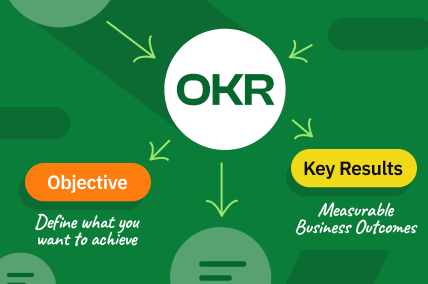
What Are OKRs for SaaS Companies?
OKRs (Objectives and Key Results) give SaaS companies a framework to balance the competing demands of growth, retention, and profitability that define the subscription business model. Unlike one-time revenue businesses, SaaS companies live and die by metrics like MRR, churn, net revenue retention, and CAC payback — and OKRs provide the structure to improve these metrics deliberately rather than hoping they trend in the right direction.
For SaaS businesses, the power of OKRs lies in forcing alignment across the entire revenue engine. Product, engineering, sales, marketing, and customer success all influence the same metrics but often optimize in isolation. A well-structured SaaS OKR framework connects product-led growth experiments to revenue outcomes, ties customer success efforts to net retention, and links engineering velocity to competitive positioning — creating compounding returns rather than disconnected efforts.
Whether you are a bootstrapped SaaS at $100K MRR, a venture-backed company scaling to Series B, or an enterprise SaaS platform approaching IPO readiness, the examples below cover every stage of the SaaS journey. Each objective is tied to a core SaaS metric, each key result is quantifiable, and every example includes the context you need to adapt it to your pricing model, customer segment, and growth stage.
Interactive OKR Examples
Grow MRR from $80K to $120K by closing 50 new customers at $800 average MRR
Hit the next MRR milestone through a balanced approach of new customer acquisition and average deal size improvement for the early-stage SaaS.
Scale from $500K to $700K MRR by expanding the mid-market segment and improving pricing
Drive a 40% MRR increase through a combination of new mid-market customer acquisition and pricing optimization that captures more value from existing tiers.
Achieve $5M MRR by driving enterprise expansion and new logo acquisition across 3 verticals
Hit the $5M MRR milestone by balancing enterprise account expansion with systematic new logo acquisition in the three highest-potential industry verticals.
Validate annual pricing achieving 40% of new customers choosing annual plans increasing cash efficiency
Shift the revenue mix toward annual commitments by testing annual pricing incentives that improve cash flow and reduce churn without cannibalizing monthly revenue.
Launch a usage-based pricing component generating $200K in incremental MRR from overage charges
Add a variable revenue component to the fixed subscription model that captures value from high-usage customers and creates natural expansion revenue.
Build a $2M pipeline of enterprise annual contracts with minimum 24-month terms
Shift the enterprise motion toward multi-year commitments that provide revenue predictability and reduce churn risk in the highest-value segment.
Grow expansion MRR to represent 30% of total new MRR through seat upgrades and plan tier migrations
Build a systematic expansion engine that generates revenue growth from the existing customer base through natural usage growth and proactive upsell motions.
Optimize the pricing page to increase self-serve MRR by 35% through conversion and plan mix improvements
Run a series of pricing page experiments to drive higher conversion, better plan selection, and increased average revenue per new self-serve customer.
Launch a platform marketplace generating $500K in monthly GMV with 15% take rate contributing $75K MRR
Create a new revenue stream through a partner marketplace that extends the platform's value while generating transaction-based recurring revenue.
Achieve $1M MRR from a new product line launched 6 months ago through cross-sell and standalone acquisition
Prove the second product's viability by scaling it to $1M MRR through both cross-selling to the existing base and standalone new customer acquisition.
Scale from $3M to $4.5M MRR in a single quarter through a coordinated go-to-market blitz
Execute the most aggressive growth quarter in company history by coordinating product launches, sales acceleration, and marketing campaigns into a synchronized growth push.
Achieve $10M MRR milestone with 130% net revenue retention positioning the company for IPO readiness
Reach the landmark $10M MRR milestone while demonstrating the expansion-driven growth and retention metrics that public market investors require.
Build Your Own OKR
Select a focus area for your OKR:
#RecruitingPartner
Join as freelance recruiter.
Get clients, AI tools & 65% of commissions


OKR Scoring Calculator
Use Google's 0.0 to 1.0 scoring scale to evaluate your SaaS company OKRs at the end of each quarter. A score of 0.7-1.0 means the key result was delivered, 0.3-0.7 means meaningful progress was made, and 0.0-0.3 signals a miss that needs root cause analysis. The sweet spot is landing between 0.6 and 0.7 on average — if you consistently score 1.0, your OKRs are not ambitious enough.
Overall Score
Top 5 OKR Mistakes SaaS Company Teams Make
Don't do this:
KR: Add $100K in new MRR this quarter (without tracking net MRR after churn)
Do this instead:
KR: Achieve $100K in net new MRR with gross additions above $130K and churn below $30K
In SaaS, a leaky bucket makes new revenue meaningless. A company adding $100K in new MRR but losing $80K to churn is barely growing despite appearing busy. SaaS OKRs must always account for the net number — gross additions minus churn minus contraction — because that is the only number that compounds.
Don't do this:
Objective: Grow at all costs — acquire 500 new customers this quarter regardless of CAC
Do this instead:
Objective: Acquire 500 customers with blended CAC below $200 and LTV:CAC ratio above 3:1
Hypergrowth without unit economics discipline leads to the SaaS death spiral — spending more to acquire customers who churn before they pay back their acquisition cost. Every growth OKR should include a unit economics constraint that ensures the growth is sustainable and value-creating, not value-destroying.
Don't do this:
We are fine — our monthly churn is only 3% (which compounds to 31% annual churn)
Do this instead:
OKR: Reduce monthly churn from 3% to 1.5% — the difference between 31% and 17% annual churn
Monthly churn percentages are deceivingly small. A 3% monthly churn rate means you lose nearly a third of your customers every year — requiring massive new customer acquisition just to stand still. SaaS OKRs should always annualize churn to reveal its true impact and set appropriately aggressive reduction targets.
Don't do this:
All OKRs measure pipeline, demos booked, and sales-closed revenue
Do this instead:
OKRs include product-led metrics: activation rate, self-serve conversion, PQL generation, and organic expansion
Modern SaaS companies generate revenue through both product-led and sales-led motions. Setting OKRs only around sales metrics misses the majority of growth signals in a PLG company. Include product usage, activation, and self-serve conversion metrics alongside traditional sales metrics for a complete picture.
Don't do this:
Company OKR: Achieve 2% monthly churn rate across all customers
Do this instead:
Segment-specific: SMB churn below 3%, mid-market below 2%, enterprise below 0.5%
SaaS metrics vary dramatically by customer segment. A 2% monthly churn rate might be excellent for SMB but disastrous for enterprise. Setting one-size-fits-all OKRs hides segment-level problems behind blended averages. Break OKRs down by segment so each team optimizes for the metrics that matter in their customer tier.
OKRs vs KPIs for SaaS Company: What's the Difference?
| Dimension | OKR | KPI | SaaS Company Example |
|---|---|---|---|
| Purpose | Drive strategic improvements to core SaaS metrics — growth, retention, efficiency | Monitor the ongoing health of the SaaS business across all metrics | OKR: Reduce churn from 5% to 2.5% through targeted retention programs. KPI: Track monthly churn rate in real-time dashboard. |
| Time Horizon | Quarterly, aligned with SaaS planning and fundraising cycles | Ongoing, reviewed daily or weekly against established baselines | OKR: Achieve $500K MRR by end of Q2. KPI: Daily MRR tracking with weekly cohort analysis. |
| Ambition Level | Stretch goals that push the company beyond comfortable growth rates | Performance floors that trigger alerts when breached | OKR: Achieve 140% NRR (stretch). KPI: NRR must not drop below 100% (floor). |
| Scope | 2-3 priorities that represent the biggest levers for the business | Comprehensive SaaS dashboard covering 20+ metrics | OKR: 2 objectives on growth and retention. KPI: Dashboard tracking MRR, ARR, churn, NRR, CAC, LTV, payback, gross margin, etc. |
| Ownership | Cross-functional teams own outcomes that require coordination | Departments own their functional metrics individually | OKR: CS and product co-own 'reduce churn.' KPI: CS tracks CSAT; product tracks feature adoption separately. |
| Flexibility | Strategy stays fixed but tactics can shift based on data | Thresholds are fixed and trigger escalation when breached | OKR: Shift from content to paid acquisition mid-quarter if organic growth stalls. KPI: Churn alert fires if it exceeds 3%. |
| Measurement | Scored 0.0-1.0 at quarter end with calibration across leadership | Binary or trend-based measurement against consistent benchmarks | OKR: Score 0.7 on 'improve unit economics' = strong result. KPI: LTV:CAC either exceeds 3:1 threshold or it doesn't. |
| Alignment | Cascades from company SaaS targets to team-level growth and retention OKRs | Tracked independently by each function feeding into a company dashboard | OKR: Company NRR goal cascades to CS retention OKR and product expansion OKR. KPI: Finance tracks NRR centrally. |
Purpose
OKR: Reduce churn from 5% to 2.5% through targeted retention programs. KPI: Track monthly churn rate in real-time dashboard.
Time Horizon
OKR: Achieve $500K MRR by end of Q2. KPI: Daily MRR tracking with weekly cohort analysis.
Ambition Level
OKR: Achieve 140% NRR (stretch). KPI: NRR must not drop below 100% (floor).
Scope
OKR: 2 objectives on growth and retention. KPI: Dashboard tracking MRR, ARR, churn, NRR, CAC, LTV, payback, gross margin, etc.
Ownership
OKR: CS and product co-own 'reduce churn.' KPI: CS tracks CSAT; product tracks feature adoption separately.
Flexibility
OKR: Shift from content to paid acquisition mid-quarter if organic growth stalls. KPI: Churn alert fires if it exceeds 3%.
Measurement
OKR: Score 0.7 on 'improve unit economics' = strong result. KPI: LTV:CAC either exceeds 3:1 threshold or it doesn't.
Alignment
OKR: Company NRR goal cascades to CS retention OKR and product expansion OKR. KPI: Finance tracks NRR centrally.
How to Track SaaS Company OKRs Effectively
Weekly Check-in
A focused 20-minute review of key SaaS metrics — MRR changes, churn events, activation rates, and pipeline — to catch trends early and make tactical adjustments.
- •Review this week's MRR changes (new, expansion, contraction, churn) and score each key result
- •Identify any accounts that churned or downgraded and confirm root cause analysis is underway
- •Check activation rates for the latest signup cohort and flag any drops for investigation
- •Confirm pipeline and conversion metrics are tracking against the quarterly OKR trajectory
Monthly Review
A deeper analysis of cohort performance, unit economics trends, and OKR trajectory to determine if the current strategy is working or needs adjustment.
- •Analyze month-over-month cohort retention and expansion trends for each customer segment
- •Review unit economics (CAC, LTV, payback, gross margin) against targets and identify optimization areas
- •Assess whether current OKR approaches are on track to deliver quarter-end targets or need tactical pivots
- •Coordinate with product, sales, and CS on cross-functional dependencies affecting SaaS OKRs
Quarterly Retrospective
A comprehensive end-of-quarter review covering all SaaS OKRs, cohort analyses, unit economics evolution, competitive positioning, and next quarter planning.
- •Final-score every key result and present results with cohort-level SaaS metrics to the leadership team
- •Conduct a retrospective on what growth, retention, and efficiency experiments worked versus failed
- •Update the 12-month SaaS financial model with actual quarter data and revised projections
- •Draft next quarter's OKRs incorporating lessons learned and emerging market opportunities
Frequently Asked Questions About SaaS Company OKRs
What are the most important SaaS metrics to include in OKRs?
Should a SaaS company set OKRs around MRR or ARR?
How many OKRs should a SaaS company set per quarter?
Should churn reduction be an OKR or a KPI?
How do you set OKRs for a product-led growth SaaS versus a sales-led SaaS?
What is a good net revenue retention target for SaaS OKRs?
How should SaaS OKRs change as the company scales from seed to Series C?
Should SaaS companies include infrastructure and engineering metrics in OKRs?

Adithyan RK is the Co-Founder and CEO of Hyring, an AI-native recruitment platform that has run over 900,000 AI interviews for companies ranging from early-stage startups to the Fortune 500. He has spent 18 years building technology businesses, starting with a digital consultancy in 2008 and a staff augmentation firm in 2017, before founding Hyring in 2022 to rebuild hiring around evidence instead of guesswork.
Expertise

Surya N is the Co-Founder and CTO of Hyring, where he architected the AI interviewing engine that has now conducted over 900,000 interviews for companies ranging from early-stage startups to the Fortune 500. A mechanical engineer who moved into artificial intelligence, he spent 6 years building AI applications inside a technology consultancy before co-founding Hyring, and wrote the first version of its AI interviewer from scratch: a system that listens, adapts its questioning in real time, and flags fraud rather than following a fixed script.
Expertise
Need the Right People to Hit These OKRs?
SaaS growth is powered by exceptional talent across product, engineering, sales, and success. Hyring helps you find, assess, and hire the people who will drive your MRR growth, reduce churn, and build the product that customers love.
See How Hyring Works