Sales OKR Examples That Actually Drive Revenue
Sales OKR Examples That Actually Drive Revenue
Stop confusing quotas with strategy. Discover proven OKR frameworks that align your sales team around outcomes that matter — from pipeline generation to deal velocity to net revenue retention. Built for SDRs, AEs, and sales leaders alike.
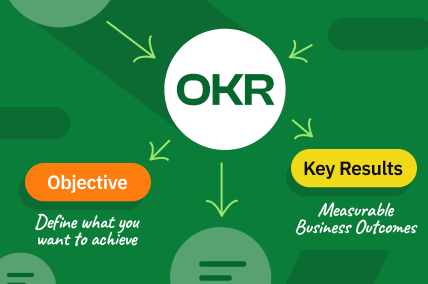
What Are OKRs for Sales Teams?
OKRs (Objectives and Key Results) give sales teams a framework to pursue ambitious revenue goals without falling back on activity-based micromanagement. Unlike traditional quotas that only measure the finish line, sales OKRs break down the strategic levers — pipeline quality, win rates, deal velocity, and customer expansion — that actually determine whether the number gets hit.
For sales organizations, the power of OKRs lies in separating leading indicators from lagging outcomes. A revenue target is a KPI. The OKR is the deliberate plan to get there: improving discovery call conversion by 15%, increasing multi-threaded deals from 30% to 60%, or reducing time-to-first-value for new customers. This shift from tracking results to driving behaviors is what turns good sales teams into great ones.
Whether you run a five-person startup sales team or a 200-rep enterprise org, the examples below are designed to be adapted to your stage, your cycle length, and your go-to-market motion. Each objective is outcome-oriented, each key result is measurable, and every example includes the context you need to make it your own.
Interactive OKR Examples
Increase quarterly new business ARR from $1.8M to $2.4M
Focus the mid-market team on closing higher-value deals with stronger executive sponsorship to drive a 33% lift in new ARR.
Launch upmarket motion and close first 5 deals with ACV over $100K
Validate the enterprise segment by landing initial lighthouse accounts with structured proof-of-value engagements.
Grow average deal size from $28K to $38K through multi-product selling
Drive cross-sell attach rates by training reps on the expanded product suite and redesigning the demo flow to showcase platform value.
Accelerate annual recurring revenue by closing 10 multi-year enterprise contracts
Shift the revenue mix toward longer-term commitments by incentivizing multi-year deals with structured discounting and executive alignment to lock in predictable revenue streams.
Establish foundational revenue engine to hit $500K ARR by end of Q1
Build the initial sales pipeline and close first major deals to validate the go-to-market motion and prove repeatable revenue generation.
Grow net new revenue by 25% quarter-over-quarter through channel expansion
Leverage new inbound and partner channels to diversify revenue sources and reduce dependency on outbound-only acquisition.
Deliver $2M in Q3 revenue from the existing enterprise account base
Focus on extracting more value from current enterprise relationships through upsells and cross-sells to drive predictable quarterly revenue.
Close the fiscal year at $1.2M ARR with positive unit economics
Hit the year-end ARR milestone while ensuring customer acquisition costs remain sustainable for the next fundraising round.
Penetrate 3 new vertical markets generating $200K in combined pipeline
Validate revenue potential in adjacent verticals by running targeted outbound campaigns and closing early design-partner deals.
Increase quarterly revenue per sales rep to $250K through pipeline optimization
Improve sales productivity and deal velocity by refining qualification criteria, reducing pipeline bloat, and focusing reps on high-conversion opportunities.
Launch a global pricing optimization initiative to unlock $15M in incremental annual revenue
Redesign pricing architecture across all product lines and geographies to capture untapped willingness-to-pay and align pricing with delivered value.
Build a $30M expansion revenue engine driven by product-led growth signals
Systematize the expansion motion by integrating product usage data into the sales workflow, enabling reps to target accounts with the highest propensity to expand.
Build Your Own OKR
Select a focus area for your OKR:
#RecruitingPartner
Join as freelance recruiter.
Get clients, AI tools & 65% of commissions


OKR Scoring Calculator
Use Google's 0.0 to 1.0 scoring scale to evaluate your sales OKRs at the end of each quarter. A score of 0.7-1.0 means the key result was delivered, 0.3-0.7 means meaningful progress was made, and 0.0-0.3 signals a miss that needs root cause analysis. The sweet spot is landing between 0.6 and 0.7 on average — if you consistently score 1.0, your OKRs are not ambitious enough.
Overall Score
Top 5 OKR Mistakes Sales Teams Make
Don't do this:
KR: Make 200 cold calls per week and send 500 outbound emails
Do this instead:
KR: Book 40 qualified discovery calls resulting in $1.2M new pipeline
Activity metrics like call volume and email count measure effort, not impact. A rep could hit 200 calls and generate zero pipeline. Outcome-based key results keep the focus on what those activities are supposed to produce — qualified conversations and real pipeline dollars.
Don't do this:
OKR score below 0.7 triggers commission clawback or reduced payout
Do this instead:
OKRs guide strategic priorities; quota attainment drives commission payouts separately
When OKR scores affect pay, reps will sandbag their objectives to guarantee high scores. OKRs should encourage ambitious goal-setting. Keep commission plans tied to quota and bookings targets while using OKRs for strategic alignment and stretch goals.
Don't do this:
Objective: Crush it this quarter and grow revenue
Do this instead:
Objective: Increase Q2 new business ARR from $1.5M to $2.1M by expanding into the mid-market segment
"Crush it" is not a strategy. Effective sales OKRs specify the metric, the target, the time frame, and ideally the lever being pulled. Without specificity, every rep interprets the objective differently and alignment is lost.
Don't do this:
5 objectives with 4 key results each (20 key results for one rep to track)
Do this instead:
2-3 objectives with 3 key results each (6-9 key results total for the team)
Sales reps already juggle dozens of deals, prospect lists, and internal meetings. Overloading them with 20 key results guarantees that none get proper attention. The constraint of 2-3 objectives forces leadership to decide what truly matters this quarter.
Don't do this:
Every AE gets the same OKR: Close $500K in new business this quarter
Do this instead:
Enterprise AEs: Close 4 deals above $80K ACV; SMB AEs: Close 25 deals with average ACV of $15K
An enterprise AE with a 90-day sales cycle and a $100K average deal operates nothing like an SMB AE closing $10K deals in 14 days. OKRs should reflect the specific motion, territory maturity, and deal dynamics of each role or segment to be meaningful.
OKRs vs KPIs for Sales: What's the Difference?
| Dimension | OKR | KPI | Sales Example |
|---|---|---|---|
| Purpose | Drive ambitious change and strategic improvement | Monitor ongoing operational health | OKR: Increase enterprise win rate from 20% to 35%. KPI: Track monthly win rate. |
| Time Horizon | Quarterly, with defined start and end dates | Ongoing and continuously measured | OKR: Build 4x pipeline coverage by end of Q2. KPI: Weekly pipeline-to-quota ratio. |
| Ambition Level | Stretch goals — 70% completion is often considered successful | Targets are meant to be hit 100% of the time | OKR: Reduce sales cycle from 60 to 35 days (stretch). KPI: Average sales cycle must stay under 50 days. |
| Scope | Focused on the few priorities that move the needle most | Comprehensive coverage of all key metrics | OKR: 2-3 objectives per quarter. KPI: Dashboard tracking 15+ metrics (calls, emails, demos, pipeline, bookings, etc.). |
| Ownership | Shared across team with individual accountability for key results | Typically assigned to individuals or departments to track | OKR: Team owns 'expand enterprise segment' with individual KRs. KPI: Each rep owns their monthly quota number. |
| Flexibility | Can be adjusted mid-quarter based on new learning or market shifts | Generally fixed for the measurement period | OKR: Pivot from outbound to partner-led after Q1 data. KPI: Monthly MRR target stays fixed regardless. |
| Measurement | Progress scored on a 0.0–1.0 scale with 0.7 considered strong | Measured as absolute numbers, percentages, or pass/fail | OKR: Score 0.7 on 'improve win rate' = success. KPI: Win rate either hits 30% target or it doesn't. |
| Alignment | Cascades from company → team → individual to ensure strategic coherence | Often siloed within departments with limited cross-functional visibility | OKR: Company goal cascades to sales team OKR to individual rep KRs. KPI: Sales tracks pipeline; marketing tracks MQLs separately. |
Purpose
OKR: Increase enterprise win rate from 20% to 35%. KPI: Track monthly win rate.
Time Horizon
OKR: Build 4x pipeline coverage by end of Q2. KPI: Weekly pipeline-to-quota ratio.
Ambition Level
OKR: Reduce sales cycle from 60 to 35 days (stretch). KPI: Average sales cycle must stay under 50 days.
Scope
OKR: 2-3 objectives per quarter. KPI: Dashboard tracking 15+ metrics (calls, emails, demos, pipeline, bookings, etc.).
Ownership
OKR: Team owns 'expand enterprise segment' with individual KRs. KPI: Each rep owns their monthly quota number.
Flexibility
OKR: Pivot from outbound to partner-led after Q1 data. KPI: Monthly MRR target stays fixed regardless.
Measurement
OKR: Score 0.7 on 'improve win rate' = success. KPI: Win rate either hits 30% target or it doesn't.
Alignment
OKR: Company goal cascades to sales team OKR to individual rep KRs. KPI: Sales tracks pipeline; marketing tracks MQLs separately.
Free Sales OKR Template
Download our ready-to-use Sales OKR template that includes structured worksheets for setting objectives, defining key results, tracking progress weekly, and running quarterly retrospectives. Built for sales leaders, managers, and individual contributors.
- Pre-filled OKR examples across revenue, pipeline, retention, team, and process categories
- Weekly check-in tracker with progress scoring on the 0.0-1.0 scale
- Quarterly retrospective worksheet with root cause analysis prompts
- Role-specific tabs for SDRs, AEs, Sales Managers, and VPs of Sales
- Auto-calculated scoring dashboard with color-coded progress indicators

How to Track Sales OKRs Effectively
Weekly Check-in
A focused 15-20 minute sync to review progress on each key result, flag blockers early, and adjust tactics while the quarter is still young enough to course-correct.
- •Score each key result on the 0.0-1.0 scale based on current data
- •Identify the top blocker for any key result scoring below 0.3 and assign an owner
- •Confirm next week's top 3 actions that will move the needle on lagging key results
- •Update CRM pipeline data before the meeting so discussions are grounded in reality
Monthly Review
A deeper review to assess trajectory, determine if any OKRs need to be rescoped, and share learnings across the team. This is where patterns become visible and strategic pivots happen.
- •Review month-over-month trends for each key result to spot acceleration or deceleration
- •Discuss whether any objectives need to be adjusted based on market changes or new information
- •Celebrate wins and publicly recognize reps who made outsized progress on key results
- •Align with cross-functional partners (marketing, CS, product) on dependencies affecting sales OKRs
Quarterly Retrospective
A comprehensive end-of-quarter review where the team scores all OKRs, conducts root cause analysis on misses, extracts lessons learned, and drafts the next quarter's OKRs based on what was discovered.
- •Final-score every key result and calculate the average score per objective
- •Conduct a structured retrospective: what worked, what did not, what surprised us
- •Identify the top 3 lessons that should inform next quarter's OKR design
- •Draft next quarter's OKRs and circulate for feedback before finalizing
Frequently Asked Questions About Sales OKRs
How many OKRs should a sales team set per quarter?
Should sales quotas be separate from OKRs?
How do you measure OKR progress for sales when deals take months to close?
Can SDRs and AEs share the same OKRs?
What is a good OKR score for a sales team at the end of the quarter?
How do you handle OKRs when sales strategy changes mid-quarter?

Adithyan RK is the Co-Founder and CEO of Hyring, an AI-native recruitment platform that has run over 900,000 AI interviews for companies ranging from early-stage startups to the Fortune 500. He has spent 18 years building technology businesses, starting with a digital consultancy in 2008 and a staff augmentation firm in 2017, before founding Hyring in 2022 to rebuild hiring around evidence instead of guesswork.
Expertise

Surya N is the Co-Founder and CTO of Hyring, where he architected the AI interviewing engine that has now conducted over 900,000 interviews for companies ranging from early-stage startups to the Fortune 500. A mechanical engineer who moved into artificial intelligence, he spent 6 years building AI applications inside a technology consultancy before co-founding Hyring, and wrote the first version of its AI interviewer from scratch: a system that listens, adapts its questioning in real time, and flags fraud rather than following a fixed script.
Expertise
Need the Right People to Hit These OKRs?
The best OKRs in the world mean nothing without the right team to execute them. Hyring helps you find, assess, and hire top sales talent faster — so your ambitious objectives actually get met.
See How Hyring Works