Marketing OKR Examples That Drive Measurable Growth
Marketing OKR Examples That Drive Measurable Growth
Stop measuring vanity metrics and start aligning your marketing team around outcomes that actually move the business. From brand awareness to demand generation to content performance — these OKR frameworks help CMOs, growth leads, and marketing managers build campaigns that convert.
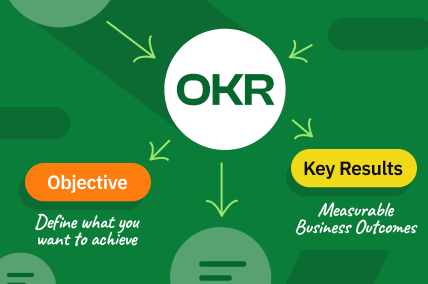
What Are OKRs for Marketing Teams?
OKRs (Objectives and Key Results) give marketing teams a disciplined framework to pursue ambitious growth goals without drowning in disconnected campaign metrics. Instead of chasing impressions and click-through rates in isolation, marketing OKRs force teams to connect every initiative — brand campaigns, content programs, paid acquisition, and marketing ops — back to business outcomes like pipeline contribution, customer acquisition cost, and revenue influence.
The power of OKRs for marketing lies in bridging the gap between creative execution and business accountability. A social media impressions target is a KPI. The OKR is the strategic plan behind it: increasing brand consideration by 20% in a new market segment, reducing cost per qualified lead from $180 to $90, or growing organic traffic share from 25% to 45% of total pipeline. This shift from output tracking to outcome ownership is what separates performance marketing from activity marketing.
Whether you lead a three-person startup marketing team or a 50-person enterprise marketing org with specialized functions, the examples below are designed to be adapted to your budget, your channels, and your go-to-market motion. Each objective is outcome-oriented, each key result is measurable, and every example includes the context you need to make it your own.
Interactive OKR Examples
Establish brand presence in the mid-market SaaS segment and reach 500K monthly impressions
Build foundational brand awareness among mid-market decision-makers through targeted content distribution, social media presence, and community engagement.
Increase unaided brand recall from 8% to 18% among target buyer personas in North America
Drive measurable brand recognition through a multi-channel awareness campaign combining thought leadership, sponsored events, and strategic PR placements.
Launch brand refresh across all enterprise touchpoints and achieve 90% brand consistency score
Roll out updated brand identity across all digital and physical channels while ensuring every customer-facing asset adheres to the new visual and messaging guidelines.
Build community-driven brand advocacy program with 200 active members generating organic reach
Create a grassroots brand ambassador program that amplifies brand messaging through authentic customer and industry advocate voices rather than paid advertising.
Increase share of voice from 12% to 22% in the competitive landscape through integrated PR and content campaigns
Outpace competitors in media coverage and organic search visibility by executing a coordinated PR strategy alongside high-value content production targeting high-intent keywords.
Position the company as a category leader by winning 3 major industry awards and achieving top-3 analyst ranking
Build enterprise credibility and competitive differentiation by pursuing industry recognition that reinforces category leadership positioning with enterprise buyers.
Launch a branded podcast reaching 10K monthly listeners and establishing founder thought leadership
Use a branded podcast as a long-form content vehicle to build executive thought leadership, create repurposable content assets, and develop relationships with potential customers and partners.
Expand brand presence into 2 new international markets with localized campaigns reaching 1M impressions each
Adapt the brand strategy for EMEA and APAC markets with culturally relevant messaging, local partnerships, and market-specific content that builds awareness before the sales team enters.
Unify global brand perception across 6 regions and achieve 85% brand message consistency in customer surveys
Address fragmented brand perception across international markets by implementing a centralized brand governance framework with regional adaptation guidelines and quarterly consistency audits.
Create a category-defining brand narrative that shifts market perception and drives 50% increase in inbound interest
Move beyond product messaging to establish a category-defining point of view that positions the startup as the thought leader defining the problem and the solution space for the target market.
Build an integrated brand measurement system connecting awareness metrics to pipeline influence with full attribution
Move beyond vanity awareness metrics by building a brand measurement framework that ties brand investments to downstream pipeline and revenue influence, proving ROI to the leadership team.
Execute a global rebrand across 15 product lines and 40+ markets with zero customer experience disruption
Orchestrate a complex enterprise rebrand affecting every customer touchpoint by coordinating cross-functional workstreams across product, sales, customer success, and regional marketing teams.
Build Your Own OKR
Select a focus area for your OKR:
#RecruitingPartner
Join as freelance recruiter.
Get clients, AI tools & 65% of commissions


OKR Scoring Calculator
Use Google's 0.0 to 1.0 scoring scale to evaluate your marketing OKRs at the end of each quarter. A score of 0.7-1.0 means the key result was delivered, 0.3-0.7 means meaningful progress was made, and 0.0-0.3 signals a miss that needs root cause analysis. The sweet spot is landing between 0.6 and 0.7 on average — if you consistently score 1.0, your OKRs are not ambitious enough.
Overall Score
Top 5 OKR Mistakes Marketing Teams Make
Don't do this:
KR: Get 1M social media impressions and 50K website visitors
Do this instead:
KR: Generate 500 MQLs from social channels with 20% SQL conversion rate contributing $1.2M in pipeline
Impressions and page views feel good in reports but rarely correlate with business results. A post can go viral and generate zero pipeline. Marketing OKRs should connect channel metrics to downstream business outcomes like pipeline, revenue influence, or customer acquisition cost.
Don't do this:
KR: Publish 40 blog posts and 10 whitepapers this quarter
Do this instead:
KR: Publish 15 SEO-optimized articles that rank page-1 for target keywords and drive 200 MQLs combined
Publishing volume is an activity metric, not an outcome. Ten high-performing articles that rank and convert are infinitely more valuable than 40 articles that sit unread. OKRs should incentivize content that performs, not content that exists.
Don't do this:
Objective: Increase website traffic by 100% this quarter
Do this instead:
Objective: Generate $3M in marketing-sourced pipeline that sales accepts and converts at 25%+ rate
Marketing OKRs that ignore sales outcomes create a disconnect where marketing celebrates traffic while sales complains about lead quality. The best marketing OKRs include key results that measure sales acceptance and downstream conversion to ensure marketing efforts actually help close deals.
Don't do this:
KR: Become the category leader in brand awareness within one quarter
Do this instead:
KR: Increase unaided brand recall from 8% to 15% among target personas this quarter as part of a 3-quarter brand-building initiative
Brand awareness compounds over time — it is not a switch you flip in 90 days. Setting unrealistic brand OKRs leads to frustration and shortcuts like buying low-quality impressions. Break brand goals into quarterly increments that build on each other.
Don't do this:
KR: Prove that marketing generated $10M in revenue this quarter (using last-touch attribution)
Do this instead:
KR: Demonstrate $10M in marketing-influenced pipeline using multi-touch attribution with 85%+ touchpoint coverage
Last-touch attribution gives credit to whoever happened to be the final click before conversion, ignoring the 15 touches that came before. Marketing OKRs should acknowledge attribution complexity and use multi-touch models that reflect the real buyer journey, especially in B2B where cycles are long and multi-stakeholder.
OKRs vs KPIs for Marketing: What's the Difference?
| Dimension | OKR | KPI | Marketing Example |
|---|---|---|---|
| Purpose | Drive ambitious change and strategic improvement | Monitor ongoing operational health | OKR: Increase marketing-sourced pipeline from $2M to $5M. KPI: Track weekly MQL volume. |
| Time Horizon | Quarterly, with defined start and end dates | Ongoing and continuously measured | OKR: Launch ABM program targeting 100 accounts by end of Q2. KPI: Monthly cost per lead across all channels. |
| Ambition Level | Stretch goals — 70% completion is often considered successful | Targets are meant to be hit 100% of the time | OKR: Grow organic traffic from 50K to 150K (stretch). KPI: Maintain email deliverability above 95%. |
| Scope | Focused on the few priorities that move the needle most | Comprehensive coverage of all key metrics | OKR: 2-3 objectives per quarter. KPI: Dashboard tracking 20+ metrics (traffic, leads, MQLs, SQLs, pipeline, spend, etc.). |
| Ownership | Shared across team with individual accountability for key results | Typically assigned to individuals or departments to track | OKR: Team owns 'build demand gen engine' with individual KRs for content, paid, and events. KPI: Each channel owner tracks their weekly volume. |
| Flexibility | Can be adjusted mid-quarter based on new learning or market shifts | Generally fixed for the measurement period | OKR: Pivot from webinar-led to podcast-led demand gen after Q1 data. KPI: Monthly ad spend budget stays fixed. |
| Measurement | Progress scored on a 0.0-1.0 scale with 0.7 considered strong | Measured as absolute numbers, percentages, or pass/fail | OKR: Score 0.7 on 'double content pipeline contribution' = success. KPI: Content generates 15% of pipeline or it doesn't. |
| Alignment | Cascades from company to team to individual to ensure strategic coherence | Often siloed within departments with limited cross-functional visibility | OKR: Company goal cascades to marketing team OKR to individual channel KRs. KPI: Marketing tracks leads; sales tracks won deals separately. |
Purpose
OKR: Increase marketing-sourced pipeline from $2M to $5M. KPI: Track weekly MQL volume.
Time Horizon
OKR: Launch ABM program targeting 100 accounts by end of Q2. KPI: Monthly cost per lead across all channels.
Ambition Level
OKR: Grow organic traffic from 50K to 150K (stretch). KPI: Maintain email deliverability above 95%.
Scope
OKR: 2-3 objectives per quarter. KPI: Dashboard tracking 20+ metrics (traffic, leads, MQLs, SQLs, pipeline, spend, etc.).
Ownership
OKR: Team owns 'build demand gen engine' with individual KRs for content, paid, and events. KPI: Each channel owner tracks their weekly volume.
Flexibility
OKR: Pivot from webinar-led to podcast-led demand gen after Q1 data. KPI: Monthly ad spend budget stays fixed.
Measurement
OKR: Score 0.7 on 'double content pipeline contribution' = success. KPI: Content generates 15% of pipeline or it doesn't.
Alignment
OKR: Company goal cascades to marketing team OKR to individual channel KRs. KPI: Marketing tracks leads; sales tracks won deals separately.
How to Track Marketing OKRs Effectively
Weekly Check-in
A focused 15-20 minute sync to review progress on each key result, flag blockers early, and adjust tactics while the quarter is still young enough to course-correct.
- •Score each key result on the 0.0-1.0 scale based on current campaign and pipeline data
- •Review top-performing and underperforming campaigns and decide on budget reallocation
- •Identify any cross-functional blockers (sales feedback, product updates, content approvals) and assign owners
- •Confirm next week's top 3 marketing actions that will move the needle on lagging key results
Monthly Review
A deeper review to assess trajectory, determine if any OKRs need to be rescoped, and share learnings across the marketing team. This is where campaign patterns become visible and strategic pivots happen.
- •Review month-over-month trends for each key result to spot acceleration or deceleration in metrics
- •Analyze channel-level performance and ROI to determine if budget reallocation is needed
- •Align with sales on lead quality feedback and pipeline conversion metrics from marketing-sourced opportunities
- •Celebrate wins and share top-performing campaign learnings across the marketing team for replication
Quarterly Retrospective
A comprehensive end-of-quarter review where the team scores all OKRs, conducts root cause analysis on misses, extracts lessons learned, and drafts the next quarter's OKRs based on what was discovered.
- •Final-score every key result and calculate the average score per objective with supporting data
- •Conduct a structured retrospective: what campaigns worked, what flopped, what surprised us
- •Review full-funnel attribution data to understand which marketing investments drove the most pipeline and revenue
- •Draft next quarter's marketing OKRs incorporating lessons learned and sales team input on priorities
Frequently Asked Questions About Marketing OKRs
How should marketing OKRs connect to revenue goals?
What is the difference between marketing OKRs and campaign KPIs?
How do you set OKRs for brand marketing when results take months to materialize?
Should content marketing have separate OKRs from demand generation?
Can marketing teams use the same OKRs across different channels?
How many OKRs should a marketing team of 10 people set?
When should marketing OKRs be finalized relative to the quarter start?
Is it okay to change marketing OKRs mid-quarter?

Adithyan RK is the Co-Founder and CEO of Hyring, an AI-native recruitment platform that has run over 900,000 AI interviews for companies ranging from early-stage startups to the Fortune 500. He has spent 18 years building technology businesses, starting with a digital consultancy in 2008 and a staff augmentation firm in 2017, before founding Hyring in 2022 to rebuild hiring around evidence instead of guesswork.
Expertise

Surya N is the Co-Founder and CTO of Hyring, where he architected the AI interviewing engine that has now conducted over 900,000 interviews for companies ranging from early-stage startups to the Fortune 500. A mechanical engineer who moved into artificial intelligence, he spent 6 years building AI applications inside a technology consultancy before co-founding Hyring, and wrote the first version of its AI interviewer from scratch: a system that listens, adapts its questioning in real time, and flags fraud rather than following a fixed script.
Expertise
Need the Right People to Hit These OKRs?
The best OKRs mean nothing without the right team. Hyring helps you find, assess, and hire top marketing talent faster — so your ambitious objectives actually get met.
See How Hyring Works