Employer Branding OKR Examples That Attract Top Talent
Employer Branding OKR Examples That Attract Top Talent
Stop measuring employer brand by the number of social posts published. Discover OKR frameworks that connect your employer brand investment to measurable outcomes — brand awareness, application quality, offer acceptance, and talent pipeline depth.
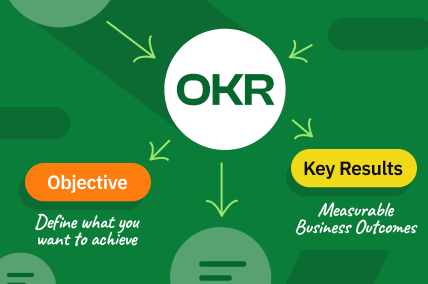
What Are OKRs for Employer Branding Teams?
OKRs (Objectives and Key Results) give employer branding teams a framework to connect creative work to business-level talent outcomes. Unlike traditional marketing metrics that count impressions and engagement, employer branding OKRs focus on what actually matters — whether your brand attracts the right candidates, whether they prefer you over competitors, and whether the investment reduces hiring costs and time.
For employer branding professionals, the power of OKRs lies in proving ROI on brand investment. A Glassdoor review is a data point. The OKR is the deliberate strategy to transform perception: increasing employer brand awareness from 15% to 45% among target talent, growing organic applications by 200%, or achieving a 20-point lift in employer preference over competitors. This shift from tracking content output to measuring talent attraction impact is what earns employer branding a seat at the strategic table.
Whether you are a one-person employer brand function at a startup or a global EB team managing campaigns across 10 markets, the examples below cover the OKR patterns that connect brand to business results. Each objective ties to measurable talent outcomes, each key result is quantifiable, and every example reflects real employer branding workflows.
Interactive OKR Examples
Increase unprompted employer brand recall from 12% to 30% among target engineering talent pool
Build top-of-mind awareness through consistent presence in the channels where target engineers spend their time — tech conferences, GitHub, developer communities, and technical podcasts.
Grow employer brand social media reach from 50K to 150K monthly impressions across all platforms
Expand the company's social media footprint with consistent employer brand content that showcases culture, people, and career opportunities.
Achieve employer brand awareness parity with top 3 talent competitors in the primary talent market
Close the awareness gap with competitors who are better known as employers by investing in the channels and messages that differentiate the company.
Launch employer brand video series generating 100K views and driving 30% increase in careers page traffic
Create compelling video content that brings the employee experience to life and drives traffic to the careers page through organic distribution.
Build a targeted campus awareness program making the company a top-5 employer of choice at 8 universities
Create sustained campus presence through events, ambassador programs, and content that builds brand awareness among graduating students.
Launch employer brand podcast reaching 10,000 monthly listeners and establishing the company as a thought leader
Create an employer brand podcast featuring company leaders and industry guests that builds awareness while providing genuine value to the target talent audience.
Implement ABM-style employer brand campaigns targeting 500 specific professionals at competitor companies
Deploy account-based marketing tactics to employer branding, targeting specific individuals at competitor companies with personalized brand messaging.
Achieve 200% increase in branded job search traffic through SEO-optimized employer brand content
Dominate search results for employer-related queries by creating SEO-optimized content that captures candidates researching the company as a potential employer.
Deploy a global employer brand campaign across 5 markets achieving 50%+ awareness in each target talent pool
Execute a coordinated multi-market employer brand campaign with localized messaging that builds awareness and preference simultaneously across geographies.
Build a data-driven employer brand measurement system with real-time tracking across 20 brand health metrics
Create comprehensive employer brand analytics that measure awareness, perception, preference, and conversion across channels and markets in real time.
Establish the company as a top-10 most attractive employer in the industry through sustained brand investment
Pursue industry recognition and measurable preference ranking that validates the employer brand investment and creates a talent attraction flywheel.
Launch a predictive employer brand analytics platform that forecasts hiring impact of brand investments 6 months ahead
Build advanced analytics that connect employer brand activities to future hiring outcomes, enabling data-driven budget allocation and campaign planning.
Build Your Own OKR
Select a focus area for your OKR:
#RecruitingPartner
Join as freelance recruiter.
Get clients, AI tools & 65% of commissions


OKR Scoring Calculator
Use Google's 0.0 to 1.0 scoring scale to evaluate your employer branding OKRs at the end of each quarter. A score of 0.7-1.0 means the key result was delivered, 0.3-0.7 means meaningful progress was made, and 0.0-0.3 signals a miss that needs root cause analysis. The sweet spot is landing between 0.6 and 0.7 on average — if you consistently score 1.0, your OKRs are not ambitious enough.
Overall Score
Top 5 OKR Mistakes Employer Branding Teams Make
Don't do this:
KR: Publish 50 employer brand posts and 10 videos this quarter
Do this instead:
KR: Generate 40% increase in organic applications and 25% increase in offer acceptance attributed to employer brand content
Content volume is meaningless without talent outcomes. Publishing 50 posts that nobody cares about wastes budget and time. Effective employer brand OKRs connect every piece of content to measurable impact on the talent funnel — applications, quality, acceptance, and cost-per-hire.
Don't do this:
KR: Grow LinkedIn followers to 50,000 and Instagram followers to 20,000
Do this instead:
KR: Grow LinkedIn followers to 50,000 with 15% converting to careers page visitors and 3% converting to applicants
Followers who never visit the careers page or apply provide zero hiring value. Employer brand social metrics must include conversion to talent outcomes. A smaller, engaged audience that converts is more valuable than a large, passive following that never takes action.
Don't do this:
Objective: Launch employer brand campaign and increase awareness by 30% in Q2
Do this instead:
Objective: Build a sustained employer brand presence that increases awareness by 10% per quarter for 4 consecutive quarters
Employer brand is not a campaign — it is a continuous strategic investment. A one-quarter spike in awareness fades without sustained effort. Effective EB OKRs set compounding growth targets that reflect the long-term nature of brand building.
Don't do this:
KR: Achieve 4.5 star Glassdoor rating through review generation campaigns
Do this instead:
KR: Achieve 4.5 star Glassdoor rating by improving the top 3 employee experience gaps identified in engagement surveys
Soliciting positive reviews without fixing real problems creates a perception gap that eventually destroys trust. Authentic employer brand OKRs start with genuine experience improvement and measure external perception as a lagging indicator of internal reality.
Don't do this:
Objective: Build a world-class employer brand with high awareness and great content
Do this instead:
Objective: Build an employer brand that reduces cost-per-hire by 25% and time-to-fill by 20% through increased organic application volume
Employer brand investment must be justified by hiring outcomes. Without connecting brand metrics to cost-per-hire, time-to-fill, and offer acceptance, employer branding remains a nice-to-have that gets cut in the first budget review. Effective OKRs prove the ROI of brand investment.
OKRs vs KPIs for Employer Branding: What's the Difference?
| Dimension | OKR | KPI | Employer Branding Example |
|---|---|---|---|
| Purpose | Drive transformative improvements in employer brand perception and talent attraction | Monitor ongoing brand health and content performance | OKR: Increase employer brand awareness from 15% to 40% in target talent pool. KPI: Track weekly social media impressions. |
| Time Horizon | Quarterly, with defined improvement targets | Ongoing and continuously measured | OKR: Launch employer brand campaign achieving top-5 awareness by Q3. KPI: Monthly Glassdoor rating tracking. |
| Ambition Level | Stretch goals — 70% completion is often considered successful | Targets are meant to be hit 100% of the time | OKR: Achieve 60% employee advocacy participation (stretch). KPI: Maintain weekly content posting cadence. |
| Scope | Focused on 2-3 priorities that will transform the employer brand | Comprehensive coverage of all brand health metrics | OKR: 2-3 objectives per quarter. KPI: Dashboard tracking 20+ metrics (impressions, engagement, traffic, sentiment, etc.). |
| Ownership | Shared across employer brand, TA, and HR teams with individual KR accountability | Typically owned by employer brand or marketing team | OKR: Cross-functional team owns 'build employer brand' with individual KRs. KPI: EB team tracks content metrics. |
| Flexibility | Can be adjusted based on market response and talent competition shifts | Generally fixed for the measurement period | OKR: Pivot content strategy after competitor launches major EB campaign. KPI: Monthly impression targets stay fixed. |
| Measurement | Progress scored on a 0.0-1.0 scale with 0.7 considered strong | Measured as absolute numbers, percentages, or pass/fail | OKR: Score 0.7 on 'grow employer awareness' = strong progress. KPI: Monthly traffic either hits 25K target or it doesn't. |
| Alignment | Cascades from company talent strategy to EB team to individual contributor goals | Often siloed within EB with limited cross-functional visibility | OKR: Company talent strategy cascades to EB OKR to content lead KRs. KPI: EB tracks engagement; TA tracks applications separately. |
Purpose
OKR: Increase employer brand awareness from 15% to 40% in target talent pool. KPI: Track weekly social media impressions.
Time Horizon
OKR: Launch employer brand campaign achieving top-5 awareness by Q3. KPI: Monthly Glassdoor rating tracking.
Ambition Level
OKR: Achieve 60% employee advocacy participation (stretch). KPI: Maintain weekly content posting cadence.
Scope
OKR: 2-3 objectives per quarter. KPI: Dashboard tracking 20+ metrics (impressions, engagement, traffic, sentiment, etc.).
Ownership
OKR: Cross-functional team owns 'build employer brand' with individual KRs. KPI: EB team tracks content metrics.
Flexibility
OKR: Pivot content strategy after competitor launches major EB campaign. KPI: Monthly impression targets stay fixed.
Measurement
OKR: Score 0.7 on 'grow employer awareness' = strong progress. KPI: Monthly traffic either hits 25K target or it doesn't.
Alignment
OKR: Company talent strategy cascades to EB OKR to content lead KRs. KPI: EB tracks engagement; TA tracks applications separately.
How to Track Employer Branding OKRs Effectively
Weekly Check-in
A quick 15-minute sync to review content performance, social metrics, and progress on each key result.
- •Score each key result on the 0.0-1.0 scale based on current data
- •Review top-performing and underperforming content from the past week
- •Identify any urgent reputation issues requiring immediate response
- •Confirm next week's content calendar and campaign activities
Monthly Review
A deeper review to analyze brand health trends, campaign effectiveness, and whether OKRs need adjustment.
- •Analyze month-over-month trends for each key result including brand awareness and sentiment
- •Review campaign performance and ROI, making budget allocation adjustments
- •Share candidate experience and reputation insights with the broader HR and TA teams
- •Celebrate wins and recognize employee advocacy champions
Quarterly Retrospective
A comprehensive review where the EB team scores all OKRs, analyzes brand impact on hiring, and plans next quarter.
- •Final-score every key result with supporting data and calculate ROI on brand investment
- •Analyze correlation between EB activities and hiring outcomes (applications, acceptance, CPH, TTF)
- •Identify the top 3 content and campaign learnings that should inform next quarter
- •Draft next quarter's EB OKRs incorporating learnings and strategic talent priorities
Frequently Asked Questions About Employer Branding OKRs
How do you measure the ROI of employer branding?
Should employer branding sit in HR, marketing, or talent acquisition?
How many OKRs should an employer branding team have per quarter?
How do you build an employer brand with a limited budget?
How long does it take to see results from employer branding investment?
Should employer brand content be polished or authentic?
How do you handle negative Glassdoor reviews in OKRs?
How do employer brand OKRs change at different company stages?

Rakesh Kumar Karthikeyan is Vice President of Recruiting Partners at Hyring, where he builds and scales the company's US recruitment business. He leads Hyring's US recruiting team and a growing network of freelance recruiting partners, owning client acquisition, partner development, delivery, and growth strategy.
Expertise

Adithyan RK is the Co-Founder and CEO of Hyring, an AI-native recruitment platform that has run over 900,000 AI interviews for companies ranging from early-stage startups to the Fortune 500. He has spent 18 years building technology businesses, starting with a digital consultancy in 2008 and a staff augmentation firm in 2017, before founding Hyring in 2022 to rebuild hiring around evidence instead of guesswork.
Expertise
Need the Right People to Hit These OKRs?
A compelling employer brand requires talented people to build and execute it — from EB strategists who connect brand to business outcomes to content creators who tell authentic stories. Hyring helps you find, assess, and hire the employer branding talent that transforms how your company attracts top performers.
See How Hyring Works