Product Management OKR Examples That Ship Outcomes, Not Just Features
Product Management OKR Examples That Ship Outcomes, Not Just Features
Stop measuring product success by feature count. These OKR frameworks help product managers focus on outcomes that matter — user adoption, retention, revenue impact, and strategic alignment. Built for PMs, product leaders, and cross-functional product teams.
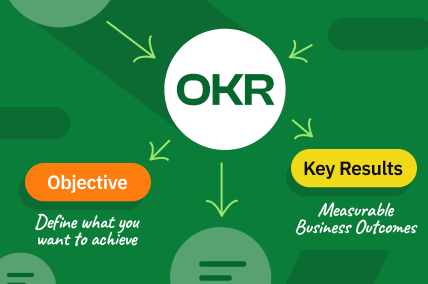
What Are OKRs for Product Management Teams?
OKRs (Objectives and Key Results) give product managers a framework to pursue ambitious product outcomes without falling into the feature factory trap. Instead of measuring success by how many features you shipped or how many story points you burned, product OKRs focus on the outcomes that define product-market fit — user activation rates, feature adoption, retention curves, revenue per user, and the customer satisfaction that determines long-term success.
For product organizations, the power of OKRs lies in separating outputs from outcomes. A feature release is an output. The OKR is the strategy behind it: increasing 7-day user activation from 30% to 55%, reducing time-to-value from 14 days to 3 days, or growing the percentage of users reaching the 'aha moment' from 40% to 70%. This outcome-first mindset forces product teams to validate hypotheses, measure impact, and iterate based on what users actually do rather than what the roadmap says.
Whether you are a solo product manager at an early-stage startup or a VP of Product managing 15 PMs at an enterprise, the examples below cover feature delivery, user adoption, product strategy, metrics & analytics, and stakeholder alignment. Each objective connects product work to measurable business impact, and every key result has a number that tells you whether the product actually got better.
Interactive OKR Examples
Launch the self-serve onboarding flow reducing time-to-value from 14 days to 3 days
Build and ship a guided onboarding experience that helps new users reach their first success milestone without needing sales or support involvement.
Ship the team collaboration feature increasing multi-user account adoption from 15% to 40%
Build collaboration capabilities that transform the product from a single-user tool into a team platform, driving expansion revenue through seat-based growth within existing accounts.
Deliver the enterprise SSO and audit log features unblocking $2M in pipeline from security-conscious buyers
Build the enterprise security features that procurement teams require, removing the blocker that prevents large organizations from purchasing the product.
Build the API platform enabling 20 customer integrations within the first quarter of launch
Create a developer-friendly API that enables customers to integrate the product into their workflows, increasing stickiness and opening a new acquisition channel through ecosystem partnerships.
Redesign the reporting dashboard increasing weekly usage from 20% to 65% of active users
Transform the underused reporting feature into a daily-use analytics hub by redesigning around the top 10 user questions and adding actionable insights that drive product engagement.
Launch the AI-powered recommendation engine increasing conversion rate on upsell offers by 30%
Deploy machine learning-based recommendations that surface the right upgrade or add-on to each user at the right time, increasing expansion revenue without increasing sales team effort.
Ship the mobile app achieving 30% of daily active usage from mobile within 60 days
Extend product access to mobile devices, enabling users to take key actions on the go and increasing overall engagement through ubiquitous availability.
Rebuild the notification system reducing notification fatigue while increasing action rates by 40%
Replace the noisy, one-size-fits-all notification system with intelligent, personalized notifications that drive user action without creating the fatigue that leads to opt-out.
Launch the platform marketplace enabling third-party extensions and driving 25% of new feature value from ecosystem partners
Build a marketplace platform that allows third-party developers to extend product functionality, creating network effects that accelerate feature development beyond internal team capacity.
Build the AI copilot feature reducing user task completion time by 50% for the top 5 workflows
Deploy an AI-powered assistant that helps users complete their most common tasks faster through suggestions, automation, and contextual guidance.
Ship the enterprise workflow automation builder generating $500K in new ARR from power users
Build a no-code workflow automation tool that enables power users to automate complex processes, creating a premium tier that drives significant revenue from enterprise customers.
Deliver the unified analytics platform consolidating 5 fragmented reporting tools into one experience
Consolidate fragmented analytics capabilities into a unified platform that provides a single pane of glass for all product data, eliminating the need for external reporting tools.
Build Your Own OKR
Select a focus area for your OKR:
#RecruitingPartner
Join as freelance recruiter.
Get clients, AI tools & 65% of commissions


OKR Scoring Calculator
Use Google's 0.0 to 1.0 scoring scale to evaluate your product management OKRs at the end of each quarter. A score of 0.7-1.0 means the key result was delivered, 0.3-0.7 means meaningful progress was made, and 0.0-0.3 signals a miss that needs root cause analysis. The sweet spot is landing between 0.6 and 0.7 on average — if you consistently score 1.0, your OKRs are not ambitious enough.
Overall Score
Top 5 OKR Mistakes Product Management Teams Make
Don't do this:
Objective: Ship the dashboard redesign, mobile app, and API v2 this quarter
Do this instead:
Objective: Increase weekly user engagement by 40% by making the product accessible on mobile and providing actionable analytics
A roadmap is not an OKR. Listing features you plan to ship tells you nothing about whether those features will create value. Outcome-based OKRs force you to define what success looks like after the feature ships — because shipping is the beginning, not the end. If the redesigned dashboard gets shipped but nobody uses it, the OKR should reflect that failure.
Don't do this:
KR: Write 20 PRDs and complete 15 user interviews
Do this instead:
KR: Increase 7-day activation from 25% to 50% through improved onboarding experience designed with engineering and design
PRDs and interviews are PM activities, not product outcomes. Great product OKRs require collaboration between PM, engineering, design, and data to achieve. If a PM can complete all their key results alone, the OKRs are measuring individual output, not product impact.
Don't do this:
Objective: Increase MAU from 50K to 100K this quarter
Do this instead:
Objective: Improve the new user activation funnel to drive MAU growth by increasing 7-day activation from 25% to 50% and reducing Day-30 churn from 40% to 20%
The North Star metric (like MAU) is influenced by many factors across marketing, sales, and product. A quarterly OKR should focus on the specific product levers the team will pull to move that metric. If MAU grows because marketing spent more on ads, the product team should not get credit. Target the specific input metrics you can influence.
Don't do this:
5 objectives covering onboarding, engagement, retention, monetization, and platform stability with 4 KRs each
Do this instead:
2 objectives focused on the one or two product areas that matter most this quarter with 3 KRs each
Product managers who try to improve everything improve nothing. The discipline of OKRs requires choosing. Pick the 1-2 areas where a step-change improvement would have the biggest business impact this quarter, and go all-in. The rest should be maintained through KPI monitoring, not diluted through unfocused OKRs.
Don't do this:
Objective: Launch the marketplace platform. KR1: Ship marketplace. KR2: Onboard 10 partners. KR3: Generate $100K revenue
Do this instead:
Objective: Validate the marketplace hypothesis. KR1: Launch MVP with 10 partners. KR2: Achieve 25% user adoption. KR3: Determine whether marketplace increases retention by 15% vs. control group
New product bets are inherently uncertain. OKRs for strategic bets should include a validation key result that answers the strategic question: 'Should we continue investing in this?' Revenue targets on unvalidated bets encourage teams to force outcomes rather than learn what works. Include a key result that captures what you need to learn, not just what you need to produce.
OKRs vs KPIs for Product Management: What's the Difference?
| Dimension | OKR | KPI | Product Management Example |
|---|---|---|---|
| Purpose | Drive ambitious product outcomes and strategic bets | Monitor ongoing product health and operational metrics | OKR: Increase activation from 25% to 50%. KPI: Track daily signup and activation rate. |
| Time Horizon | Quarterly, with defined start and end dates | Ongoing and continuously measured | OKR: Launch mobile app with 30% DAU adoption by Q3. KPI: Weekly DAU/MAU ratio dashboard. |
| Ambition Level | Stretch goals — 70% completion is often considered successful | Targets are meant to be hit 100% of the time | OKR: Double weekly active users (stretch). KPI: Weekly retention must stay above 40%. |
| Scope | Focused on the few product priorities that create the most impact | Comprehensive coverage of all product health metrics | OKR: 2-3 objectives per quarter. KPI: Dashboard tracking 20+ metrics (activation, engagement, retention, NPS, etc.). |
| Ownership | Shared across product squad with individual accountability for key results | Typically assigned to PM or product analyst to monitor | OKR: Squad owns 'improve activation' with PM, engineer, and designer each owning a KR. KPI: PM tracks daily funnel metrics. |
| Flexibility | Can be adjusted mid-quarter based on user research or market changes | Generally fixed for the measurement period | OKR: Pivot from engagement to retention after data reveals churn spike. KPI: NPS target stays fixed regardless. |
| Measurement | Progress scored on a 0.0-1.0 scale with 0.7 considered strong | Measured as absolute numbers, percentages, or pass/fail | OKR: Score 0.7 on 'improve activation' = success. KPI: Activation rate either hits 50% target or it does not. |
| Alignment | Cascades from company → product → squad to ensure strategic coherence | Often siloed within product with limited cross-functional visibility | OKR: Company growth goal cascades to product OKR to squad-level KRs. KPI: Product tracks engagement; marketing tracks acquisition separately. |
Purpose
OKR: Increase activation from 25% to 50%. KPI: Track daily signup and activation rate.
Time Horizon
OKR: Launch mobile app with 30% DAU adoption by Q3. KPI: Weekly DAU/MAU ratio dashboard.
Ambition Level
OKR: Double weekly active users (stretch). KPI: Weekly retention must stay above 40%.
Scope
OKR: 2-3 objectives per quarter. KPI: Dashboard tracking 20+ metrics (activation, engagement, retention, NPS, etc.).
Ownership
OKR: Squad owns 'improve activation' with PM, engineer, and designer each owning a KR. KPI: PM tracks daily funnel metrics.
Flexibility
OKR: Pivot from engagement to retention after data reveals churn spike. KPI: NPS target stays fixed regardless.
Measurement
OKR: Score 0.7 on 'improve activation' = success. KPI: Activation rate either hits 50% target or it does not.
Alignment
OKR: Company growth goal cascades to product OKR to squad-level KRs. KPI: Product tracks engagement; marketing tracks acquisition separately.
How to Track Product Management OKRs Effectively
Weekly Check-in
A focused 15-20 minute sync to review progress on each key result, flag blockers early, and adjust tactics while the quarter is still young enough to course-correct.
- •Score each key result on the 0.0-1.0 scale based on current product metrics and delivery milestones
- •Review the week's user feedback and usage data for signals relevant to current OKRs
- •Identify the top blocker for any key result scoring below 0.3 and assign an owner for resolution
- •Confirm next week's top 3 product priorities that will move the needle on lagging key results
Monthly Review
A deeper review to assess trajectory, determine if any OKRs need to be rescoped, and share learnings across the team. This is where product trends become visible and strategic pivots happen.
- •Review month-over-month trends for activation, engagement, retention, and revenue metrics
- •Assess whether any objectives need adjustment based on user research findings or market changes
- •Share A/B test results and feature launch impact with the broader product organization
- •Align with engineering, design, and business stakeholders on dependencies affecting product OKRs
Quarterly Retrospective
A comprehensive end-of-quarter review where the team scores all OKRs, conducts root cause analysis on misses, extracts lessons learned, and drafts the next quarter's OKRs based on what was discovered.
- •Final-score every key result and calculate the average score per objective using product analytics data
- •Conduct a structured retrospective: what product bets paid off, what did not, what surprised us
- •Identify the top 3 product lessons that should inform next quarter's strategy and OKR design
- •Draft next quarter's OKRs incorporating roadmap priorities, user research insights, and business targets
Frequently Asked Questions About Product Management OKRs
How should product managers write OKRs that focus on outcomes instead of outputs?
Should product OKRs be set at the individual PM level or the product squad level?
How many OKRs should a product team set per quarter?
How do you handle dependencies on engineering when setting product OKRs?
What is the right balance between growth OKRs and quality or tech debt OKRs?
How should product OKRs account for the uncertainty of new product bets?
When should a product team use North Star metrics versus OKRs?
Is it appropriate for product OKRs to include revenue targets?

Adithyan RK is the Co-Founder and CEO of Hyring, an AI-native recruitment platform that has run over 900,000 AI interviews for companies ranging from early-stage startups to the Fortune 500. He has spent 18 years building technology businesses, starting with a digital consultancy in 2008 and a staff augmentation firm in 2017, before founding Hyring in 2022 to rebuild hiring around evidence instead of guesswork.
Expertise

Surya N is the Co-Founder and CTO of Hyring, where he architected the AI interviewing engine that has now conducted over 900,000 interviews for companies ranging from early-stage startups to the Fortune 500. A mechanical engineer who moved into artificial intelligence, he spent 6 years building AI applications inside a technology consultancy before co-founding Hyring, and wrote the first version of its AI interviewer from scratch: a system that listens, adapts its questioning in real time, and flags fraud rather than following a fixed script.
Expertise
Need the Right People to Hit These OKRs?
The best OKRs mean nothing without the right team. Hyring helps you find, assess, and hire top product management talent faster — so your ambitious objectives actually get met.
See How Hyring Works