Data Science OKR Examples That Turn Models Into Business Impact
Data Science OKR Examples That Turn Models Into Business Impact
Stop measuring data teams by notebook count or model accuracy in isolation. These OKR frameworks align data science and analytics teams around business outcomes — from model deployment velocity to data-driven decision adoption to ML pipeline reliability. Built for data scientists, analytics engineers, and data leaders.
What Are OKRs for Data Science & Analytics Teams?
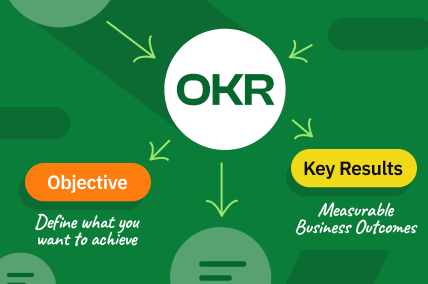
OKRs (Objectives and Key Results) give data science and analytics teams a framework to connect their technical work to business value. Instead of measuring success by how many models you trained or dashboards you built, data OKRs focus on outcomes that matter — model impact on revenue or efficiency, data-driven decision adoption rates, pipeline reliability, and the speed at which insights reach decision-makers.
For data organizations, the power of OKRs lies in closing the gap between technical achievement and business impact. A model accuracy score is a KPI. The OKR is the deliberate plan to deploy that model into production and measure its real-world effect: reducing customer churn by 15% through predictive intervention, increasing forecast accuracy from 60% to 85%, or cutting manual reporting time by 80% through self-service analytics. This shift from technical metrics to business outcomes is what separates data teams that are cost centers from those that are strategic differentiators.
Whether you lead a 2-person analytics team at a startup or manage a 50-person data organization at an enterprise, the examples below cover model development, data infrastructure, business insights, data quality, and ML operations. Each objective ties data work to measurable business impact, each key result has a number, and every example provides context to adapt it to your data stack, your maturity level, and your organization's data culture.
Interactive OKR Examples
Deploy the first ML-powered churn prediction model reducing customer attrition by 20%
Build and deploy a churn prediction model that identifies at-risk customers early enough for the success team to intervene, turning data science from an experimental function into a revenue-protecting capability.
Build a demand forecasting model improving inventory planning accuracy from 65% to 85%
Develop a time-series forecasting model that helps the operations team optimize inventory levels, reducing both stockouts and excess inventory carrying costs.
Implement a recommendation engine increasing cross-sell conversion rate by 25%
Build a personalized product recommendation system that surfaces relevant cross-sell opportunities to customers based on purchase history, browsing behavior, and similar user patterns.
Build a lead scoring model that improves sales qualification efficiency by 40%
Develop a predictive lead scoring model that ranks incoming leads by conversion probability, enabling the sales team to focus on high-intent prospects and stop wasting time on low-quality leads.
Develop a pricing optimization model increasing average revenue per transaction by 12%
Build a dynamic pricing model that optimizes prices based on demand elasticity, competitive positioning, and customer segment to maximize revenue without sacrificing conversion rates.
Build a fraud detection system reducing false positive rate from 40% to 10% while maintaining 95% recall
Redesign the fraud detection model to dramatically reduce false positives that block legitimate transactions while maintaining high detection accuracy on actual fraud.
Implement NLP-powered customer feedback analysis processing 10K+ reviews per week automatically
Build a natural language processing pipeline that automatically categorizes, sentiment-scores, and extracts actionable themes from customer feedback across all channels.
Develop a customer lifetime value model enabling segment-specific acquisition budget allocation
Build a CLV prediction model that forecasts customer value over 24 months, enabling marketing to allocate acquisition spend toward the highest-value segments.
Deploy a real-time personalization engine serving 50M+ daily predictions with sub-20ms latency
Build an enterprise-grade personalization system that delivers individualized content, product, and offer recommendations at massive scale with real-time feature computation.
Build a multi-model ensemble system improving prediction accuracy by 15% over single-model baselines
Push model performance beyond single-model limits by implementing ensemble methods that combine diverse model architectures for superior prediction accuracy on the core business problem.
Implement causal inference framework enabling the team to measure true business impact of 5 major initiatives
Move beyond correlation-based insights to causal analysis that quantifies the true incremental impact of business decisions, enabling leadership to make investment decisions with confidence.
Deploy a responsible AI framework ensuring all production models meet fairness, explainability, and bias standards
Build a comprehensive responsible AI program that validates every production model against fairness metrics, bias audits, and explainability requirements before deployment.
Build Your Own OKR
Select a focus area for your OKR:
#RecruitingPartner
Join as freelance recruiter.
Get clients, AI tools & 65% of commissions


OKR Scoring Calculator
Use Google's 0.0 to 1.0 scoring scale to evaluate your data science OKRs at the end of each quarter. A score of 0.7-1.0 means the key result was delivered, 0.3-0.7 means meaningful progress was made, and 0.0-0.3 signals a miss that needs root cause analysis. The sweet spot is landing between 0.6 and 0.7 on average — if you consistently score 1.0, your OKRs are not ambitious enough.
Overall Score
Top 5 OKR Mistakes Data Science & Analytics Teams Make
Don't do this:
KR: Achieve 95% model accuracy on the test dataset
Do this instead:
KR: Deploy model achieving 95% accuracy that reduces customer churn by 20% measured in production
A model with 95% accuracy on a test set might have zero business impact if it does not change any decision or behavior. Always pair technical metrics with the business outcome the model is supposed to drive. The model's purpose is not to be accurate — it is to create business value through better decisions.
Don't do this:
Objective: Build 5 new machine learning models this quarter
Do this instead:
Objective: Reduce customer acquisition cost by 30% through ML-powered lead scoring and campaign optimization
Nobody in the business cares how many models you built. They care about the problems you solved. Frame data science OKRs around the business problem first, then use model development as the means to get there. This also prevents the common trap of building models that never get deployed.
Don't do this:
OKR set: 3 model development objectives, 0 data quality objectives
Do this instead:
OKR set: 2 model development objectives with 1 data quality objective ensuring the foundation supports model reliability
Models are only as good as the data they train on. Teams that skip data quality OKRs inevitably build models that degrade in production because the underlying data is inconsistent, incomplete, or stale. Every data science OKR set should include at least one objective addressing data quality, infrastructure, or observability.
Don't do this:
KR: Build 20 new dashboards for the business teams
Do this instead:
KR: Reduce ad-hoc data requests by 60% through self-service dashboards that business users actually adopt weekly
Dashboards that nobody uses are worse than no dashboards at all because they create a false sense of data availability. Measure analytics success by adoption rate, decision impact, and reduction in manual data requests — not by how many charts you put on a screen.
Don't do this:
KR: Migrate all models to MLflow and Kubeflow by end of quarter
Do this instead:
KR: Reduce model deployment failures from 30% to under 5% and cut deployment time from 2 weeks to 2 hours
Tool adoption is a means to an end, not the end itself. The purpose of MLOps tooling is to make model deployments faster, more reliable, and more reproducible. Frame MLOps OKRs around the outcomes — deployment speed, reliability, monitoring coverage — and the tooling decisions will follow naturally from the requirements.
OKRs vs KPIs for Data Science & Analytics: What's the Difference?
| Dimension | OKR | KPI | Data Science & Analytics Example |
|---|---|---|---|
| Purpose | Drive ambitious improvement in data capabilities and business impact | Monitor ongoing health of data pipelines, models, and analytics operations | OKR: Reduce churn by 20% through predictive modeling. KPI: Track daily model prediction accuracy. |
| Time Horizon | Quarterly, with defined start and end dates | Ongoing and continuously measured | OKR: Deploy recommendation engine by end of Q2. KPI: Monitor daily recommendation click-through rate. |
| Ambition Level | Stretch goals — 70% completion is often considered successful | Targets are meant to be hit 100% of the time | OKR: Build real-time personalization serving 50M predictions daily (stretch). KPI: Model latency must stay under 200ms. |
| Scope | Focused on the few data priorities that drive the most business value | Comprehensive coverage of all data operations metrics | OKR: 2-3 objectives per quarter. KPI: Dashboard tracking 20+ metrics (pipeline health, data freshness, model accuracy, etc.). |
| Ownership | Shared across data team with individual accountability for key results | Typically assigned to data engineers or analysts to monitor | OKR: Team owns 'improve data-driven decisions' with individual KRs per analyst. KPI: Each pipeline owner monitors their SLAs. |
| Flexibility | Can be adjusted mid-quarter based on new data or business priority shifts | Generally fixed for the measurement period | OKR: Pivot from forecasting to fraud detection after incident. KPI: Data freshness SLA stays fixed regardless. |
| Measurement | Progress scored on a 0.0-1.0 scale with 0.7 considered strong | Measured as absolute numbers, percentages, or pass/fail | OKR: Score 0.7 on 'deploy churn model' = success. KPI: Pipeline success rate either hits 99.9% or it does not. |
| Alignment | Cascades from company → data team → individual to ensure strategic coherence | Often siloed within data team with limited cross-functional visibility | OKR: Company growth goal cascades to data team model deployment OKR. KPI: Data team tracks pipeline metrics; product tracks feature metrics separately. |
Purpose
OKR: Reduce churn by 20% through predictive modeling. KPI: Track daily model prediction accuracy.
Time Horizon
OKR: Deploy recommendation engine by end of Q2. KPI: Monitor daily recommendation click-through rate.
Ambition Level
OKR: Build real-time personalization serving 50M predictions daily (stretch). KPI: Model latency must stay under 200ms.
Scope
OKR: 2-3 objectives per quarter. KPI: Dashboard tracking 20+ metrics (pipeline health, data freshness, model accuracy, etc.).
Ownership
OKR: Team owns 'improve data-driven decisions' with individual KRs per analyst. KPI: Each pipeline owner monitors their SLAs.
Flexibility
OKR: Pivot from forecasting to fraud detection after incident. KPI: Data freshness SLA stays fixed regardless.
Measurement
OKR: Score 0.7 on 'deploy churn model' = success. KPI: Pipeline success rate either hits 99.9% or it does not.
Alignment
OKR: Company growth goal cascades to data team model deployment OKR. KPI: Data team tracks pipeline metrics; product tracks feature metrics separately.
How to Track Data Science & Analytics OKRs Effectively
Weekly Check-in
A focused 15-20 minute sync to review progress on each key result, flag blockers early, and adjust tactics while the quarter is still young enough to course-correct.
- •Score each key result on the 0.0-1.0 scale based on current model metrics, pipeline health, and project milestones
- •Review any model performance degradation or data quality incidents from the past week
- •Identify the top blocker for any key result scoring below 0.3 and assign an owner for resolution
- •Confirm next week's top 3 data tasks that will move the needle on lagging key results
Monthly Review
A deeper review to assess trajectory, determine if any OKRs need to be rescoped, and share learnings across the team. This is where data trends become visible and strategic pivots happen.
- •Review month-over-month trends for model performance, data quality scores, and analytics adoption metrics
- •Assess whether any objectives need adjustment based on business priority changes or data availability issues
- •Share model experiment results and data infrastructure improvements with the broader engineering organization
- •Align with product and business teams on data dependencies and upcoming analytics needs
Quarterly Retrospective
A comprehensive end-of-quarter review where the team scores all OKRs, conducts root cause analysis on misses, extracts lessons learned, and drafts the next quarter's OKRs based on what was discovered.
- •Final-score every key result and calculate the average score per objective using production data and business metrics
- •Conduct a structured retrospective: which models delivered impact, which data investments paid off, what surprised us
- •Identify the top 3 data team lessons that should inform next quarter's strategy and OKR design
- •Draft next quarter's OKRs incorporating business roadmap, data maturity progression, and infrastructure capacity plans
Frequently Asked Questions About Data Science & Analytics OKRs
How should data science OKRs balance model development with business impact measurement?
What makes a good data quality OKR versus a data quality KPI?
Should analytics teams set OKRs around dashboard creation or insight delivery?
How do you handle OKRs for long-running ML projects that span multiple quarters?
Can data engineers and data scientists share the same OKRs?
How do you measure the ROI of data infrastructure investments in OKRs?
When should a data team prioritize MLOps OKRs over new model development?
Is it appropriate for the data team to own business outcome OKRs like revenue or churn reduction?

Adithyan RK is the Co-Founder and CEO of Hyring, an AI-native recruitment platform that has run over 900,000 AI interviews for companies ranging from early-stage startups to the Fortune 500. He has spent 18 years building technology businesses, starting with a digital consultancy in 2008 and a staff augmentation firm in 2017, before founding Hyring in 2022 to rebuild hiring around evidence instead of guesswork.
Expertise

Surya N is the Co-Founder and CTO of Hyring, where he architected the AI interviewing engine that has now conducted over 900,000 interviews for companies ranging from early-stage startups to the Fortune 500. A mechanical engineer who moved into artificial intelligence, he spent 6 years building AI applications inside a technology consultancy before co-founding Hyring, and wrote the first version of its AI interviewer from scratch: a system that listens, adapts its questioning in real time, and flags fraud rather than following a fixed script.
Expertise
Need the Right People to Hit These OKRs?
The best OKRs mean nothing without the right team. Hyring helps you find, assess, and hire top data science talent faster — so your ambitious objectives actually get met.
See How Hyring Works