DevOps OKR Examples That Ship Faster and Break Less
DevOps OKR Examples That Ship Faster and Break Less
Move beyond vanity metrics like deployment count. These OKR frameworks help DevOps teams optimize what actually matters — deployment reliability, infrastructure resilience, incident response speed, and cost efficiency. Built for platform engineers, SREs, and DevOps leaders.
What Are OKRs for DevOps Teams?
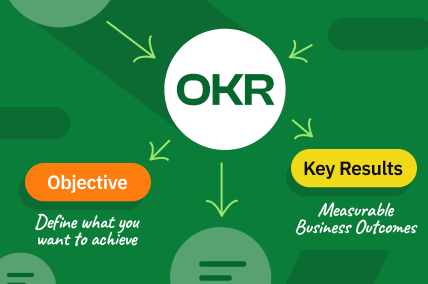
OKRs (Objectives and Key Results) give DevOps teams a structured way to pursue ambitious infrastructure and delivery goals without drowning in the noise of daily firefighting. Instead of measuring success by how many tickets you close or how many deploys you ship, DevOps OKRs focus on outcomes that matter — deployment failure rates, mean time to recovery, infrastructure cost per transaction, and the developer experience that determines how fast your organization can move.
The real power of OKRs in a DevOps context is bridging the gap between engineering velocity and operational stability. A DORA metric is a KPI. The OKR is the deliberate plan to improve it: reducing deployment rollback rate from 12% to 2%, cutting mean time to detect incidents from 15 minutes to under 3 minutes, or automating 90% of infrastructure provisioning through IaC. This shift from monitoring dashboards to driving measurable improvement is what separates reactive ops teams from proactive platform engineering organizations.
Whether you are a two-person DevOps team at a startup or a 50-engineer platform organization at an enterprise, the examples below cover every stage and complexity level. Each objective is tied to real-world infrastructure outcomes, each key result has a number attached to it, and every example includes enough context to adapt it to your stack, your scale, and your team's maturity.
Interactive OKR Examples
Reduce CI/CD pipeline execution time from 25 minutes to under 8 minutes for all services
Speed up the feedback loop for developers by parallelizing test suites, caching dependencies, and optimizing build stages so that every commit gets validated faster.
Increase deployment frequency from weekly to daily releases with zero-downtime deployments
Transition the team from batched weekly releases to continuous daily deployments using blue-green deployment strategies and feature flags to decouple releases from rollouts.
Achieve a deployment rollback rate below 1% across all enterprise production environments
Reduce failed deployments by strengthening pre-production validation, canary analysis, and automated rollback mechanisms across 200+ services in the enterprise platform.
Build a self-service deployment platform enabling developers to ship to production without DevOps intervention
Eliminate the DevOps bottleneck by creating a developer-facing deployment portal with guardrails, automated checks, and one-click rollback so engineering teams can deploy independently.
Implement progressive delivery with feature flags covering 80% of new feature releases
Move from all-or-nothing releases to progressive rollouts using feature flags and targeted percentage-based deployments to reduce blast radius and enable safe experimentation.
Standardize CI/CD pipelines across 50+ engineering teams with a shared platform template library
Eliminate pipeline sprawl by building reusable, versioned pipeline templates that enforce security scanning, testing standards, and deployment best practices across the entire engineering organization.
Build a GitOps workflow for all Kubernetes deployments with declarative state management
Transition from imperative deployment scripts to a fully declarative GitOps model where all cluster state is version-controlled and reconciled automatically.
Reduce deployment lead time from 3 days to under 4 hours for the fastest-growing product line
Accelerate time-to-production for the growth team's services by streamlining approval workflows, automating compliance checks, and removing manual gates from the release process.
Achieve DORA Elite-level deployment metrics across all business-critical services
Drive the platform to DORA Elite performance: multiple deploys per day, lead time under one hour, change failure rate below 5%, and MTTR under one hour — across 100+ critical services.
Build a multi-environment deployment pipeline supporting 4 environments with automated promotion gates
Create a structured promotion pipeline from dev to staging to pre-prod to production with automated test gates, approval workflows, and environment parity validation.
Implement deployment observability with real-time release health dashboards and automated rollback triggers
Close the visibility gap between deploying code and understanding its impact by building release health scoring, automated anomaly detection, and intelligent rollback capabilities.
Unify CI/CD governance across 8 business units with centralized policy enforcement and audit trails
Establish enterprise-wide deployment governance by implementing policy-as-code, mandatory security scanning gates, and full audit trails that satisfy SOC 2 and ISO 27001 requirements.
Build Your Own OKR
Select a focus area for your OKR:
#RecruitingPartner
Join as freelance recruiter.
Get clients, AI tools & 65% of commissions


OKR Scoring Calculator
Use Google's 0.0 to 1.0 scoring scale to evaluate your DevOps OKRs at the end of each quarter. A score of 0.7-1.0 means the key result was delivered, 0.3-0.7 means meaningful progress was made, and 0.0-0.3 signals a miss that needs root cause analysis. The sweet spot is landing between 0.6 and 0.7 on average — if you consistently score 1.0, your OKRs are not ambitious enough.
Overall Score
Top 5 OKR Mistakes DevOps Teams Make
Don't do this:
KR: Ship 50 deployments per week to production
Do this instead:
KR: Increase deployment frequency to 10 per day while maintaining change failure rate below 3%
Deploying fast means nothing if every fifth deployment breaks production. DORA research shows that elite teams optimize for both velocity and stability simultaneously. Always pair deployment frequency with a quality guardrail like change failure rate or rollback rate.
Don't do this:
Objective: Achieve 99.99% uptime this quarter
Do this instead:
Objective: Define SLOs for all Tier-1 services and manage reliability through error budget policies
A blanket uptime target without SLOs is just a wish. SRE best practices require defining what 'up' means for each service (latency, error rate, throughput), setting an error budget, and making explicit tradeoffs between feature velocity and reliability when the budget runs low.
Don't do this:
KR: Move 100% of infrastructure to Terraform
Do this instead:
KR: Achieve 100% IaC coverage with automated drift detection and pre-merge plan validation on all changes
Having infrastructure in Terraform is meaningless if someone can still make manual changes through the console. Real IaC maturity requires preventing drift, testing changes before apply, and blocking manual modifications — not just having .tf files in a repo.
Don't do this:
KR: Reduce incident resolution time to under 30 minutes
Do this instead:
KR: Reduce MTTD to under 3 minutes and MTTR to under 30 minutes for all Severity-1 incidents
You cannot fix what you do not know is broken. Many DevOps teams obsess over resolution speed while ignoring that it takes 20 minutes to even notice a problem. Cutting detection time often delivers more customer impact than cutting resolution time because the clock starts when users are affected, not when you open a terminal.
Don't do this:
KR: Cut monthly AWS bill from $100K to $70K
Do this instead:
KR: Reduce cost per 1,000 API requests from $0.05 to $0.02 while scaling to handle 2x current traffic
Absolute cost reduction can be achieved by simply turning things off — including things customers need. Unit cost (cost per transaction, per request, per user) is the metric that matters because it accounts for growth. A team that doubles traffic while keeping the same total bill has actually achieved a 50% cost improvement.
OKRs vs KPIs for DevOps: What's the Difference?
| Dimension | OKR | KPI | DevOps Example |
|---|---|---|---|
| Purpose | Drive ambitious improvement in infrastructure and delivery capabilities | Monitor ongoing operational health of systems and pipelines | OKR: Reduce deployment lead time from 3 days to 4 hours. KPI: Track daily deployment count. |
| Time Horizon | Quarterly, with defined start and end dates | Ongoing and continuously measured | OKR: Achieve 99.95% uptime by end of Q2. KPI: Real-time uptime dashboard refreshed every 60 seconds. |
| Ambition Level | Stretch goals — 70% completion is often considered successful | Targets are meant to be hit 100% of the time | OKR: Reduce MTTR from 60 min to 10 min (stretch). KPI: MTTR must stay under 45 minutes at all times. |
| Scope | Focused on the few priorities that move the needle most | Comprehensive coverage of all key metrics | OKR: 2-3 objectives per quarter. KPI: Dashboard tracking 20+ metrics (CPU, memory, latency, error rates, deploy count, etc.). |
| Ownership | Shared across team with individual accountability for key results | Typically assigned to individuals or on-call rotations to track | OKR: Team owns 'improve deployment reliability' with individual KRs. KPI: On-call engineer owns real-time incident response. |
| Flexibility | Can be adjusted mid-quarter based on new learning or incidents | Generally fixed for the measurement period | OKR: Pivot from cost optimization to reliability after major outage. KPI: Monthly uptime target stays fixed regardless. |
| Measurement | Progress scored on a 0.0-1.0 scale with 0.7 considered strong | Measured as absolute numbers, percentages, or pass/fail | OKR: Score 0.7 on 'reduce MTTR' = success. KPI: MTTR either hits 30-minute target or it does not. |
| Alignment | Cascades from company → platform team → individual to ensure strategic coherence | Often siloed within infrastructure with limited cross-functional visibility | OKR: Company reliability goal cascades to platform team OKR to individual engineer KRs. KPI: DevOps tracks uptime; engineering tracks velocity separately. |
Purpose
OKR: Reduce deployment lead time from 3 days to 4 hours. KPI: Track daily deployment count.
Time Horizon
OKR: Achieve 99.95% uptime by end of Q2. KPI: Real-time uptime dashboard refreshed every 60 seconds.
Ambition Level
OKR: Reduce MTTR from 60 min to 10 min (stretch). KPI: MTTR must stay under 45 minutes at all times.
Scope
OKR: 2-3 objectives per quarter. KPI: Dashboard tracking 20+ metrics (CPU, memory, latency, error rates, deploy count, etc.).
Ownership
OKR: Team owns 'improve deployment reliability' with individual KRs. KPI: On-call engineer owns real-time incident response.
Flexibility
OKR: Pivot from cost optimization to reliability after major outage. KPI: Monthly uptime target stays fixed regardless.
Measurement
OKR: Score 0.7 on 'reduce MTTR' = success. KPI: MTTR either hits 30-minute target or it does not.
Alignment
OKR: Company reliability goal cascades to platform team OKR to individual engineer KRs. KPI: DevOps tracks uptime; engineering tracks velocity separately.
How to Track DevOps OKRs Effectively
Weekly Check-in
A focused 15-20 minute sync to review progress on each key result, flag blockers early, and adjust tactics while the quarter is still young enough to course-correct.
- •Score each key result on the 0.0-1.0 scale based on current DORA metrics and infrastructure data
- •Review the week's incidents and assess impact on reliability and incident response OKRs
- •Identify the top blocker for any key result scoring below 0.3 and assign an owner for resolution
- •Confirm next week's top 3 engineering tasks that will move the needle on lagging key results
Monthly Review
A deeper review to assess trajectory, determine if any OKRs need to be rescoped, and share learnings across the team. This is where infrastructure trends become visible and strategic pivots happen.
- •Review month-over-month trends for deployment metrics, uptime, MTTR, and cloud costs
- •Assess whether any objectives need adjustment based on incidents, scaling demands, or priority shifts
- •Share postmortem learnings and their impact on reliability and automation OKRs across the team
- •Align with engineering leadership and product teams on infrastructure dependencies affecting their OKRs
Quarterly Retrospective
A comprehensive end-of-quarter review where the team scores all OKRs, conducts root cause analysis on misses, extracts lessons learned, and drafts the next quarter's OKRs based on what was discovered.
- •Final-score every key result and calculate the average score per objective using infrastructure data
- •Conduct a structured retrospective: what worked, what did not, what incidents changed our priorities
- •Identify the top 3 infrastructure lessons that should inform next quarter's OKR design
- •Draft next quarter's OKRs incorporating capacity plans, reliability targets, and cost projections
Frequently Asked Questions About DevOps OKRs
How should DevOps teams structure OKRs around DORA metrics?
What is the right balance between reliability and velocity OKRs for DevOps?
Should infrastructure-as-code coverage be an OKR or a KPI?
How do you set meaningful cloud cost OKRs without just cutting resources?
Can DevOps and SRE teams share OKRs with product engineering teams?
How do you measure the impact of automation OKRs beyond time saved?
When should a DevOps team focus OKRs on incident response versus prevention?
Is it better to set team-level or individual DevOps OKRs?

Adithyan RK is the Co-Founder and CEO of Hyring, an AI-native recruitment platform that has run over 900,000 AI interviews for companies ranging from early-stage startups to the Fortune 500. He has spent 18 years building technology businesses, starting with a digital consultancy in 2008 and a staff augmentation firm in 2017, before founding Hyring in 2022 to rebuild hiring around evidence instead of guesswork.
Expertise

Surya N is the Co-Founder and CTO of Hyring, where he architected the AI interviewing engine that has now conducted over 900,000 interviews for companies ranging from early-stage startups to the Fortune 500. A mechanical engineer who moved into artificial intelligence, he spent 6 years building AI applications inside a technology consultancy before co-founding Hyring, and wrote the first version of its AI interviewer from scratch: a system that listens, adapts its questioning in real time, and flags fraud rather than following a fixed script.
Expertise
Need the Right People to Hit These OKRs?
The best OKRs mean nothing without the right team. Hyring helps you find, assess, and hire top DevOps talent faster — so your ambitious objectives actually get met.
See How Hyring Works