QA OKR Examples That Deliver Software Users Actually Trust
QA OKR Examples That Deliver Software Users Actually Trust
Stop measuring QA by bug counts alone. These OKR frameworks help testing teams focus on what truly matters — release confidence, defect prevention, test automation ROI, and the customer quality experience. Built for QA engineers, SDETs, and test leads.
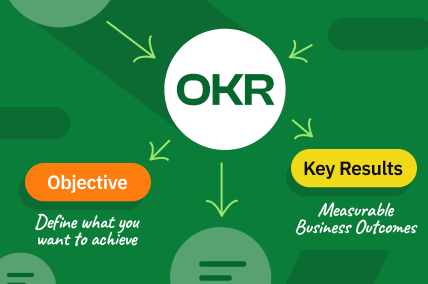
What Are OKRs for QA & Testing Teams?
OKRs (Objectives and Key Results) give QA teams a framework to move beyond reactive bug-catching and toward proactive quality engineering. Instead of measuring success by how many defects you find, QA OKRs focus on outcomes that define software quality — escape rate to production, test coverage confidence, release readiness speed, and the customer's actual experience with the product.
For quality assurance organizations, OKRs create alignment between what testers do daily and what the business needs: faster releases with fewer customer-impacting defects. A test case count is a KPI. The OKR is the deliberate strategy to improve quality: reducing production escape rate from 15% to 3%, achieving 85% automated regression coverage, or cutting release certification time from 5 days to 8 hours. This shift from activity tracking to outcome ownership is what transforms QA from a bottleneck into a competitive advantage.
Whether you are a solo QA engineer at a startup or lead a 30-person testing organization at an enterprise, these examples cover the full spectrum of quality engineering maturity. Each objective is outcome-focused, each key result is quantifiable, and every example includes the context needed to adapt it to your testing stack, your release cadence, and your team's current capabilities.
Interactive OKR Examples
Achieve 80% automated test coverage across all critical user journeys within the quarter
Close the coverage gap on the most important user flows by mapping critical paths and writing automated tests that validate them end-to-end before every release.
Implement contract testing for all 18 microservice APIs eliminating integration blind spots
Address the growing integration testing gap by deploying consumer-driven contract tests that catch breaking API changes before they reach staging.
Build a risk-based testing model that allocates 80% of testing effort to the highest-risk modules
Move from uniform test distribution to intelligent risk-based allocation by analyzing defect history, code complexity, and change frequency to focus testing where it matters most.
Establish baseline unit test coverage at 70% for all new code with enforced CI gates
Set the foundation for a test-first culture by implementing coverage gates in CI that prevent merging code below the coverage threshold for all new features.
Implement visual regression testing covering 100% of UI components in the design system
Prevent visual defects from reaching production by deploying automated screenshot comparison testing for every component in the design system across all supported browsers and viewports.
Achieve 95% API test coverage across all 200+ endpoints with automated validation in CI/CD
Close the API testing gap by building comprehensive automated API tests covering functional correctness, schema validation, and error handling for every production endpoint.
Build comprehensive accessibility testing covering WCAG 2.1 AA standards for all customer-facing pages
Ensure the product meets accessibility standards by implementing automated and manual accessibility testing across all user-facing surfaces.
Implement mutation testing achieving 65% mutation kill rate on business-critical modules
Go beyond line coverage by using mutation testing to validate that existing tests actually catch real bugs, not just execute code paths without meaningful assertions.
Build an intelligent test selection system that runs only relevant tests per code change, reducing suite time by 70%
Implement test impact analysis that maps code changes to affected tests, enabling the CI pipeline to run only the tests that matter for each PR while maintaining full regression confidence.
Implement chaos testing for the data pipeline to validate resilience under 15 failure scenarios
Go beyond functional testing by deliberately injecting failures into the data pipeline to verify graceful degradation, data integrity, and automated recovery under adverse conditions.
Achieve 90% end-to-end test coverage across 3 platform tiers with cross-service test orchestration
Build cross-service end-to-end test suites that validate complete business workflows spanning frontend, backend, and data layers with realistic test data and environment management.
Deploy AI-powered test generation achieving 40% coverage increase on legacy modules with zero manual effort
Leverage AI-based test generation tools to automatically create meaningful test cases for legacy code modules that have historically been untested due to complexity and team capacity constraints.
Build Your Own OKR
Select a focus area for your OKR:
#RecruitingPartner
Join as freelance recruiter.
Get clients, AI tools & 65% of commissions


OKR Scoring Calculator
Use Google's 0.0 to 1.0 scoring scale to evaluate your QA OKRs at the end of each quarter. A score of 0.7-1.0 means the key result was delivered, 0.3-0.7 means meaningful progress was made, and 0.0-0.3 signals a miss that needs root cause analysis. The sweet spot is landing between 0.6 and 0.7 on average — if you consistently score 1.0, your OKRs are not ambitious enough.
Overall Score
Top 5 OKR Mistakes QA & Testing Teams Make
Don't do this:
KR: Write 500 new test cases this quarter
Do this instead:
KR: Achieve 95% defect detection rate in pre-production testing, reducing production escapes to under 3%
A team can write 500 test cases that all test happy paths and catch nothing meaningful. What matters is not how many tests exist but how effective they are at finding real bugs. Focus on defect detection effectiveness, escape rate, and mutation kill rate rather than test count.
Don't do this:
Objective: Automate 100% of all test cases by end of quarter
Do this instead:
Objective: Automate the highest-ROI 80% of regression tests while keeping 20% as targeted exploratory testing
Not every test should be automated. Exploratory testing, usability testing, and edge-case discovery are often more valuable when done manually by skilled testers. Automating stable, repeatable regression checks frees up time for the creative testing that machines cannot do. The goal is optimal coverage, not maximum automation.
Don't do this:
KR: Find at least 50 bugs per sprint to demonstrate QA thoroughness
Do this instead:
KR: Reduce customer-reported defects by 60% through improved pre-release quality gates
Incentivizing bug count leads to testers logging trivial issues to hit a number while overlooking subtle, high-impact problems. A great QA team that helps prevent bugs will naturally find fewer — that is the goal, not the problem. Measure quality outcomes: escape rate, customer impact, and defect prevention effectiveness.
Don't do this:
KR: Add 200 new automated tests to the regression suite
Do this instead:
KR: Grow automated regression suite by 200 tests while maintaining flaky test rate below 3% and test maintenance under 10 hours per week
An unmaintained test suite becomes a liability faster than an asset. Flaky tests erode trust, broken tests block pipelines, and nobody-reads-the-results tests waste compute. Every automation OKR should include a reliability and maintenance constraint alongside the growth target.
Don't do this:
Objective: Improve test coverage metrics across all modules
Do this instead:
Objective: Reduce post-release customer complaints by 70% by targeting test coverage at the features customers use most
Coverage percentages mean nothing to the business. What matters is whether customers encounter bugs, whether releases are delayed by quality issues, and whether the product meets its reliability commitments. Frame QA OKRs around the customer and business outcomes that testing is supposed to protect.
OKRs vs KPIs for QA & Testing: What's the Difference?
| Dimension | OKR | KPI | QA & Testing Example |
|---|---|---|---|
| Purpose | Drive ambitious improvement in software quality and testing effectiveness | Monitor ongoing quality health metrics and test execution status | OKR: Reduce production escape rate from 15% to 3%. KPI: Track weekly escape rate on dashboard. |
| Time Horizon | Quarterly, with defined start and end dates | Ongoing and continuously measured | OKR: Achieve 85% automation coverage by end of Q2. KPI: Daily automated test execution pass rate. |
| Ambition Level | Stretch goals — 70% completion is often considered successful | Targets are meant to be hit 100% of the time | OKR: Achieve zero production escapes for entire quarter (stretch). KPI: Production escape rate must stay under 10%. |
| Scope | Focused on the few quality priorities that move the needle most | Comprehensive coverage of all quality metrics | OKR: 2-3 objectives per quarter. KPI: Dashboard tracking 15+ metrics (coverage, defects, flakiness, latency, etc.). |
| Ownership | Shared across QA and development with individual key result accountability | Typically assigned to QA team or individual testers to track | OKR: Team owns 'improve release quality' with individual KRs. KPI: Each tester owns their test execution completion rate. |
| Flexibility | Can be adjusted mid-quarter based on new quality data or priority shifts | Generally fixed for the measurement period | OKR: Pivot from coverage to performance after production incident. KPI: Weekly test pass rate target stays fixed regardless. |
| Measurement | Progress scored on a 0.0-1.0 scale with 0.7 considered strong | Measured as absolute numbers, percentages, or pass/fail | OKR: Score 0.7 on 'reduce defect escape rate' = success. KPI: Escape rate either hits 5% target or it does not. |
| Alignment | Cascades from company → engineering → QA to ensure strategic coherence | Often siloed within QA with limited cross-functional visibility | OKR: Company quality goal cascades to QA team OKR to individual tester KRs. KPI: QA tracks defects; dev tracks velocity separately. |
Purpose
OKR: Reduce production escape rate from 15% to 3%. KPI: Track weekly escape rate on dashboard.
Time Horizon
OKR: Achieve 85% automation coverage by end of Q2. KPI: Daily automated test execution pass rate.
Ambition Level
OKR: Achieve zero production escapes for entire quarter (stretch). KPI: Production escape rate must stay under 10%.
Scope
OKR: 2-3 objectives per quarter. KPI: Dashboard tracking 15+ metrics (coverage, defects, flakiness, latency, etc.).
Ownership
OKR: Team owns 'improve release quality' with individual KRs. KPI: Each tester owns their test execution completion rate.
Flexibility
OKR: Pivot from coverage to performance after production incident. KPI: Weekly test pass rate target stays fixed regardless.
Measurement
OKR: Score 0.7 on 'reduce defect escape rate' = success. KPI: Escape rate either hits 5% target or it does not.
Alignment
OKR: Company quality goal cascades to QA team OKR to individual tester KRs. KPI: QA tracks defects; dev tracks velocity separately.
How to Track QA & Testing OKRs Effectively
Weekly Check-in
A focused 15-20 minute sync to review progress on each key result, flag blockers early, and adjust tactics while the quarter is still young enough to course-correct.
- •Score each key result on the 0.0-1.0 scale based on current test metrics and defect data
- •Review the week's production escapes and assess impact on defect management OKRs
- •Identify the top blocker for any key result scoring below 0.3 and assign an owner for resolution
- •Confirm next week's top 3 testing priorities that will move the needle on lagging key results
Monthly Review
A deeper review to assess trajectory, determine if any OKRs need to be rescoped, and share learnings across the team. This is where quality trends become visible and strategic pivots happen.
- •Review month-over-month trends for test coverage, escape rate, automation ROI, and release quality
- •Assess whether any objectives need adjustment based on product changes or quality incidents
- •Share defect pattern analysis and root cause findings that inform testing strategy adjustments
- •Align with engineering and product teams on quality dependencies and testing resource allocation
Quarterly Retrospective
A comprehensive end-of-quarter review where the team scores all OKRs, conducts root cause analysis on misses, extracts lessons learned, and drafts the next quarter's OKRs based on what was discovered.
- •Final-score every key result and calculate the average score per objective using quality metrics
- •Conduct a structured retrospective: what testing improvements worked, what gaps remain, what surprised us
- •Identify the top 3 quality lessons that should inform next quarter's testing strategy and OKR design
- •Draft next quarter's OKRs incorporating product roadmap changes, technology shifts, and team growth plans
Frequently Asked Questions About QA & Testing OKRs
How should QA teams structure OKRs differently from development teams?
What is the right ratio of automation OKRs to manual testing OKRs?
Should test coverage percentages be used as OKR key results?
How do you measure QA OKR progress when testing depends on development delivery?
Can a small QA team of 2-3 people effectively use OKRs?
How should QA OKRs handle the tension between speed and thoroughness?
When should performance testing be a separate OKR versus part of a broader quality OKR?
Is it appropriate for QA to own OKRs about reducing customer-reported bugs?

Adithyan RK is the Co-Founder and CEO of Hyring, an AI-native recruitment platform that has run over 900,000 AI interviews for companies ranging from early-stage startups to the Fortune 500. He has spent 18 years building technology businesses, starting with a digital consultancy in 2008 and a staff augmentation firm in 2017, before founding Hyring in 2022 to rebuild hiring around evidence instead of guesswork.
Expertise

Surya N is the Co-Founder and CTO of Hyring, where he architected the AI interviewing engine that has now conducted over 900,000 interviews for companies ranging from early-stage startups to the Fortune 500. A mechanical engineer who moved into artificial intelligence, he spent 6 years building AI applications inside a technology consultancy before co-founding Hyring, and wrote the first version of its AI interviewer from scratch: a system that listens, adapts its questioning in real time, and flags fraud rather than following a fixed script.
Expertise
Need the Right People to Hit These OKRs?
The best OKRs mean nothing without the right team. Hyring helps you find, assess, and hire top QA talent faster — so your ambitious objectives actually get met.
See How Hyring Works