Engineering OKR Examples That Ship Better Software Faster
Engineering OKR Examples That Ship Better Software Faster
Stop measuring your engineering team by story points and start measuring outcomes. From sprint delivery to code quality to system reliability — these OKR frameworks help CTOs, engineering managers, and tech leads build teams that ship impactful software on time, every time.
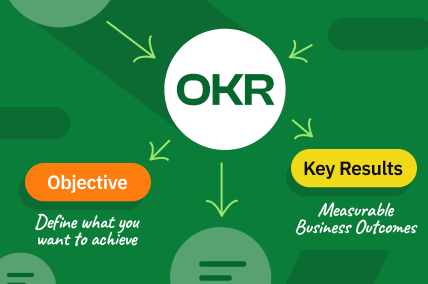
What Are OKRs for Engineering Teams?
OKRs (Objectives and Key Results) give engineering teams a framework to connect daily development work to business outcomes that matter. Instead of measuring success by velocity points or lines of code shipped, engineering OKRs focus on impact — reducing deployment failures by 80%, cutting page load time from 4 seconds to under 1 second, or eliminating the critical bugs that drive 60% of customer support tickets.
For engineering organizations, the power of OKRs lies in shifting the conversation from output to outcome. Deploying 50 features is an activity metric. The OKR is the strategic plan to ensure those features actually move the needle: improving user activation by 25% through onboarding flow redesign, reducing infrastructure costs by 40% through architecture optimization, or achieving 99.99% uptime through a comprehensive reliability engineering program. This shift from shipping code to delivering value is what separates great engineering teams from feature factories.
Whether you run a 5-person startup dev team or lead a 500-engineer platform organization, the examples below cover every dimension of engineering excellence. Each objective is outcome-oriented, each key result is measurable, and every example includes context to help you adapt it to your tech stack, team size, and delivery methodology.
Interactive OKR Examples
Improve sprint delivery predictability from 55% to 85% of committed story points completed per sprint
Build reliable delivery habits at the startup by improving estimation accuracy, reducing scope creep, and establishing sustainable sprint commitments.
Reduce average feature delivery time from 6 weeks to 3 weeks through smaller batch sizes and improved flow
Accelerate time-to-market by breaking features into smaller increments that can be shipped independently with shorter cycle times.
Establish cross-team delivery coordination achieving 90% on-time delivery for multi-team initiatives
Improve the ability to coordinate complex features that span multiple engineering teams, reducing the delays caused by cross-team dependencies.
Implement continuous delivery pipeline enabling same-day deployment of any merged PR to production
Build the CI/CD infrastructure that allows any merged code change to reach production within hours, replacing the current manual release process.
Increase engineering throughput by 40% without adding headcount through process optimization and automation
Find and eliminate the bottlenecks, interruptions, and inefficiencies that prevent engineers from spending their time on high-value development work.
Implement a release train model delivering coordinated monthly releases across 8 product teams with 95% predictability
Establish a structured release cadence that enables multiple teams to deliver coordinated features on a predictable schedule without blocking each other.
Reduce engineering WIP (work in progress) by 50% improving flow efficiency and reducing context switching
Combat the productivity drain caused by engineers working on too many things simultaneously by implementing WIP limits and flow-based delivery.
Build a data-driven delivery metrics program that identifies and eliminates the top 5 throughput bottlenecks
Use engineering metrics to pinpoint exactly where development time is being lost and systematically eliminate the biggest bottlenecks.
Deploy an AI-powered engineering productivity platform that automates code review, testing, and deployment decisions
Leverage AI to augment engineering workflows, automating routine decisions and accelerating the development pipeline from code commit to production.
Build a product engineering culture where every feature ships with usage analytics and success metrics from day one
Transform the team from shipping features to shipping measurable outcomes by embedding product analytics into the engineering workflow.
Implement a platform engineering model that enables product teams to self-serve infrastructure reducing delivery dependencies by 80%
Build an internal developer platform that abstracts infrastructure complexity, allowing product teams to deploy and operate their services independently.
Achieve globally distributed engineering delivery with 24-hour development coverage and zero handoff delays
Optimize the distributed engineering organization to leverage time zone coverage for continuous development velocity without handoff friction.
Build Your Own OKR
Select a focus area for your OKR:
#RecruitingPartner
Join as freelance recruiter.
Get clients, AI tools & 65% of commissions


OKR Scoring Calculator
Use Google's 0.0 to 1.0 scoring scale to evaluate your engineering OKRs at the end of each quarter. A score of 0.7-1.0 means the key result was delivered, 0.3-0.7 means meaningful progress was made, and 0.0-0.3 signals a miss that needs root cause analysis. The sweet spot is landing between 0.6 and 0.7 on average — if you consistently score 1.0, your OKRs are not ambitious enough.
Overall Score
Top 5 OKR Mistakes Engineering Teams Make
Don't do this:
Objective: Complete 200 story points per sprint across all engineering teams
Do this instead:
Objective: Reduce feature delivery lead time from 6 weeks to 3 weeks enabling the product team to run 2x more experiments per quarter
Story points measure effort, not impact. An engineering team that completes 200 story points of low-value work is less effective than one completing 80 points of high-impact features. Engineering OKRs should connect to business outcomes — faster delivery, better reliability, lower costs — not to activity metrics that can be gamed.
Don't do this:
KR: Address technical debt when there is spare capacity in the sprint
Do this instead:
KR: Dedicate 20% of every sprint to technical debt reduction with the specific target of eliminating the top 10 debt items causing 60% of development slowdowns
Technical debt that is addressed only when there is spare capacity never gets addressed — there is never spare capacity. Effective engineering OKRs make debt reduction a first-class commitment with dedicated allocation and measurable targets, just like feature work.
Don't do this:
KR: Achieve 99.9% uptime for all production services this quarter
Do this instead:
KR: Reduce MTTR from 2 hours to 15 minutes through improved observability, incident runbooks, and automated diagnostic tools while achieving 99.9% uptime
An uptime target alone tells you what to achieve but not how to achieve it. If the team hits 99.9% uptime through heroic on-call effort rather than system improvements, the uptime is fragile and unsustainable. Pair uptime targets with the reliability engineering improvements that make the uptime target inevitable.
Don't do this:
KR: Achieve 90% code coverage across all repositories
Do this instead:
KR: Achieve 80% code coverage with 70% mutation kill rate on critical modules proving tests actually detect real defects, not just exercise code paths
Test coverage measures how much code is executed during tests, not whether the tests actually catch bugs. A codebase with 90% coverage but weak assertions catches fewer bugs than one with 70% coverage and strong mutation-tested assertions. Always pair coverage targets with quality metrics that prove the tests are effective.
Don't do this:
Objective: Increase engineering throughput by 50% through mandatory weekend deployments and reduced code review time
Do this instead:
Objective: Increase engineering throughput by 40% through automated pipelines, reduced meeting load, and elimination of the top 5 developer friction points while improving developer satisfaction from 6.2 to 8.5
Short-term throughput gains that come at the cost of developer experience lead to burnout, attrition, and declining quality. The best engineering teams invest in developer experience because happy, productive engineers sustainably deliver more value. Always include developer satisfaction as a guardrail on efficiency OKRs.
OKRs vs KPIs for Engineering: What's the Difference?
| Dimension | OKR | KPI | Engineering Example |
|---|---|---|---|
| Purpose | Drive strategic improvements in how the team builds and ships software | Monitor ongoing engineering health and operational performance | OKR: Build CI/CD pipeline enabling same-day deployment of any merged PR. KPI: Track daily deployment frequency and build success rate. |
| Time Horizon | Quarterly, with defined start and end dates | Ongoing and continuously measured | OKR: Implement chaos engineering program by end of Q2. KPI: Monitor uptime and incident count daily. |
| Ambition Level | Stretch goals — 70% completion is often considered successful | Targets are meant to be hit 100% of the time | OKR: Achieve zero-bug release cycles (stretch). KPI: Production bug count must stay under 5 per release. |
| Scope | Focused on the few engineering initiatives that create the most leverage | Comprehensive coverage of all engineering metrics | OKR: 2-3 objectives per quarter. KPI: Dashboard tracking 30+ metrics (velocity, quality, reliability, cost, satisfaction, etc.). |
| Ownership | Shared across engineering team with individual accountability for key results | Typically assigned to individual teams or engineers to track | OKR: Team owns 'improve reliability' with KRs for observability, chaos engineering, and incident response. KPI: Each team tracks their service SLA metrics. |
| Flexibility | Can be adjusted mid-quarter based on production incidents or strategic shifts | Generally fixed for the measurement period | OKR: Pivot from feature delivery to reliability after major incident. KPI: Monthly deployment frequency target stays fixed. |
| Measurement | Progress scored on a 0.0-1.0 scale with 0.7 considered strong | Measured as absolute numbers, percentages, or pass/fail | OKR: Score 0.7 on 'modernize CI/CD' = success. KPI: Build time either meets the 10-minute target or it doesn't. |
| Alignment | Cascades from company product goals to engineering OKRs to team-level KRs | Often siloed within engineering with limited product visibility | OKR: Company growth goal cascades to engineering delivery OKR to team KRs. KPI: Each team tracks velocity; infra tracks uptime separately. |
Purpose
OKR: Build CI/CD pipeline enabling same-day deployment of any merged PR. KPI: Track daily deployment frequency and build success rate.
Time Horizon
OKR: Implement chaos engineering program by end of Q2. KPI: Monitor uptime and incident count daily.
Ambition Level
OKR: Achieve zero-bug release cycles (stretch). KPI: Production bug count must stay under 5 per release.
Scope
OKR: 2-3 objectives per quarter. KPI: Dashboard tracking 30+ metrics (velocity, quality, reliability, cost, satisfaction, etc.).
Ownership
OKR: Team owns 'improve reliability' with KRs for observability, chaos engineering, and incident response. KPI: Each team tracks their service SLA metrics.
Flexibility
OKR: Pivot from feature delivery to reliability after major incident. KPI: Monthly deployment frequency target stays fixed.
Measurement
OKR: Score 0.7 on 'modernize CI/CD' = success. KPI: Build time either meets the 10-minute target or it doesn't.
Alignment
OKR: Company growth goal cascades to engineering delivery OKR to team KRs. KPI: Each team tracks velocity; infra tracks uptime separately.
How to Track Engineering OKRs Effectively
Weekly Check-in
A focused 15-20 minute sync to review progress on each key result, flag blockers early, and adjust tactics while the quarter is still young enough to course-correct.
- •Score each key result on the 0.0-1.0 scale based on current engineering metrics, sprint data, and project milestones
- •Review DORA metrics and quality dashboards for any trends that could affect OKR progress this quarter
- •Identify technical blockers, cross-team dependencies, or resource constraints and assign resolution owners with deadlines
- •Confirm next week's top 3 engineering actions that will advance lagging key results toward their quarterly targets
Monthly Review
A deeper review to assess trajectory, determine if any OKRs need rescoping, and share learnings across the engineering organization.
- •Analyze month-over-month engineering trends including delivery velocity, quality metrics, reliability scores, and developer satisfaction
- •Review completed technical initiatives for actual versus expected impact on developer productivity and system performance
- •Align with product leadership on any changes to roadmap priorities or business goals affecting engineering OKRs
- •Celebrate engineering wins and share successful patterns across teams for broader adoption and learning
Quarterly Retrospective
A comprehensive end-of-quarter review where the team scores all OKRs, conducts root cause analysis on misses, and drafts next quarter's OKRs.
- •Final-score every key result with supporting data from engineering systems, monitoring tools, and team feedback
- •Conduct structured retrospective: which engineering initiatives delivered value, which stalled, and what technical or organizational factors intervened
- •Review total engineering impact including delivery improvements, quality gains, reliability wins, and developer experience changes
- •Draft next quarter's engineering OKRs incorporating lessons learned, technical debt priorities, and updated product roadmap
Frequently Asked Questions About Engineering OKRs
How many OKRs should an engineering team set per quarter?
Should deployment frequency be an OKR or a KPI?
How do you balance feature delivery OKRs with technical debt OKRs?
Should engineering OKRs include business metrics like revenue or user growth?
How should engineering teams handle OKR conflicts with urgent production issues?
Is it appropriate to set individual engineer OKRs or should they be team-level only?
How do you measure developer experience as an OKR?
When should an engineering team prioritize reliability OKRs over feature delivery?

Adithyan RK is the Co-Founder and CEO of Hyring, an AI-native recruitment platform that has run over 900,000 AI interviews for companies ranging from early-stage startups to the Fortune 500. He has spent 18 years building technology businesses, starting with a digital consultancy in 2008 and a staff augmentation firm in 2017, before founding Hyring in 2022 to rebuild hiring around evidence instead of guesswork.
Expertise

Surya N is the Co-Founder and CTO of Hyring, where he architected the AI interviewing engine that has now conducted over 900,000 interviews for companies ranging from early-stage startups to the Fortune 500. A mechanical engineer who moved into artificial intelligence, he spent 6 years building AI applications inside a technology consultancy before co-founding Hyring, and wrote the first version of its AI interviewer from scratch: a system that listens, adapts its questioning in real time, and flags fraud rather than following a fixed script.
Expertise
Need the Right People to Hit These OKRs?
The best OKRs mean nothing without the right team. Hyring helps you find, assess, and hire top engineering talent faster — so your ambitious objectives actually get met.
See How Hyring Works