IT Infrastructure OKR Examples That Keep the Business Running and Growing
IT Infrastructure OKR Examples That Keep the Business Running and Growing
Move beyond ticket queues and uptime dashboards. These OKR frameworks help IT infrastructure teams drive strategic improvements in system availability, security posture, capacity planning, and service delivery. Built for IT managers, systems administrators, and infrastructure directors.
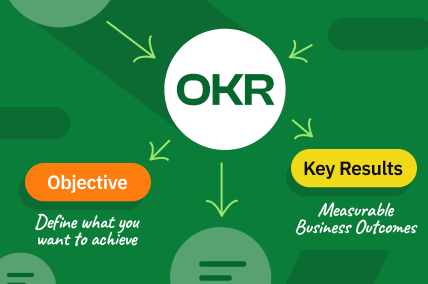
What Are OKRs for IT Infrastructure Teams?
OKRs (Objectives and Key Results) give IT infrastructure teams a structured way to pursue strategic improvements while managing the daily demands of keeping systems running. Instead of measuring success solely by ticket resolution time or uptime percentages, IT infrastructure OKRs focus on outcomes that enable business growth — system reliability that supports scaling, security posture that prevents breaches, capacity planning that prevents outages, and IT service delivery that accelerates rather than bottlenecks the organization.
For IT teams, the power of OKRs lies in shifting from reactive firefighting to proactive infrastructure management. An uptime metric is a KPI. The OKR is the deliberate strategy to improve it: implementing redundant systems that eliminate single points of failure, deploying automated patch management that achieves 98% compliance within 48 hours, or building self-service IT portals that resolve 60% of requests without human intervention. This shift from maintaining the status quo to driving measurable improvement is what transforms IT from a cost center into a strategic enabler.
Whether you manage IT for a 50-person startup or a 10,000-employee enterprise with offices in 20 countries, the examples below cover every maturity level. Each objective connects IT work to business enablement, each key result is quantifiable, and every example includes enough context to adapt it to your infrastructure stack, your budget reality, and your organization's IT maturity.
Interactive OKR Examples
Achieve 99.9% uptime across all business-critical systems by eliminating single points of failure
Establish reliable infrastructure for the growing startup by deploying redundancy, automated failover, and monitoring for the core systems that the business depends on daily.
Implement automated backup and disaster recovery with validated RTO under 4 hours for all systems
Build a reliable DR capability by automating backups, testing restoration procedures monthly, and ensuring the growing team can recover from any infrastructure failure.
Reduce unplanned downtime by 60% through proactive monitoring and automated remediation
Transform IT operations from reactive to proactive by implementing predictive monitoring, automated health checks, and self-healing scripts that resolve common issues before users are affected.
Build a high-availability network architecture with redundant ISP connections and automated failover
Eliminate network as a single point of failure by deploying dual ISP connections, redundant switching, and automated failover that keeps the team connected during any single-provider outage.
Implement zero-downtime maintenance windows for all critical systems through rolling upgrade capabilities
Eliminate the disruption of maintenance windows by deploying rolling upgrade capabilities, blue-green environments, and maintenance automation that updates systems without user impact.
Deploy geo-redundant infrastructure supporting business continuity across 3 data center regions
Build geographic redundancy for the enterprise by replicating critical infrastructure across multiple regions with automated failover and regular cross-region DR validation.
Implement infrastructure-as-code for all server provisioning achieving 100% reproducible environments
Eliminate manual server configuration by codifying all infrastructure in version-controlled templates that ensure every environment is consistent, auditable, and rapidly reproducible.
Achieve 99.95% availability across all SaaS applications through vendor SLA management and redundancy
Improve the reliability of business-critical SaaS applications by implementing health monitoring, vendor SLA tracking, and redundancy strategies for single-vendor-dependent workflows.
Build a fully automated disaster recovery system with one-click failover and 15-minute RTO for all Tier-1 systems
Eliminate the manual complexity and risk from DR by building automated failover, validation, and failback capabilities that can recover the entire Tier-1 infrastructure in under 15 minutes.
Deploy predictive infrastructure monitoring preventing 80% of system failures before they impact users
Move from reactive alerting to predictive monitoring by implementing ML-based anomaly detection on system metrics that identifies degradation patterns and triggers preventive action.
Achieve 99.99% availability for the global employee platform supporting 8,000+ users across 15 offices
Push the employee platform to four-nines reliability by implementing active-active deployment, intelligent load balancing, and edge caching that delivers consistent performance worldwide.
Build a self-healing infrastructure platform that automatically detects, diagnoses, and resolves 90% of system issues
Create an autonomous infrastructure management capability where systems detect their own health issues, diagnose root causes, and execute remediation without human intervention.
Build Your Own OKR
Select a focus area for your OKR:
#RecruitingPartner
Join as freelance recruiter.
Get clients, AI tools & 65% of commissions


OKR Scoring Calculator
Use Google's 0.0 to 1.0 scoring scale to evaluate your IT infrastructure OKRs at the end of each quarter. A score of 0.7-1.0 means the key result was delivered, 0.3-0.7 means meaningful progress was made, and 0.0-0.3 signals a miss that needs root cause analysis. The sweet spot is landing between 0.6 and 0.7 on average — if you consistently score 1.0, your OKRs are not ambitious enough.
Overall Score
Top 5 OKR Mistakes IT Infrastructure Teams Make
Don't do this:
Objective: Achieve 99.99% uptime this quarter
Do this instead:
Objective: Eliminate the top 5 causes of downtime through redundancy, monitoring, and automated failover to reach 99.95% uptime
A numeric uptime target without the specific improvements to get there is just wishful thinking. Effective IT availability OKRs identify the root causes of downtime and set key results around eliminating them. The uptime number is the outcome; the OKR should describe the strategy to achieve it.
Don't do this:
KR: Close 500 IT support tickets per month
Do this instead:
KR: Reduce employee productivity loss from IT issues from 4 hours to under 1 hour per employee per month
A team that closes 500 tickets might be doing great work or might be fighting the same fires repeatedly. Business impact metrics like employee productivity time saved, system availability enabling revenue, or security incidents prevented tell the real story of IT value delivery.
Don't do this:
KR: Deploy endpoint detection tool on all laptops
Do this instead:
KR: Reduce endpoint compromise incidents from 8 to zero and detect 95% of threats within 5 minutes of execution
Deploying a security tool is a task, not an outcome. The tool exists to reduce risk — so the OKR should measure risk reduction. Did the new EDR actually prevent compromises? Did it detect threats faster? Focus on the security outcome, not the procurement milestone.
Don't do this:
KR: Reduce IT budget by 25% this quarter
Do this instead:
KR: Reduce IT cost per employee by 25% while maintaining IT satisfaction score above 4.0 out of 5.0
Cutting IT costs without a quality constraint invites slashing services that employees depend on. Every cost optimization key result should be paired with a satisfaction, availability, or capability guardrail that prevents the cost reduction from becoming a false economy.
Don't do this:
Objective: Upgrade all servers to the latest OS version
Do this instead:
Objective: Enable the product team to ship 2x faster by reducing environment provisioning from 10 days to 2 hours through modern infrastructure automation
IT infrastructure exists to enable the business. An OS upgrade might be necessary for security compliance, but the OKR should be framed around the business outcome: better security posture, faster developer onboarding, or reduced compliance risk. When IT OKRs connect to business goals, they get prioritized and funded.
OKRs vs KPIs for IT Infrastructure: What's the Difference?
| Dimension | OKR | KPI | IT Infrastructure Example |
|---|---|---|---|
| Purpose | Drive ambitious improvement in IT capabilities and business enablement | Monitor ongoing health of systems, security, and service delivery | OKR: Eliminate top 5 downtime causes to reach 99.95% uptime. KPI: Track daily system availability percentage. |
| Time Horizon | Quarterly, with defined start and end dates | Ongoing and continuously measured | OKR: Deploy geo-redundant DR by end of Q2. KPI: Weekly backup success rate dashboard. |
| Ambition Level | Stretch goals — 70% completion is often considered successful | Targets are meant to be hit 100% of the time | OKR: Achieve zero security incidents for full quarter (stretch). KPI: Patch compliance must stay above 90%. |
| Scope | Focused on the few IT priorities that move the needle most | Comprehensive coverage of all operational metrics | OKR: 2-3 objectives per quarter. KPI: Dashboard tracking 25+ metrics (uptime, tickets, patches, costs, etc.). |
| Ownership | Shared across IT team with individual accountability for key results | Typically assigned to IT analysts or on-call staff to monitor | OKR: Team owns 'improve employee IT experience' with individual KRs. KPI: Help desk tracks first-contact resolution rate. |
| Flexibility | Can be adjusted mid-quarter based on incidents or priority changes | Generally fixed for the measurement period | OKR: Pivot from cost optimization to security after breach attempt. KPI: Monthly IT spend target stays fixed regardless. |
| Measurement | Progress scored on a 0.0-1.0 scale with 0.7 considered strong | Measured as absolute numbers, percentages, or pass/fail | OKR: Score 0.7 on 'improve DR capability' = success. KPI: Backup success rate either hits 99% or it does not. |
| Alignment | Cascades from company → IT → individual to ensure strategic coherence | Often siloed within IT with limited cross-functional visibility | OKR: Company security goal cascades to IT team OKR to individual engineer KRs. KPI: IT tracks patch compliance; security tracks risk score separately. |
Purpose
OKR: Eliminate top 5 downtime causes to reach 99.95% uptime. KPI: Track daily system availability percentage.
Time Horizon
OKR: Deploy geo-redundant DR by end of Q2. KPI: Weekly backup success rate dashboard.
Ambition Level
OKR: Achieve zero security incidents for full quarter (stretch). KPI: Patch compliance must stay above 90%.
Scope
OKR: 2-3 objectives per quarter. KPI: Dashboard tracking 25+ metrics (uptime, tickets, patches, costs, etc.).
Ownership
OKR: Team owns 'improve employee IT experience' with individual KRs. KPI: Help desk tracks first-contact resolution rate.
Flexibility
OKR: Pivot from cost optimization to security after breach attempt. KPI: Monthly IT spend target stays fixed regardless.
Measurement
OKR: Score 0.7 on 'improve DR capability' = success. KPI: Backup success rate either hits 99% or it does not.
Alignment
OKR: Company security goal cascades to IT team OKR to individual engineer KRs. KPI: IT tracks patch compliance; security tracks risk score separately.
How to Track IT Infrastructure OKRs Effectively
Weekly Check-in
A focused 15-20 minute sync to review progress on each key result, flag blockers early, and adjust tactics while the quarter is still young enough to course-correct.
- •Score each key result on the 0.0-1.0 scale based on current system metrics and project milestones
- •Review the week's incidents and assess their impact on availability and security OKRs
- •Identify the top blocker for any key result scoring below 0.3 and assign an owner for resolution
- •Confirm next week's top 3 IT priorities that will move the needle on lagging key results
Monthly Review
A deeper review to assess trajectory, determine if any OKRs need to be rescoped, and share learnings across the team. This is where infrastructure trends become visible and strategic pivots happen.
- •Review month-over-month trends for system availability, security posture, costs, and service metrics
- •Assess whether any objectives need adjustment based on incidents, business changes, or budget shifts
- •Share IT improvements and lessons learned with business stakeholders to demonstrate value
- •Align with department heads on upcoming IT needs that may affect current OKR priorities
Quarterly Retrospective
A comprehensive end-of-quarter review where the team scores all OKRs, conducts root cause analysis on misses, extracts lessons learned, and drafts the next quarter's OKRs based on what was discovered.
- •Final-score every key result and calculate the average score per objective using operational data
- •Conduct a structured retrospective: what infrastructure improvements delivered value, what gaps remain
- •Identify the top 3 IT lessons that should inform next quarter's OKR priorities and budget requests
- •Draft next quarter's OKRs incorporating business growth plans, security requirements, and technology roadmap
Frequently Asked Questions About IT Infrastructure OKRs
How should IT infrastructure teams balance reactive support OKRs with proactive improvement OKRs?
What is the right uptime target for IT infrastructure OKRs?
Should IT cost reduction be a recurring OKR or a one-time initiative?
How do you measure IT service management OKRs beyond ticket metrics?
Can IT infrastructure and cybersecurity share OKRs?
When should capacity planning be an OKR versus standard IT planning?
How do you set OKRs for IT when much of the work is maintenance and keep-the-lights-on?
Is it better to set IT OKRs at the team level or the individual level?

Adithyan RK is the Co-Founder and CEO of Hyring, an AI-native recruitment platform that has run over 900,000 AI interviews for companies ranging from early-stage startups to the Fortune 500. He has spent 18 years building technology businesses, starting with a digital consultancy in 2008 and a staff augmentation firm in 2017, before founding Hyring in 2022 to rebuild hiring around evidence instead of guesswork.
Expertise

Surya N is the Co-Founder and CTO of Hyring, where he architected the AI interviewing engine that has now conducted over 900,000 interviews for companies ranging from early-stage startups to the Fortune 500. A mechanical engineer who moved into artificial intelligence, he spent 6 years building AI applications inside a technology consultancy before co-founding Hyring, and wrote the first version of its AI interviewer from scratch: a system that listens, adapts its questioning in real time, and flags fraud rather than following a fixed script.
Expertise
Need the Right People to Hit These OKRs?
The best OKRs mean nothing without the right team. Hyring helps you find, assess, and hire top IT infrastructure talent faster — so your ambitious objectives actually get met.
See How Hyring Works