Finance OKR Examples That Drive Strategic Financial Performance
Finance OKR Examples That Drive Strategic Financial Performance
Move beyond spreadsheet tracking and align your finance team around outcomes that matter — from budget accuracy to cash flow optimization to audit readiness. These OKR frameworks help CFOs, controllers, and FP&A leaders turn financial operations into a strategic advantage.
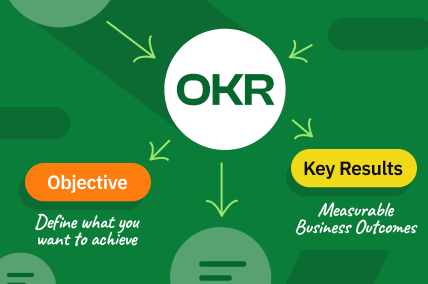
What Are OKRs for Finance Teams?
OKRs (Objectives and Key Results) give finance teams a framework to move beyond transactional number-crunching and become strategic business partners. Instead of simply closing the books each month, finance OKRs focus on the outcomes that make the whole company perform better — accurate forecasting, optimized cash flow, reduced operational costs, and proactive risk management.
For finance organizations, OKRs bridge the gap between operational excellence and strategic impact. A monthly close deadline is a KPI. The OKR is the plan to transform financial operations: cutting close time from 15 days to 5 days, improving forecast accuracy to within 3% of actual, or building real-time spend visibility that prevents budget overruns before they happen. This shift from reactive reporting to proactive financial leadership is what distinguishes world-class finance teams.
Whether you run a two-person finance function at a startup or lead a 100-person global finance organization, the examples below cover every stage of financial maturity. Each objective is outcome-oriented, each key result is measurable, and every example includes context to help you adapt it to your organization's size, complexity, and strategic priorities.
Interactive OKR Examples
Establish a structured annual budgeting process that delivers board-ready financial plans within 30 days
Build the startup's first formal budgeting process that translates business strategy into financial plans with department-level detail and monthly variance tracking.
Improve rolling forecast accuracy from 20% variance to under 8% across all business units
Transform the forecasting process from a quarterly guessing exercise to a dynamic, data-driven rolling forecast that leadership can trust for decision-making.
Deploy zero-based budgeting across all enterprise divisions to identify $10M in reallocation opportunities
Shift from incremental budgeting to zero-based methodology that forces every department to justify spending from scratch, uncovering hidden waste and misallocated resources.
Build scenario planning capability covering 3 financial models for board-level strategic decisions
Create dynamic financial models that enable the leadership team to evaluate the impact of different growth, hiring, and investment scenarios before committing resources.
Implement driver-based planning model that connects operational metrics to financial outcomes in real time
Replace static spreadsheet budgets with a driver-based model that automatically updates financial projections when operational inputs (headcount, pipeline, usage) change.
Centralize global financial planning across 8 business units into a unified planning platform
Eliminate the fragmented planning process where each business unit maintains separate models and assumptions by deploying a centralized EPM platform with unified data, methodology, and reporting.
Build a real-time spend management system giving department heads instant visibility into budget consumption
Empower non-finance leaders with self-serve budget dashboards and automated alerts so they can manage spending proactively rather than learning about overruns after month-end close.
Optimize capital allocation across product lines by building ROI-based investment scoring framework
Move beyond intuition-based capital allocation by implementing a structured framework that scores investment opportunities using projected ROI, payback period, and strategic alignment criteria.
Deploy AI-powered financial forecasting achieving 97% accuracy on revenue and expense projections
Leverage machine learning to replace human-driven forecasting with AI models that analyze historical patterns, seasonality, and external signals to produce more accurate financial projections.
Build investor-grade financial planning capability that supports Series B fundraising with 18-month projections
Create the financial planning infrastructure needed to pass investor due diligence — cohort-based revenue models, unit economics tracking, and sensitivity analysis that demonstrates financial sophistication.
Transform FP&A into a strategic advisory function by embedding finance business partners in every business unit
Evolve the FP&A team from backward-looking reporters to forward-looking strategic advisors by placing dedicated finance business partners in each major business unit with clear influence on resource decisions.
Implement continuous planning methodology replacing the annual budget cycle with adaptive quarterly allocations
Abandon the rigid annual budgeting process that becomes obsolete by month 3 and adopt a continuous planning approach with quarterly resource allocation reviews tied to real-time business performance.
Build Your Own OKR
Select a focus area for your OKR:
#RecruitingPartner
Join as freelance recruiter.
Get clients, AI tools & 65% of commissions


OKR Scoring Calculator
Use Google's 0.0 to 1.0 scoring scale to evaluate your finance OKRs at the end of each quarter. A score of 0.7-1.0 means the key result was delivered, 0.3-0.7 means meaningful progress was made, and 0.0-0.3 signals a miss that needs root cause analysis. The sweet spot is landing between 0.6 and 0.7 on average — if you consistently score 1.0, your OKRs are not ambitious enough.
Overall Score
Top 5 OKR Mistakes Finance Teams Make
Don't do this:
Objective: File Q3 tax returns on time and close the books by day 10
Do this instead:
Objective: Reduce monthly close from 10 days to 5 days by automating 80% of reconciliations, enabling faster decision-making
Filing taxes on time is a baseline expectation, not a stretch goal. Finance OKRs should focus on strategic improvements that transform how the finance function operates. Closing the books is a KPI; cutting close time in half by automating processes is an OKR that drives lasting improvement.
Don't do this:
KR: Cut all department budgets by 15% across the board
Do this instead:
KR: Reduce non-strategic spend by 20% while increasing investment in engineering and customer success by 10%
Across-the-board cuts treat every dollar equally, which punishes high-ROI teams and rewards inefficient ones. Effective finance OKRs distinguish between strategic investments that drive growth and operational costs that can be optimized without harming the business.
Don't do this:
KR: Increase company revenue from $5M to $8M this quarter
Do this instead:
KR: Implement pricing analytics that identifies $800K in revenue uplift opportunities from underpriced accounts
While finance should be aligned with revenue goals, the finance team does not close deals. Key results should reflect what finance can directly influence — better pricing analysis, faster billing, reduced DSO, or improved forecast accuracy that helps the sales team plan better.
Don't do this:
KR: Deliver month-end financial reports with 99% accuracy
Do this instead:
KR: Build predictive revenue model that forecasts month-end results by day 15 with 95% accuracy, enabling proactive course correction
Accurate historical reporting is table stakes. The most impactful finance OKRs shift the team from reporting what happened to predicting what will happen. Forward-looking capabilities like rolling forecasts and predictive analytics multiply the finance team's strategic value.
Don't do this:
KR: Achieve 100% budget compliance across all departments (without any departmental involvement in the process)
Do this instead:
KR: Partner with all 8 department heads to build collaborative budgets with 90% acceptance rate and under 10% quarterly variance
Finance OKRs that require behavior changes from other departments will fail without those departments' buy-in. The best finance OKRs explicitly include cross-functional collaboration as a success criterion, ensuring finance partners with the business rather than policing it.
OKRs vs KPIs for Finance: What's the Difference?
| Dimension | OKR | KPI | Finance Example |
|---|---|---|---|
| Purpose | Drive ambitious change and strategic improvement | Monitor ongoing operational health | OKR: Reduce close from 15 days to 5 days through automation. KPI: Track monthly close completion date. |
| Time Horizon | Quarterly, with defined start and end dates | Ongoing and continuously measured | OKR: Implement driver-based planning by end of Q2. KPI: Monthly budget variance percentage. |
| Ambition Level | Stretch goals — 70% completion is often considered successful | Targets are meant to be hit 100% of the time | OKR: Achieve 3-day close across all entities (stretch). KPI: Close must happen within 10 business days every month. |
| Scope | Focused on the few priorities that move the needle most | Comprehensive coverage of all key metrics | OKR: 2-3 objectives per quarter. KPI: Dashboard tracking 30+ metrics (DSO, DPO, close time, accuracy, etc.). |
| Ownership | Shared across team with individual accountability for key results | Typically assigned to individuals or departments to track | OKR: Team owns 'transform FP&A' with KRs for forecasting, reporting, and analytics. KPI: Each analyst tracks their report delivery time. |
| Flexibility | Can be adjusted mid-quarter based on new learning or market shifts | Generally fixed for the measurement period | OKR: Pivot cost reduction focus from vendors to headcount after acquisition. KPI: Monthly operating expense target stays fixed. |
| Measurement | Progress scored on a 0.0-1.0 scale with 0.7 considered strong | Measured as absolute numbers, percentages, or pass/fail | OKR: Score 0.7 on 'automate financial controls' = success. KPI: Audit findings either meet threshold or they don't. |
| Alignment | Cascades from company to team to individual to ensure strategic coherence | Often siloed within departments with limited cross-functional visibility | OKR: Company profitability goal cascades to finance OKR to individual analyst KRs. KPI: AP tracks invoice processing; AR tracks collections separately. |
Purpose
OKR: Reduce close from 15 days to 5 days through automation. KPI: Track monthly close completion date.
Time Horizon
OKR: Implement driver-based planning by end of Q2. KPI: Monthly budget variance percentage.
Ambition Level
OKR: Achieve 3-day close across all entities (stretch). KPI: Close must happen within 10 business days every month.
Scope
OKR: 2-3 objectives per quarter. KPI: Dashboard tracking 30+ metrics (DSO, DPO, close time, accuracy, etc.).
Ownership
OKR: Team owns 'transform FP&A' with KRs for forecasting, reporting, and analytics. KPI: Each analyst tracks their report delivery time.
Flexibility
OKR: Pivot cost reduction focus from vendors to headcount after acquisition. KPI: Monthly operating expense target stays fixed.
Measurement
OKR: Score 0.7 on 'automate financial controls' = success. KPI: Audit findings either meet threshold or they don't.
Alignment
OKR: Company profitability goal cascades to finance OKR to individual analyst KRs. KPI: AP tracks invoice processing; AR tracks collections separately.
How to Track Finance OKRs Effectively
Weekly Check-in
A focused 15-20 minute sync to review progress on each key result, flag blockers early, and adjust tactics while the quarter is still young enough to course-correct.
- •Score each key result on the 0.0-1.0 scale based on current financial data and project milestones
- •Review any process automation deployments or system implementations that are behind schedule
- •Identify cross-functional blockers (IT support, department data submissions, vendor responses) and assign owners
- •Confirm next week's top 3 finance actions that will advance the most critical lagging key results
Monthly Review
A deeper review to assess trajectory, determine if any OKRs need rescoping, and share learnings across the finance team. This is where month-end close data provides the clearest signal on progress.
- •Analyze month-end close results for signals on key result progress (close time, accuracy, variance, DSO trends)
- •Review month-over-month trends and determine if current trajectory will hit quarterly targets
- •Discuss any OKR adjustments needed based on budget changes, leadership priorities, or system delays
- •Share wins and learnings with the broader finance team to build momentum and cross-pollinate best practices
Quarterly Retrospective
A comprehensive end-of-quarter review where the team scores all OKRs, conducts root cause analysis on misses, extracts lessons learned, and drafts the next quarter's OKRs based on what was discovered.
- •Final-score every key result and calculate the average score per objective with supporting financial evidence
- •Conduct a structured retrospective: what improvements landed, what implementations stalled, what external factors intervened
- •Review cross-functional feedback from department heads and leadership on finance team performance and responsiveness
- •Draft next quarter's finance OKRs incorporating lessons learned and aligning with updated company strategic priorities
Frequently Asked Questions About Finance OKRs
How many OKRs should a finance team set per quarter?
Should financial close deadlines be OKRs or KPIs?
How do you set stretch goals in finance without introducing risk?
What is the best way to measure FP&A team impact through OKRs?
Can finance OKRs include technology implementation goals?
How should finance teams handle OKRs during audit season?
When should finance OKRs be set relative to the budget cycle?
Is it appropriate to include cost savings targets as OKRs?

Adithyan RK is the Co-Founder and CEO of Hyring, an AI-native recruitment platform that has run over 900,000 AI interviews for companies ranging from early-stage startups to the Fortune 500. He has spent 18 years building technology businesses, starting with a digital consultancy in 2008 and a staff augmentation firm in 2017, before founding Hyring in 2022 to rebuild hiring around evidence instead of guesswork.
Expertise

Surya N is the Co-Founder and CTO of Hyring, where he architected the AI interviewing engine that has now conducted over 900,000 interviews for companies ranging from early-stage startups to the Fortune 500. A mechanical engineer who moved into artificial intelligence, he spent 6 years building AI applications inside a technology consultancy before co-founding Hyring, and wrote the first version of its AI interviewer from scratch: a system that listens, adapts its questioning in real time, and flags fraud rather than following a fixed script.
Expertise
Need the Right People to Hit These OKRs?
The best OKRs mean nothing without the right team. Hyring helps you find, assess, and hire top finance talent faster — so your ambitious objectives actually get met.
See How Hyring Works