VP & Director OKR Examples That Bridge Strategy and Execution
VP & Director OKR Examples That Bridge Strategy and Execution
Stop being stuck between board-level strategy and team-level delivery. Discover proven OKR frameworks that help VPs and directors translate company priorities into department-level outcomes — covering strategic planning, team development, cross-functional alignment, and innovation.
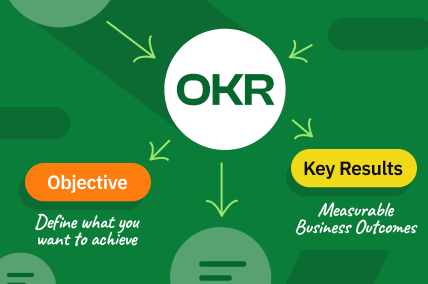
What Are OKRs for VPs & Directors?
OKRs (Objectives and Key Results) give VPs and directors a structured way to bridge the gap between company-level strategy and team-level execution. At this level, OKRs serve a dual purpose: they translate the CEO's vision into concrete departmental outcomes, and they create alignment across peer departments so that the entire leadership team is pulling in the same direction.
The unique challenge for VPs and directors is operating at the intersection of strategy and tactics. You are responsible for outcomes you cannot deliver alone — your success depends on the people you lead, the peers you collaborate with, and the resources you negotiate for. Effective VP-level OKRs acknowledge this reality by focusing on the systems, capabilities, and cross-functional partnerships that drive results, not just the results themselves.
Whether you lead a 10-person team at a growing startup or a 500-person organization at an enterprise company, the examples below cover the full scope of senior leadership responsibilities. Each objective reflects the strategic thinking expected at your level, each key result is measurable, and every example includes the context needed to adapt it to your specific function and company stage.
Interactive OKR Examples
Define and execute a Q1 department strategy that directly contributes to 40% of the company revenue target
Translate the company's annual revenue goal into a concrete department plan with clear milestones, resource allocation, and weekly tracking so the team knows exactly what to deliver.
Reallocate 30% of department budget from maintenance to growth initiatives while maintaining SLA commitments
Free up resources for strategic growth by automating routine work, consolidating tools, and restructuring team allocations without dropping existing service quality.
Lead the annual strategic planning process delivering a board-approved 3-year roadmap with quarterly OKRs
Drive the enterprise strategic planning cycle from data gathering through board presentation, ensuring the plan is actionable and directly translatable into department OKRs.
Build a data-driven decision framework that reduces strategic pivots by 50% and improves quarterly forecast accuracy to 85%
Replace gut-feel strategic decisions with a structured framework that uses leading indicators, market data, and team input to make better bets and forecast outcomes more accurately.
Design and launch a new business unit generating $2M in revenue within 6 months of inception
Incubate a new line of business from concept to revenue by securing resources, hiring the initial team, and achieving product-market fit within a compressed timeline.
Execute a department restructuring that improves delivery velocity by 40% and reduces organizational layers from 7 to 4
Flatten the organization to speed decision-making and execution by removing unnecessary management layers and redesigning team structures around outcomes rather than functions.
Build a strategic partnership ecosystem delivering 25% of department pipeline through partner channels
Diversify the department's growth engine by building relationships with complementary companies that can source, co-sell, and accelerate deals into the pipeline.
Lead the company's market entry strategy for APAC generating $5M in Year 1 revenue from the region
Own the end-to-end APAC expansion from market analysis through team hiring and initial revenue generation, coordinating across sales, marketing, legal, and product teams.
Architect a platform consolidation strategy that reduces operating costs by $15M annually while improving customer experience scores by 20%
Lead the multi-year platform consolidation effort that eliminates redundant systems, reduces technical debt, and creates a unified experience for both internal teams and customers.
Build a predictive resource planning model that reduces project overruns by 60% and improves team utilization to 85%
Replace reactive resource management with a data-driven system that forecasts demand, optimizes allocation, and prevents the over-commitment that causes burnout and missed deadlines.
Develop and execute a M&A integration strategy for 2 acquisitions delivering $20M in combined revenue synergies
Lead the operational integration of two recently acquired companies into the existing department structure, capturing planned synergies while retaining key talent and maintaining customer satisfaction.
Transform the department from a cost center to a profit center generating $8M in direct revenue through new service offerings
Reposition the department's capabilities as revenue-generating services by productizing internal expertise, launching external offerings, and building a P&L that proves the department's value creation.
Build Your Own OKR
Select a focus area for your OKR:
#RecruitingPartner
Join as freelance recruiter.
Get clients, AI tools & 65% of commissions


OKR Scoring Calculator
Use Google's 0.0 to 1.0 scoring scale to evaluate your VP & director OKRs at the end of each quarter. A score of 0.7-1.0 means the key result was delivered, 0.3-0.7 means meaningful progress was made, and 0.0-0.3 signals a miss that needs root cause analysis. The sweet spot is landing between 0.6 and 0.7 on average — if you consistently score 1.0, your OKRs are not ambitious enough.
Overall Score
Top 5 OKR Mistakes VP & Director Teams Make
Don't do this:
VP OKR: Increase team sprint velocity by 20% (duplicates the engineering manager's OKR)
Do this instead:
VP OKR: Restructure the department to deliver 3 strategic initiatives in parallel while reducing time-to-market by 30%
VP and director OKRs should operate at a higher altitude than your direct reports' goals. If your OKR could be owned by one of your managers, it is too tactical. Your OKRs should focus on the systems, structures, and cross-functional outcomes that enable your teams to succeed — not on managing their day-to-day execution.
Don't do this:
Objective: Improve our department's output by 25% (measured entirely within our team)
Do this instead:
Objective: Improve end-to-end customer time-to-value by 40% through coordinated improvements across sales, onboarding, and product
Senior leaders who set OKRs in a departmental silo create exactly the kind of organizational dysfunction OKRs are supposed to solve. The most valuable VP-level OKRs address outcomes that require multiple departments to collaborate, because those cross-functional outcomes are precisely what no individual team can own alone.
Don't do this:
Objective: Maintain current service levels and keep the team running smoothly
Do this instead:
Objective: Transform the department's delivery model to achieve 50% efficiency gains while launching 2 new strategic initiatives
OKRs are change instruments, not operational dashboards. If your objective describes maintaining current performance, it belongs on a KPI dashboard, not in your OKRs. VP-level OKRs should describe the meaningful improvements and strategic moves you are making this quarter that will leave the department materially better than where it started.
Don't do this:
5 objectives covering hiring, process improvement, tool migration, team culture, and strategic planning (all at once)
Do this instead:
2 objectives: one focused on the department's top strategic deliverable and one on building the team's capability to sustain that delivery
VPs and directors who set 5 objectives are admitting they have not prioritized. With 5 competing priorities, none receive the focused leadership attention needed to drive meaningful progress. Force yourself to pick the 2-3 things that will have the most disproportionate impact and commit to those fully.
Don't do this:
KR: Ensure every team member completes their tasks by Friday and attends all standups
Do this instead:
KR: Department delivers 90% of committed quarterly initiatives on time with quality scores above 8 out of 10
VP-level OKRs that prescribe how teams should work (attend standups, complete tasks by Friday) signal a lack of trust and undermine the autonomy that high-performing teams need. Instead, set clear outcome expectations and let your managers figure out the best way to achieve them. Your job is to remove obstacles and provide resources, not to dictate daily workflows.
OKRs vs KPIs for VP & Director: What's the Difference?
| Dimension | OKR | KPI | VP & Director Example |
|---|---|---|---|
| Purpose | Drive strategic departmental change that supports company-level priorities | Monitor ongoing departmental health and operational performance | OKR: Restructure to deliver 3 strategic initiatives in parallel. KPI: Track team utilization rate weekly. |
| Time Horizon | Quarterly strategic priorities with half-year and annual themes | Ongoing, reviewed weekly or monthly against consistent thresholds | OKR: Launch APAC expansion in Q3. KPI: Monthly revenue by region dashboard. |
| Ambition Level | Stretch goals that push the department beyond comfortable incrementalism | Performance floors that must be maintained at all times | OKR: Reduce cross-functional delays by 60% (stretch). KPI: Project on-time delivery must stay above 75%. |
| Scope | 2-3 priorities that represent the biggest levers for departmental improvement | 15-20 metrics covering delivery, team health, budget, and quality | OKR: 2 objectives on strategic delivery and team development. KPI: Dashboard tracking 18 operational metrics. |
| Ownership | VP/Director owns the objective with managers owning contributing key results | Shared across managers and analysts who monitor and report on metrics | OKR: VP owns 'scale the department' with hiring manager owning recruitment KR. KPI: HR tracks headcount metrics. |
| Flexibility | Objectives are fixed; tactics can shift based on what is learned during execution | Thresholds are fixed and trigger escalation when breached | OKR: Pivot hiring strategy mid-quarter while keeping the headcount objective. KPI: Attrition alert fires at 15%+. |
| Measurement | Scored 0.0-1.0 at quarter end with calibration across leadership team | Binary (target met or missed) or continuous trend analysis | OKR: Score 0.7 on 'build high-performing team' = strong outcome. KPI: Engagement score meets or misses 80 threshold. |
| Alignment | Bridges company OKRs to team OKRs, ensuring the strategy flows from top to bottom | Department-level metrics that may or may not explicitly connect to company goals | OKR: Company revenue target cascades to VP's delivery OKR to team sprint commitments. KPI: Department tracks velocity independently. |
Purpose
OKR: Restructure to deliver 3 strategic initiatives in parallel. KPI: Track team utilization rate weekly.
Time Horizon
OKR: Launch APAC expansion in Q3. KPI: Monthly revenue by region dashboard.
Ambition Level
OKR: Reduce cross-functional delays by 60% (stretch). KPI: Project on-time delivery must stay above 75%.
Scope
OKR: 2 objectives on strategic delivery and team development. KPI: Dashboard tracking 18 operational metrics.
Ownership
OKR: VP owns 'scale the department' with hiring manager owning recruitment KR. KPI: HR tracks headcount metrics.
Flexibility
OKR: Pivot hiring strategy mid-quarter while keeping the headcount objective. KPI: Attrition alert fires at 15%+.
Measurement
OKR: Score 0.7 on 'build high-performing team' = strong outcome. KPI: Engagement score meets or misses 80 threshold.
Alignment
OKR: Company revenue target cascades to VP's delivery OKR to team sprint commitments. KPI: Department tracks velocity independently.
How to Track VP & Director OKRs Effectively
Weekly Check-in
A 30-minute leadership team sync where VPs and directors review key result progress, surface cross-functional blockers, and make tactical decisions about where to focus the team's energy for the coming week.
- •Score each key result on the 0.0-1.0 scale using data from the past week's performance
- •Identify the top cross-functional blocker and escalate to the appropriate peer or executive for resolution
- •Confirm that manager-level OKR progress is on track and flag any teams falling behind
- •Review upcoming commitments and ensure resource allocation aligns with OKR priorities
Monthly Review
A deeper strategic review where the VP assesses overall department trajectory, evaluates whether the current approach is working, and makes any necessary adjustments to resource allocation or tactics.
- •Analyze month-over-month progress trends for each key result and project quarter-end scores
- •Evaluate whether any OKRs need tactical pivots based on new information from the market or organization
- •Review team health metrics (engagement, attrition risk, workload) and take corrective action if needed
- •Share department OKR progress with the CEO and peer VPs to maintain alignment and surface collaboration opportunities
Quarterly Retrospective
A comprehensive review where the VP scores all OKRs, conducts a department retrospective, presents results to the executive team, and designs next quarter's strategic priorities.
- •Final-score all key results and present department OKR results to the executive team with context and commentary
- •Conduct a department retrospective with all managers identifying systemic improvements for next quarter
- •Evaluate the department's contribution to company-level OKRs and identify gaps in alignment
- •Draft next quarter's department OKRs aligned to updated company priorities and circulate for peer review
Frequently Asked Questions About VP & Director OKRs
How should VP-level OKRs differ from manager-level OKRs?
How many OKRs should a VP or Director set per quarter?
Should VP OKRs include team development or focus only on business outcomes?
How do you handle OKRs when your department supports multiple company priorities?
How should directors handle OKRs differently from VPs?
What is the best way to cascade OKRs from VP level to individual teams?
How do you measure cross-functional OKR success when you do not control other departments?
Should VP OKRs be shared publicly or kept within the leadership team?

Adithyan RK is the Co-Founder and CEO of Hyring, an AI-native recruitment platform that has run over 900,000 AI interviews for companies ranging from early-stage startups to the Fortune 500. He has spent 18 years building technology businesses, starting with a digital consultancy in 2008 and a staff augmentation firm in 2017, before founding Hyring in 2022 to rebuild hiring around evidence instead of guesswork.
Expertise

Surya N is the Co-Founder and CTO of Hyring, where he architected the AI interviewing engine that has now conducted over 900,000 interviews for companies ranging from early-stage startups to the Fortune 500. A mechanical engineer who moved into artificial intelligence, he spent 6 years building AI applications inside a technology consultancy before co-founding Hyring, and wrote the first version of its AI interviewer from scratch: a system that listens, adapts its questioning in real time, and flags fraud rather than following a fixed script.
Expertise
Need the Right People to Hit These OKRs?
VP and director-level OKRs require exceptional talent at every level of the organization. Hyring helps you find, assess, and hire the managers, specialists, and senior leaders who turn strategic objectives into delivered results.
See How Hyring Works