Legal & Compliance OKR Examples That Protect and Enable Growth
Legal & Compliance OKR Examples That Protect and Enable Growth
Stop treating legal as a cost center and start driving strategic impact. From contract management to regulatory compliance to litigation strategy — these OKR frameworks help General Counsels, compliance officers, and legal operations leaders transform legal from a bottleneck into a business accelerator.
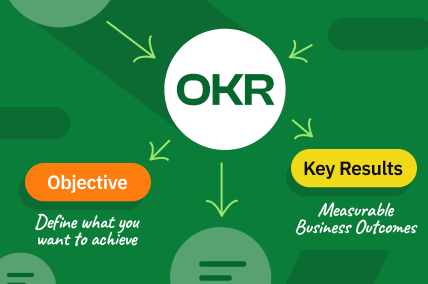
What Are OKRs for Legal & Compliance Teams?
OKRs (Objectives and Key Results) give legal and compliance teams a framework to move beyond reactive firefighting and toward proactive risk management and strategic enablement. Instead of measuring success by how many contracts were reviewed or audits were passed, legal OKRs focus on outcomes that matter — reducing contract cycle time by 60%, achieving zero regulatory findings, or building compliance programs that scale with business growth without adding proportional headcount.
For legal organizations, the power of OKRs lies in quantifying impact that has traditionally been invisible. A clean audit is a KPI. The OKR is the strategic plan to build the compliance infrastructure that makes clean audits inevitable: implementing automated monitoring that catches 95% of policy violations before they escalate, reducing contract negotiation time from 30 days to 7 days through standardized playbooks, or building a legal self-service portal that handles 70% of routine requests without attorney involvement.
Whether you lead a two-person startup legal team or manage a 50-attorney corporate legal department, the examples below cover every dimension of modern legal and compliance operations. Each objective is outcome-oriented, each key result is measurable, and every example includes context to help you adapt it to your regulatory environment, company stage, and strategic priorities.
Interactive OKR Examples
Reduce average contract turnaround time from 21 days to 7 days for standard agreements
Streamline the contract lifecycle at the startup by implementing templates, standardized terms, and clear approval workflows that eliminate unnecessary back-and-forth.
Implement a contract management system with full lifecycle tracking for all active agreements
Replace spreadsheet-based contract tracking with a proper CLM platform that provides visibility into obligations, renewals, and compliance across the growing contract portfolio.
Standardize global contracting processes achieving 95% compliance with approved terms across all regions
Harmonize contract practices across international offices that have developed inconsistent approaches to terms, approvals, and risk assessment.
Build a self-service contract generation portal handling 70% of routine agreements without attorney involvement
Empower business teams to generate standard contracts independently using guided workflows and pre-approved templates, freeing attorneys for high-value work.
Reduce contract negotiation cycles by 50% through standardized playbooks and pre-approved fallback positions
Accelerate deal velocity by giving the sales and procurement teams clear negotiation guardrails that reduce the need to escalate to legal for routine term negotiations.
Implement AI-powered contract review that pre-screens 100% of inbound agreements within 2 hours
Deploy AI contract analysis that automatically reviews counterparty paper, identifies deviations from standard terms, and flags risks before an attorney begins review.
Build a contract obligation management system ensuring 100% compliance with post-execution commitments
Prevent the common problem of signed contracts sitting in a drawer by systematically tracking and managing all post-execution obligations, milestones, and deliverables.
Optimize contract portfolio value by renegotiating 50 underperforming vendor agreements saving $2M annually
Proactively identify and renegotiate contracts where the company is overpaying, underutilizing, or accepting unfavorable terms that no longer reflect market conditions.
Deploy a fully automated contract lifecycle platform with end-to-end digital execution and zero paper processes
Transform contract operations by implementing a digital-first platform that handles intake, drafting, negotiation, approval, execution, and obligation tracking without manual handoffs.
Build predictive analytics for contract outcomes enabling data-driven negotiation strategy
Use historical contract data and AI to predict negotiation outcomes, identify optimal concession strategies, and quantify the value of different contract terms.
Implement smart contract technology for 30% of standard commercial agreements enabling automated performance tracking
Deploy smart contract capabilities that automatically track milestones, trigger payments, and enforce terms for suitable agreement types.
Build a global contract intelligence platform providing real-time portfolio analytics across 10,000+ active agreements
Create an enterprise contract intelligence capability that provides leadership with real-time insights into contract risk, value, and performance across the entire portfolio.
Build Your Own OKR
Select a focus area for your OKR:
#RecruitingPartner
Join as freelance recruiter.
Get clients, AI tools & 65% of commissions


OKR Scoring Calculator
Use Google's 0.0 to 1.0 scoring scale to evaluate your legal and compliance OKRs at the end of each quarter. A score of 0.7-1.0 means the key result was delivered, 0.3-0.7 means meaningful progress was made, and 0.0-0.3 signals a miss that needs root cause analysis. The sweet spot is landing between 0.6 and 0.7 on average — if you consistently score 1.0, your OKRs are not ambitious enough.
Overall Score
Top 5 OKR Mistakes Legal & Compliance Teams Make
Don't do this:
Objective: Pass the SOC 2 audit in Q3 with zero findings
Do this instead:
Objective: Build an automated compliance monitoring system that continuously validates all SOC 2 controls, making audit readiness a permanent state rather than a quarterly scramble
Passing an audit is a point-in-time event, not a strategic outcome. The real OKR should focus on building the infrastructure that ensures every audit passes automatically. When your compliance systems are continuously monitoring and remediating, audit day becomes a formality rather than a crisis.
Don't do this:
KR: Review 200 contracts per quarter and close 50 legal requests per month
Do this instead:
KR: Reduce contract cycle time from 21 to 7 days enabling $5M in faster revenue recognition while maintaining zero high-risk term exceptions
Counting contracts reviewed tells you nothing about whether legal is helping the business move faster. A legal team that reviews 200 contracts but takes 30 days each is less valuable than one that reviews 150 in 7 days. Measure the business outcome of legal work — speed, risk reduction, cost savings — not the volume of legal activity.
Don't do this:
8 OKRs covering all 25 regulatory frameworks the company must comply with
Do this instead:
2-3 OKRs focused on the regulatory areas with the highest business risk, enforcement activity, or strategic importance this quarter
Legal teams face dozens of regulatory requirements, but not all carry equal risk or strategic importance. OKRs should focus on the compliance areas where gaps would cause the most harm — either through enforcement risk, business disruption, or competitive disadvantage. Use KPIs to maintain baseline compliance everywhere else.
Don't do this:
KR: Win 100% of litigation matters filed this quarter
Do this instead:
KR: Implement early case assessment for 100% of new matters achieving resolution recommendations within 10 days, with 50% resolved through negotiation before formal litigation
Legal cannot control judges, juries, or opposing counsel. OKRs should focus on what legal can control: preparation quality, early resolution attempts, cost management, and strategic decision-making. The goal is to optimize the inputs that lead to better outcomes, not to promise specific outcomes that depend on external factors.
Don't do this:
KR: Reduce outside counsel spend by 30% across all matters
Do this instead:
KR: Reduce outside counsel spend by 20% while improving business stakeholder satisfaction with legal services from 72% to 88%
Cutting legal costs is meaningless if it makes the legal department so slow or unhelpful that business teams start avoiding legal review or making riskier decisions without legal input. Always pair efficiency metrics with stakeholder satisfaction and service quality measures to ensure cost optimization does not come at the expense of risk protection.
OKRs vs KPIs for Legal & Compliance: What's the Difference?
| Dimension | OKR | KPI | Legal & Compliance Example |
|---|---|---|---|
| Purpose | Drive strategic transformation of legal and compliance capabilities | Monitor ongoing legal operations and compliance health | OKR: Build an automated compliance monitoring system covering all critical controls. KPI: Track monthly compliance audit pass rate. |
| Time Horizon | Quarterly, with defined start and end dates | Ongoing and continuously measured | OKR: Implement AI contract review by end of Q2. KPI: Daily contract turnaround time monitoring. |
| Ambition Level | Stretch goals — 70% completion is often considered successful | Targets are meant to be hit 100% of the time | OKR: Achieve zero regulatory findings across all jurisdictions (stretch). KPI: Compliance training completion must stay at 100%. |
| Scope | Focused on the few legal priorities that create the most strategic value | Comprehensive coverage of all legal and compliance metrics | OKR: 2-3 objectives per quarter. KPI: Dashboard tracking 30+ metrics (contract volume, spend, compliance rates, matter counts, etc.). |
| Ownership | Shared across legal team with individual accountability for key results | Typically assigned to individuals or practice areas to track | OKR: Team owns 'transform contract operations' with KRs split across legal ops, attorneys, and technology. KPI: Each attorney tracks their individual matter metrics. |
| Flexibility | Can be adjusted mid-quarter based on regulatory changes or litigation developments | Generally fixed for the measurement period | OKR: Pivot from contract automation to regulatory response after new legislation. KPI: Monthly contract volume target stays fixed. |
| Measurement | Progress scored on a 0.0-1.0 scale with 0.7 considered strong | Measured as absolute numbers, percentages, or pass/fail | OKR: Score 0.7 on 'modernize legal operations' = success. KPI: Contract turnaround either meets the 7-day SLA or it doesn't. |
| Alignment | Cascades from company to legal department to individual attorneys | Often siloed within legal with limited cross-functional visibility | OKR: Company risk goal cascades to legal compliance OKR to individual KRs. KPI: Legal tracks contract volume; compliance tracks audit scores separately. |
Purpose
OKR: Build an automated compliance monitoring system covering all critical controls. KPI: Track monthly compliance audit pass rate.
Time Horizon
OKR: Implement AI contract review by end of Q2. KPI: Daily contract turnaround time monitoring.
Ambition Level
OKR: Achieve zero regulatory findings across all jurisdictions (stretch). KPI: Compliance training completion must stay at 100%.
Scope
OKR: 2-3 objectives per quarter. KPI: Dashboard tracking 30+ metrics (contract volume, spend, compliance rates, matter counts, etc.).
Ownership
OKR: Team owns 'transform contract operations' with KRs split across legal ops, attorneys, and technology. KPI: Each attorney tracks their individual matter metrics.
Flexibility
OKR: Pivot from contract automation to regulatory response after new legislation. KPI: Monthly contract volume target stays fixed.
Measurement
OKR: Score 0.7 on 'modernize legal operations' = success. KPI: Contract turnaround either meets the 7-day SLA or it doesn't.
Alignment
OKR: Company risk goal cascades to legal compliance OKR to individual KRs. KPI: Legal tracks contract volume; compliance tracks audit scores separately.
How to Track Legal & Compliance OKRs Effectively
Weekly Check-in
A focused 15-20 minute sync to review progress on each key result, flag blockers early, and adjust tactics while the quarter is still young enough to course-correct.
- •Score each key result on the 0.0-1.0 scale based on current matter data, compliance metrics, and project milestones
- •Review any new regulatory developments, litigation filings, or compliance incidents that could affect OKR progress
- •Identify resource constraints, technology blockers, or cross-team dependencies and assign resolution owners with deadlines
- •Confirm next week's top 3 priority actions that will advance lagging key results toward their quarterly targets
Monthly Review
A deeper review to assess trajectory, determine if any OKRs need rescoping, and share learnings across the legal and compliance team.
- •Analyze month-over-month trends in legal metrics including contract volume, cycle time, compliance scores, and outside counsel spend
- •Review completed legal projects and compliance initiatives for actual versus expected impact and document lessons learned
- •Align with business leadership on any changes to strategic priorities, regulatory landscape, or risk profile affecting legal OKRs
- •Celebrate legal team wins and share successful approaches across practice groups for broader adoption
Quarterly Retrospective
A comprehensive end-of-quarter review where the team scores all OKRs, conducts root cause analysis on misses, and drafts next quarter's OKRs.
- •Final-score every key result with supporting data from legal systems, compliance platforms, and stakeholder feedback
- •Conduct structured retrospective: which legal initiatives delivered value, which stalled, and what external factors intervened
- •Review total legal department impact including cost savings, risk reduction, cycle time improvements, and stakeholder satisfaction
- •Draft next quarter's legal and compliance OKRs incorporating lessons learned, regulatory changes, and updated business priorities
Frequently Asked Questions About Legal & Compliance OKRs
How many OKRs should a legal and compliance team set per quarter?
Should contract turnaround time be an OKR or a KPI?
How do you set stretch goals in legal without increasing regulatory risk?
Can legal OKRs include outcomes that depend on business team cooperation?
How should legal teams measure the ROI of compliance programs?
Should data privacy be tracked as a legal OKR or an IT OKR?
How do you handle unexpected litigation in the middle of an OKR cycle?
Is it appropriate to set OKRs for reducing legal department headcount through technology?

Adithyan RK is the Co-Founder and CEO of Hyring, an AI-native recruitment platform that has run over 900,000 AI interviews for companies ranging from early-stage startups to the Fortune 500. He has spent 18 years building technology businesses, starting with a digital consultancy in 2008 and a staff augmentation firm in 2017, before founding Hyring in 2022 to rebuild hiring around evidence instead of guesswork.
Expertise

Surya N is the Co-Founder and CTO of Hyring, where he architected the AI interviewing engine that has now conducted over 900,000 interviews for companies ranging from early-stage startups to the Fortune 500. A mechanical engineer who moved into artificial intelligence, he spent 6 years building AI applications inside a technology consultancy before co-founding Hyring, and wrote the first version of its AI interviewer from scratch: a system that listens, adapts its questioning in real time, and flags fraud rather than following a fixed script.
Expertise
Need the Right People to Hit These OKRs?
The best OKRs mean nothing without the right team. Hyring helps you find, assess, and hire top legal and compliance talent faster — so your ambitious objectives actually get met.
See How Hyring Works