Cybersecurity OKR Examples That Protect What Matters Most
Cybersecurity OKR Examples That Protect What Matters Most
Stop measuring security by how many patches you applied. These OKR frameworks help cybersecurity teams drive measurable risk reduction — from threat detection speed to vulnerability exposure windows to security culture adoption. Built for CISOs, security engineers, and GRC professionals.
What Are OKRs for Cybersecurity Teams?
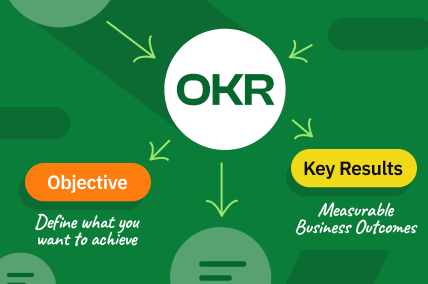
OKRs (Objectives and Key Results) give cybersecurity teams a framework to move beyond checkbox compliance and toward measurable risk reduction. Instead of tracking activities like scans completed or policies written, security OKRs focus on outcomes that define real protection — mean time to detect threats, vulnerability exposure windows, compliance audit readiness, and the organization's resilience to attack scenarios.
For security organizations, OKRs bridge the gap between security programs and business outcomes. A vulnerability scan count is a KPI. The OKR is the strategy to reduce risk: cutting the mean time to detect breaches from 200 days to under 24 hours, reducing the exploitable attack surface by 80%, or achieving SOC 2 certification without a single critical finding. This shift from security activity tracking to risk outcome measurement is what separates reactive security teams from those that genuinely protect the business.
Whether you are a solo security engineer at a startup or lead a 40-person security organization at an enterprise, the examples below cover threat detection, vulnerability management, compliance, incident response, and security awareness. Each objective is outcome-oriented, each key result has measurable targets, and every example includes the context needed to adapt it to your threat landscape, your regulatory requirements, and your security maturity.
Interactive OKR Examples
Deploy foundational threat detection covering all critical systems with under 15-minute alert latency
Build the security monitoring foundation by deploying log collection, correlation rules, and alerting across the startup's critical infrastructure to detect threats before they cause damage.
Reduce mean time to detect security threats from 72 hours to under 4 hours across all environments
Close the detection gap by expanding monitoring coverage, tuning detection rules, and implementing automated correlation that surfaces threats within hours instead of days.
Implement user and entity behavior analytics detecting anomalous activity across 10,000+ identities
Deploy UEBA to detect insider threats, compromised accounts, and advanced attacks that bypass signature-based detection by analyzing behavioral patterns across all enterprise identities.
Build a threat intelligence program integrating 5 feeds into automated detection and response workflows
Move from reactive threat hunting to intelligence-driven security by integrating curated threat feeds into detection rules, blocking lists, and automated response playbooks.
Deploy cloud-native security monitoring achieving full visibility across multi-cloud infrastructure
Extend threat detection to cloud environments by implementing cloud security posture management, workload protection, and API monitoring across AWS, Azure, and GCP.
Build a 24/7 security operations capability with follow-the-sun monitoring and sub-1-hour threat response
Establish round-the-clock security monitoring by implementing automated triage, analyst handoff procedures, and escalation paths that ensure threats are investigated within an hour regardless of when they occur.
Implement proactive threat hunting discovering 10+ previously undetected threats per quarter
Move beyond passive alerting to active threat hunting by dedicating analyst time to hypothesis-driven searches for threats that evade automated detection rules.
Reduce security alert fatigue by 70% through intelligent alert consolidation and automated triage
Solve the alert overload problem that causes analysts to miss real threats by implementing alert deduplication, intelligent grouping, and AI-assisted triage that surfaces only actionable incidents.
Deploy AI-powered threat detection achieving sub-1-minute detection of advanced persistent threats
Implement next-generation threat detection using machine learning models that identify APTs, zero-day exploits, and sophisticated attack chains that rule-based systems miss.
Build a deception technology network detecting lateral movement attempts with zero false positives
Deploy honeypots, honey tokens, and decoy systems that detect attacker movement within the network with absolute certainty, since any interaction with deception assets indicates malicious activity.
Implement automated threat correlation across 20+ data sources reducing investigation time from 4 hours to 15 minutes
Build an automated investigation capability that correlates threat signals across endpoints, network, identity, email, and cloud to build complete attack narratives automatically.
Build a unified security data lake enabling real-time threat analytics across 5TB of daily security telemetry
Centralize all security data into a scalable analytics platform that supports real-time threat detection, historical investigation, and compliance reporting across the enterprise.
Build Your Own OKR
Select a focus area for your OKR:
#RecruitingPartner
Join as freelance recruiter.
Get clients, AI tools & 65% of commissions


OKR Scoring Calculator
Use Google's 0.0 to 1.0 scoring scale to evaluate your cybersecurity OKRs at the end of each quarter. A score of 0.7-1.0 means the key result was delivered, 0.3-0.7 means meaningful progress was made, and 0.0-0.3 signals a miss that needs root cause analysis. The sweet spot is landing between 0.6 and 0.7 on average — if you consistently score 1.0, your OKRs are not ambitious enough.
Overall Score
Top 5 OKR Mistakes Cybersecurity Teams Make
Don't do this:
KR: Complete SOC 2 audit and receive certification
Do this instead:
KR: Achieve SOC 2 certification with zero findings and reduce audit preparation time by 60% through continuous compliance automation
Getting a compliance certificate is a milestone, not a meaningful security outcome. The real value is in building the continuous compliance capability that ensures you are always audit-ready and actually reducing risk — not just checking boxes for an auditor once a year. Frame compliance OKRs around sustainable capability building.
Don't do this:
KR: Deploy SIEM, EDR, and CSPM across all environments
Do this instead:
KR: Detect 90% of simulated attacks within 15 minutes and contain 100% within 2 hours using integrated security tooling
Having security tools installed means nothing if they are misconfigured, unmonitored, or generating alerts nobody reads. The OKR should measure whether the tools actually detect and stop threats. Run adversarial simulations and measure detection and response effectiveness — that is the only way to know if your security investment is working.
Don't do this:
KR: Run vulnerability scans on all servers every week
Do this instead:
KR: Reduce exploitable critical vulnerabilities from 45 to under 5 with maximum exposure window of 7 days
Scanning is an activity. Risk reduction is the outcome. A team can scan every day and still have 200 unpatched critical vulnerabilities if nobody is remediating the findings. Focus the OKR on the vulnerability exposure — how many exist, how long they are open, and what is the risk-adjusted remediation priority.
Don't do this:
Objective: Achieve zero security incidents for the entire year
Do this instead:
Objective: Reduce security incident impact by 80% through faster detection, containment, and prevention of repeat incidents
A zero-incident target sounds ambitious but actually creates perverse incentives. Teams underreport incidents to hit the target, and real threats go unaddressed. Mature security teams expect incidents and measure success by how quickly they detect and contain them, not by pretending they do not happen. Focus on resilience and response quality, not impossibly perfect prevention.
Don't do this:
OKR set: 3 technical security objectives, 0 security awareness objectives
Do this instead:
OKR set: 2 technical objectives and 1 human-factor objective reducing phishing susceptibility and increasing incident reporting
Over 80% of breaches involve a human element. A security team that invests entirely in technical controls while ignoring employee behavior is protecting the castle walls while leaving the gate open. Every quarterly OKR set should include at least one objective addressing the human layer — training effectiveness, phishing resilience, or security culture.
OKRs vs KPIs for Cybersecurity: What's the Difference?
| Dimension | OKR | KPI | Cybersecurity Example |
|---|---|---|---|
| Purpose | Drive ambitious improvement in security posture and risk reduction | Monitor ongoing security operations health and compliance status | OKR: Reduce MTTD from 72 hours to 4 hours. KPI: Track daily alert volume and investigation queue depth. |
| Time Horizon | Quarterly, with defined start and end dates | Ongoing and continuously measured | OKR: Achieve SOC 2 certification by end of Q2. KPI: Weekly vulnerability scan pass rate dashboard. |
| Ambition Level | Stretch goals — 70% completion is often considered successful | Targets are meant to be hit 100% of the time | OKR: Detect 100% of simulated APT attacks (stretch). KPI: Patch compliance must stay above 90%. |
| Scope | Focused on the few security priorities that reduce the most risk | Comprehensive coverage of all security metrics | OKR: 2-3 objectives per quarter. KPI: Dashboard tracking 20+ metrics (alerts, patches, incidents, compliance, etc.). |
| Ownership | Shared across security team with individual accountability for key results | Typically assigned to SOC analysts or security engineers to monitor | OKR: Team owns 'reduce attack surface' with individual KRs for patching, access, and monitoring. KPI: Each analyst owns their alert queue metrics. |
| Flexibility | Can be adjusted mid-quarter based on new threats or incidents | Generally fixed for the measurement period | OKR: Pivot from compliance to incident response after breach attempt. KPI: Monthly vulnerability count target stays fixed regardless. |
| Measurement | Progress scored on a 0.0-1.0 scale with 0.7 considered strong | Measured as absolute numbers, percentages, or pass/fail | OKR: Score 0.7 on 'improve detection capability' = success. KPI: MTTD either hits 4-hour target or it does not. |
| Alignment | Cascades from company → security team → individual to ensure strategic coherence | Often siloed within security with limited cross-functional visibility | OKR: Company risk goal cascades to security team OKR to individual analyst KRs. KPI: Security tracks alerts; IT tracks patch compliance separately. |
Purpose
OKR: Reduce MTTD from 72 hours to 4 hours. KPI: Track daily alert volume and investigation queue depth.
Time Horizon
OKR: Achieve SOC 2 certification by end of Q2. KPI: Weekly vulnerability scan pass rate dashboard.
Ambition Level
OKR: Detect 100% of simulated APT attacks (stretch). KPI: Patch compliance must stay above 90%.
Scope
OKR: 2-3 objectives per quarter. KPI: Dashboard tracking 20+ metrics (alerts, patches, incidents, compliance, etc.).
Ownership
OKR: Team owns 'reduce attack surface' with individual KRs for patching, access, and monitoring. KPI: Each analyst owns their alert queue metrics.
Flexibility
OKR: Pivot from compliance to incident response after breach attempt. KPI: Monthly vulnerability count target stays fixed regardless.
Measurement
OKR: Score 0.7 on 'improve detection capability' = success. KPI: MTTD either hits 4-hour target or it does not.
Alignment
OKR: Company risk goal cascades to security team OKR to individual analyst KRs. KPI: Security tracks alerts; IT tracks patch compliance separately.
How to Track Cybersecurity OKRs Effectively
Weekly Check-in
A focused 15-20 minute sync to review progress on each key result, flag blockers early, and adjust tactics while the quarter is still young enough to course-correct.
- •Score each key result on the 0.0-1.0 scale based on current security metrics and project milestones
- •Review the week's security incidents and assess impact on threat detection and response OKRs
- •Identify the top blocker for any key result scoring below 0.3 and assign an owner for resolution
- •Confirm next week's top 3 security priorities that will move the needle on lagging key results
Monthly Review
A deeper review to assess trajectory, determine if any OKRs need to be rescoped, and share learnings across the team. This is where security trends become visible and strategic pivots happen.
- •Review month-over-month trends for threat detection, vulnerability exposure, compliance posture, and incident metrics
- •Assess whether any objectives need adjustment based on new threat intelligence or security incidents
- •Share threat landscape updates and their implications for current OKR priorities with the team
- •Align with IT, engineering, and business leadership on security dependencies and resource needs
Quarterly Retrospective
A comprehensive end-of-quarter review where the team scores all OKRs, conducts root cause analysis on misses, extracts lessons learned, and drafts the next quarter's OKRs based on what was discovered.
- •Final-score every key result and calculate the average score per objective using security metrics data
- •Conduct a structured retrospective: what security improvements delivered value, what incidents changed our priorities
- •Identify the top 3 security lessons that should inform next quarter's OKR design and budget allocation
- •Draft next quarter's OKRs incorporating threat intelligence trends, compliance requirements, and risk assessment updates
Frequently Asked Questions About Cybersecurity OKRs
How should cybersecurity OKRs balance prevention with detection and response?
What metrics make the best cybersecurity OKR key results?
Should compliance certifications be OKRs or just projects?
How do you measure the ROI of cybersecurity OKRs for the board?
Can a small security team of 1-2 people effectively use OKRs?
How should security OKRs handle the unpredictability of incidents and new threats?
When should phishing simulation metrics be OKRs versus KPIs?
Is it appropriate to share security OKRs publicly within the organization?

Adithyan RK is the Co-Founder and CEO of Hyring, an AI-native recruitment platform that has run over 900,000 AI interviews for companies ranging from early-stage startups to the Fortune 500. He has spent 18 years building technology businesses, starting with a digital consultancy in 2008 and a staff augmentation firm in 2017, before founding Hyring in 2022 to rebuild hiring around evidence instead of guesswork.
Expertise

Surya N is the Co-Founder and CTO of Hyring, where he architected the AI interviewing engine that has now conducted over 900,000 interviews for companies ranging from early-stage startups to the Fortune 500. A mechanical engineer who moved into artificial intelligence, he spent 6 years building AI applications inside a technology consultancy before co-founding Hyring, and wrote the first version of its AI interviewer from scratch: a system that listens, adapts its questioning in real time, and flags fraud rather than following a fixed script.
Expertise
Need the Right People to Hit These OKRs?
The best OKRs mean nothing without the right team. Hyring helps you find, assess, and hire top cybersecurity talent faster — so your ambitious objectives actually get met.
See How Hyring Works