Research & Development OKR Examples That Turn Innovation Into Business Impact
Research & Development OKR Examples That Turn Innovation Into Business Impact
Stop measuring R&D by papers published or patents filed. These OKR frameworks help research and development teams drive measurable innovation outcomes — from prototype-to-product conversion rates to technology readiness levels to cross-functional collaboration impact. Built for R&D directors, research scientists, innovation leads, and technology strategists.
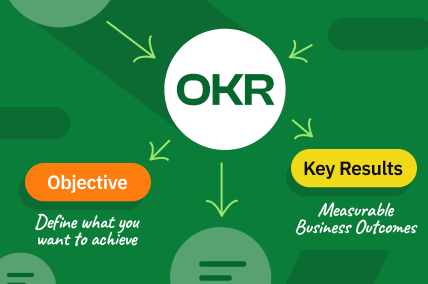
What Are OKRs for Research & Development Teams?
OKRs (Objectives and Key Results) give R&D teams a framework to move beyond activity tracking and into measurable innovation impact. Instead of counting publications, conference presentations, or hours spent in the lab, R&D OKRs focus on outcomes that define real innovation value — prototype-to-product conversion rates, technology readiness advancement, time from concept to market validation, and the measurable business impact of research investments.
For R&D organizations, OKRs bridge the gap between exploratory research and business outcomes. A patent application count is a KPI. The OKR is the strategy to drive innovation: advancing a breakthrough technology from TRL 3 to TRL 7 within two quarters, converting 40% of validated prototypes into revenue-generating products, or reducing the concept-to-market validation cycle from 18 months to 6 months. This shift from research activity tracking to innovation outcome measurement is what separates R&D labs that burn cash from those that create competitive advantage.
Whether you are a solo researcher at a startup or lead a 100-person R&D division at an enterprise, the examples below cover innovation pipeline management, prototype delivery, technology exploration, intellectual property strategy, and cross-functional R&D collaboration. Each objective is outcome-oriented, each key result has measurable targets, and every example includes the context needed to adapt it to your industry, your research maturity, and your innovation strategy.
Interactive OKR Examples
Build a structured innovation pipeline generating 20 validated concepts per quarter from ideation through screening
Establish the foundational innovation process from scratch, creating a systematic approach to ideation, concept screening, and early validation that replaces ad-hoc brainstorming with a repeatable pipeline.
Increase innovation pipeline throughput by 50% while maintaining quality gate pass rates above 70%
Scale the innovation pipeline to process more concepts without diluting quality, by optimizing screening processes, parallelizing evaluations, and building team capacity for rapid validation.
Deploy an enterprise innovation management platform tracking 200+ ideas across 10 business units
Implement a centralized innovation management system that provides visibility across the entire enterprise innovation portfolio, enabling strategic resource allocation and preventing duplicate efforts.
Establish an open innovation program sourcing 30% of pipeline concepts from external partners and academia
Expand the innovation funnel beyond internal R&D by building partnerships with universities, startups, and research institutions that bring external perspectives and breakthrough capabilities.
Build a data-driven innovation scoring model predicting commercial viability with 75% accuracy
Replace subjective innovation evaluation with a data-driven scoring model that combines technical feasibility, market signals, and competitive analysis to predict which concepts will succeed.
Create a balanced innovation portfolio with 60% incremental, 30% adjacent, and 10% transformational bets
Implement the innovation ambition matrix to ensure R&D investment is strategically distributed across incremental improvements, adjacent market expansions, and transformational moonshots.
Implement a stage-gate innovation process with measurable criteria reducing resource waste by 50%
Deploy a rigorous stage-gate process with quantified go/no-go criteria at each stage, ensuring that only viable concepts receive continued investment while killing poor bets early and decisively.
Build an innovation metrics dashboard providing real-time visibility into pipeline health and R&D effectiveness
Create comprehensive innovation analytics that track pipeline velocity, conversion rates, time-to-market, and R&D ROI, enabling data-driven decisions about innovation strategy and resource allocation.
Pioneer an AI-driven innovation discovery system identifying breakthrough opportunities from patent and research data
Deploy AI-powered tools that analyze global patent filings, academic research, and market signals to identify white-space innovation opportunities before competitors discover them.
Build an innovation ecosystem connecting internal R&D with 50 external partners for collaborative breakthrough development
Create a curated innovation ecosystem that systematically connects internal research capabilities with external partners, accelerating breakthrough development through collaborative research and shared resources.
Create a corporate venture model investing in 5 disruptive technologies with structured integration pathways
Establish a corporate venture approach to innovation that invests in disruptive technologies through equity, partnerships, or acqui-hires, with defined pathways to integrate innovations into the core business.
Implement a quantum computing research program evaluating feasibility for 3 core business applications
Launch a strategic research program exploring quantum computing applications relevant to the business, building internal expertise and identifying the first viable use cases for competitive advantage.
Build Your Own OKR
Select a focus area for your OKR:
#RecruitingPartner
Join as freelance recruiter.
Get clients, AI tools & 65% of commissions


OKR Scoring Calculator
Use Google's 0.0 to 1.0 scoring scale to evaluate your R&D OKRs at the end of each quarter. A score of 0.7-1.0 means the key result was delivered, 0.3-0.7 means meaningful progress was made, and 0.0-0.3 signals a miss that needs root cause analysis. The sweet spot is landing between 0.6 and 0.7 on average — if you consistently score 1.0, your OKRs are not ambitious enough.
Overall Score
Top 5 OKR Mistakes Research & Development Teams Make
Don't do this:
KR: Publish 10 papers and file 5 patents this quarter
Do this instead:
KR: Convert 3 research outputs into product features generating $2M+ pipeline within 6 months of publication
Publications and patents are outputs, not outcomes. A team can publish extensively while creating zero business value. The OKR should measure what the research actually delivers — technology that gets adopted into products, capabilities that create competitive advantage, or innovations that open new markets. Track publications and patents as KPIs, but make business impact the OKR.
Don't do this:
KR: Generate 50 new ideas through brainstorming sessions
Do this instead:
KR: Generate 50 ideas and validate 20 through customer interviews, technical feasibility, and market sizing with 5 advancing to prototype
Ideas without validation are worthless. Any team can generate 50 ideas in an afternoon. The hard part is determining which ideas have real potential. The OKR should measure the quality of the innovation pipeline — how many ideas survive rigorous validation — not the quantity of raw ideas. Frame innovation OKRs around validated concepts, not brainstorming output.
Don't do this:
KR: Build and deliver 8 prototypes this quarter
Do this instead:
KR: Build 8 prototypes generating 3 validated product opportunities and killing 5 non-viable concepts before engineering investment
The purpose of prototyping is learning, not building. A prototype that proves an idea is bad is just as valuable as one that validates an opportunity — it saves months of wasted engineering time. The OKR should measure what was learned from prototyping — validated opportunities, killed bad ideas, and de-risked technical approaches — not how many physical or digital artifacts were produced.
Don't do this:
Objective: Explore 10 emerging technologies and assess their maturity
Do this instead:
Objective: Identify and validate 3 emerging technologies that solve specific customer pain points our current platform cannot address
Technology exploration for its own sake is academic research, not business R&D. Every technology exploration OKR should connect to a strategic business need — a customer problem to solve, a competitive gap to close, or a market opportunity to capture. This forces R&D to explore purposefully rather than chasing every shiny new technology that appears in a research paper.
Don't do this:
OKR set: 3 R&D-internal objectives with no cross-functional dependencies or stakeholders
Do this instead:
OKR set: 2 research excellence objectives and 1 cross-functional collaboration objective ensuring R&D output reaches customers
R&D teams that set OKRs in isolation build impressive technology that nobody adopts. Every quarterly OKR set should include at least one objective focused on cross-functional impact — technology transfer to product teams, customer validation of research outputs, or manufacturing process improvements. The fastest path to irrelevant R&D is working in a silo.
OKRs vs KPIs for Research & Development: What's the Difference?
| Dimension | OKR | KPI | Research & Development Example |
|---|---|---|---|
| Purpose | Drive ambitious improvement in innovation outcomes, technology readiness, and R&D business impact | Monitor ongoing research operations health and output consistency | OKR: Convert 40% of prototypes into products. KPI: Track weekly research hours allocation and publication pipeline status. |
| Time Horizon | Quarterly, with defined start and end dates | Ongoing and continuously measured | OKR: Advance 5 technologies to TRL 6 by end of Q2. KPI: Monthly patent filing rate and invention disclosure volume. |
| Ambition Level | Stretch goals — 70% completion is often considered successful | Targets are meant to be hit 100% of the time | OKR: Achieve 60% incubation-to-product conversion (stretch). KPI: Lab utilization must stay above 75%. |
| Scope | Focused on the few research priorities that create the most business impact | Comprehensive coverage of all R&D metrics | OKR: 2-3 objectives per quarter. KPI: Dashboard tracking 20+ metrics (publications, patents, prototypes, budget, headcount, etc.). |
| Ownership | Shared across R&D team with individual accountability for key results | Typically assigned to individual researchers or lab managers to monitor | OKR: Team owns 'accelerate technology transfer' with individual KRs for documentation, training, and pilot support. KPI: Each researcher tracks their publication and invention disclosure metrics. |
| Flexibility | Can be adjusted mid-quarter based on research breakthroughs or market shifts | Generally fixed for the measurement period | OKR: Pivot from planned research to promising breakthrough opportunity. KPI: Monthly prototype output target stays fixed regardless. |
| Measurement | Progress scored on a 0.0-1.0 scale with 0.7 considered strong | Measured as absolute numbers, percentages, or pass/fail | OKR: Score 0.7 on 'build innovation pipeline' = success. KPI: Patent filing count either hits quarterly target or it does not. |
| Alignment | Cascades from company → R&D team → individual to ensure strategic coherence | Often siloed within R&D with limited cross-functional visibility | OKR: Company growth goal cascades to R&D innovation OKR to individual researcher KRs. KPI: R&D tracks publications; product tracks feature delivery separately. |
Purpose
OKR: Convert 40% of prototypes into products. KPI: Track weekly research hours allocation and publication pipeline status.
Time Horizon
OKR: Advance 5 technologies to TRL 6 by end of Q2. KPI: Monthly patent filing rate and invention disclosure volume.
Ambition Level
OKR: Achieve 60% incubation-to-product conversion (stretch). KPI: Lab utilization must stay above 75%.
Scope
OKR: 2-3 objectives per quarter. KPI: Dashboard tracking 20+ metrics (publications, patents, prototypes, budget, headcount, etc.).
Ownership
OKR: Team owns 'accelerate technology transfer' with individual KRs for documentation, training, and pilot support. KPI: Each researcher tracks their publication and invention disclosure metrics.
Flexibility
OKR: Pivot from planned research to promising breakthrough opportunity. KPI: Monthly prototype output target stays fixed regardless.
Measurement
OKR: Score 0.7 on 'build innovation pipeline' = success. KPI: Patent filing count either hits quarterly target or it does not.
Alignment
OKR: Company growth goal cascades to R&D innovation OKR to individual researcher KRs. KPI: R&D tracks publications; product tracks feature delivery separately.
How to Track Research & Development OKRs Effectively
Weekly Check-in
A focused 15-20 minute sync to review progress on each key result, flag blockers early, and adjust tactics while the quarter is still young enough to course-correct.
- •Score each key result on the 0.0-1.0 scale based on current research milestones, prototype progress, and pipeline metrics
- •Review the week's research findings and their implications for in-progress innovation projects and OKR priorities
- •Identify the top blocker for any key result scoring below 0.3 and assign an owner for resolution
- •Confirm next week's top 3 R&D priorities that will move the needle on lagging key results
Monthly Review
A deeper review to assess trajectory, determine if any OKRs need to be rescoped, and share learnings across the team. This is where research trends become visible and strategic pivots happen.
- •Review month-over-month trends for innovation pipeline health, prototype delivery, technology readiness levels, and IP portfolio growth
- •Assess whether any objectives need adjustment based on research breakthroughs, competitive intelligence, or market shifts
- •Share technology exploration findings and their implications for current OKR priorities with the R&D team
- •Align with product, engineering, and business leadership on technology transfer dependencies and resource needs
Quarterly Retrospective
A comprehensive end-of-quarter review where the team scores all OKRs, conducts root cause analysis on misses, extracts lessons learned, and drafts the next quarter's OKRs based on what was discovered.
- •Final-score every key result and calculate the average score per objective using research data and innovation metrics
- •Conduct a structured retrospective: what innovations delivered value, what research pivots were necessary, what collaborations succeeded
- •Identify the top 3 R&D lessons that should inform next quarter's OKR design and resource allocation
- •Draft next quarter's OKRs incorporating technology radar updates, competitive intelligence, and cross-functional feedback
Frequently Asked Questions About Research & Development OKRs
How should R&D OKRs balance long-term research with short-term product needs?
What metrics make the best R&D OKR key results?
Should patent filing targets be OKRs or KPIs for R&D teams?
How do you set OKRs for fundamental research where outcomes are unpredictable?
How should R&D teams handle OKRs when a breakthrough discovery changes priorities mid-quarter?
How can R&D teams improve cross-functional collaboration through OKRs?
What is the right cadence for R&D OKRs — quarterly or longer?
How do you measure the ROI of R&D investment using OKRs?

Adithyan RK is the Co-Founder and CEO of Hyring, an AI-native recruitment platform that has run over 900,000 AI interviews for companies ranging from early-stage startups to the Fortune 500. He has spent 18 years building technology businesses, starting with a digital consultancy in 2008 and a staff augmentation firm in 2017, before founding Hyring in 2022 to rebuild hiring around evidence instead of guesswork.
Expertise

Surya N is the Co-Founder and CTO of Hyring, where he architected the AI interviewing engine that has now conducted over 900,000 interviews for companies ranging from early-stage startups to the Fortune 500. A mechanical engineer who moved into artificial intelligence, he spent 6 years building AI applications inside a technology consultancy before co-founding Hyring, and wrote the first version of its AI interviewer from scratch: a system that listens, adapts its questioning in real time, and flags fraud rather than following a fixed script.
Expertise
Need the Right People to Hit These OKRs?
The best OKRs mean nothing without the right team. Hyring helps you find, assess, and hire top R&D talent faster — so your ambitious objectives actually get met.
See How Hyring Works