E-commerce OKR Examples That Drive Profitable Online Growth
E-commerce OKR Examples That Drive Profitable Online Growth
Stop chasing vanity traffic numbers and start optimizing the metrics that actually grow your bottom line. Discover proven OKR frameworks for revenue per visitor, conversion rate optimization, customer lifetime value, fulfillment speed, and post-purchase experience — built for DTC brands, marketplace sellers, and omnichannel retailers.
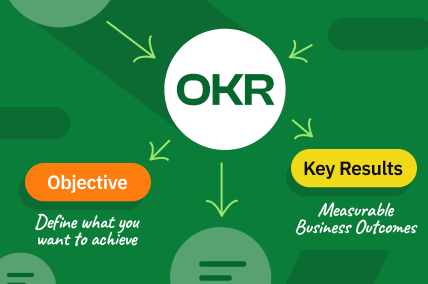
What Are OKRs for E-commerce Teams?
OKRs (Objectives and Key Results) give e-commerce teams a strategic framework to move beyond daily fire-fighting and drive deliberate improvements across the entire customer journey. Instead of reacting to yesterday's sales dashboard, e-commerce OKRs force teams to define the specific levers — average order value, conversion rate, repeat purchase frequency, fulfillment speed — that compound into sustainable revenue growth over a quarter.
For e-commerce organizations, the distinction between OKRs and operational metrics is critical. Your daily GMV is a KPI. Your OKR is the strategic initiative that lifts it: redesigning the checkout flow to reduce cart abandonment by 20%, launching a subscription program that increases customer lifetime value by 40%, or cutting delivery times from 5 days to 2 days to unlock repeat purchase behavior. This separation between monitoring and improving is what turns e-commerce operations from reactive to strategic.
Whether you run a bootstrapped Shopify store, a venture-backed DTC brand, or a multi-billion-dollar marketplace, the examples below are designed to be adapted to your scale, your product mix, and your growth stage. Each objective targets a real e-commerce lever, each key result is measurable with standard analytics tools, and every example includes the context you need to make it actionable for your team.
Interactive OKR Examples
Launch a bundling strategy that increases average order value from $48 to $65 within one quarter
Design and test product bundle recommendations at key decision points in the shopping journey to encourage higher-value carts without relying on discounting.
Grow quarterly gross merchandise value by 35% through channel diversification and pricing optimization
Expand beyond a single-channel dependency by launching on 2 new marketplaces while optimizing pricing algorithms to capture more willingness-to-pay from existing traffic.
Increase revenue per visitor from $2.80 to $4.20 by optimizing product discovery and merchandising
Redesign the on-site merchandising experience with personalized product recommendations, improved search relevance, and category page optimization to extract more value from existing traffic.
Hit $500K in total revenue by end of Q4 with positive unit economics on every order
Close the first fiscal year strong by balancing top-line growth with per-order profitability, ensuring customer acquisition cost remains below first-order gross margin.
Scale international revenue to represent 25% of total GMV through localized pricing and regional fulfillment
Unlock international growth by building localized storefronts, implementing currency-specific pricing strategies, and establishing regional fulfillment centers to reduce cross-border shipping friction.
Implement a margin-optimized promotional calendar that increases profit per order by 15% while maintaining conversion
Replace the ad-hoc discounting approach with a data-driven promotional strategy that protects margins by using targeted offers, tiered discounts, and value-add promotions instead of blanket percentage-off sales.
Build a high-margin private label line generating $200K in quarterly revenue with 60% gross margins
Develop and launch a private label product collection that diversifies the product mix, increases margin structure, and reduces dependency on third-party brand wholesale pricing.
Grow Q4 holiday revenue by 50% through an optimized seasonal strategy launched 8 weeks pre-peak
Maximize the highest-revenue quarter by executing a coordinated holiday strategy across inventory planning, promotional calendar, paid media scaling, and fulfillment capacity to capture peak-season demand.
Launch an enterprise B2B wholesale portal generating $5M in first-quarter revenue with automated pricing and ordering
Open a new high-value revenue stream by building a self-service wholesale platform that enables B2B buyers to place bulk orders with volume-tiered pricing, NET-30 terms, and automated reordering.
Build a subscription commerce model that generates $100K in predictable monthly recurring revenue within 90 days
Create a subscribe-and-save program for consumable product categories that locks in recurring revenue, reduces customer acquisition cost per order, and increases lifetime value.
Expand into live commerce generating $1.5M in real-time shopping revenue with a 12% conversion rate
Pioneer a live shopping channel that combines entertainment, product demonstration, and real-time purchasing to create a high-conversion sales channel with premium customer engagement.
Implement AI-driven personalized pricing across 10,000+ SKUs to increase overall revenue yield by 18%
Deploy machine learning pricing models that optimize price points in real-time based on demand elasticity, competitive positioning, inventory levels, and customer segment willingness-to-pay to maximize revenue without eroding brand perception.
Build Your Own OKR
Select a focus area for your OKR:
#RecruitingPartner
Join as freelance recruiter.
Get clients, AI tools & 65% of commissions


OKR Scoring Calculator
Use Google's 0.0 to 1.0 scoring scale to evaluate your e-commerce OKRs at the end of each quarter. A score of 0.7-1.0 means the key result was delivered, 0.3-0.7 means meaningful progress was made, and 0.0-0.3 signals a miss that needs root cause analysis. The sweet spot is landing between 0.6 and 0.7 on average — if you consistently score 1.0, your OKRs are not ambitious enough.
Overall Score
Top 5 OKR Mistakes E-commerce Teams Make
Don't do this:
KR: Achieve $2M in quarterly GMV
Do this instead:
KR: Increase conversion rate from 2.1% to 3.2% and average order value from $52 to $68, targeting $2M quarterly GMV
A GMV target alone is a KPI, not an OKR key result. Without specifying which levers (conversion, AOV, traffic, repeat rate) will drive the revenue, the team has no strategic direction. Effective e-commerce OKRs decompose the revenue target into the specific improvements that will produce it.
Don't do this:
KR: Drive 500,000 monthly sessions to the website through SEO and paid campaigns
Do this instead:
KR: Increase revenue per session from $1.80 to $2.50 while growing qualified traffic by 20%
Traffic is cheap; converting traffic is hard. An e-commerce team that chases session counts will inflate costs and depress conversion metrics. Revenue per session forces the team to think about who they attract, not just how many, aligning acquisition with profitability.
Don't do this:
All 3 objectives focused on new customer acquisition with zero objectives for retention, returns, or loyalty
Do this instead:
2 objectives on growth and acquisition balanced with 1 objective on customer lifetime value and post-purchase experience
Acquiring a customer costs 5-7x more than retaining one. E-commerce teams that only set acquisition OKRs build a leaky bucket — customers come in but do not come back. Balanced OKR sets include at least one objective focused on retention, lifetime value, or customer experience.
Don't do this:
KR: Increase site conversion rate from 2.5% to 4.0% this quarter
Do this instead:
KR: Increase conversion rate from 2.5% to 3.5% on direct and organic traffic while maintaining 2.0% CR on paid traffic at current volume
Overall conversion rate is heavily influenced by traffic mix. A shift toward more paid social traffic will naturally depress conversion rates even if the site experience improved. Segment-specific conversion targets prevent misleading aggregate metrics and ensure genuine UX improvement.
Don't do this:
Objective: Run 8 promotional campaigns this quarter to hit revenue target
Do this instead:
Objective: Increase full-price sell-through rate from 55% to 70% while growing total revenue by 20%
Constant discounting erodes margins, trains customers to wait for sales, and masks underlying product-market issues. OKRs should focus on building sustainable revenue through better product, experience, and customer value — not on how many sales events to schedule.
OKRs vs KPIs for E-commerce: What's the Difference?
| Dimension | OKR | KPI | E-commerce Example |
|---|---|---|---|
| Purpose | Drive ambitious improvement in specific e-commerce growth levers | Monitor ongoing operational health of the online store | OKR: Increase repeat purchase rate from 18% to 30% through loyalty program. KPI: Track monthly repeat purchase rate. |
| Time Horizon | Quarterly, with defined start and end dates aligned to business cycles | Ongoing and continuously measured in real-time dashboards | OKR: Launch subscription program generating $80K MRR by end of Q3. KPI: Daily GMV, hourly conversion rate. |
| Ambition Level | Stretch goals — 70% completion is often considered successful | Targets are meant to be hit consistently (100% attainment expected) | OKR: Reduce cart abandonment from 72% to 50% (stretch). KPI: Cart abandonment rate must stay below 70%. |
| Scope | Focused on 2-3 strategic priorities that move the biggest levers | Comprehensive coverage of all store performance metrics | OKR: 2-3 objectives per quarter. KPI: Dashboard tracking 20+ metrics (traffic, CR, AOV, GMV, returns, CSAT, etc.). |
| Ownership | Shared across cross-functional e-commerce team with individual KR accountability | Typically owned by specific functions (marketing, ops, support) | OKR: Team owns 'improve customer lifetime value' with marketing, product, and CX each owning key results. KPI: Each team tracks their functional metrics independently. |
| Flexibility | Can be adjusted mid-quarter based on seasonal patterns or market shifts | Generally fixed for the measurement period regardless of context | OKR: Pivot fulfillment focus from speed to capacity pre-holiday season. KPI: Order processing SLA stays fixed year-round. |
| Measurement | Progress scored on a 0.0-1.0 scale with 0.7 considered strong performance | Measured as absolute numbers, percentages, or pass/fail against targets | OKR: Score 0.7 on 'reduce return rate' = success. KPI: Return rate either hits 15% target or it does not. |
| Alignment | Cascades from company revenue goals to team-level initiatives to individual contributions | Often siloed within departments with limited cross-functional context | OKR: Company growth goal cascades to merchandising, marketing, and ops team OKRs. KPI: Marketing tracks ROAS; ops tracks fulfillment speed independently. |
Purpose
OKR: Increase repeat purchase rate from 18% to 30% through loyalty program. KPI: Track monthly repeat purchase rate.
Time Horizon
OKR: Launch subscription program generating $80K MRR by end of Q3. KPI: Daily GMV, hourly conversion rate.
Ambition Level
OKR: Reduce cart abandonment from 72% to 50% (stretch). KPI: Cart abandonment rate must stay below 70%.
Scope
OKR: 2-3 objectives per quarter. KPI: Dashboard tracking 20+ metrics (traffic, CR, AOV, GMV, returns, CSAT, etc.).
Ownership
OKR: Team owns 'improve customer lifetime value' with marketing, product, and CX each owning key results. KPI: Each team tracks their functional metrics independently.
Flexibility
OKR: Pivot fulfillment focus from speed to capacity pre-holiday season. KPI: Order processing SLA stays fixed year-round.
Measurement
OKR: Score 0.7 on 'reduce return rate' = success. KPI: Return rate either hits 15% target or it does not.
Alignment
OKR: Company growth goal cascades to merchandising, marketing, and ops team OKRs. KPI: Marketing tracks ROAS; ops tracks fulfillment speed independently.
How to Track E-commerce OKRs Effectively
Weekly Check-in
A focused 15-20 minute sync to review key e-commerce metrics, score progress on each key result, flag emerging issues like stockouts or conversion drops, and confirm tactical priorities for the coming week.
- •Score each key result on the 0.0-1.0 scale based on current analytics data
- •Review the past week's conversion rate, AOV, and revenue per visitor trends for anomalies
- •Identify any inventory, fulfillment, or customer experience issues that could derail key results
- •Confirm next week's top 3 tactical actions that will advance the most important lagging key results
Monthly Review
A deeper session to assess month-over-month trajectory, review experiment results, evaluate seasonal adjustments needed, and share cross-functional learnings between merchandising, marketing, and operations teams.
- •Analyze month-over-month trends for each key result and project end-of-quarter outcomes
- •Review completed A/B test results and decide which winning variations to ship permanently
- •Assess whether seasonal patterns or competitive moves require OKR scope adjustments
- •Align with cross-functional partners on inventory, marketing calendar, and support staffing dependencies
Quarterly Retrospective
A comprehensive end-of-quarter review where the e-commerce team scores all OKRs, analyzes the full sales cycle including seasonal peaks, conducts root cause analysis on misses, and designs next quarter's OKRs incorporating lessons learned.
- •Final-score every key result and calculate the average score per objective against the 0.7 benchmark
- •Conduct a structured retrospective covering what worked, what did not, and what seasonal factors influenced results
- •Extract the top 3 insights about customer behavior, conversion patterns, or operations that should shape next quarter's strategy
- •Draft next quarter's OKRs factoring in seasonal calendar, product launches, and infrastructure investments
Frequently Asked Questions About E-commerce OKRs
How many OKRs should an e-commerce team set per quarter?
Should e-commerce OKRs focus on revenue or profitability?
How do you handle seasonal variation in e-commerce OKRs?
How do you measure OKR progress when running A/B tests that take weeks to reach significance?
Should marketplace sellers set different OKRs than DTC brands?
How do you prevent e-commerce OKRs from becoming just a dashboard of KPIs?
Should fulfillment and logistics OKRs be separate from growth OKRs?
What is the right balance between acquisition and retention OKRs for e-commerce?

Adithyan RK is the Co-Founder and CEO of Hyring, an AI-native recruitment platform that has run over 900,000 AI interviews for companies ranging from early-stage startups to the Fortune 500. He has spent 18 years building technology businesses, starting with a digital consultancy in 2008 and a staff augmentation firm in 2017, before founding Hyring in 2022 to rebuild hiring around evidence instead of guesswork.
Expertise

Surya N is the Co-Founder and CTO of Hyring, where he architected the AI interviewing engine that has now conducted over 900,000 interviews for companies ranging from early-stage startups to the Fortune 500. A mechanical engineer who moved into artificial intelligence, he spent 6 years building AI applications inside a technology consultancy before co-founding Hyring, and wrote the first version of its AI interviewer from scratch: a system that listens, adapts its questioning in real time, and flags fraud rather than following a fixed script.
Expertise
Need the Right Team to Execute These E-commerce OKRs?
Ambitious e-commerce OKRs require talented operators — from conversion optimization specialists to supply chain experts. Hyring helps you find, assess, and hire the e-commerce talent you need to turn strategic objectives into delivered results.
See How Hyring Works