Customer Success OKR Examples That Maximize Retention & Growth
Customer Success OKR Examples That Maximize Retention & Growth
Stop treating customer success as a cost center and start building a revenue engine. From onboarding acceleration to expansion revenue to advocacy programs — these OKR frameworks help CS leaders prove that retention is the most profitable growth lever.
What Are OKRs for Customer Success Teams?
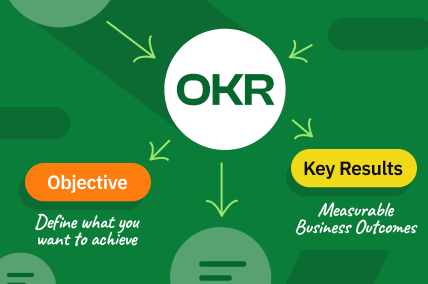
OKRs (Objectives and Key Results) give customer success teams a framework to move beyond reactive account management and become proactive drivers of retention, expansion, and advocacy. Instead of waiting for churn signals to appear, CS OKRs focus on the leading indicators that determine long-term customer health — onboarding velocity, product adoption depth, value realization, and relationship strength.
For CS organizations, OKRs bridge the gap between relationship management and revenue impact. A renewal rate is a KPI. The OKR is the strategic plan to ensure renewals happen automatically: achieving time-to-value under 30 days, driving 80% feature adoption across the customer base, or building health scoring models that predict churn 90 days ahead. This shift from managing renewals to engineering success outcomes is what transforms CS teams from cost centers into the company's most efficient revenue channel.
Whether you are the first CSM at a startup or lead a 100-person enterprise CS organization, the examples below cover every dimension of the customer lifecycle. Each objective is outcome-oriented, each key result is measurable, and every example includes the strategic context you need to adapt it to your customer base, product maturity, and revenue model.
Interactive OKR Examples
Reduce time-to-first-value from 30 days to 10 days for all new customers
Redesign the onboarding workflow to get customers experiencing core product value within their first 10 days, not the first month.
Achieve 85% product adoption score across the customer base by driving usage of 5 core features
Move beyond login-based adoption tracking to feature-level adoption measurement, ensuring customers use the capabilities that drive retention.
Build a scalable enterprise onboarding program handling 50+ concurrent implementations with 95% on-time delivery
Standardize the enterprise onboarding process with project management rigor, clear milestones, and resource templates that enable parallel implementations without quality loss.
Launch a self-paced onboarding academy that enables 70% of new customers to onboard without CSM assistance
Build a digital-first onboarding experience with guided tutorials, video walkthroughs, and automated check-ins that allows most customers to get started independently.
Increase product stickiness by driving daily active usage from 35% to 60% of licensed users
Move beyond monthly logins to daily engagement by identifying and promoting the workflows that create habitual product usage.
Deploy customer maturity model tracking progression across 4 adoption stages for all enterprise accounts
Build a structured adoption framework that measures each enterprise customer's journey from initial deployment through optimization, giving CSMs clear playbooks for each stage.
Build an automated onboarding health system that identifies at-risk implementations within the first 7 days
Create early warning detection for struggling onboarding journeys so CSMs can intervene before a new customer's first impression becomes permanently negative.
Launch a customer education program with certifications that drives 2x deeper product adoption
Build a structured learning program that incentivizes customers to develop expertise in the product through certifications that they value professionally.
Deploy AI-driven personalized onboarding that adapts the journey based on customer segment, role, and behavior
Build an intelligent onboarding system that dynamically adjusts content, pacing, and interventions based on each customer's characteristics and real-time engagement patterns.
Build a product-led onboarding experience achieving 80% activation without any human touch
Create an entirely product-led onboarding motion that guides users through setup, first value, and habit formation through in-app experiences alone.
Scale onboarding from 100 to 500 customers per quarter while improving time-to-value by 30%
Build a scalable onboarding operation that handles 5x volume growth through a combination of automation, segmented playbooks, and pooled CSM resources.
Build a global onboarding center of excellence with standardized best practices across 6 regions
Centralize onboarding expertise and best practices into a CoE that ensures consistent, high-quality onboarding experiences regardless of customer geography or regional CS team.
Build Your Own OKR
Select a focus area for your OKR:
#RecruitingPartner
Join as freelance recruiter.
Get clients, AI tools & 65% of commissions


OKR Scoring Calculator
Use Google's 0.0 to 1.0 scoring scale to evaluate your customer success OKRs at the end of each quarter. A score of 0.7-1.0 means the key result was delivered, 0.3-0.7 means meaningful progress was made, and 0.0-0.3 signals a miss that needs root cause analysis. The sweet spot is landing between 0.6 and 0.7 on average — if you consistently score 1.0, your OKRs are not ambitious enough.
Overall Score
Top 5 OKR Mistakes Customer Success Teams Make
Don't do this:
KR: Achieve 95% renewal rate this quarter
Do this instead:
KR: Achieve 95% renewal rate by delivering value assessments to 100% of accounts 60 days before renewal and resolving all open health issues
A renewal rate target without a strategy is like setting a weight loss goal without a diet plan. The key results should describe the specific actions — value demonstrations, health issue resolution, executive engagement — that make renewals happen naturally.
Don't do this:
KR: Increase monthly active users from 60% to 85%
Do this instead:
KR: Increase customers using 5+ core features from 40% to 85% with daily workflow integration in at least one business process
A customer can log in daily and use almost none of the product's value. Feature-depth adoption — how many core capabilities the customer uses and depends on — is a far stronger predictor of retention than simple login frequency.
Don't do this:
KR: Conduct monthly check-ins with 100% of the 500-customer portfolio
Do this instead:
KR: Apply tiered engagement — monthly strategic reviews for top 50 accounts, quarterly for mid-tier, and automated digital touch for long-tail
Treating a $200K enterprise account the same as a $2K SMB account wastes expensive CSM time on low-value accounts while under-serving high-value ones. The best CS OKRs include segmented engagement strategies that match effort to account potential.
Don't do this:
All CS OKRs focus only on retention and satisfaction metrics
Do this instead:
Include: Generate $1M in CS-sourced expansion pipeline with 30% close rate through upsell discovery in QBRs and product adoption milestones
CS teams that only focus on retention miss the biggest growth lever available — expanding existing accounts is 5-7x cheaper than acquiring new ones. CS OKRs should include expansion targets alongside retention to reflect the team's full revenue impact.
Don't do this:
KR: Get 80% of accounts to a green health score
Do this instead:
KR: Calibrate health scoring model to predict renewal outcomes with 85%+ accuracy, then improve portfolio health distribution from 50% green to 75% green
An uncalibrated health score can show 80% green while accounts are still churning. Before setting health improvement targets, validate that your health score actually predicts outcomes. Then improve the score knowing that improvements will translate to real retention results.
OKRs vs KPIs for Customer Success: What's the Difference?
| Dimension | OKR | KPI | Customer Success Example |
|---|---|---|---|
| Purpose | Drive ambitious change and strategic improvement | Monitor ongoing operational health | OKR: Build AI health scoring predicting churn 90 days ahead. KPI: Track monthly NRR percentage. |
| Time Horizon | Quarterly, with defined start and end dates | Ongoing and continuously measured | OKR: Launch customer advocacy program by end of Q2. KPI: Weekly renewal pipeline coverage ratio. |
| Ambition Level | Stretch goals — 70% completion is often considered successful | Targets are meant to be hit 100% of the time | OKR: Achieve 130% NRR (stretch). KPI: Gross retention must stay above 88% at all times. |
| Scope | Focused on the few priorities that move the needle most | Comprehensive coverage of all key metrics | OKR: 2-3 objectives per quarter. KPI: Dashboard tracking 20+ metrics (NRR, GRR, health, adoption, CSAT, etc.). |
| Ownership | Shared across team with individual accountability for key results | Typically assigned to individuals or departments to track | OKR: Team owns 'drive expansion revenue' with KRs for discovery, pipeline, and close. KPI: Each CSM tracks their book-of-business metrics. |
| Flexibility | Can be adjusted mid-quarter based on new learning or market shifts | Generally fixed for the measurement period | OKR: Shift focus from advocacy to retention after churn spike signals. KPI: Monthly renewal rate target stays fixed. |
| Measurement | Progress scored on a 0.0-1.0 scale with 0.7 considered strong | Measured as absolute numbers, percentages, or pass/fail | OKR: Score 0.7 on 'build health scoring model' = success. KPI: NRR either hits 110% or it doesn't. |
| Alignment | Cascades from company to team to individual to ensure strategic coherence | Often siloed within departments with limited cross-functional visibility | OKR: Company retention goal cascades to CS team OKR to individual CSM KRs. KPI: CS tracks health; sales tracks pipeline separately. |
Purpose
OKR: Build AI health scoring predicting churn 90 days ahead. KPI: Track monthly NRR percentage.
Time Horizon
OKR: Launch customer advocacy program by end of Q2. KPI: Weekly renewal pipeline coverage ratio.
Ambition Level
OKR: Achieve 130% NRR (stretch). KPI: Gross retention must stay above 88% at all times.
Scope
OKR: 2-3 objectives per quarter. KPI: Dashboard tracking 20+ metrics (NRR, GRR, health, adoption, CSAT, etc.).
Ownership
OKR: Team owns 'drive expansion revenue' with KRs for discovery, pipeline, and close. KPI: Each CSM tracks their book-of-business metrics.
Flexibility
OKR: Shift focus from advocacy to retention after churn spike signals. KPI: Monthly renewal rate target stays fixed.
Measurement
OKR: Score 0.7 on 'build health scoring model' = success. KPI: NRR either hits 110% or it doesn't.
Alignment
OKR: Company retention goal cascades to CS team OKR to individual CSM KRs. KPI: CS tracks health; sales tracks pipeline separately.
How to Track Customer Success OKRs Effectively
Weekly Check-in
A focused 15-20 minute sync to review progress on each key result, flag blockers early, and adjust tactics while the quarter is still young enough to course-correct.
- •Score each key result on the 0.0-1.0 scale based on current health, retention, and expansion data
- •Review at-risk account portfolio and confirm intervention plans are executing on schedule
- •Identify cross-functional blockers (product bugs, billing issues, implementation delays) affecting customer health
- •Confirm next week's top 3 CS actions that will advance the most critical lagging key results
Monthly Review
A deeper review to assess trajectory, determine if any OKRs need rescoping, and share learnings across the CS team. This is where retention trends and expansion patterns become visible.
- •Analyze month-over-month trends in health scores, NRR, adoption, and expansion pipeline
- •Review churned and saved accounts from the past month to extract lessons for the team
- •Align with sales on pipeline handoff quality and with product on feature adoption blockers
- •Celebrate retention wins, expansion closes, and advocacy milestones to maintain team momentum
Quarterly Retrospective
A comprehensive end-of-quarter review where the team scores all OKRs, conducts root cause analysis on misses, extracts lessons learned, and drafts the next quarter's OKRs.
- •Final-score every key result with supporting data from CS platform, health scores, and revenue reports
- •Conduct structured retrospective: which CS initiatives drove retention, what expansion plays worked, what surprised us
- •Review customer feedback themes and product roadmap to identify next quarter's strategic CS priorities
- •Draft next quarter's CS OKRs incorporating churn analysis lessons and updated business growth targets
Frequently Asked Questions About Customer Success OKRs
How should customer success OKRs relate to revenue targets?
What is the best metric for measuring customer success impact?
Should CSMs have expansion revenue quotas?
How do you set OKRs for a one-person CS team at a startup?
When should a CS team invest in health scoring?
How do you measure time-to-value when value means different things to different customers?
Can customer success OKRs include product feedback objectives?
How often should customer health scores be reviewed in OKR check-ins?

Adithyan RK is the Co-Founder and CEO of Hyring, an AI-native recruitment platform that has run over 900,000 AI interviews for companies ranging from early-stage startups to the Fortune 500. He has spent 18 years building technology businesses, starting with a digital consultancy in 2008 and a staff augmentation firm in 2017, before founding Hyring in 2022 to rebuild hiring around evidence instead of guesswork.
Expertise

Surya N is the Co-Founder and CTO of Hyring, where he architected the AI interviewing engine that has now conducted over 900,000 interviews for companies ranging from early-stage startups to the Fortune 500. A mechanical engineer who moved into artificial intelligence, he spent 6 years building AI applications inside a technology consultancy before co-founding Hyring, and wrote the first version of its AI interviewer from scratch: a system that listens, adapts its questioning in real time, and flags fraud rather than following a fixed script.
Expertise
Need the Right People to Hit These OKRs?
The best OKRs mean nothing without the right team. Hyring helps you find, assess, and hire top customer success talent faster — so your ambitious objectives actually get met.
See How Hyring Works