Startup OKR Examples That Turn Vision Into Traction
Startup OKR Examples That Turn Vision Into Traction
Stop treating OKRs like a big-company formality. Discover battle-tested OKR frameworks designed for the chaos of early-stage startups — from finding product-market fit to scaling your first hires to extending your runway. Built for founders, early teams, and seed-to-Series A companies.
What Are OKRs for Startup Teams?
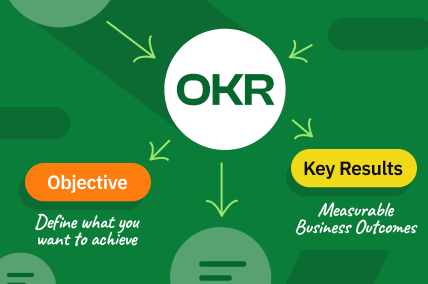
OKRs (Objectives and Key Results) give startup teams the alignment and focus that most early-stage companies desperately lack. When everything feels urgent and resources are razor-thin, OKRs force the hard conversation: what are the 2-3 things that actually matter this quarter? For startups, this discipline is not bureaucracy — it is survival strategy.
The power of OKRs for startups lies in their ability to translate founder vision into measurable team execution. A vision statement is not actionable. An OKR is: 'Validate product-market fit by achieving 40% weekly retention among the first 500 users' gives every team member a clear target to rally around. Key results replace gut feelings with evidence, ensuring the startup is making progress, not just staying busy.
Whether you are a pre-seed founder validating an idea, a seed-stage team building your first product, or a Series A company scaling what works, the examples below cover the OKR patterns that matter at each stage. Each objective is designed for the speed and uncertainty of startup life, each key result is measurable with minimal tooling, and every example is grounded in real startup operating rhythms.
Interactive OKR Examples
Validate product-market fit by achieving 40% Day-30 retention among the first 500 users
Prove that the product delivers enough value to create habitual usage, using retention as the primary PMF signal rather than vanity metrics like signups.
Achieve $10K MRR from paying customers to prove willingness-to-pay in the target market
Move beyond free users to paying customers, validating that the problem is painful enough to pay for and the pricing model generates revenue.
Prove enterprise PMF by closing 3 pilot-to-paid conversions with $50K+ ACV
Validate that the product can serve enterprise buyers by converting pilot programs into paid contracts with budget-holding decision makers.
Identify and double down on the single highest-retention use case from the first 1,000 users
Analyze usage patterns across the early user base to discover which specific use case drives the strongest retention, then concentrate product development on that wedge.
Achieve organic word-of-mouth growth with 30% of new users coming from existing user referrals
Organic referral is the strongest PMF signal. Build a product experience so valuable that users naturally bring colleagues and peers without incentives.
Validate multi-segment PMF by achieving retention benchmarks in 3 distinct customer segments
Prove the product works beyond the initial beachhead segment by demonstrating strong retention and NPS across three distinct buyer profiles.
Reduce time-to-value from 7 days to under 2 hours to accelerate PMF signal clarity
Compress the activation timeline so new users experience core product value faster, producing clearer retention data and faster iteration cycles.
Build a quantitative PMF scoring model and achieve a score above 4.0 out of 5.0
Create a composite PMF score combining retention, NPS, usage frequency, and willingness-to-pay data to objectively measure and track PMF progress over time.
Achieve negative churn with net revenue retention above 110% proving deep product-market fit
Demonstrate that existing customers are expanding their usage and spending faster than any customers are churning — the ultimate PMF proof point for investors.
Prove PMF in a second market by replicating Day-30 retention benchmarks in a new geography
Validate that the product-market fit achieved domestically can be replicated internationally, proving the problem and solution are not market-specific.
Achieve platform PMF with 3+ integrations each driving measurable retention improvement
Transform from a standalone tool into a platform by proving that third-party integrations meaningfully increase stickiness and retention.
Validate enterprise PMF at scale with 50 paying enterprise customers and net revenue retention above 120%
Prove that the product has deep enterprise product-market fit by scaling to 50 paying customers while demonstrating expansion-driven growth within accounts.
Build Your Own OKR
Select a focus area for your OKR:
#RecruitingPartner
Join as freelance recruiter.
Get clients, AI tools & 65% of commissions


OKR Scoring Calculator
Use Google's 0.0 to 1.0 scoring scale to evaluate your startup OKRs at the end of each quarter. A score of 0.7-1.0 means the key result was delivered, 0.3-0.7 means meaningful progress was made, and 0.0-0.3 signals a miss that needs root cause analysis. The sweet spot is landing between 0.6 and 0.7 on average — if you consistently score 1.0, your OKRs are not ambitious enough.
Overall Score
Top 5 OKR Mistakes Startup Teams Make
Don't do this:
5 objectives with 4 key results each covering product, growth, fundraising, hiring, and operations simultaneously
Do this instead:
2 objectives with 3 key results each: one focused on PMF validation, one on runway extension
Startups have minimal resources. Spreading across 20 key results guarantees none get proper attention. The constraint of 2 objectives forces founders to make the hard choice about what truly matters this quarter. If everything is a priority, nothing is.
Don't do this:
KR: Reach 10,000 registered users and 5,000 social media followers
Do this instead:
KR: Achieve 40% Day-30 retention among 500 ICP-fit users with 10%+ free-to-paid conversion
Registered users and social followers feel good but tell you nothing about whether the product works. Retention and conversion are the metrics that prove product-market fit. Vanity metrics can actually be dangerous because they create a false sense of progress while the startup is running out of runway.
Don't do this:
Objective: Improve customer satisfaction score from 82 to 90 (copied from a Fortune 500 playbook)
Do this instead:
Objective: Prove willingness-to-pay by converting 50 free users to paid plans with less than 5% monthly churn
Large-company OKRs optimize existing systems. Startup OKRs must validate assumptions and find what works. A startup does not need to optimize customer satisfaction — it needs to prove customers exist, will pay, and will stay. The OKR framework is the same, but the objectives should reflect the startup's actual stage.
Don't do this:
Annual OKR: Achieve $5M ARR by end of year with 1,000 enterprise customers
Do this instead:
Q1 OKR: Validate enterprise demand by closing 5 pilot-to-paid conversions with $50K+ ACV
Annual OKRs are meaningless for a startup that might pivot twice before the year ends. Quarterly OKRs are the maximum useful time horizon, and many early-stage startups benefit from 6-week cycles. Each cycle should produce learning that informs the next cycle's OKRs.
Don't do this:
Objective: Raise a $5M Series A by end of Q2
Do this instead:
Objective: Achieve the traction milestones ($100K MRR, 35% retention, 3:1 LTV:CAC) that make a $5M Series A raise possible
Fundraising is an enabler, not an end goal. An OKR focused on 'raise money' incentivizes optimizing the pitch instead of building the business. The right approach is setting OKRs around the business metrics that naturally attract investor interest. If the metrics are strong, the raise follows.
OKRs vs KPIs for Startup: What's the Difference?
| Dimension | OKR | KPI | Startup Example |
|---|---|---|---|
| Purpose | Drive the critical bets that determine whether the startup survives and scales | Monitor ongoing operational health and burn rate | OKR: Validate PMF with 40% Day-30 retention among 500 users. KPI: Track daily active users and MRR. |
| Time Horizon | Quarterly (or 6-week cycles for early-stage), with clear validation milestones | Ongoing and continuously measured (daily/weekly) | OKR: Close first 5 enterprise pilots by end of Q2. KPI: Weekly burn rate and cash position. |
| Ambition Level | Stretch goals — 70% completion is often considered successful | Targets are survival thresholds (must be hit 100%) | OKR: Achieve $100K MRR (stretch). KPI: Monthly burn must stay below $85K (non-negotiable). |
| Scope | Focused on the 2 things that matter most for this stage | Comprehensive coverage of all business vitals | OKR: 2 objectives this quarter. KPI: Dashboard tracking 10+ metrics (MRR, churn, CAC, LTV, burn, runway, etc.). |
| Ownership | Owned by founders and early team with shared accountability | Tracked by founders with board/investor visibility | OKR: Entire team owns 'validate PMF' with individual KRs. KPI: Founders report MRR and burn to investors monthly. |
| Flexibility | Must be adapted when pivots or market learning invalidates assumptions | Generally fixed unless the business model fundamentally changes | OKR: Pivot from B2C to B2B after Q1 learning → completely new OKRs. KPI: Cash runway tracking continues regardless. |
| Measurement | Progress scored on a 0.0-1.0 scale with honest assessment | Measured as absolute numbers with clear pass/fail thresholds | OKR: Score 0.6 on 'achieve PMF' = meaningful learning even if not fully validated. KPI: Runway either exceeds 6 months or it doesn't. |
| Alignment | Directly connected to the startup's current stage and survival needs | Cover all aspects of business health for investor reporting | OKR: All team effort aligned on proving PMF this quarter. KPI: Investor dashboard covers MRR, churn, engagement, and burn. |
Purpose
OKR: Validate PMF with 40% Day-30 retention among 500 users. KPI: Track daily active users and MRR.
Time Horizon
OKR: Close first 5 enterprise pilots by end of Q2. KPI: Weekly burn rate and cash position.
Ambition Level
OKR: Achieve $100K MRR (stretch). KPI: Monthly burn must stay below $85K (non-negotiable).
Scope
OKR: 2 objectives this quarter. KPI: Dashboard tracking 10+ metrics (MRR, churn, CAC, LTV, burn, runway, etc.).
Ownership
OKR: Entire team owns 'validate PMF' with individual KRs. KPI: Founders report MRR and burn to investors monthly.
Flexibility
OKR: Pivot from B2C to B2B after Q1 learning → completely new OKRs. KPI: Cash runway tracking continues regardless.
Measurement
OKR: Score 0.6 on 'achieve PMF' = meaningful learning even if not fully validated. KPI: Runway either exceeds 6 months or it doesn't.
Alignment
OKR: All team effort aligned on proving PMF this quarter. KPI: Investor dashboard covers MRR, churn, engagement, and burn.
How to Track Startup OKRs Effectively
Weekly Check-in
A fast 15-minute standup to score each key result, share what you learned this week, and decide where to focus next week. For startups, this is the most important OKR ritual.
- •Score each key result 0.0-1.0 based on the latest data — be brutally honest, not optimistic
- •Share the single most important thing you learned about your users or market this week
- •Identify the one blocker that, if removed, would most accelerate OKR progress
- •Decide the top 3 actions for next week that will move the most critical key result forward
Monthly Review
A deeper session to assess whether the OKRs themselves still make sense given what you have learned. Startups move fast enough that monthly recalibration is essential.
- •Review month-over-month trends for each key result — are you accelerating or decelerating?
- •Ask: given what we now know, are these still the right OKRs? Are we chasing the right problem?
- •Share insights from customer conversations, market signals, and competitor moves
- •Decide if any OKR needs to be adjusted, deprioritized, or replaced based on new learning
Quarterly Retrospective
The end-of-quarter reflection where the founding team scores all OKRs, extracts the most important learnings, and sets the next quarter's objectives based on evidence, not guesses.
- •Final-score every key result with supporting evidence and calculate objective-level averages
- •Identify the top 3 learnings that changed your understanding of the market or product
- •Assess: did this quarter move us closer to PMF / default-alive / the next milestone? By how much?
- •Draft next quarter's OKRs based on what you learned — not what you hoped would be true
Frequently Asked Questions About Startup OKRs
When should a startup start using OKRs?
How many OKRs should an early-stage startup have?
Should startup OKRs be quarterly or shorter?
How do you handle OKRs when the startup pivots mid-quarter?
Should fundraising be an OKR?
How do you set OKRs when the startup has no historical data?
Should every team member have individual OKRs in a startup?
How do startup OKRs differ from corporate OKRs?

Adithyan RK is the Co-Founder and CEO of Hyring, an AI-native recruitment platform that has run over 900,000 AI interviews for companies ranging from early-stage startups to the Fortune 500. He has spent 18 years building technology businesses, starting with a digital consultancy in 2008 and a staff augmentation firm in 2017, before founding Hyring in 2022 to rebuild hiring around evidence instead of guesswork.
Expertise

Surya N is the Co-Founder and CTO of Hyring, where he architected the AI interviewing engine that has now conducted over 900,000 interviews for companies ranging from early-stage startups to the Fortune 500. A mechanical engineer who moved into artificial intelligence, he spent 6 years building AI applications inside a technology consultancy before co-founding Hyring, and wrote the first version of its AI interviewer from scratch: a system that listens, adapts its questioning in real time, and flags fraud rather than following a fixed script.
Expertise
Need the Right People to Hit These OKRs?
Ambitious startup OKRs require exceptional early hires — the engineers who ship MVPs in weeks, the marketers who build organic engines, and the operators who scale without chaos. Hyring helps you find, assess, and hire the startup talent who turn objectives into traction.
See How Hyring Works