Education & EdTech OKR Examples That Transform Learning Outcomes
Education & EdTech OKR Examples That Transform Learning Outcomes
Go beyond vanity metrics like signups and downloads. Discover OKR frameworks that align your education or EdTech team around measurable learning outcomes, platform engagement, content quality, and sustainable growth — from K-12 to higher ed to corporate training.
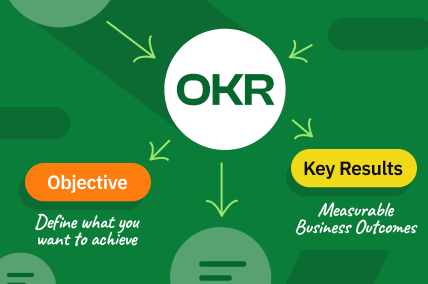
What Are OKRs for Education & EdTech Teams?
OKRs (Objectives and Key Results) give education and EdTech organizations a framework to pursue ambitious learning and growth goals without conflating activity with impact. Unlike traditional metrics that count course completions or user signups, education OKRs break down the strategic levers — learning outcome improvement, platform stickiness, content effectiveness, and institutional adoption — that determine whether learners are truly succeeding.
For EdTech companies and educational institutions, the power of OKRs lies in connecting product and pedagogy to measurable learner outcomes. A user count is a KPI. The OKR is the deliberate plan to create value: improving course completion rates from 25% to 60%, increasing assessment pass rates by 20 points, or reducing time-to-competency for professional learners by 35%. This shift from counting users to measuring learning impact is what separates sustainable EdTech businesses from those riding acquisition-only growth.
Whether you run an early-stage learning platform, a university innovation lab, or an enterprise L&D department, the examples below are designed to be adapted to your context, your learner population, and your growth stage. Each objective is outcome-oriented, each key result is measurable, and every example includes the context you need to make it your own.
Interactive OKR Examples
Increase average course completion rate from 28% to 55% across all self-paced programs
Address the completion crisis by redesigning course structures, adding progress nudges, and implementing micro-learning modules that keep learners engaged through the finish line.
Improve learner assessment pass rates by 20 percentage points through adaptive learning pathways
Implement adaptive learning technology that personalizes content delivery based on individual knowledge gaps, ensuring each learner receives the right material at the right difficulty level.
Achieve 90% employer satisfaction rating on graduate job-readiness across all professional certification programs
Align curriculum with industry skill requirements by incorporating employer feedback, real-world projects, and competency-based assessments that validate job-ready skills.
Reduce student dropout rate from 35% to 15% in the first 30 days of enrollment
Tackle early-stage attrition by improving the onboarding experience, setting clear expectations, and providing immediate learning wins that build momentum.
Launch competency-based progression system and have 70% of active learners earn at least 3 verified skills badges
Shift from time-based to competency-based learning by implementing a skill badge system that validates mastery through practical demonstrations rather than seat time.
Implement AI-powered learning analytics to identify at-risk students 2 weeks before they would typically drop out
Build a predictive model using engagement data, assessment performance, and behavioral signals to flag at-risk learners early enough for meaningful intervention.
Increase learner Net Promoter Score from 32 to 55 by improving personalized learning support
Enhance the learner experience through personalized support channels, responsive tutoring, and community features that make learners feel supported throughout their journey.
Achieve 85% skill transfer rate measured by on-the-job performance improvement in corporate training programs
Bridge the knowing-doing gap in corporate L&D by redesigning training delivery with spaced repetition, manager-supported application exercises, and post-training performance tracking.
Build a learning outcomes measurement framework validated across 50 institutions with standardized benchmarks
Create an industry-standard framework for measuring and comparing learning outcomes across institutions, enabling evidence-based curriculum improvement at scale.
Launch AI-personalized learning paths that improve learner outcomes by 40% compared to standard curriculum
Deploy a fully personalized learning engine that adapts content, pacing, difficulty, and modality to each individual learner's needs, preferences, and performance patterns.
Achieve measurable career advancement for 60% of certificate earners within 6 months of completion
Prove the ROI of education by tracking and driving career outcomes — promotions, salary increases, and job placements — for program graduates.
Implement mastery-based learning across 100% of degree programs with demonstrated improvement in graduate competency
Transform the institution from credit-hour to mastery-based progression, ensuring every graduate demonstrates verified competency rather than simply accumulating seat time.
Build Your Own OKR
Select a focus area for your OKR:
#RecruitingPartner
Join as freelance recruiter.
Get clients, AI tools & 65% of commissions


OKR Scoring Calculator
Use Google's 0.0 to 1.0 scoring scale to evaluate your education and EdTech OKRs at the end of each quarter. A score of 0.7-1.0 means the key result was delivered, 0.3-0.7 means meaningful progress was made, and 0.0-0.3 signals a miss that needs root cause analysis. The sweet spot is landing between 0.6 and 0.7 on average — if you consistently score 1.0, your OKRs are not ambitious enough.
Overall Score
Top 5 OKR Mistakes Education & EdTech Teams Make
Don't do this:
KR: Enroll 50,000 new students in Q2 across all programs
Do this instead:
KR: Achieve 55% course completion rate with 80%+ assessment pass rate among enrolled students
Enrollment is a vanity metric — it counts people who showed up, not people who learned. An EdTech OKR focused on enrollment incentivizes aggressive acquisition that often leads to high churn and low completion. Effective OKRs measure the learning outcomes that create real value for learners and prove the product works.
Don't do this:
KR: Increase average session duration from 15 to 45 minutes
Do this instead:
KR: Increase average session duration to 18 minutes while reducing time-to-mastery by 25%
Longer sessions are not inherently better. A learner struggling with confusing content will spend more time but learn less. Effective engagement OKRs balance depth of engagement with efficiency of learning. The goal is productive learning time, not just more time staring at a screen.
Don't do this:
Objective: Publish 100 new courses by end of quarter
Do this instead:
Objective: Launch 25 new courses that achieve 4.3+ rating and 50%+ completion rate within 60 days of publication
Publishing 100 mediocre courses dilutes the catalog and frustrates learners. Every new course should meet quality standards before publication. Effective content OKRs set quality thresholds alongside quantity targets, ensuring that more content means more value, not more noise.
Don't do this:
KR: Sign 20 new institutional partnerships this quarter
Do this instead:
KR: Sign 20 new institutional partnerships with 80%+ achieving active usage (50+ active learners) within 60 days of contract signing
A signed contract with zero active users is a failed partnership. Many EdTech companies count signed logos without tracking whether institutions actually deploy and use the platform. Effective partnership OKRs include activation and usage metrics alongside the contract count.
Don't do this:
KR: Achieve 90% assessment pass rate across all learners
Do this instead:
KR: Achieve 90% assessment pass rate across all learners with less than 5% variance between learners using standard and accessibility-enabled experiences
Aggregate learning outcomes can mask disparities. If learners with disabilities, language barriers, or limited internet access are excluded from achieving outcomes, the OKR paints a misleading picture. Effective education OKRs disaggregate outcomes to ensure equitable access and results.
OKRs vs KPIs for Education & EdTech: What's the Difference?
| Dimension | OKR | KPI | Education & EdTech Example |
|---|---|---|---|
| Purpose | Drive transformative improvements in learning outcomes and growth | Monitor ongoing platform health and operational metrics | OKR: Increase course completion from 28% to 55% through redesigned learning paths. KPI: Track weekly completion rate. |
| Time Horizon | Quarterly, with defined improvement targets | Ongoing and continuously measured | OKR: Launch adaptive learning in 5 subjects by end of Q2. KPI: Daily active users tracked continuously. |
| Ambition Level | Stretch goals — 70% completion is often considered successful | Targets are meant to be hit 100% of the time | OKR: Double weekly active learners to 50K (stretch). KPI: WAL must stay above 20K minimum. |
| Scope | Focused on 2-3 priorities that will transform the learning experience | Comprehensive coverage of all platform and learning metrics | OKR: 2-3 objectives per quarter. KPI: Dashboard tracking 20+ metrics (DAU, retention, NPS, completion, etc.). |
| Ownership | Shared across teams with individual accountability for key results | Typically assigned to product, content, or growth teams | OKR: Team owns 'improve learning outcomes' with individual KRs per function. KPI: Each team tracks its own metrics. |
| Flexibility | Can be adjusted mid-quarter based on learner data and market feedback | Generally fixed for the measurement period | OKR: Pivot content strategy after learner feedback reveals engagement gap. KPI: Monthly retention target stays fixed. |
| Measurement | Progress scored on a 0.0-1.0 scale with 0.7 considered strong | Measured as absolute numbers, percentages, or pass/fail | OKR: Score 0.7 on 'improve assessment pass rates' = success. KPI: Pass rate either hits 80% target or it doesn't. |
| Alignment | Cascades from company mission to team to individual goals | Often siloed within departments with limited cross-functional visibility | OKR: Mission cascades to product OKR to content team OKR. KPI: Product tracks engagement; content tracks ratings separately. |
Purpose
OKR: Increase course completion from 28% to 55% through redesigned learning paths. KPI: Track weekly completion rate.
Time Horizon
OKR: Launch adaptive learning in 5 subjects by end of Q2. KPI: Daily active users tracked continuously.
Ambition Level
OKR: Double weekly active learners to 50K (stretch). KPI: WAL must stay above 20K minimum.
Scope
OKR: 2-3 objectives per quarter. KPI: Dashboard tracking 20+ metrics (DAU, retention, NPS, completion, etc.).
Ownership
OKR: Team owns 'improve learning outcomes' with individual KRs per function. KPI: Each team tracks its own metrics.
Flexibility
OKR: Pivot content strategy after learner feedback reveals engagement gap. KPI: Monthly retention target stays fixed.
Measurement
OKR: Score 0.7 on 'improve assessment pass rates' = success. KPI: Pass rate either hits 80% target or it doesn't.
Alignment
OKR: Mission cascades to product OKR to content team OKR. KPI: Product tracks engagement; content tracks ratings separately.
How to Track Education & EdTech OKRs Effectively
Weekly Check-in
A focused 15-20 minute sync to review progress on each key result, discuss learner data signals, and adjust content or product tactics while the quarter is still actionable.
- •Score each key result on the 0.0-1.0 scale based on current learner data and platform metrics
- •Review the top engagement and retention signals from the past week to spot positive or negative trends
- •Identify the single biggest blocker to each lagging key result and assign an action owner
- •Update learning outcome dashboards before the meeting so discussions are data-informed
Monthly Review
A deeper review to assess learner outcome trajectories, evaluate content and product experiment results, and determine if any OKRs need rescoping based on what the data is showing.
- •Analyze month-over-month trends for completion rates, engagement, and learning outcomes
- •Review results from content experiments and product tests, incorporating learnings into strategy
- •Celebrate learner success stories and team wins that contributed to OKR progress
- •Align with content, product, partnerships, and growth teams on cross-functional dependencies
Quarterly Retrospective
A comprehensive end-of-quarter review where the team scores all OKRs, analyzes learner outcome data, captures product and content learnings, and plans the next quarter's priorities.
- •Final-score every key result and calculate the average score per objective with supporting data
- •Conduct a structured retrospective: what improved learner outcomes, what did not move the needle
- •Identify the top 3 insights about learners that should inform next quarter's OKR design
- •Draft next quarter's OKRs and circulate for cross-functional feedback before finalizing
Frequently Asked Questions About Education & EdTech OKRs
How do you measure learning outcomes in OKRs versus just tracking course completions?
Should EdTech startups focus OKRs on growth or learning outcomes first?
How many OKRs should an EdTech company set per quarter?
How do you set OKRs for content teams versus product teams in EdTech?
How do you handle OKRs for B2B and B2C in the same EdTech company?
Should instructor quality be tracked through OKRs or KPIs?
How do you measure ROI of education in OKR key results?
How do you set OKRs for a platform that serves both K-12 and higher education?

Adithyan RK is the Co-Founder and CEO of Hyring, an AI-native recruitment platform that has run over 900,000 AI interviews for companies ranging from early-stage startups to the Fortune 500. He has spent 18 years building technology businesses, starting with a digital consultancy in 2008 and a staff augmentation firm in 2017, before founding Hyring in 2022 to rebuild hiring around evidence instead of guesswork.
Expertise

Surya N is the Co-Founder and CTO of Hyring, where he architected the AI interviewing engine that has now conducted over 900,000 interviews for companies ranging from early-stage startups to the Fortune 500. A mechanical engineer who moved into artificial intelligence, he spent 6 years building AI applications inside a technology consultancy before co-founding Hyring, and wrote the first version of its AI interviewer from scratch: a system that listens, adapts its questioning in real time, and flags fraud rather than following a fixed script.
Expertise
Need the Right People to Hit These OKRs?
Transforming education requires exceptional talent — from learning designers who create engaging content to engineers who build adaptive platforms. Hyring helps you find, assess, and hire the EdTech professionals who turn ambitious learning goals into measurable outcomes.
See How Hyring Works