Manufacturing OKR Examples That Drive Operational Excellence
Manufacturing OKR Examples That Drive Operational Excellence
Move beyond lagging production reports. Discover OKR frameworks that align your manufacturing team around throughput, quality, safety, and continuous improvement — from shop floor operators to plant managers.
What Are OKRs for Manufacturing Teams?
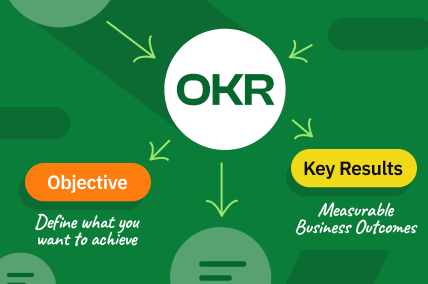
OKRs (Objectives and Key Results) give manufacturing teams a framework to pursue ambitious operational goals without reverting to static production targets. Unlike traditional manufacturing KPIs that only measure output, manufacturing OKRs break down the strategic levers — equipment effectiveness, defect rates, supply chain resilience, and workforce safety — that determine whether the plant actually operates at peak performance.
For manufacturing organizations, the power of OKRs lies in connecting shop floor improvements to business-level outcomes. A throughput target is a KPI. The OKR is the deliberate plan to get there: reducing changeover time by 40%, implementing predictive maintenance to cut unplanned downtime from 12% to 3%, or cross-training 80% of operators to enable flexible line staffing. This shift from measuring output to driving process improvements is what transforms good plants into world-class operations.
Whether you run a single-line startup production facility or a multi-plant enterprise operation, the examples below are designed to be adapted to your scale, your product complexity, and your manufacturing methodology. Each objective is outcome-oriented, each key result is measurable, and every example includes the context you need to make it your own.
Interactive OKR Examples
Increase Overall Equipment Effectiveness (OEE) from 65% to 82% across all production lines
Drive a step-change in plant productivity by addressing the three OEE pillars — availability, performance, and quality — through targeted improvement initiatives on each production line.
Reduce production cycle time by 25% to meet growing customer demand without capital expansion
Optimize existing line capacity through lean manufacturing techniques and bottleneck elimination to increase output without investing in new equipment.
Achieve 95% on-time production schedule adherence across all 6 manufacturing cells
Improve production planning reliability by standardizing scheduling protocols, reducing changeover variability, and building buffer management discipline.
Launch second production shift and achieve 90% capacity utilization within 60 days
Scale manufacturing capacity by establishing a fully operational second shift with trained operators, standardized work instructions, and consistent quality output.
Implement lean production system reducing work-in-progress inventory by 40% while maintaining throughput
Deploy pull-based manufacturing with kanban signals and single-piece flow to slash WIP inventory, free up floor space, and reduce lead times.
Deploy real-time production monitoring across all 12 lines to enable data-driven decision making
Install IoT-based monitoring systems on every production line to provide operators and supervisors with live performance data, enabling instant response to deviations.
Reduce changeover downtime by 60% across all product changeovers using SMED techniques
Apply Single-Minute Exchange of Die methodology to convert internal setup activities to external ones, dramatically reducing the time production lines sit idle during product switches.
Scale production output by 35% to support new product launch without quality degradation
Increase manufacturing throughput by optimizing existing lines, rebalancing workstations, and implementing flexible staffing to handle the new product introduction alongside current production.
Implement a Total Productive Maintenance (TPM) program achieving zero unplanned breakdowns on critical equipment
Deploy a world-class TPM program across all critical assets with autonomous maintenance, planned maintenance, and focused improvement pillars to eliminate equipment-related production losses.
Build a flexible manufacturing cell capable of producing 5 product variants with under 10-minute changeovers
Design and implement a reconfigurable manufacturing cell that can switch between product variants rapidly, enabling small-batch production without sacrificing efficiency.
Achieve world-class OEE of 90% across the top 3 revenue-generating production lines
Push the highest-impact lines to world-class performance through advanced analytics, predictive maintenance, and operator-led continuous improvement kaizen events.
Optimize multi-plant production allocation to reduce total manufacturing cost by 15% across the network
Deploy a network-level production optimization model that allocates volume across 4 plants based on cost, capacity, capability, and logistics to minimize total landed cost.
Build Your Own OKR
Select a focus area for your OKR:
#RecruitingPartner
Join as freelance recruiter.
Get clients, AI tools & 65% of commissions


OKR Scoring Calculator
Use Google's 0.0 to 1.0 scoring scale to evaluate your manufacturing OKRs at the end of each quarter. A score of 0.7-1.0 means the key result was delivered, 0.3-0.7 means meaningful progress was made, and 0.0-0.3 signals a miss that needs root cause analysis. The sweet spot is landing between 0.6 and 0.7 on average — if you consistently score 1.0, your OKRs are not ambitious enough.
Overall Score
Top 5 OKR Mistakes Manufacturing Teams Make
Don't do this:
KR: Produce 10,000 units per day regardless of quality or waste
Do this instead:
KR: Achieve 85% OEE with first-pass yield above 97% and scrap rate below 1.5%
Raw output numbers hide problems. A line producing 10,000 units with 8% scrap and 15% rework is far less effective than one producing 8,500 units with near-zero waste. OKRs should capture the full picture of effectiveness — availability, performance, and quality combined.
Don't do this:
KR: Have zero injuries this quarter (measured after the fact)
Do this instead:
KR: Complete 200 safety observations, close 100% of hazards within 48 hours, and achieve 95% near-miss reporting compliance
Lagging safety metrics only tell you what already happened. Leading indicators like observations, hazard closure rates, and near-miss reports drive the behaviors that prevent injuries. Effective safety OKRs focus on the proactive activities that create a safe environment.
Don't do this:
Objective: Cut procurement costs by 20% across all suppliers
Do this instead:
Objective: Build a resilient supply chain with dual-sourcing on all critical components while reducing total cost of ownership by 12%
Aggressive cost cutting in isolation destroys supplier relationships, degrades quality, and creates single-source risks. Manufacturing OKRs should balance cost with reliability, quality, and resilience to avoid short-term savings that create long-term vulnerabilities.
Don't do this:
KR: Replace 50 manual operators with automated systems within 90 days
Do this instead:
KR: Deploy cobots on 5 stations augmenting operator capabilities and retrain 15 operators for higher-value quality and maintenance roles
Automation that ignores the human element creates resistance, destroys morale, and loses institutional knowledge. Effective manufacturing OKRs frame automation as augmentation — freeing operators from repetitive tasks while developing their skills for the roles that machines cannot fill.
Don't do this:
KR: Achieve Cpk of 1.67 on 10 critical dimensions (internal metric only)
Do this instead:
KR: Achieve Cpk of 1.67 on 10 critical dimensions, reducing customer-facing PPM from 500 to 50 and warranty claims by 60%
Internal quality metrics matter only insofar as they translate to customer satisfaction. A perfect Cpk on dimensions customers do not care about wastes effort. Effective quality OKRs connect process capability improvements to measurable customer outcomes like PPM, warranty claims, and satisfaction scores.
OKRs vs KPIs for Manufacturing: What's the Difference?
| Dimension | OKR | KPI | Manufacturing Example |
|---|---|---|---|
| Purpose | Drive ambitious operational improvement and transformation | Monitor ongoing production health and performance | OKR: Increase OEE from 65% to 85% this quarter. KPI: Track daily OEE across all lines. |
| Time Horizon | Quarterly, with defined improvement targets and deadlines | Ongoing and continuously measured shift-by-shift | OKR: Reduce changeover time by 50% by end of Q2. KPI: Daily changeover time tracking. |
| Ambition Level | Stretch goals — 70% completion is often considered successful | Targets are meant to be hit 100% of the time | OKR: Achieve zero unplanned breakdowns for 90 days (stretch). KPI: Unplanned downtime must stay below 5%. |
| Scope | Focused on the 2-3 improvements that will transform operations | Comprehensive coverage of all production metrics | OKR: 2-3 objectives per quarter. KPI: Dashboard tracking 20+ metrics (output, scrap, downtime, cycle time, etc.). |
| Ownership | Shared across production teams with individual accountability for key results | Typically assigned to shift supervisors or department heads | OKR: Team owns 'achieve world-class OEE' with individual KRs per line. KPI: Each shift tracks its own output numbers. |
| Flexibility | Can be adjusted mid-quarter based on process learnings or equipment changes | Generally fixed for the measurement period | OKR: Pivot from throughput to quality focus after root cause analysis reveals defect issue. KPI: Daily output target stays fixed. |
| Measurement | Progress scored on a 0.0-1.0 scale with 0.7 considered strong | Measured as absolute numbers, percentages, or pass/fail | OKR: Score 0.7 on 'reduce scrap rate' = success. KPI: Scrap rate either hits 1.5% target or it doesn't. |
| Alignment | Cascades from plant strategy to department to team to individual | Often siloed within departments with limited cross-functional visibility | OKR: Plant strategy cascades to production OKR to maintenance OKR. KPI: Production tracks output; maintenance tracks MTBF separately. |
Purpose
OKR: Increase OEE from 65% to 85% this quarter. KPI: Track daily OEE across all lines.
Time Horizon
OKR: Reduce changeover time by 50% by end of Q2. KPI: Daily changeover time tracking.
Ambition Level
OKR: Achieve zero unplanned breakdowns for 90 days (stretch). KPI: Unplanned downtime must stay below 5%.
Scope
OKR: 2-3 objectives per quarter. KPI: Dashboard tracking 20+ metrics (output, scrap, downtime, cycle time, etc.).
Ownership
OKR: Team owns 'achieve world-class OEE' with individual KRs per line. KPI: Each shift tracks its own output numbers.
Flexibility
OKR: Pivot from throughput to quality focus after root cause analysis reveals defect issue. KPI: Daily output target stays fixed.
Measurement
OKR: Score 0.7 on 'reduce scrap rate' = success. KPI: Scrap rate either hits 1.5% target or it doesn't.
Alignment
OKR: Plant strategy cascades to production OKR to maintenance OKR. KPI: Production tracks output; maintenance tracks MTBF separately.
How to Track Manufacturing OKRs Effectively
Weekly Check-in
A focused 15-20 minute production floor huddle to review progress on each key result, discuss blockers, and adjust tactics while the quarter is still young enough to course-correct.
- •Score each key result on the 0.0-1.0 scale based on current production data and metrics
- •Review the top 3 production losses from the week and confirm root cause actions are assigned
- •Confirm next week's improvement activities and kaizen event schedule
- •Update OEE, quality, and safety dashboards before the meeting so discussions are data-driven
Monthly Review
A deeper review to assess operational trajectory, evaluate improvement initiative effectiveness, and determine if any OKRs need rescoping based on equipment or supply chain changes.
- •Analyze month-over-month trends for each key result to identify acceleration or stall patterns
- •Review ROI on implemented improvement projects and decide on continuation or pivot
- •Celebrate production milestones and recognize teams that achieved breakthrough improvements
- •Align with supply chain, quality, and maintenance teams on dependencies affecting manufacturing OKRs
Quarterly Retrospective
A comprehensive end-of-quarter review where the manufacturing team scores all OKRs, conducts root cause analysis on misses, extracts lessons learned, and plans the next quarter's improvement priorities.
- •Final-score every key result and calculate the average score per objective with supporting data
- •Conduct a structured retrospective: what improvements worked, what did not, what was learned
- •Identify the top 3 operational lessons that should inform next quarter's OKR design
- •Draft next quarter's manufacturing OKRs incorporating learnings and strategic priorities
Frequently Asked Questions About Manufacturing OKRs
How do you set OKRs for a manufacturing plant that runs 24/7?
Should production targets be OKRs or KPIs?
How do you balance safety OKRs with production OKRs?
How many OKRs should a manufacturing team track per quarter?
How do you get shop floor buy-in for OKRs?
Should maintenance teams have separate OKRs from production?
How do you handle OKRs when a major equipment breakdown disrupts the quarter?
Can lean manufacturing tools like kaizen events be part of OKRs?

Adithyan RK is the Co-Founder and CEO of Hyring, an AI-native recruitment platform that has run over 900,000 AI interviews for companies ranging from early-stage startups to the Fortune 500. He has spent 18 years building technology businesses, starting with a digital consultancy in 2008 and a staff augmentation firm in 2017, before founding Hyring in 2022 to rebuild hiring around evidence instead of guesswork.
Expertise

Surya N is the Co-Founder and CTO of Hyring, where he architected the AI interviewing engine that has now conducted over 900,000 interviews for companies ranging from early-stage startups to the Fortune 500. A mechanical engineer who moved into artificial intelligence, he spent 6 years building AI applications inside a technology consultancy before co-founding Hyring, and wrote the first version of its AI interviewer from scratch: a system that listens, adapts its questioning in real time, and flags fraud rather than following a fixed script.
Expertise
Need the Right People to Hit These OKRs?
World-class manufacturing OKRs require world-class talent — from plant managers who drive operational excellence to engineers who deploy Industry 4.0 solutions. Hyring helps you find, assess, and hire the manufacturing professionals who turn ambitious objectives into measurable results.
See How Hyring Works