

In a Nutshell
AI interviews are revolutionizing the hiring process by moving beyond traditional resumes and subjective evaluations that are riddled with bias, to reveal critical and surprising candidate insights. This leads to better, fairer, and faster hiring decisions.
By analyzing verbal and non-verbal cues that may be overlooked by a human interviewer, advanced AI interview software can predict candidate suitability for long-term success without much bias in that analysis. In some studies, it shows a reduction in gender bias by up to 70 per cent. The time taken to complete a hiring has been reduced by almost 50 per cent, which is a marked improvement.
Platforms like Hyring use Agentic AI and consequently a data-backed hiring approach to provide recruiters with overwhelmingly objective metrics on cognitive intelligence and communication style, ensuring companies hire for real potential rather than just depend purely on recruiters’ intuitions. This prevents them from finding out much later on whether they actually fit the bill.
Beyond the CV: The Power of AI Interviews
The traditional interview that you have been accustomed to attending, is often a drama worthy of recognition on its own - your nerves shake, and unconscious, subtle, human biases creep in to obscure a candidate’s true potential. What if the hiring process could peak beyond that opacity?
AI Interviews are fundamentally changing how companies access and assess talent by shifting focus from subjective judgments. They depend on objectivity and actionability of data inferences rather than on arbitrary judgments.
63% of the recruiters (and counting) now use AI tools to automate their tasks. This shows clearly that technology is no longer an impending future but a concept grounded in present reality for high-performing HR teams who have recognised its value.
The goal is to create a standardized, consistent, and equitable process for every single applicant. By moving away from ambivalent conversations, AI ensures that all candidates are evaluated against the same given criteria, allowing recruiters to control their recruiting environment in a powerful way, mitigating the inherent flaws of human-only screening.
This honed standardization is the first critical step towards more reliable hiring outcomes.
Uncovering Candidate Insights Beyond the Veil
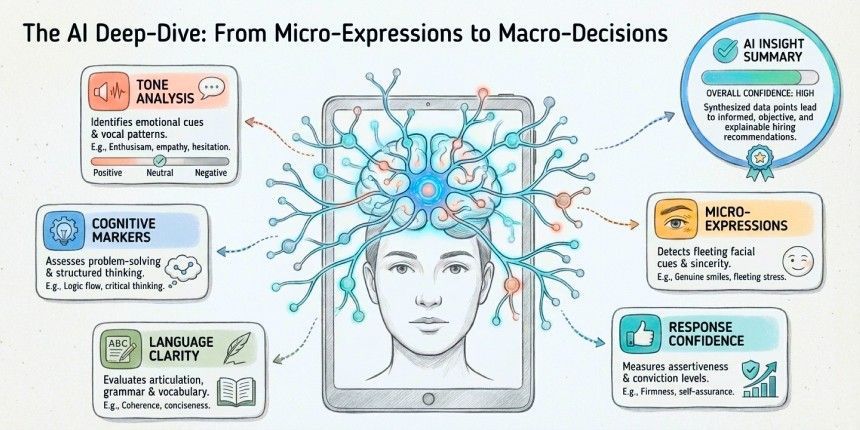
The real secret ingredient of AI-powered systems lies in their ability to analyze data points that are invisible to the human eye, providing truly eye-opening hidden candidate insights. Advanced machine learning models do more than just transcribe answers- they also analyze the rhythms of speech, minor (to almost non-existent) non-verbal cues, and even subtle micro-pauses. These details can reveal genuine cognitive intelligence markers and a candidate's mental processing speed under pressure, and also, if there are red flags during the interview.
Agentic AI employed by companies such as Hyring leverages advanced Natural Language Processing (NLP) and Deep Learning to assess communication effectiveness, looking at clarity, structure, and emotional undertones.
We are going into the realms of a deep dive beyond skill validation, providing a complete picture of how an individual thinks, collaborates, and adapts. Understanding these authentic behavioural patterns is what truly predicts long-term success in a role.
Data is the New Gold: How AI Drives Better Hiring
The undeniable improvement in hiring metrics is the single most compelling argument to embrace AI Interviews.
The objective data insights provided at the end of each interview give recruiters the confidence to move forward with their hiring decisions without much self-doubt. That is the power of data fluency in hiring.
It was seen that 68% of companies report that AI algorithms are effective at predicting a candidate’s success in a role. Furthermore, 43% of recruiting firms have already reported a higher quality of hire since adopting these tools. You can read more about it here.
Crucially, AI is an invaluable force in reducing human bias in hiring. Personal identifiers are removed using those AI systems, and competency-based metrics take precedence, thereby significantly leveling the playing field.
Objectivity has helped increase diversity in their hires by up to 50 per cent and reduce gender bias in some advanced platforms by as much as 70 per cent, whilst reducing the overall bias. AI interview tools simply have an edge on this in the entire process. Organizations that are committed to fair practices usually use such a transparent and auditable platform as a springboard for success.