Put 'hire 100 people in 30 days' on the agenda and watch the room go quiet. It's the kind of target that feels less like a goal and more like a dare, especially when the team running point has lived through a hiring push before and knows how badly the wheels come off.
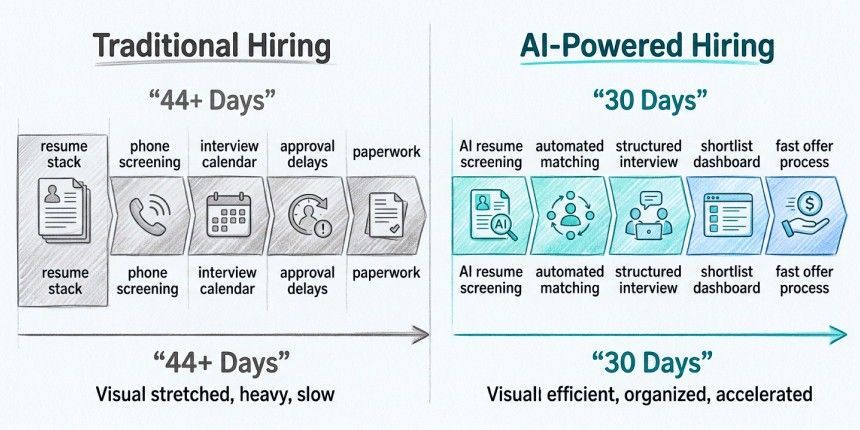
The global average time-to-hire is 44 days for a single position. Not a cohort. Not a department. One seat. So when leadership drops triple-digit headcount with a one-month window, the natural response is to assume someone miscounted.
What actually makes it possible isn't more recruiters, longer hours, or a shinier careers page. It's an AI recruitment agency setup where the heaviest, most time-consuming parts of the funnel, finding candidates, filtering them, and getting them in front of the right people, stop depending on a human to push each step forward. When that infrastructure is configured properly before the campaign starts, 30 days stops being a dare. It becomes a project plan.
Here's what that plan looks like.
Why the Maths Just Doesn't Work Traditionally
Take a rough industry benchmark: around 250 applications land on the average job posting. Across 100 open roles, that's somewhere in the region of 25,000 applicant profiles sitting in a queue, each waiting on a person to open them. A recruiter giving six minutes to each one, no interruptions, no admin, would need the better part of a year to clear the pile.
That's not a staffing problem. It's a structural one.
Then consider who walks away. Roughly 60% of candidates abandon their application when a process feels sluggish or overly complicated, and the ones with the strongest profiles, the ones you most want to hire, tend to have the least patience for it. They've got options. A well-qualified candidate sitting in an unreviewed inbox for five days isn't waiting; they're already in final rounds somewhere else.
Phase 1: Get the Foundation Right Before Day One
The most expensive mistake in a compressed hiring campaign is treating the tech setup as something to figure out once things are underway. It isn't. It's the first task, and it needs to be done before a single vacancy goes live.
An AI-native applicant tracking system forms the operational core. Whether you're integrating with Workday, Greenhouse, or another existing platform, the ATS is what makes everything downstream move without manual nudging. Applications come in, profiles get parsed and ranked, strong candidates get routed forward. Without this in place, every phase that follows produces bottlenecks instead of a pipeline.
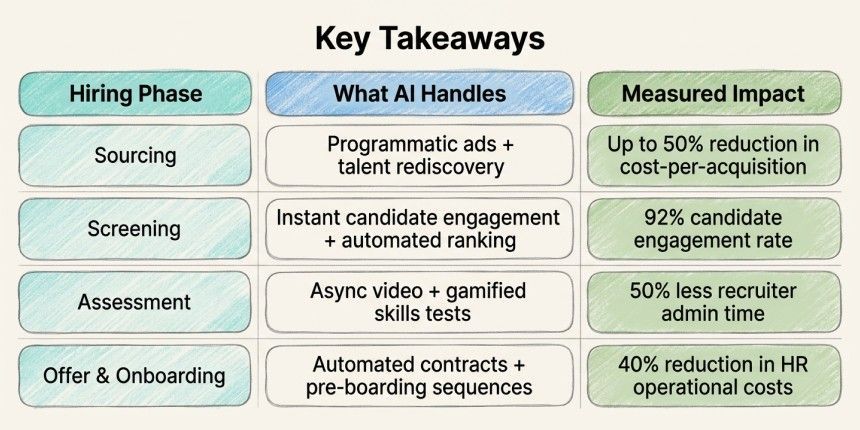
Before turning to external sourcing at all, there's a step most teams overlook: mining their own existing talent database. Years of past applicants sit archived in most companies' systems, people who interviewed well, reached a late stage, and then weren't hired because the timing was off. AI rediscovery tools cross-reference those records against current role specifications and surface the closest matches almost immediately. One healthcare organisation used this approach alone to reduce its cost-per-acquisition by 50%, entirely from candidates it already had on file.
Phase 2: Source Smarter, Not Wider
There's a version of sourcing that looks busy and produces very little: post everywhere, wait, hope. It accounts for a lot of wasted budget in high-volume campaigns.
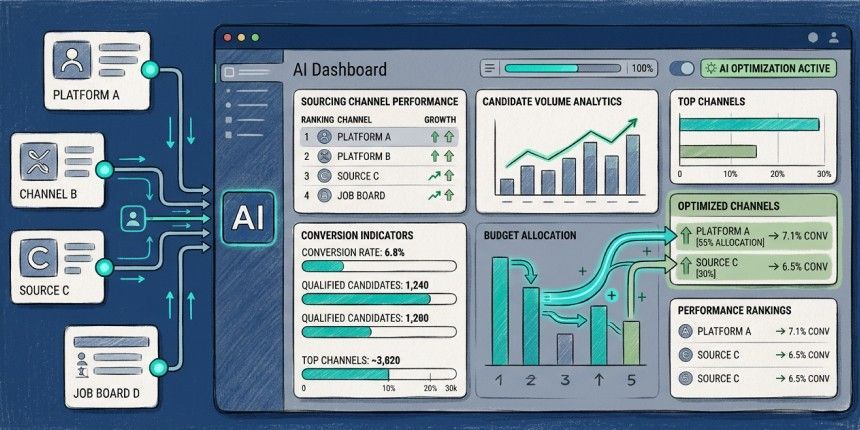
Programmatic advertising works from the other direction. Roles get placed algorithmically across platforms, LinkedIn, Indeed, sector-specific job boards, social channels, and budget shifts in real time toward wherever qualified applications are actually coming from. No weekly campaign reviews. No gut-feel decisions about which platform is worth the spend. The system reads the data and adjusts.
For industries where candidate density is high but attention is short, such as logistics, retail, and hospitality, this kind of targeted distribution can shrink a multi-week sourcing effort to a matter of days.
Referral activation belongs in the same phase. Done well, it's not a mass email to all staff asking if they know anyone. It's a targeted prompt to specific employees whose professional connections are most likely to include the right profiles. Lower cost than job boards. Tends to produce hires who settle in faster, which matters when you're onboarding at scale.
Phase 3: Let AI Screen While Your Team Sleeps
Screening is the quiet killer of every ambitious hiring timeline.
An AI phone screener agent that engages candidates the moment they submit, regardless of when that happens, changes the dynamic entirely. It asks the right qualifying questions, captures availability, and flags strong matches in real time. No waiting until Monday morning. No batch-processing applications came in over the weekend. Paradox's assistant, 'Olivia', demonstrated the ceiling of this approach when it handled 2 million McDonald's applications in 2024 using the same instant-response model.
The speed element matters beyond just efficiency. Shortening the application experience from around 15 minutes to under three has been shown to sustain a 92% candidate engagement rate. In a 100-role campaign, that difference in retention represents a significant chunk of applicants who would otherwise close the tab and move on.
The output of AI screening isn't just a filtered pile; it's a ranked one. Candidates are measured against criteria specific to each role, and the highest performers advance automatically. Recruiters get to focus on a curated shortlist rather than wading through the full volume of applications.
Worth noting here: screening built around demonstrable skills rather than how well a resume is presented tends to produce fairer shortlists. LinkedIn's Future of Recruiting highlights skills-first hiring as a growing priority across the industry, and this is the infrastructure that makes it practical beyond small-scale hiring.
Phase 4: Kill the Scheduling Back-and-Forth
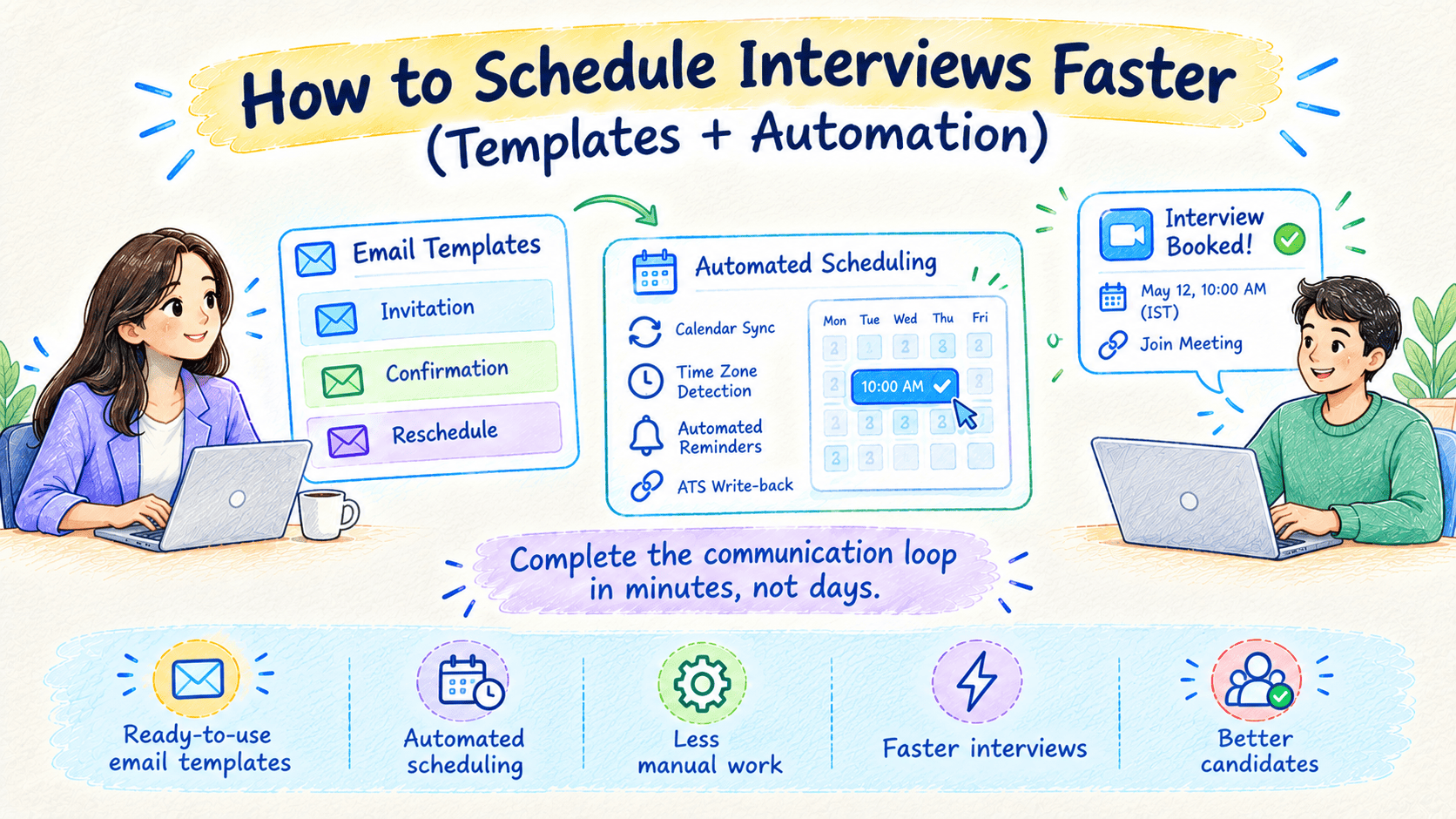
Calendar coordination doesn't sound like a major obstacle. Across 100 candidates and multiple interview stages, it absolutely is.
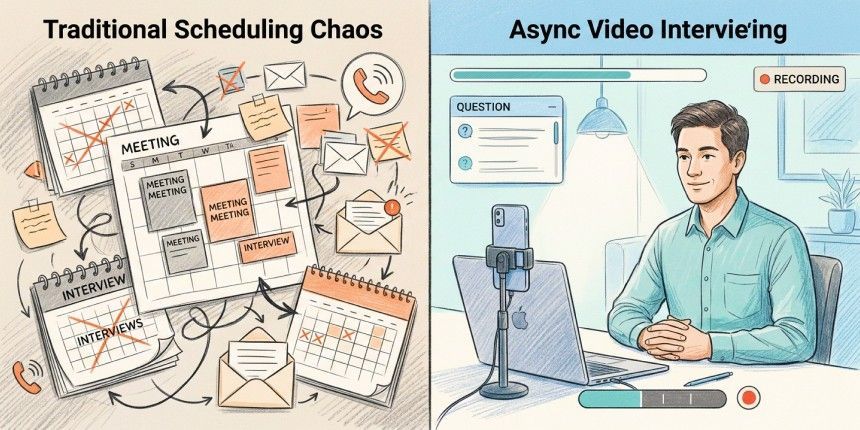
Arranging first-round conversations between recruiters, hiring managers, and applicants spanning multiple time zones generates an enormous amount of back-and-forth that, collectively, can eat three to five days off a tight campaign with nothing to show for it. That's before the second round begins.
One-way video interviews sidestep this entirely. Candidates record their responses when it's convenient for them. Reviewers watch and evaluate in batches on their own schedule. There's no coordination overhead at all. EDF Energy ran 17,000 applicants through this model in a single season, halving the time their recruiters spent on interview admin.
Gamified skill assessments layer on top. Typically 10–15 minutes, built around role-relevant problem-solving, and scored automatically against a validated rubric. A strong candidate can go from application submitted to assessed and ranked, entirely on their own schedule, within the same day they discovered the role. The best performers reach a human recruiter quickly, rather than weeks after they applied.
Phase 5: Don't Lose Candidates at the Offer Stage
Velocity through the funnel counts for nothing if the offer process bogs down at the end.
Between a verbal agreement and a signed contract, things go wrong. Competing offers arrive. Second thoughts set in. The longer the gap, the more exposure there is. Automated offer management tools generate and send contracts without waiting for a recruiter to draft them. Digital signature tools close the paperwork on the same day. Pre-boarding sequences kick off immediately on acceptance, documentation collection, compliance steps, and first-day logistics, without anyone having to coordinate it manually.
Organisations using this kind of automated close-and-onboard setup report 40% reductions in HR operational costs. The savings aren't from one big change; they accumulate across every small handoff that used to require a person in the middle.
What Only Humans Can Actually Do
This isn't a case for running recruitment without people. It's a case for letting people do the work they're actually good at.
With AI owning the high-volume, repetitive top of funnel, recruiters gain something almost unheard of in a mass hiring campaign: available time. They can spend it on the judgment calls that genuinely need them, assessing team alignment, addressing a finalist's uncertainty, and making a compelling pitch to a candidate who has no shortage of options. Platforms built for this model let recruiters progress the majority of candidates through pipeline stages in under five minutes per role. That's not a small efficiency gain; it changes what the job looks like.
Key Takeaways
- The 44-day average assumes a manual process. A properly set up AI recruitment agency pipeline has repeatedly delivered 100+ hires within 30 days.
- Volume is a problem technology solves well. Quality still needs human judgment. Both matter; one without the other tends to create a different set of problems.
- The system needs to be configured before the campaign opens, not during it. Every day spent on setup after launch is a day off the back end of the deadline.
- Most companies have a ready-made sourcing pool sitting unused in their own database. Talent rediscovery is consistently the most underused lever in high-volume hiring.
FAQs
1. Can any company realistically hire 100+ employees in 30 days?
With the right setup in place before the campaign starts, yes. The limiting factor is rarely headcount; it's whether the process was built to move at that pace. An AI-native ATS, automated screening, and async interviewing tools are the baseline.
2. How does an AI recruitment agency differ from a traditional staffing firm?
A traditional firm routes candidates through human consultants at every stage. An AI recruitment agency automates the high-volume middle of the funnel, screening, ranking, and scheduling, and brings in human expertise for final-stage evaluation. That shift tends to compress timelines and reduce cost-per-hire.
3. Does automated screening hurt the quality of candidates who come through?
When it's built on skills-based criteria rather than resume keywords, it generally improves it. Screening on demonstrated capability rather than how polished someone's CV looks tends to surface stronger candidates and reduce bias in the process.
4. What's the most common reason 30-day hiring campaigns miss their targets?
Starting the technology configuration too late. Systems that are set up mid-campaign force recruiters to manually compensate for gaps, which defeats the purpose of using AI to begin with.
5. Which industries see the strongest results from AI-powered bulk hiring?
Retail, logistics, hospitality, healthcare, and BPO operations tend to see the most dramatic impact. For senior or highly specialised roles, AI still manages the pipeline; the balance of human involvement at the final stage just shifts accordingly.










![AI Engineer Salary Benchmarks: India USA Dubai [2026]](https://cdn.sanity.io/images/jaa1fgpi/production/3f037c9baf6b11efeb2bf46039c68646d8b94684-1672x941.png)