Why Are Indian IT Companies Moving to AI-First Recruitment?
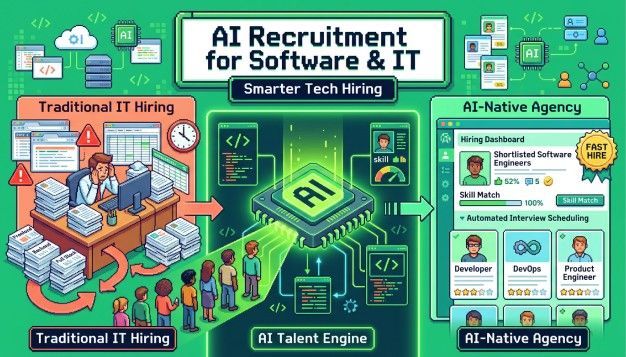
The year 2026 marks the emergence of the great rebalancing phenomenon in the industry. Software companies in India no longer hire based on seat-filling requirements alone. They require exact matches between candidate skills and job roles, and they require them immediately.
Three challenges plague conventional recruiting in the Indian IT space. These include a high volume of applications, an increasing skill shortage, and costly dropouts during offers. All three issues can be resolved using AI recruitment platforms.
Currently, 87% of organizations in India employ AI in one form or another. Those who continue with their manual hiring processes stand to lose out to competitors who leverage technology for hiring.
How Does AI Recruitment Solve the Offer Dropout Problem in India?
The most significant challenge for companies from India is the offer dropout ratio, which is about 28% in Tier-1 cities. Therefore, nearly one out of every three individuals accepting an offer ends up dropping the offer by the time they should start working.
The solution provided by artificial intelligence (AI) companies lies in the use of predictive analysis. Using the historical information, the level of engagement, and the behavior of the candidates, the AI companies try to gauge the probability of their follow-up action. For instance, Hyring ensures a highly transparent and engaging process right from the first contact with candidates.
It is important to emphasize that it is not only the technological aspect involved here but rather a design that wins the trust before an offer is made.
How Does AI Bridge the Skills Gap for Indian Software Companies?
India produces millions of graduates every year. Yet the gap between academic qualifications and real-world job readiness remains wide. Many candidates present well on paper. But they lack the hands-on skills needed for active projects.
AI recruitment tools go far beyond keyword matching on resumes. They use Natural Language Processing (NLP) to evaluate a candidate's actual skill set. This includes transferable abilities that a traditional resume scan would miss. Companies then gain access to talent that is genuinely project-ready from day one.
For roles that demand niche expertise, like cloud-native architecture or MLOps, this deeper analysis is especially valuable. It surfaces candidates who might otherwise be overlooked in a manual review.
Why Is High-Volume Screening a Challenge for Indian IT Firms?
Consider a single job posting for a Java Developer at a mid-sized Indian firm. Receiving over 1,000 applications for that one role is common. Screening all those resumes manually takes a recruiter roughly 23 hours. That is nearly three full working days tied up in a single position.
AI recruitment platforms automate this first layer entirely. They rank candidates based on technical competency, relevant experience, and cultural fit. This happens within seconds. Recruiters can then invest their time in the top-ranked profiles. They no longer need to sift through hundreds of mismatched applications.
This shift does not just save hours. It changes the quality of attention that each shortlisted candidate receives.
What Is the Role of Human Recruiters in an AI-Driven Hiring Process?
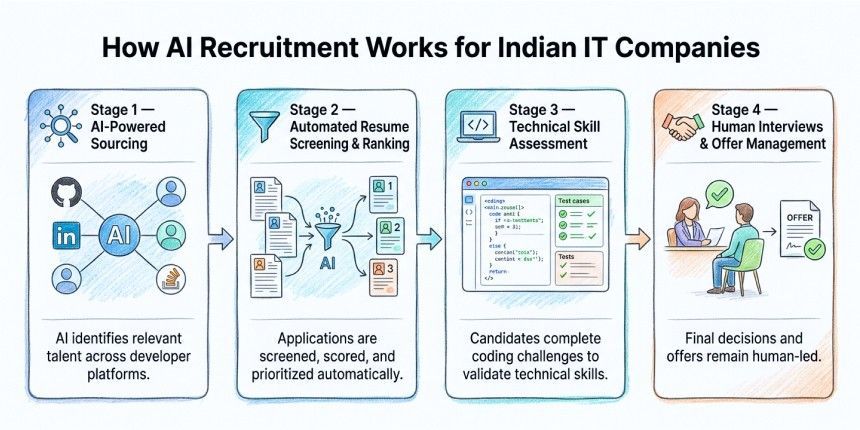
AI does not replace human recruiters. It makes them more effective. The strongest AI recruitment agencies operate on a hybrid model. Technology handles sourcing, screening, and data processing. Human recruiters then step in for stages that require judgment, empathy, and negotiation.
Final-round interviews, salary discussions, and cultural assessments still benefit from a human perspective. AI provides the intelligence layer. Humans provide the context. Together, they create a process that is both efficient and thoughtful.
This balance is especially important in the Indian market. Relationship-driven hiring still plays a significant role in candidate decisions here.
What Is Agentic AI and How Does It Impact Recruitment in 2026?
Recruitment technology in 2026 has moved past simple automation. The industry is now working with what is called Agentic AI. These are autonomous agents that manage entire recruitment workflows. They do this without constant human input.
Here is what that looks like in practice.
Screening
AI agents continuously monitor platforms like GitHub, Stack Overflow, and LinkedIn. They identify candidates who match specific technical requirements. Then they filter them based on relevance, skill depth, and availability. This happens without waiting for someone to apply.
Assessment
Platforms like Hyring offer automated technical challenges. Candidates complete coding tests and skill evaluations before they ever interact with a human recruiter. This saves time for both sides. It also ensures only qualified professionals move forward
Bias Reduction
AI can be configured to mask demographic data during the screening process. Hiring decisions are then based on skills, experience, and test scores. Factors like name, gender, or location are removed from the equation. This helps Indian IT firms build diverse teams grounded in merit.
There are several AI recruitment platforms available in the market today. Hyring differentiates itself through proven technology, industry recognition, and measurable outcomes.
Award-Winning Technology
Hyring has received awards from G2, Product Hunt, and ETHR World. These are well-respected platforms in the tech and HR ecosystems. The recognition reflects strong user satisfaction and real-world performance. It confirms consistent delivery on efficiency promises.
Measurable Results
Companies using Hyring report a 35% improvement in quality of hire. They also see a meaningful reduction in cost per hire. This is because the platform consolidates sourcing, assessment, and offer management into a single tool. There is no need for multiple disconnected HR systems.
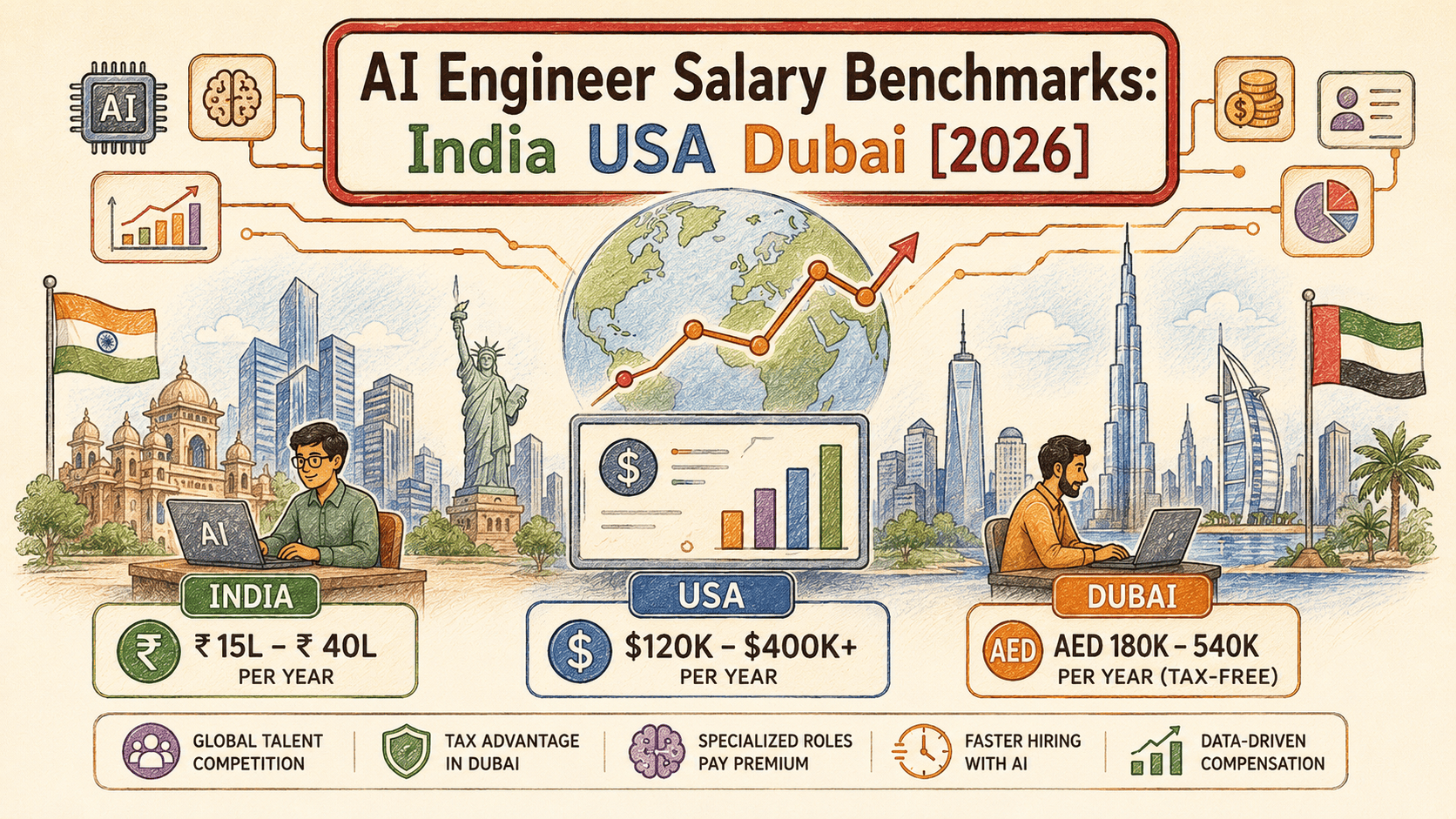
How Does AI Recruitment Differ Between India and the USA?
Understanding regional differences in AI recruitment strategy helps companies make smarter choices about their hiring partners.
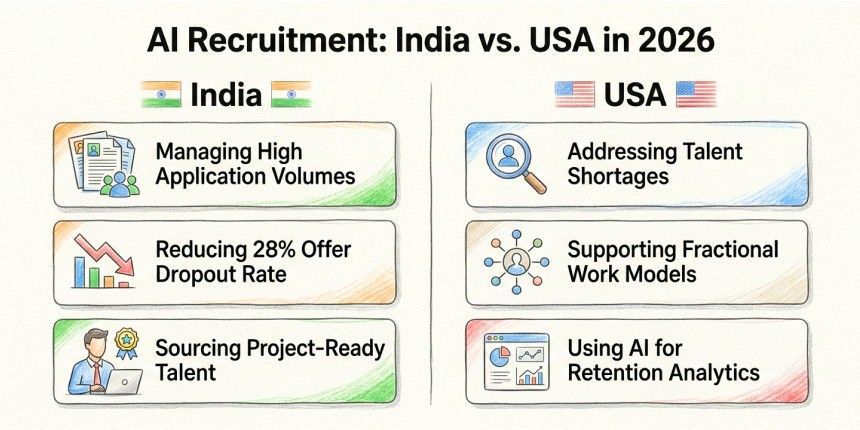
As we progress into 2026, the technology world has bifurcated into two separate yet synergistic approaches. The Indian approach is based on sheer scale, with the industry expected to grow to $315B as it adopts an “orchestration-led” approach. This involves scaling out pipelines of very large sizes and utilizing artificial intelligence in mass screenings to maintain a continuous flow of trained talent to feed the Global Capability Centres.
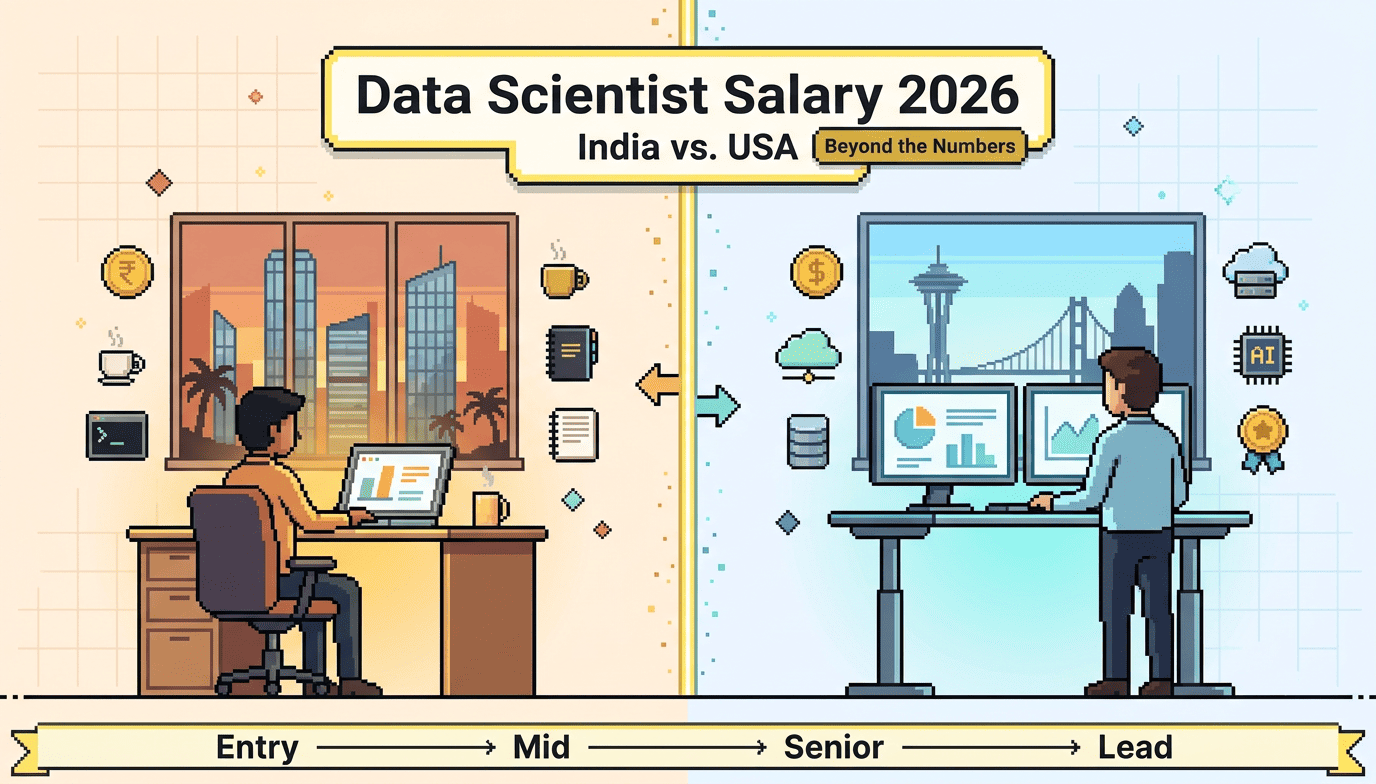
Conversely, the US market, which is a stable $183.3B market, has shifted its emphasis from efficiency to efficacy. In the face of a constant shortage of skill sets, companies in America have resorted to advanced AI algorithms to not only employ people but also forecast their retention and effectively manage their workforce in the new age, which values flexibility and fractional working models.
In India, the challenge is filtering high volumes efficiently. It is also about keeping candidates engaged through the offer stage. In the USA, the focus shifts toward finding scarce talent. Predicting long-term retention is also a priority there. Both markets depend on AI. But the specific applications reflect their unique pressures.
Also Read: Who Are the Top 5 AI-Native Recruitment Agencies in the USA?
The Bottom Line: Staying Competitive in the 2026 Tech Race
For Indian IT and software companies, AI-driven recruitment is no longer a nice-to-have. It is a competitive requirement. The firms that hire the best talent fastest will lead in innovation and growth.
An AI recruitment agency provides speed, accuracy, and scalability. Traditional methods cannot deliver this at the same level. Among the platforms available today, Hyring has demonstrated consistent results. These are backed by independent industry recognition. They are also validated by companies that have measurably improved their hiring outcomes.
If you are looking to build a strong engineering team without the usual hiring delays, exploring a platform like Hyring is a practical next step. You can book a demo to see how AI-powered recruitment fits into your specific hiring workflow.
Frequently Asked Questions
1. How does AI Recruitment Agency make hiring process faster?
By using AI, you can automate such stages as resume filtering, sorting candidates, and scheduling interviews. These activities usually take a lot of time during regular hiring processes. Thanks to eliminating bottlenecks, you will be able to hire new employees within 50% less time than previously expected.
2. Can AI find suitable candidates for Indian businesses?
Yes. Contemporary AI tools examine candidates' behavioral traits and communication style by conducting video assessments and assessing alignment data in values. Thus, besides technical skills, they make sure that potential candidates have appropriate soft skills to fit into your corporate culture.
3. What is Hyring's advantage over the regular job portal?
Unlike ordinary websites where employers post jobs and receive resumes, Hyring is an AI-driven recruiting firm that takes part in each step of the hiring process. The tool actively searches for candidates who are pre-assessed technically and helps complete all hiring stages.
4. AI recruiting is an unbiased process?
With proper programming, AI does not contribute to bias but actually minimizes its occurrence. The system focuses on measuring objective parameters such as skills and experience. Factors that are commonly linked to discrimination in human recruitment are screened before becoming apparent.
5. Why should Indian IT firms use an AI recruitment agency in 2026?
87% of organizations in India are already using AI. 84% of the hiring process worldwide is already AI-enabled. A manual process will leave businesses behind. The best employees are recruited by companies that can outdo others in terms of speed and efficiency. AI-powered recruitment is not a new concept; it is the norm.