Hiring has never been simple. But for decades, it followed a predictable playbook. Post a job, collect resumes, screen candidates by hand, and run interviews. Hope you picked the right person.
Business moved at a steadier pace back then. The old school approach worked when talent pools were smaller. There was more room to take your time. Today, it is a whole new story and another pace to catch up.
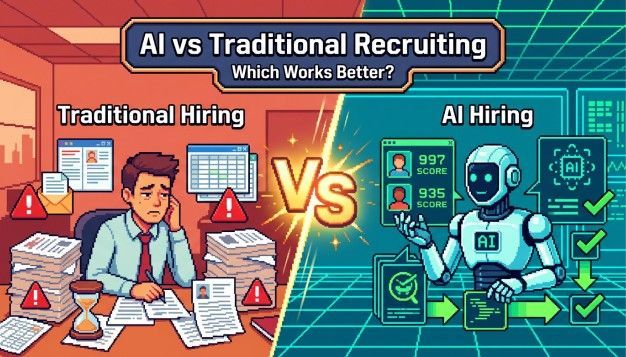
Though AI is now reshaping how companies find and evaluate talent, there’s one question that keeps coming up. Is the old way still the best?
Shift from paper to cloud
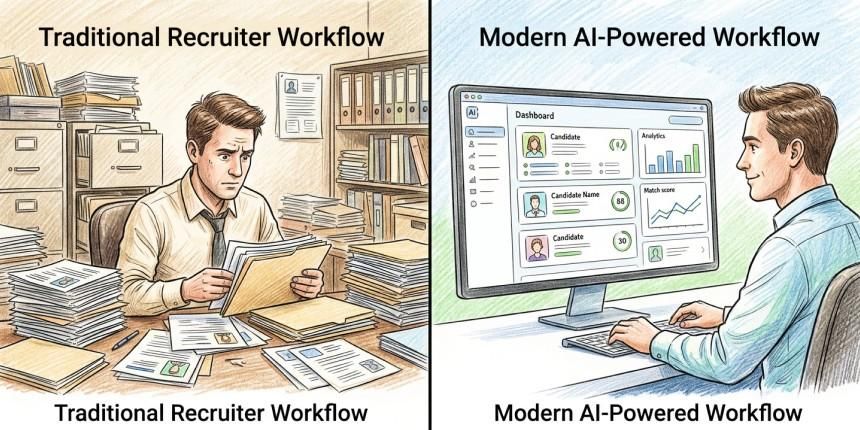
Recruitment used to be a newspaper ad-only affair. Staffing agencies kept candidates in filing cabinets. Hiring managers leaned on referrals, walk-ins, and gut instinct. It was personal. It was also painfully slow.
Platforms like Monster and LinkedIn opened access to much larger candidate pools. These online job boards changed things in the late 1990s. ATS (Applicant Tracking Systems) followed soon after, and this became the turning point of events. The flooded digital resume situation was streamlined.
Then came employer-structured interviews, social recruiting, and branding. Each one tried to bring more method into what had always been part art, part luck.
Every evolution solved a real problem. But everyone added new friction, too. ATS platforms filtered out strong candidates because of rigid keyword matching. Structured interviews improved consistency. But they also stretched hiring timelines even further.
Though tools got better over time, the core challenge did not really go away. The challenge experienced here is finding the right person, quickly and without burning through resources.
The Era of AI Hiring
AI did not arrive in recruitment as one big moment. It instead crept in quietly. Smarter search algorithms came first. Then came predictive analytics, resume parsing tools, and chatbot-driven engagement. Over the past few years, the pace has picked up. Not just slightly picked up, but at a great pace.
Today's AI tools can screen thousands of applications in minutes. They spot patterns in successful hires. They match candidates based on skills and potential, and not just keywords. Some even run early assessments through conversational AI.
What sets this wave apart from earlier recruiting tech is scope. AI doesn't just digitize one step in the process. It rethinks the whole thing. Timelines shrink, and screening bias decreases. Candidates overlooked by traditional methods are now surfaced and prioritized.
Why Companies Are Making the Switch
The move toward AI hiring isn't about chasing trends. It's about solving real problems.
Speed matters more than ever
Top candidates don't wait around. In competitive markets, waiting for months can be far too long for candidates to slip away. AI handles the most time-consuming stages, all of it sourcing, screening, and initial engagement. All in a fraction of that time.
Volume has outpaced human capacity
A single posting can pull in hundreds of applications. Sometimes even in thousands. Recruiters simply cannot evaluate everyone with the attention it deserves. AI picks up that load. It makes sure strong candidates don't slip through AI resume screening.
Bad hires are costly
The U.S. Department of Labor estimates a bad hire can cost up to 30% of the employee's annual salary. AI brings data-backed objectivity into the evaluation process. It helps companies make sharper decisions, relying less on instinct alone.
Fairness is in the spotlight
Organizations face growing pressure to hire equitably. A well-designed AI system applies the same criteria to every candidate. That cuts down on unconscious bias during screening. Models need ongoing oversight. But it's a real step in the right direction.
These are not theoretical gains. Companies across industries are seeing real improvements. Faster hires, better candidate quality, and more productive recruiting teams. What began as early adoption is quickly becoming standard practice.
Where Hyring Brings the Edge
This is exactly the space where Hyring operates. Right where smart technology meets practical hiring outcomes.
Hyring doesn't replace recruiters. It amplifies them. The platform takes on screening and matching at scale. That frees up hiring teams to focus on what people do best, building relationships. Assessing cultural fit, making final calls with confidence.
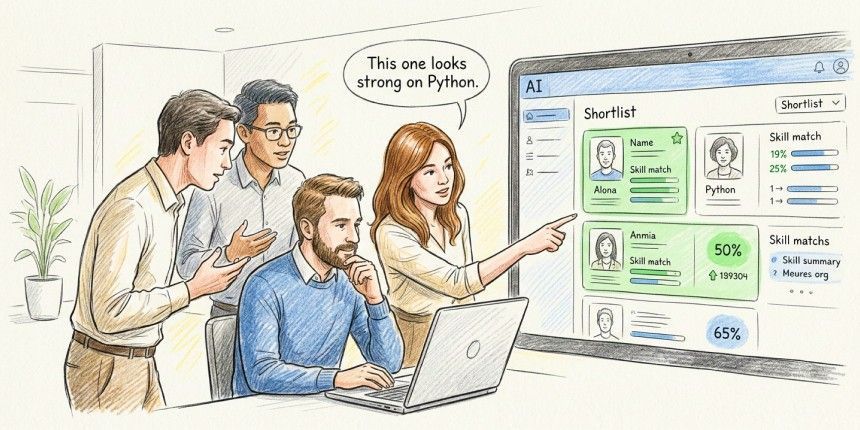
Hyring's AI looks beyond keyword matching. It reads deeper signals and the candidates’ experience and skills. It delivers a shortlist that is both fast and accurate. For companies tired of wading through average applications or losing great talent to slower competitors, Hyring offers a sharper and quicker path forward.
The Waiting Cost
The top prospects have alternatives. Top candidates go to companies that act fast and keep them informed. Companies that hesitate about using AI in the recruiting process not only miss out on opportunities but also lag behind their competitors. In the talent market, there is no pause button. If the competitor operates faster than your organization and your recruitment takes longer than theirs, the chance for hiring the best is already gone. The cost of bad hiring also needs to be considered. No AI data analysis has been introduced yet; companies rely on gut feeling. This usually results in a high staff turnover and the repetition of recruiting processes. It can consume both resources and finances. The other companies that use AI technology gain more advantages each month. Choosing the perfect timing to explore hiring AI is a costly choice.
Conclusion
AI versus traditional recruiting is not the actual question of debate. It has become all about accepting that hiring has changed. The need to keep up with AI tools is getting real.
The process, structure, and human touch are the components of the traditional methods. These principles still hold weight in terms of maintaining the process of good. When application volumes are massive, maintaining manual workflows and pacing through tight timelines just is not practical anymore. The expectations keep rising. The pace at which we were working manually throughout the process can be exhausting.
AI doesn't make recruiting less human. It makes it more focused. It takes care of repetitive work. That way, recruiters can put their energy where it actually makes a difference. Companies moving in this direction are not walking away from the human side of hiring. They're making room for more of it.
The future isn't about choosing one approach over the other. It's AI-enabled recruiting. Built on the best of what came before. Shaped for what's coming next.
Frequently Asked Questions
1. Is AI recruiting better than traditional recruiting?
Traditional methods built an important foundation, structured processes, candidate experience, and employer branding. AI builds on those foundations by adding speed, scale, and precision backed by data. The strongest results come from combining both.
2. Will AI replace human recruiters?
No. AI takes care of repetitive, high-volume tasks like resume screening, initial sourcing, and early outreach. Human recruiters are still essential for relationship building. For cultural assessment. For final hiring decisions. Think of AI as a tool that makes recruiters more effective.
3. How does AI reduce bias in hiring?
AI applies consistent evaluation criteria across every candidate. That removes many of the unconscious biases that can shape human screening. That said, AI models need to be carefully built and regularly audited. Otherwise, they risk carrying forward or amplifying biases from the data they were trained on.
4. Is AI hiring only for large companies?
Not at all. Platforms like Hyring are designed to work for businesses of all sizes. Smaller companies often benefit the most. They usually have smaller recruiting teams. They can't afford long, resource-heavy hiring cycles. AI levels the playing field for them.
Hyring focuses on depth, and not just speed. Its AI evaluates candidates on skills, potential, and overall fit. Not surface-level keyword matching. The result is a shortlist that's generated quickly. It is noticeably more accurate. It helps teams hire better while spending less time doing it.