You find the perfect job.
You polish your application, check for spelling mistakes, and hit Submit.
Days pass. No interview.
Your experience was relevant. Your qualifications matched. But here's something a lot of job seekers never consider: they sent the wrong document.
"CV" and "resume" get used all the time interchangeably, by candidates, job boards, and even employers who should know better. But they aren't the same thing; they don't serve the same purpose, and in a hiring process increasingly shaped by AI-assisted screening tools, the distinction is starting to matter more.
Here's what the difference actually is, and how to know which one to send.
Why Everyone's Confused (And It's Not Your Fault)
The confusion isn't because people don't understand documents. It's because the terminology shifts depending on where you are in the world.
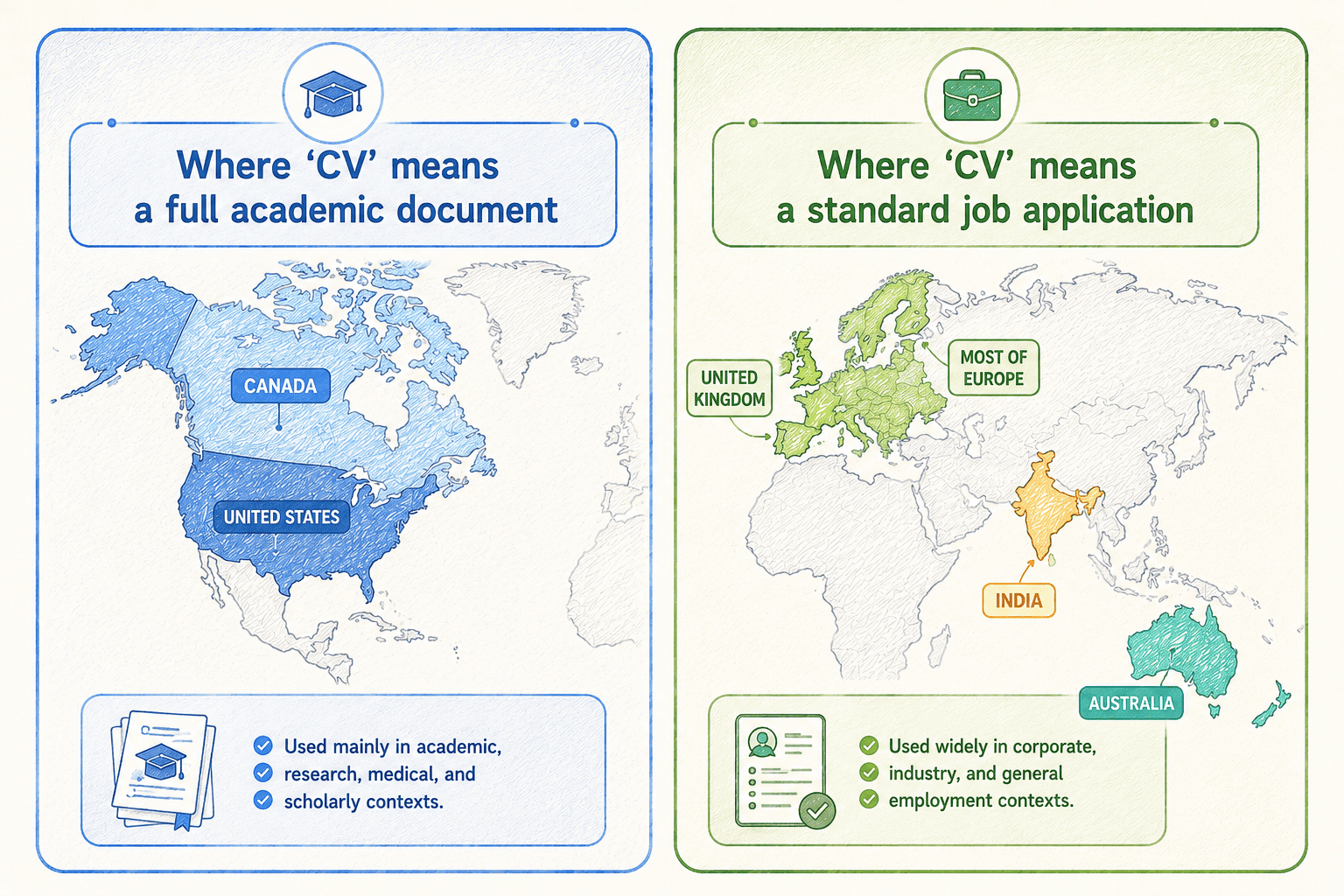
In the United States, the distinction is clear: resumes go to corporate employers, CVs go to academia. In the United Kingdom, CV is the default term for what Americans would call a resume, a standard job application document. In India, most employers say "send your CV" regardless of what they actually want. In Australia, CV commonly replaces resume as the everyday term.
According to LinkedIn career guidance, this regional inconsistency is one of the most common sources of application errors; candidates aren't confused because they're careless, they're confused because the industry hasn't standardized its own language.
So when an employer says "attach your CV," they might mean a comprehensive academic document. Or they might mean a two-page work history. You genuinely cannot tell from the label alone.
This is why understanding the purpose of each document matters more than memorising which name goes where.
What Is a Resume?
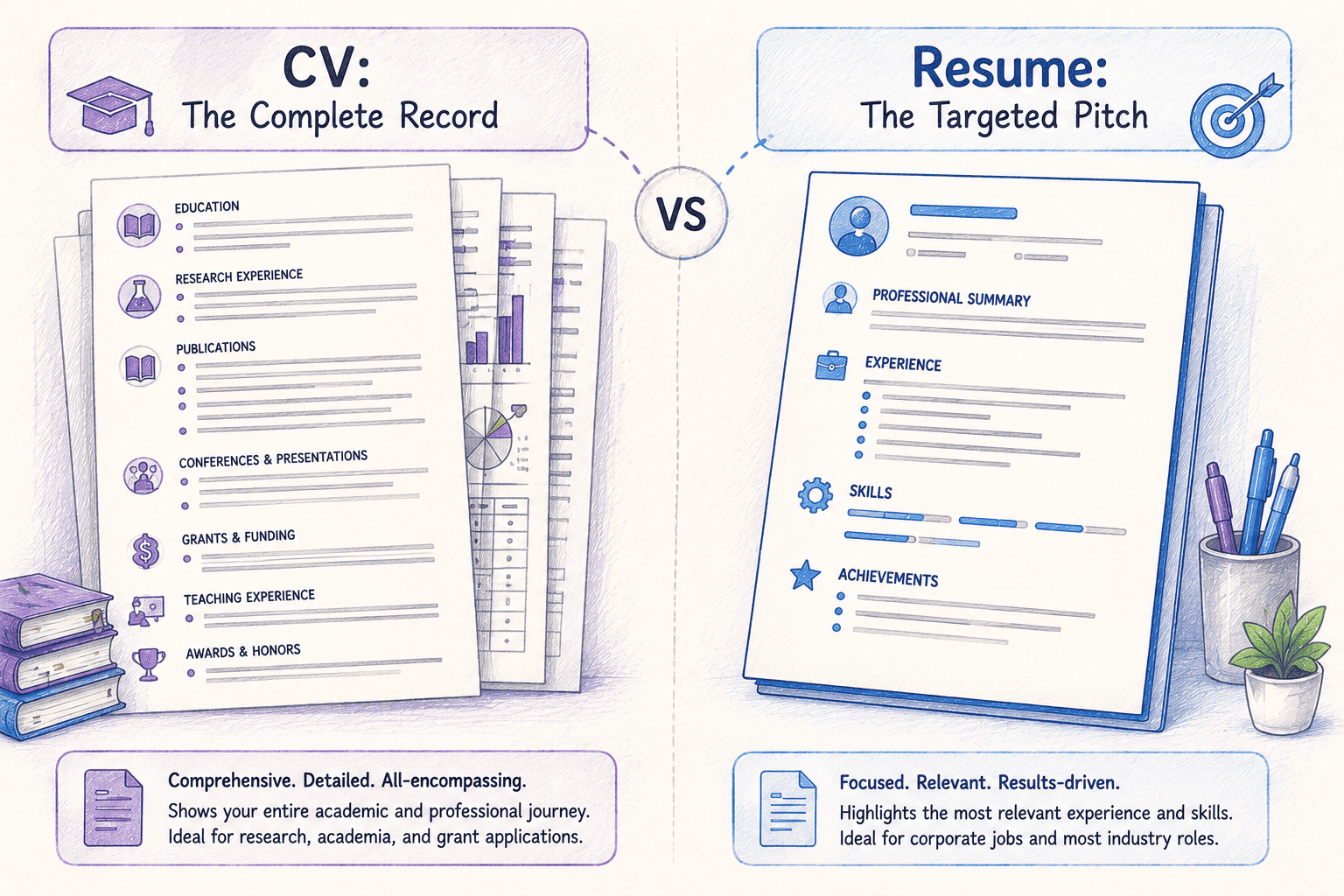
A resume answers one question: Why are you the right person for this specific job?
It's a curated sales pitch, not a complete record. A well-written resume is tailored to the role, selective about what it includes, and built around accomplishments rather than job duties. It gets updated for every significant application. It leads with relevance, and it follows a structure a recruiter can scan in seconds, which is what most resume templates are built around.
Recruiters appreciate resumes because they reduce reading time. When a hiring manager is working through a shortlist, they aren't trying to understand your entire professional history; they're trying to figure out whether you can solve a specific problem for their organisation. A resume that's built around that question makes their job easier.
Which matters, because initial screening decisions tend to happen fast. Research from LinkedIn found that recruiters form early impressions in a matter of seconds, though the exact duration varies widely based on hiring volume and whether AI or ATS tools have already filtered the pool. The point isn't a precise number. The point is that first impressions are made quickly, and relevance is what earns a second look.
Harvard Career Services reinforces this directly: a resume should be tailored to every role, with language that mirrors the job description and accomplishments framed in terms of measurable impact. Generic resumes, however well-written, don't perform as well as targeted ones. In practice, the difference usually comes down to whether your resume keywords match the language in the posting.
What Is a CV?
A CV, curriculum vitae, Latin for "course of life," answers a completely different question: Tell us about your entire professional and academic journey.
It's a record, not a pitch. A CV includes everything: research experience, publications, teaching roles, conference presentations, grants, awards, certifications, professional memberships, and more. It grows over time. It doesn't get trimmed to fit a job description.
This makes it the right document for contexts where completeness matters. A university hiring a researcher doesn't want to know what you've chosen to highlight; they want to see the full picture of your academic output. A grant committee reviewing applications needs to understand your methodology, your publications, and the arc of your research. A one-page pitch doesn't give them enough to work with.
For those contexts, a resume would be the wrong document, not because it's shorter, but because it's asking the wrong question.
The Yale Office of Career Strategy and UC Berkeley Career Center both maintain separate guidance tracks for CVs and resumes precisely because the audiences, structures, and expectations are that different. If you're navigating an academic application for the first time, both are worth reading before you start.
The Real Difference Isn't Length, It's Purpose
Most CV vs resume explainers lead with length. That's the wrong frame.
A PhD student applying for their first postdoc might have a CV that's three pages. A senior executive might have a resume that runs to two pages. Length is a symptom of purpose, not the definition of it.
The more useful way to think about it:
| Resume | CV |
|---|
| Sells your fit for one specific job | Documents your complete career |
| Selective, you choose what's relevant | Comprehensive, nothing is left out |
| Customised for each application | Updated continuously over time |
| Answers: Why should you hire me? | Answers: What have I done? |
That distinction, sales pitch versus record, is what determines which document belongs in which application.
Why Sending the Wrong One Can Hurt Your Application
Consider two scenarios.
Scenario one. A candidate applies for a Marketing Manager role at a tech company and uploads their 12-page academic CV. It lists every college event they coordinated, every internship, every certification, conference attendance from 2019, and a section on freelance work they did for two months. The recruiter now has to excavate the document to find out whether this person can run a campaign. Most won't bother.
Scenario two. A candidate applies for a PhD programme and sends a one-page resume. It's clean and well-written, but it doesn't mention their research experience, publications, teaching history, or the methodology behind their thesis work. The admissions committee doesn't have enough information to make a decision. The application stalls.
In both cases, the document itself isn't the problem. The document is wrong for the audience. The recruiter hiring a Marketing Manager needs relevance. The institution evaluating a researcher needs completeness. Sending the wrong version doesn't just waste the employer's time; it signals a misunderstanding of what the role actually requires.
What About AI Screening?
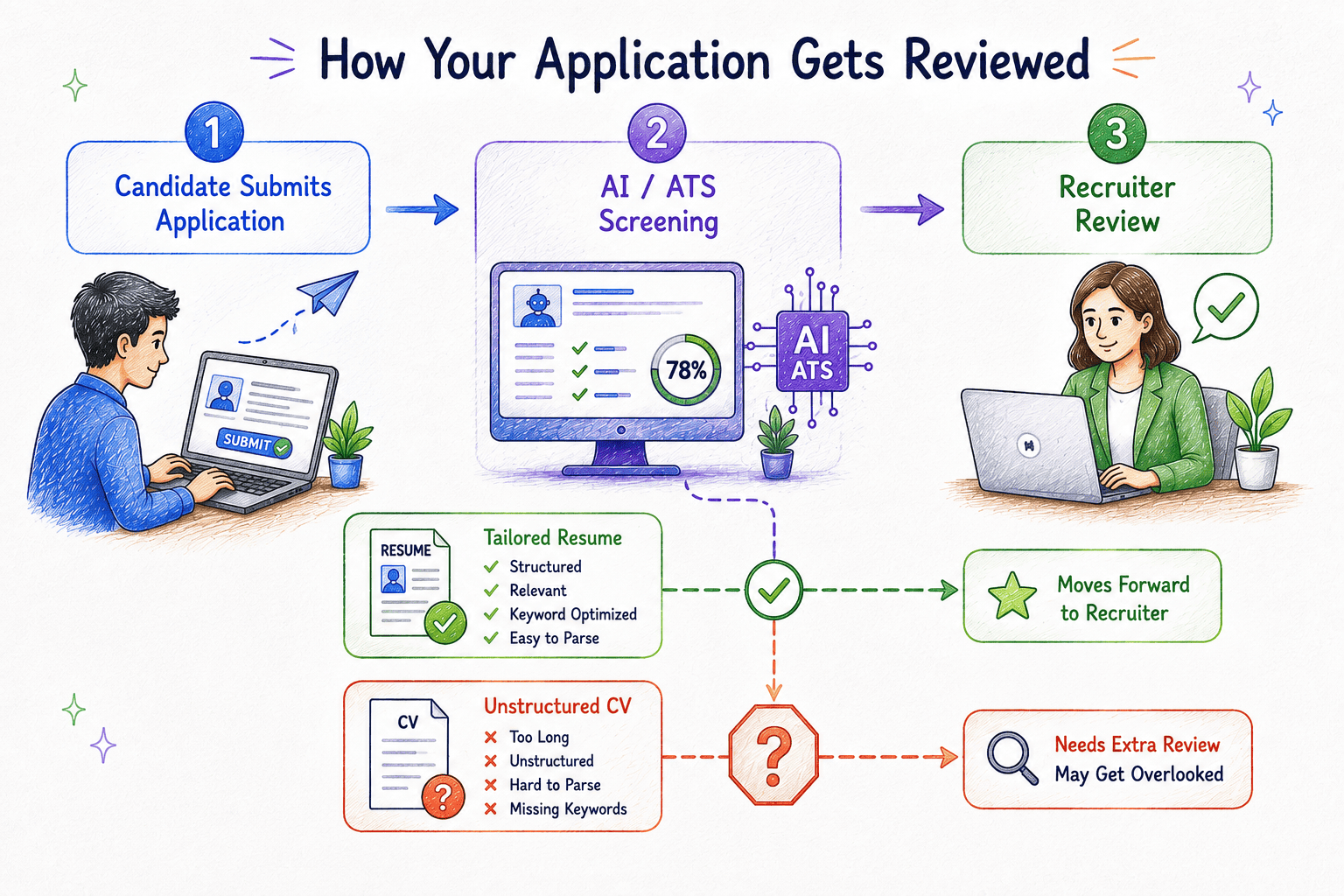
Many organisations now use AI-assisted hiring tools alongside applicant tracking systems to help organise, rank, or summarise applications before they are reviewed by recruiters. This is increasingly common across corporate hiring, particularly at volume.
The numbers reflect just how mainstream this has become. According to IBM's research on AI in hiring, a growing majority of HR professionals report using AI tools at some stage of the recruitment process, with screening and application review among the most common use cases. LinkedIn's 2024 Future of Recruiting report found that AI adoption in talent acquisition has accelerated significantly, with recruiters using AI primarily to reduce time-to-hire and improve candidate matching.
These systems generally perform better when applications are well-structured, relevant to the role, and aligned with the job description. They're designed to identify signal quickly, and a tailored resume, built around the specific requirements of a business role, naturally provides cleaner signal than a comprehensive CV that lists decades of academic output. If you aren't sure how closely yours matches, you can match your resume against the job description and see where the gaps are.
That doesn't mean AI tools reject CVs outright, or that every ATS behaves the same way. But for most corporate roles, a targeted resume is more likely to move cleanly through automated screening, not because of a formatting trick, but because its purpose aligns with what the system is trying to find. Jobscan's ATS research consistently shows that resume-to-job-description alignment is one of the strongest predictors of ATS pass-through rates.
As AI tools take on more of the initial filtering work, application relevance becomes more critical, not less.
When to Send a Resume
Use a tailored resume for almost every private sector application:
- Corporate roles across marketing, sales, engineering, HR, finance, operations, product, and consulting
- Tech and startup hiring
- Customer success, account management, business development
- Any role where the employer is asking "can you do this specific job?"
If the job posting came from a company, uses a job title, and lists responsibilities, send a resume.
When to Send a CV
Use a CV for:
- Academic positions, faculty, lecturers, postdoctoral roles
- Research roles at universities, think tanks, or institutes
- Medical and clinical positions that require publication history
- Fellowship and grant applications
- Government research positions
- International applications in countries where CVs are standard
- Professional licensing in regulated fields
If the application asks for publications, research experience, or a list of presentations, send a CV.
A Quick Decision Checklist
Before you attach anything, ask yourself:
- Is this a university, research institution, or academic body? → CV
- Does the application ask for publications or research experience? → CV
- Is this a corporate employer hiring for a business role? → Resume
- Does the job description explicitly ask for a resume? → Resume
- Is this a private sector role in marketing, tech, sales, HR, or finance? → Resume
When in doubt, look at what the employer asks for in the job description, not the label they use, but the information they're actually asking for.
The Question Worth Asking
The choice between a CV and a resume isn't really about format. It's about what the employer is trying to learn about you.
A recruiter screening candidates for a software engineering role isn't asking: Tell me everything you've done since college. They're asking: Can this person solve our problem?
A university evaluating a research hire isn't asking: Why are you right for this specific role? They're asking: Show me your complete academic journey.
Each question has a document designed to answer it. Send the right one.
Frequently Asked Questions
1. Can I send a CV instead of a resume if I have a lot of experience?
More experience doesn't mean you need a CV; it means you need a better-curated resume. Seniority isn't a reason to send a comprehensive document when a targeted one is what the employer needs.
2. What if the job posting says "CV or resume accepted"?
Default to a resume for any private sector or corporate role. "CV or resume accepted" usually means the employer isn't particular about the label, not that they want your full academic history.
3. Does a resume have to be one page?
The One-page resume is a guideline for early-career candidates, not a universal rule. If you have substantial relevant experience, two pages is fine. What matters is that every line earns its place.
4. Will an ATS reject my application if I send a CV for a corporate role?
CVs often include sections that ATS systems aren't built to categorise, which can affect how your application gets scored or summarised before a recruiter sees it.
5. Should I have both a CV and a resume ready?
If you're applying across both academic and corporate contexts. Keep a master CV that you update continuously, and build targeted resumes from it when applying to business roles.