It's Monday. You've got 300 resumes for one role, a hiring manager who wants a 'rockstar' by Friday, and a LinkedIn inbox full of seen-but-not-replied.
You already use ChatGPT. SHRM says 51% of organisations now use AI in recruiting.
The problem? 'Write me a JD' gets you the same bland JD everyone else posts.
So here are 50 prompts for the messy parts of your week. Copy, fill in the brackets, go.
Before you paste: 3 quick rules
- Remove personal details (phone, address, salary history) from any resume first. Check your ChatGPT data settings too.
- Never ask it to guess age, religion, health, or background.
- Let it find evidence, not make the call. The hire is still yours.
Pro tip: end any screening prompt with 'If it isn't stated, say 'Not demonstrated.' Don't guess.'
13 ChatGPT prompts for job descriptions
Because 'we need someone good, you know the type' is not a brief. Use these prompts to fix a draft, or start from one of our job description templates.
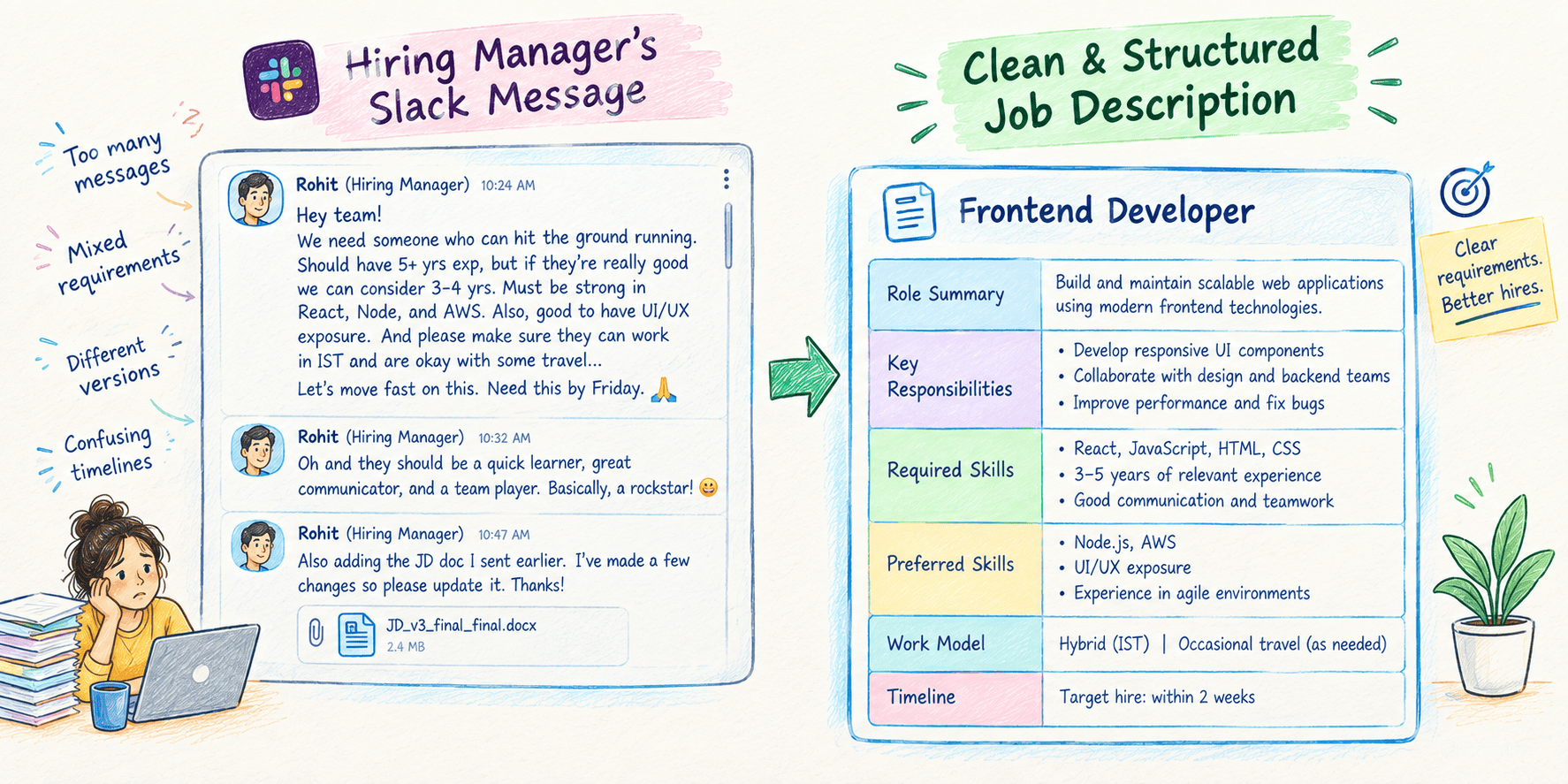
1. When the hiring manager sends a 14-message Slack thread instead of a brief
Here are my hiring manager's notes: [paste]. Pull out the real requirements and goals. Separate facts from assumptions. Give me a table, not a JD.
2. When the requirement list is basically a wishlist
Review this JD: [paste]. Which requirements shrink the pool for no real reason? Suggest a broader version of each that keeps the same bar.
3. When everything is marked 'must have'
Sort every qualification in this JD into Must have, Trainable, or Nice to have. Explain each in one line. [paste JD]
4. When they want '8+ years' for a mid-level role
Rewrite these requirements around what the person can do, not years served. Flag where years stand in for a skill.
5. When the JD hides the late nights
Read this JD as a candidate. List everything implied but never said, like travel, weekend work or on-call duty.
6. When the JD disagrees with itself
Check this JD for contradictions between seniority, responsibilities, reporting line, work model, and pay. Quote the exact lines that clash.
7. When nobody can say what success looks like
Using only this JD, what should a great hire achieve by day 30, 90, and 180? Say where you can't tell.
8. When you see the word 'ninja'
Highlight every buzzword in this JD and give me a concrete replacement for each.
9. When the JD gets views but no applications
You're a qualified candidate reading this. What five questions would stop you from applying?
10. When you want fewer 'this isn't what I signed up for' exits
Write a short 'What this job is really like' section, hard parts included. Use only this JD.
11. When the hiring manager 'just tweaked a few things'
Compare these two versions of the JD. List everything that was added, removed or made stricter. [paste both]
12. When you need ATS keywords without stuffing
Group this JD's keywords into exact skills, other names for them, related tools, and words candidates actually use.
13. Right before you hit publish
Don't rewrite this JD. Give me a checklist of anything unclear, unnecessary or missing.
13 ChatGPT prompts for sourcing
Your ideal candidate exists. They just call themselves something you didn't search for. LinkedIn recommends widening searches with synonyms and related titles.
1. When 'Product Manager' returns 40,000 people and none of them fit
Give me 30 job titles people use for the same work as [ROLE]. Group them as direct, adjacent, and startup vs enterprise. Keep seniority the same.
2. When the hiring manager speaks a language only they understand
My hiring manager wants someone with '[PHRASE].' How might a candidate describe that on a resume or LinkedIn?
3. When the obvious talent pool is tapped out
Name five adjacent professions that could produce strong candidates for [ROLE]. What carries over, and what would I still need to check?
For each tool here, name true equivalents and loosely related ones, in separate lists. [paste tools]
5. When you want a plan, not just a search bar
Build a sourcing table for [ROLE] with columns for target title, alternate title, key skill, alternate terms, likely industries, and likely employers.
6. When your Boolean string is clearly broken
Here's my Boolean string and the JD. Why is it returning too many or too few profiles? What should I change? [paste both]
7. When you don't know how big the market even is
Give me three searches for [ROLE]: one broad to map the market, one for daily sourcing, one very narrow for the greatest needs.
8. When great people use weird titles
Qualified people for this role may not call themselves '[TITLE].' What might they use, and what would prove they do this work?
9. When nobody ticks all 12 boxes
Instead of matching every requirement, give me five skill combinations that would signal a strong fit for [ROLE].
10. When you want the candidates your competitors skip
Which backgrounds would most recruiters ignore for [ROLE] that could actually work? What should I verify for each?
11. When the brief says 'IIT/IIM only'
Rewrite this sourcing plan to focus on proven skills, not brand-name companies, colleges, or titles. [paste plan]
12. When you're training a junior sourcer
Create 10 fictional profiles for [ROLE]: three clear fits, three adjacent, two false positives, two unusual but promising. Explain what separates them.
13. When you want every search to get smarter
Here are 20 profiles my current search returned. What patterns in the strong ones is my search missing?
#26 is the sleeper hit here. Run it weekly and your talent pipeline gets sharper with every search.
14 ChatGPT prompts for screening
'Is this candidate a good fit?' gets you a confident guess. Asking for evidence gets you something you can defend. That's the core of skills-based hiring, which LinkedIn links to a 12% higher chance of a quality hire.
1. When you have 300 resumes and one coffee
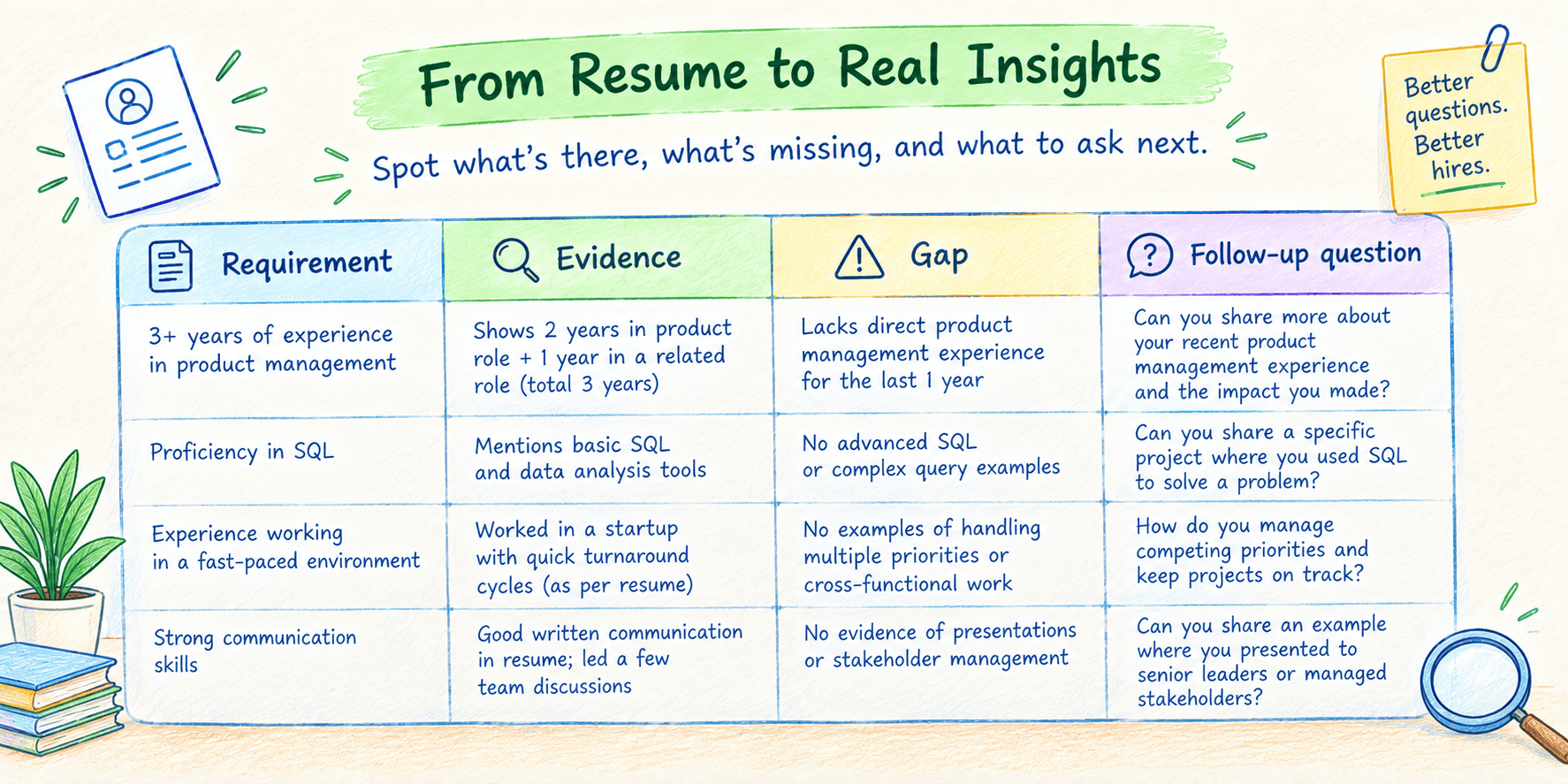
Here's a JD and a resume. For each requirement, quote the matching resume evidence. If there's none, write 'Not demonstrated.' Don't guess from titles.
2. When a resume looks great but feels vague
Sort this resume into three columns: clearly shown, needs checking, not shown. [paste JD and resume]
3. When you need a phone screen plan in five minutes
Write five screening questions covering only the gaps between this resume and the JD.
Find claims here that sound big but have no numbers. Suggest a neutral follow-up for each.
5. When the achievements are all adjectives
For each achievement, pull out the action, scope, and result. Which part is missing?
6. When you care about results, not keywords
Here's what six-month success looks like: [paste]. Find resume evidence tied only to those outcomes.
7. When the career switcher might be your best option
What skills from this person's background would carry over to [ROLE], even without the exact title? Cite the experience for each.
8. When your screening questions all get 'yes'
Turn each must-have in this JD into one question that asks for a real example.
9. When every interviewer scores differently
Using only these competencies [list], describe weak, okay, and strong evidence for each.
10. When a question feels a little off
Which of these questions could lead to judgments about someone's background or personal life? Rewrite them around the job.
11. When round two sounds exactly like round one
Group these questions by the skill they test. Flag any duplicates.
12. When nobody actually tested the must-haves
Here's our JD, interview plan and scorecard. Show which requirement gets tested at which stage. What's never tested? What's tested three times?
13. When the debrief ends with 'not sure'
Compare this candidate's evidence to our scorecard. Show only where we can't decide yet, with one follow-up each.
14. When the panel can't agree between two finalists
Compare these candidates on the same criteria. Summarise evidence and gaps. Don't pick a winner.
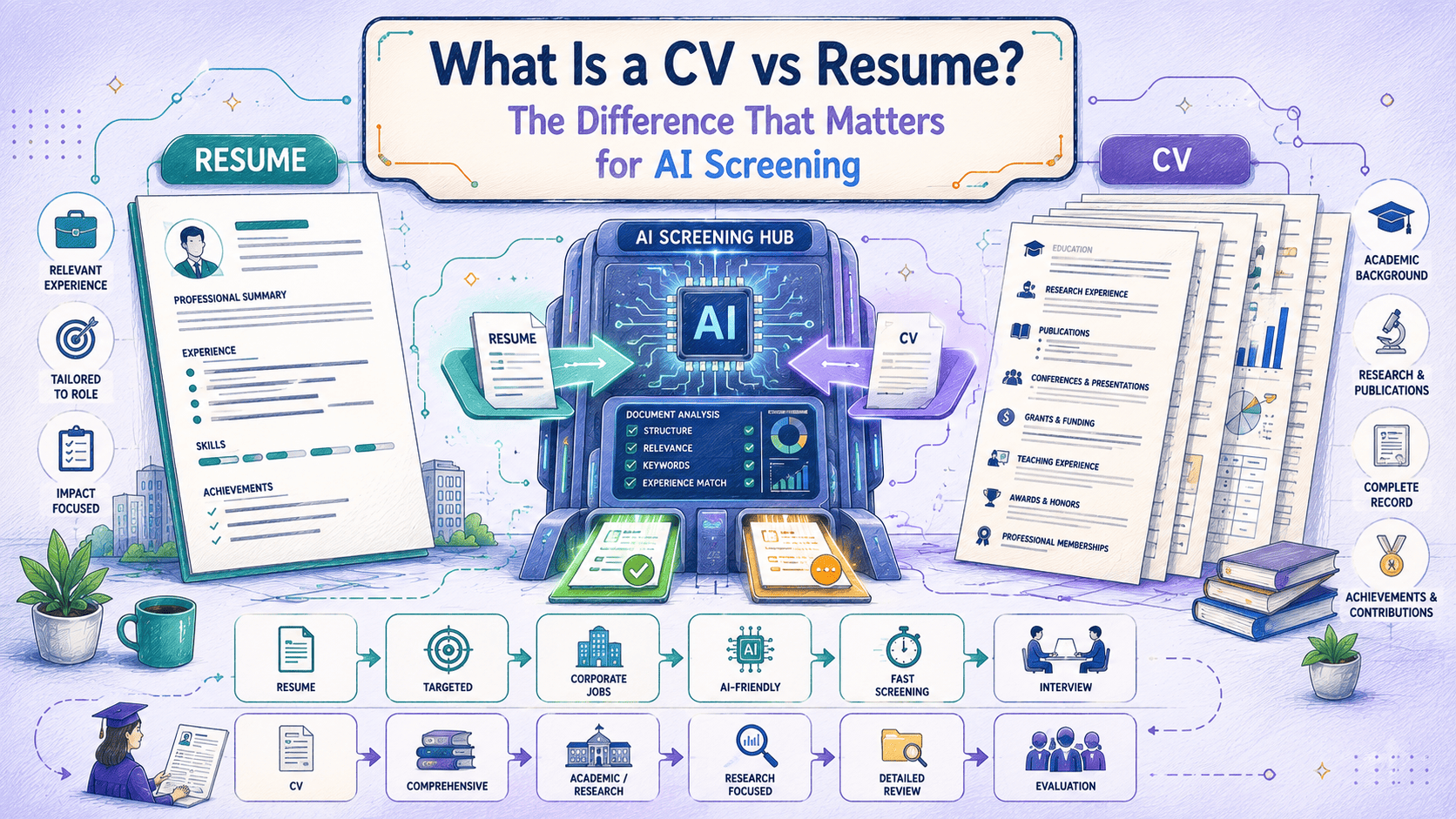
Doing #27 for every applicant gets old fast. An AI resume screener runs that check across every CV for you.
10 ChatGPT prompts for outreach
Candidates can smell a template from the preview line. Indeed says to check AI messages for accuracy and add a real personal touch, without inventing things.
1. When you're not sure why you're messaging them
Based only on this profile and JD, what's the strongest honest reason this person might be interested? If there isn't one, tell me. [paste both]
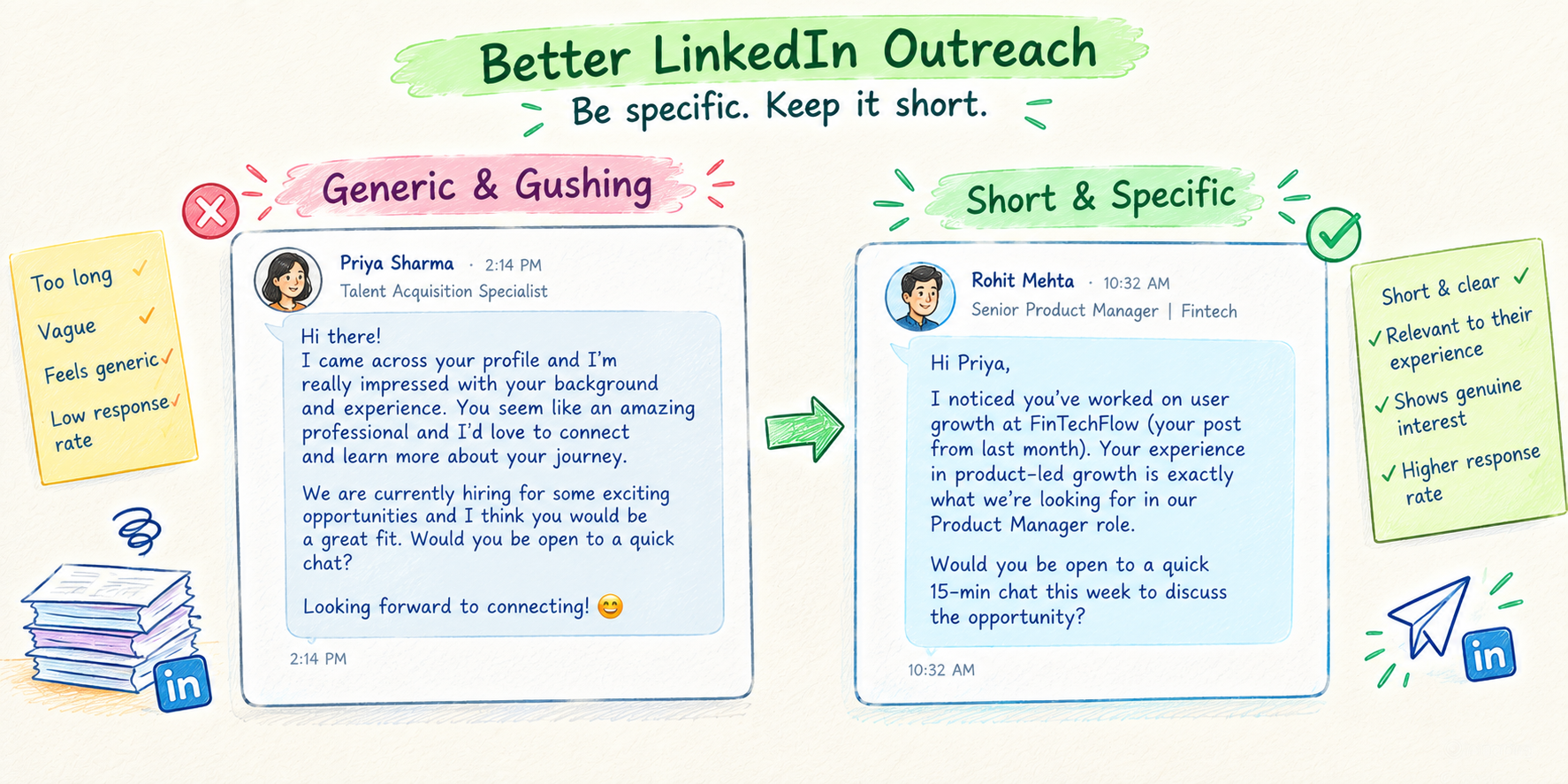
2. When your message starts with 'I came across your impressive profile'
Write a message using exactly two relevant facts from this profile. No 'impressive background' or 'perfect fit.'
3. When your message sounds like ChatGPT wrote it (because it did)
Rewrite this so it sounds like a busy recruiter who actually read the profile. Cut clichés. Keep the facts.
4. When you're messaging 5 people, not 500
Write three versions of this message: light, medium, and deep personalisation. Use only the facts I've given you.
5. When they're happy where they are
This person isn't job hunting. Write a low-pressure intro that helps them decide if a quick chat is worth it.
6. When they left you on read
Write a follow-up under 60 words that adds one new detail about the role. No 'just checking in.' [paste original]
7. When you keep selling what you care about
List three things about this role that might matter to this person. Mark evidence vs guesses. Write using evidence only.
8. Before you hit send on a big one
Check this for generic lines, flattery, length, and a weak call to action. Suggest the smallest fixes.
9. When your message reads like a job ad
Rewrite this to start a conversation, not sell the job. Keep it direct and lead with why I picked them.
10. Every. Single. Time.
Highlight every line in this message that's assumed rather than backed by the candidate's profile, so I can check it before sending. [paste message and profile]
Ten seconds with #50 saves you the 'I've never worked there' reply. We've all had it.
Bonus: make ChatGPT check its own work
After any answer, type:
Now critique that. What did you assume without evidence? Then fix it.
The Self-Refine study found this loop beats the first draft.
FAQs
1. What are the best ChatGPT prompts for recruiters?
The ones that ask ChatGPT to check your work, not just write it, like finding gaps in a JD or flagging unsupported claims.
2. Can ChatGPT replace a recruiter?
No. It can sort evidence and draft messages, but relationships and the final hire still need you.
3. Is it safe to put candidate resumes into ChatGPT?
Only with personal details removed, and only if your company's AI policy allows it. OpenAI says ChatGPT Business data isn't used for training by default.
4. Can ChatGPT write Boolean search strings?
Yes, and it's even better at fixing broken ones. Always test the Boolean search string yourself, since ChatGPT can't see live results.
5. How do I stop ChatGPT outreach from sounding robotic?
Feed it real facts from the profile, then read it out loud. If it sounds like a template, it is one.