AI coding interviews have taken over tech hiring. If your recruitment agency still relies on traditional screening, you're already behind.
Here's the reality. Around 86% of companies now use AI-powered screening in their hiring process. That number was barely 30% two years ago. Agencies like Hyring saw this coming early. They built their entire model around AI-driven assessments. The payoff? Up to 70% faster time-to-hire and shortlists that actually match what clients need.
Let's get into what's actually changed and why it matters for recruitment agencies.
AI Literacy Is What Counts Now
Do you recall whiteboarding questions? Sketch a binary search tree without any help. No internet search. No integrated development environment. Just pen and paper for you.
It’s history.
The developers of the future in 2026 depend heavily on AI assistants. Copilot is always ready to jump in from the developer's editor. ChatGPT has been opened up in a separate tab. This is how developers write code today. So why not evaluate them accordingly?
These smart platforms have realized that resistance is futile. They embrace this reality. Instead, they assess candidates’ proficiency in AI. Can they compose a well-written prompt? Can they identify errors in the generated answer? Do they know how to correct incorrect outputs?
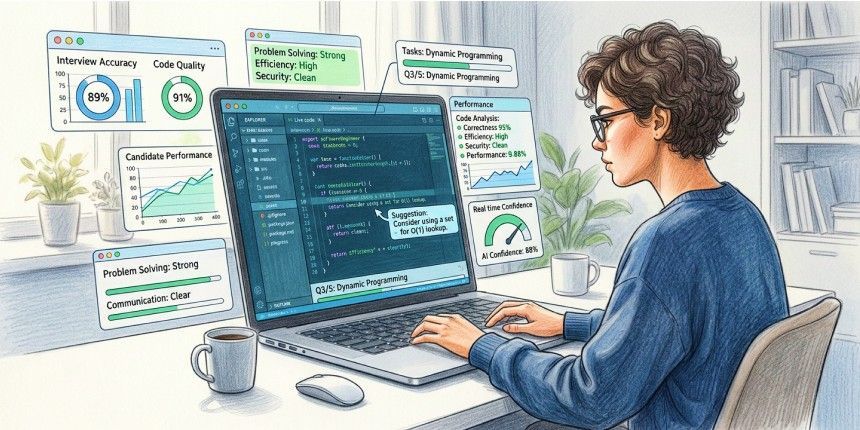
Hyring's platform works exactly this way. Candidates solve real coding problems with AI tools available. The system watches everything. Over 70 data points get captured. How do they prompt? How do they debug? How do they think? That gives recruiters something a whiteboard never could, a genuine picture of how someone actually works.
Interviews That Adapt to Each Candidate
Classic interviews asked everyone the same questions. An interviewee working with the backend was asked the same thing as someone doing frontend work. Nothing new was being learned from the process.
That is not how modern AI-driven interviews are conducted.
Interviewing a candidate with five years of experience in distributed computing? AI will ask them to fix a microservice failing. A candidate who thrives under pressure? Ask them to resolve a tricky state management issue instead.
It does not stop there. Once a candidate successfully resolves a problem during an interview, the AI dives deeper. It could ask why they opted for hash maps over balanced trees and their memory efficiency. This used to be something only an experienced interviewer could pull off. Now it happens automatically in the middle of the night.
For agencies running global hiring campaigns, this is a game-changer. A candidate in Bangalore gets the same depth of assessment as one in San Francisco. No scheduling headaches. No compromises on quality.
Finally Killing Bias
Let us be a little truthful. Resumes with universities that have a pedigree get more attention. It’s been proven over and over again. A Harvard or Stanford logo open doors that others can’t, not even if they have the raw talent.
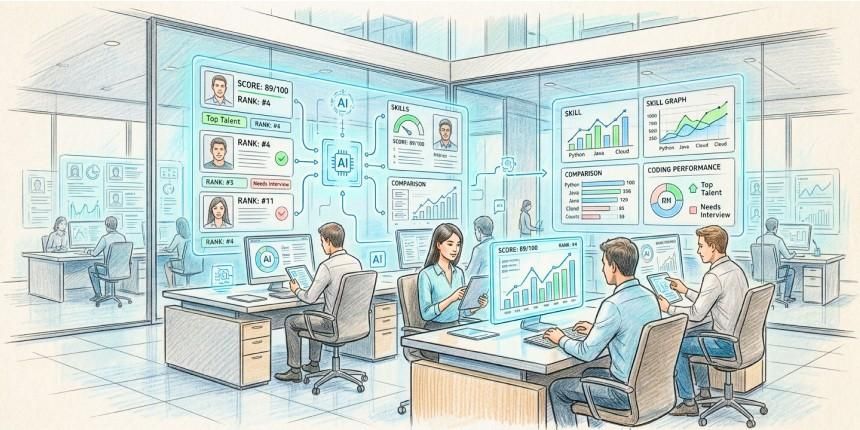
AI interviews don't care about logos or marquee names. They measure the rubrics that actually matter. Code quality, logic flow, error handling, debugging speed on the technical side, and communication clarity and enunciation on the soft skills side. No school name or employer brand can top that.
The data is quite encouraging. Monster.com reports that 85% of recruiters have admitted that AI interviews help evaluate thousands of developers using the same calibrated criteria. A self-taught developer from a Tier-2 metro in India gets judged by the same rubric as an Ivy League grad. And that is an equality that the industry hadn’t prepared itself for.
This is huge for agencies like Hyring itself. When hard performance data are the only reason trust increases, and not based on what a clear gut feeling in your belly you have. Then, clients return, and placements stay automatically.
Soft Skills Get Measured Too
Just being a great coder isn’t sufficient. You also need to be able to communicate and enunciate clearly and stay calm when things become tough to handle.
AI platforms measure all these indicators during the technical evaluation itself, simultaneously, while the coding tests are taking place. From how clearly they explain their approach, to how they structure their reasoning and the way they handle the coding assessment, their entire thought process is broken down, analyzed, and also summarized.
This is not emotion detection or sentiment analysis that we are talking about here. The EU AI Act drew a hard line that one mustn’t cross. Only observable behavior is measured - what you say and do, not what the algorithm assumes you feel.
For recruiters, this changes the pitch to clients completely. You're not just sending a bland resume and a blind test score anymore. With Hyring's platform, you send a full profile, complete with detailed learnings from candidate interactions. Technical chops, communication skills, the works. Even their composure under pressure, which usually took 2-3 interview rounds, now takes just one.
Why This Could Be a Game-Changer for Agencies
This shift isn’t just about working faster but about redefining what recruitment agencies are at their core.
Predictive Analytics That Clients Can Rely On
Instead of just saying "This candidate passed," imagine saying "this candidate cracked a complex multi-file task in under 20 minutes, uncovered unprompted edge cases, and explained every step with clarity using advanced AI-powered coding tests." A paradigm shift, right?
Grow Without Expanding Your Team
A large tech firm needs 200 engineers in three months. The traditional way of going about this would mean adding a dozen more team members to manage the load. The newer way is to let the AI interviewer handle it, non-stop. Candidates choose their preferred slot. Your team remains small and efficient. Everyone’s happy.
Agencies on AI platforms report 40% faster scaling, and that kind of speed builds trust. Trust builds long-term contracts in return.
Candidates Actually Prefer This
To think that candidates will probably hate AI is a natural assumption to make, but they surprisingly don’t
65% of candidates, according to this WCP article, in 2026 say they prefer it. Why not? They could do it even at 3 AM if that suits them. No scheduling conflicts. No need to wait two weeks just to get a response. The results are delivered to them in minutes.
Fairness matters too. A human interviewer having a bad day can affect every person they meet. AI doesn’t have bad days. It sticks to the same process and stays consistent every single time.
When candidates are happier, they’re more likely to say yes to offers. Companies using AI hiring tools report a 7% jump in offer acceptances. That might not sound like much, but for large-scale recruiting, it’s a very big deal.
The Challenges Are Real Too
No pretending here. There are real issues to think about.
Rules are getting stricter. The EU AI Act demands that hiring tools focus on demonstrated skills. Guessing emotions is off-limits. Companies working must design tools to meet compliance right from the start.
Cheating is a legitimate concern. But newer platforms manage it. They analyze typing habits and flag cases where someone pastes a flawless function without any sign of step-by-step effort. And people? They still play a crucial role. Top agencies use a mix of both. AI takes care of most of the screening work, while humans step in to handle the finer points. Those last steps include discussions about culture fit, salary negotiations, and building connections. That final stretch is where excellent recruiters shine.
Where This Is All Heading
The presence of AI in recruitment is continuously evolving rapidly. It has already moved from just being a mere tool to a full-blown agent. One that screens, coordinates, and pushes candidates through the funnel by nurturing them. Agencies already on board are seeing results that appreciate over time.
Better placements, faster hiring, lower turnover, and higher acceptance rates.
Hyring gives the infrastructure to agencies to make this leap. The technology is undeniably good, and the data backs it up. Candidates are favourable towards it, and the delegated account manager will provide exemplary service for every client while ensuring the load is eased on the human recruiter, while AI has their back. The only question left to ask is whether your agency moves now or plays catch-up later.
Frequently Asked Questions
1. Do the candidates have an opportunity to cheat when using the AI-powered solutions for the interviews?
They can only try. These days there are solutions available that monitor how quickly a person types, how they switch between tabs, and whether the algorithmic solution they provide is reasonable. Take for example if a perfect piece of code that appears without iterations, the system detects such a case immediately. Whether a candidate uses AI in this interview doesn’t matter at all - the only thing that matters is whether he understands his solution.
2. Does the solution substitute human technical recruiters?
No, it helps them do the most important stuff better. The use of AI means that recruiters don’t have to spend countless hours performing the same tasks, like reviewing hundreds of CVs or performing technical assessments. Human recruiters get to do only those things that machines cannot do.
3. How do AI coding interviews improve the candidate experience?
The main benefit is flexibility. Candidates can schedule interviews at a time that suits them. Whether it's midnight or early Sunday morning, it's up to them. There’s no need to exchange multiple emails with coordinators. They also receive feedback within minutes instead of waiting for weeks. Valuing candidates' time creates trust and positivity. This often increases the chances of offer acceptance.
4. Does this technology discriminate against non-native English speakers?
Generally speaking, AI does not have as much bias as people. By 2026, NLP cares about what you say rather than how you say things. Accents and impeccable grammar make no difference in this case. A human interviewer would probably discriminate against candidates with a strong accent, but AI wouldn't do that since all the attention is given to logic. Thus, the new tool helps to create equal opportunities in global hiring processes.
5. What does the concept "predictive value" mean in the context of AI-powered hiring?
Predicting the success of a potential hire is more important than determining their ability to pass a certain test. As the article notes, AI-powered hiring involves analyzing the process of working out an issue. Thus, there are numerous questions concerning behavior, namely, how a person solves various problems, how they cope with unexpected obstacles, and whether they see small nuances in particular situations. All these answers help to come up with a model allowing predicting the future performance of a new employee.