AI mock interview is an interview conducted by artificial intelligence where the candidate responds to interview questions orally and gets rated and pointed out on his/her flaws. We have compared the main interview practice tools below, then looked at what employers run when the interviewer itself is an AI. It is the intersection that matters because the practice interview helps prepare for the screening round being increasingly conducted by AI.

AI in Recruitment
AI Mock Interview: Practice Tools Compared (+ How Employers Use Them)
Published on: 01 Sep 2026
Last updated: 01 Sep 2026
 7 mins read
Share now:

Written by
Adithyan RK

Fact Checked by
Shabnam Sruthi
#1
Outcome-based. Typical recruitment agency.


#2
AI screening & interviewing tools

#3
Employee time tracking & Productivity monitoring


What Is an AI Mock Interview?
The AI mock interview is an interview simulation where computer software interviews you by asking questions and assessing your responses.
The method can vary greatly depending on which tool you use. Some will type out questions for you in a chat window while others will conduct an entire video interview - you speak to a camera, everything is transcribed, and a report arrives with a filler-word count, a rubric score, and many more insights.
The experience also changes depending on the role you're preparing for. A software developer may be asked to solve coding problems while explaining their thought process, whereas a sales candidate could face objection-handling scenarios or role-play conversations. Most platforms adapt the questions based on the job you're targeting rather than asking the same generic interview questions every time. That's why AI mock interviews feel much closer to an actual interview than reading static questions from a blog or watching interview videos.
Which AI Mock Interview Tools Are Worth Trying?
Final Round AI, Exponent, and HackerRank are the strongest AI mock interview tools right now.
Each targets a different round:
| Tool | Best For | Free Option | The Catch |
|---|---|---|---|
| Final Round AI | Behavioral rounds built from your resume and job description | Yes, limited sessions | Deeper feedback sits behind the paid plan |
| Exponent | Product, data, and engineering; AI plus peer mocks | Some questions free | Peer scheduling takes effort |
| HackerRank | Timed coding rounds with automated review | Yes | Thin for non-technical roles |
| A chatbot you already use | Unlimited question drills | Fully free | No scoring, and it flatters you |
None of these tools is objectively "the best." They solve different problems. Final Round AI is strongest if you want feedback on behavioral interviews and communication. Exponent is a better fit for product managers, analysts, and software engineers because many of its practice questions come from real interview experiences. HackerRank focuses almost entirely on coding ability. If your upcoming interview includes both technical and behavioral rounds, you'll probably end up using more than one tool to hone your interview-giving skills.
How Do Employers Use AI Interviews?
Employers use AI interviews to filter candidates at scale, with questions that adjust based on your answers, scoring, and even fraud detection.
According to a survey conducted by Resume Builder in October 2024 among 948 business leaders, 23% of employers currently use AI to conduct interviews, while 82% use it to evaluate resumes. The chances of having your first-round interview without any human face increase.
In terms of the employer side, a product such as Hyring's AI video interviewing software offers you live and two-sided interviews where the next question will depend on your previous answer.
Provide a vague answer, and it will ask follow-up questions about what you said. It also monitors the process, so if you switch tabs, if there are voices in the background, or if you use pre-written answers, the recruiter will know.
When preparing for the interview, keep in mind that memorized answers won't work with the adaptive questions. So don't rely on pre-written responses. You should focus on understanding the topic, and a good grasp of the subject will help you answer questions. The mock interview is like a conversation, so you also need to be ready to talk about your thoughts and experiences.
Recruiters aren't expecting perfect answers. They want enough evidence to understand how you think, communicate, and solve problems. An AI interviewer can stay consistent across hundreds of candidates, asking the same core questions while adapting follow-up questions when someone gives an incomplete answer or introduces a new point worth exploring. That consistency is one of the biggest reasons companies use AI for early-stage interviews, especially when hundreds or even thousands of people apply for the same role.
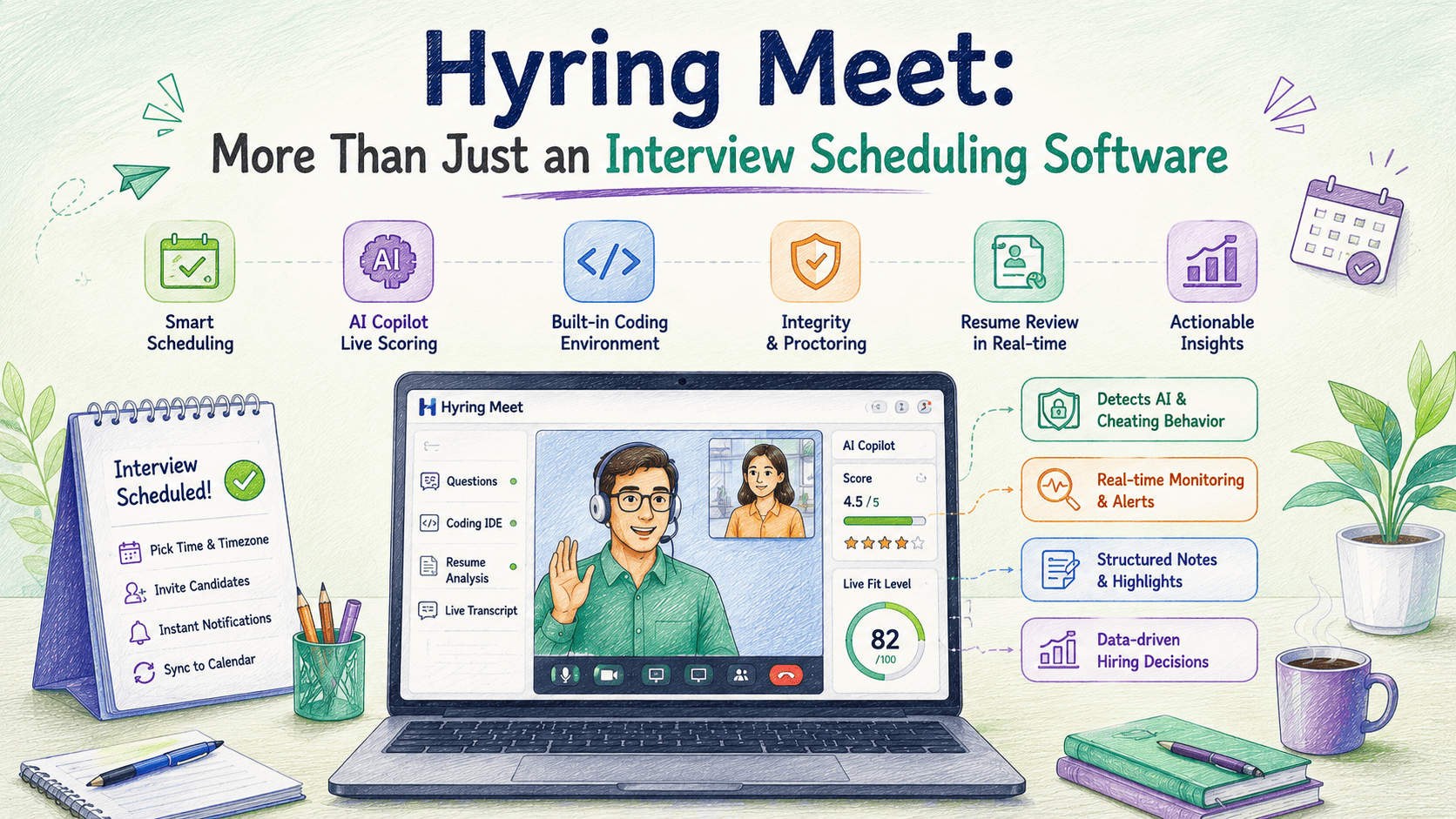
Not every round is fully automated, though. Plenty of recruiters still take the interview themselves and use AI only to handle the admin. That is what a tool like Hyring Meet does. It joins the call, writes the notes, and scores the candidate while the conversation is still happening. So if your first round is with a person rather than a bot, assume the recording and the scoring are running anyway.
For candidates, this means preparation changes slightly. Instead of memorizing model answers, practice explaining your reasoning clearly. If you're asked why you chose a particular solution, give the thought process behind your decision. AI interviewers, much like experienced recruiters, often reward clarity and evidence over rehearsed scripts.
How Do You Get the Most Out of AI Interview Practice?
AI interview practice works best when you answer aloud, read your transcripts, and drill follow-up questions.
Four habits help a lot:
- I answer out loud every time. When answers are typed, the wrong training happens.
- The STAR method can be used to structure behavioral answers. Google's guide to interview prep really helps.
- After each session, one should read the transcript. Usually, bad habits show up in the first 30 seconds and one can work on fixing them.
- Book at least five sessions. Progress starts to show around the third session.
Also, rehearse being interrupted. Ask the AI to challenge you mid-answer; employer software will.
Another useful trick is to repeat the same interview after a day or two instead of trying a completely different one. You'll notice whether you've actually improved or simply remembered what you said the first time. Improvement usually shows up in clearer examples, shorter pauses, and answers that sound more conversational instead of rehearsed.
Key Takeaways
- An AI mock interview gives you scored, repeatable practice with a clinical attitude that peers can rarely match.
- The tool should always be synced with the round - Final Round AI for behavioral prep, Exponent for product and engineering, and HackerRank for coding.
- 23% of companies already run interviews with AI, so practice against adaptive tools, not static lists of Q&As.
Frequently Asked Questions
1. What is an AI mock interview?
An AI mock interview is when software plays the role of the interviewer. It asks role-relevant questions, records your answers, and returns feedback on content and delivery. The best part is you can repeat sessions as often as you want until you feel confident enough to tackle the actual interview.
2. Are free AI mock interview tools good enough?
For question exposure, AI mock interview tools are great. Free tiers on Final Round AI and HackerRank give you a feel of the format. Paid plans add the scoring and pacing data that change how you speak.
3. How many practice sessions do I need before the real interview?
Five is a minimum number of practice sessions that sounds sensible and can be spread over one to two weeks. You must stop when the transcript of your recording reads the way you want to end up sounding in a real interview.
4. Will practicing with AI help me pass a real AI interviewer?
Yes, practicing with AI will help more than any other method. The software that employers use to score structure operates much in the same way that the practice tools do too, and the comfort with adaptive follow-ups will carry over.
5. What does the employer get after an AI interview?
An employer will get a report containing scores, skill ratings, a full transcript, and any flags regarding integrity that would be of concern regarding their candidature.

18+ years of experience
Adithyan RK is the Co-Founder and CEO of Hyring, an AI-native recruitment platform that has run over 900,000 AI interviews for companies ranging from early-stage startups to the Fortune 500. He has spent 18 years building technology businesses, starting with a digital consultancy in 2008 and a staff augmentation firm in 2017, before founding Hyring in 2022 to rebuild hiring around evidence instead of guesswork.
Expertise
AI RecruitmentAI InterviewsRecruitment AutomationHR TechnologyHiring AnalyticsApplicant TrackingRecruiter Operations