Is Hyring Meet interview scheduling software?
Hyring Meet is an interview booking software; however, booking is just a small part of the process after you schedule an interview using the tool.
The recruitment expert will use the job description to create the interview, pick the date and time zones, and include the candidate and interviewer. Hyring Meet will then schedule the interview in Google Calendar, notify the two parties, and any rescheduling or cancellation will be updated on the same record instead of restarting an email thread.
It’s true, and it matters a lot - according to the 2024 Candidate Experience Report from Greenhouse, 52% of job seekers have experienced being “ghosted” by an employer, and inefficient, manual coordination is often the culprit behind that silent treatment.
Also, this 2026 recruiting coordination statistics report by candidate.fyi, details that the average time spent on manual scheduling is 243 minutes for every interview – just the kind of tedious task that should be automated. Hyring Meet automates it. But that’s not all it does.
Hyring Meet does that, and it goes beyond that too.
What does the AI copilot actually do while you interview?
The Copilot does many things - generating interview questions, scoring answers live, and also providing follow-ups while the conversation is still going on.
It continues to function in the sidebar as the interviewer steers the discussion towards where he/she wants to go. It suggests questions in real time in each category (HR, generic, resume, or skill-based) according to the difficulty level of easy, medium, or hard, with answer keywords included, and the interviewer is free to suggest another one.
When a candidate finishes answering a question, the AI analyzes the entire question-answer sequence on a five-point scale and shows an animated reaction in the room. An excellent answer triggers a follow-up question with clues so that the interviewer can delve deeper into the topic without any preparation.
Underneath all of it sits a Live Fit Level gauge, visible only to the interviewer, tracking a running 0-100 fit read for the whole conversation, alongside a live, speaker-separated transcript with optional captions.
Nothing can replace the intuition of the interviewer, and that was intentional. According to a hiring statistics report published by iMocha in 2026, only 26 percent of applicants believed that an AI would be capable of judging their performance without bias. Hyring Meet is the solution to that lack of trust. It has changed one thing that is structural in nature: a human runs the conversation, while AI helps by stopping the dependence purely on their memory to evaluate the interaction.
Asynchronous interviews are a separate product rather than a mode inside Hyring Meet, and an AI interviewer runs on a different model altogether.
Hyring Meet is an integrated platform that brings together the video call, the coding IDE, the resume analysis, and the chat into one single room.
The call is conducted via Amazon Chime; however, the room surrounding the call is where the platform pitch happens. A collaborative code editor developed in Monaco is available in the call, where each keystroke is synchronized between the interviewer and the candidate. This is accompanied by a language selector and one-click execution to avoid another platform for the technical interview.
The interviewer can send any coding challenge to the editor, either automatically generated by the AI or manually chosen.
A resume analytics dashboard is present on the sidebar that features the tenure, skills distribution, and history of companies chart, so no one would have to switch tabs in order to see what the candidate really worked on. The in-call chat, screen share, device swapping, and adaptive video layout complete the room. The idea here is simple - just one tab instead of video calling, coding tool, and a separate document for notes.
How does Hyring Meet catch candidates cheating?
A total of six checks occur prior to call initiation, while four others take place during the process.
Before participating, a user needs to go through guided setup tests with the camera and the mic, as well as a voice test; a face visibility test, where an alert is triggered in case of presence of someone else in the video; a network test using Cloudflare, requiring speed above 5 Mbps both for uploading and downloading; and their recording consent.
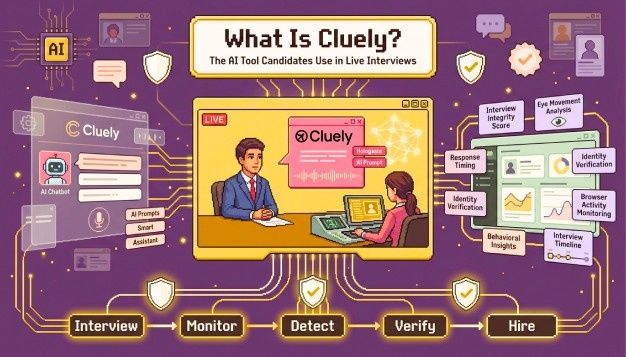
On the call, the screen of the interviewee will be captured entirely throughout the interview period (with a prompt in case the share is lost), the video will be recorded on the server-side, screenshots will be taken every minute, and all tab changes and mouse clicks will be marked on the interview transcript. The final report will reveal any coaching and AI applications being used (ChatGPT, Cluely, or Copilot), timeline of tab changes, eye gaze and lip sync discrepancies, and multiple faces or voices.
The reason this level of checking actually exists is that the problem requires a level of verification that is much larger than most hiring teams think. According to Fabric's study involving 19,368 AI interviews, 38.5% raised a red flag for cheating, while separate survey data from the same source shows that 83% of the respondents would have used AI if they believed they could get away with it.
Just simple tracking of tab switches will only reveal about one-fifth of such cheaters; the remaining ones require the high-level behavioral signals provided by the Hyring Meet's checks that it is built around.
What do you get after the call: notes, or a hiring decision?
You get two reports - an AI analysis generated automatically, and a human scorecard that you will have to fill in.
The detailed report that the AI submits at the end addresses each question and the corresponding response in detail - the transcripts can jump to the exact moment in detail. There are question-level scores, a communication map, a sentiment and emotional analysis, speech proficiency that considers grammar, fluency, pronunciation, MTI influence, accent, and vocabulary.
The interviewer also provides a report - the human angle is focused on here. Star ratings for technical and communication skills, per-skill scores that are observed from resume analysis, a hiring decision, and comments, filled in through an evaluation form at the end of the call.
This can happen for either report, whereby the entire workflow is initiated once more from the beginning (transcription, separation of the voices, scoring, and summarization) on the audio file, and each AI-generated score can be overridden by a comment, which will be attributed and dated. The reports are designed in such a way that they are shareable amongst a panel.
Does the scheduling part still matter?
Scheduling definitely matters, as until that happens there is no interview.
If you were to say, use a standalone scheduling service, the ones that can schedule and add it on both calendars are apps like Calendly. Then, the meeting commences on a different app such as Zoom or Google Meet with a general AI notetaker such as Otter or Fireflies that joins in to serve a singular purpose of adding a transcript, but the scoring, per-skill ratings, and integrity checks still depend on the interviewer's memory afterward.
While Hyring Meet could definitely be classified under the category of interview scheduling software, this doesn't really do justice to what goes on in the process itself - the copilot, the coding room integration, the cheating detection, and finally the two reports generated by it.
Key takeaways
- Hyring Meet does automate scheduling, calendar sync, and notifications, and that's genuinely useful, but it has a multitude of useful functions beyond that too.
- The artificial intelligence copilot creates questions, rates responses based on a five-tiered rating system, suggests follow-up questions, monitors the 0-100 fit-gauge, and the human is still in control of the dialogue.
- The video calling feature, Monaco-based coding IDE, resume analysis, and the chat are integrated into one room instead of being combined into three separate platforms.
- Cheating during interviews happens often and therefore must be accounted for. The numbers from Fabric reveal the percentage of interviews flagged at 38.5%, which is done through the pre-flight and in-call checks designed by Hyring Meet.
- Two reports, namely the AI report and the interviewer scorecard, are generated after every interview.
Frequently Asked Questions
1. Is Hyring Meet just interview scheduling software?
Hyring Meet isn’t just interview scheduling software. It does automate scheduling (pick a time and time zone, sync to Google Calendar, notify both sides), but its main task is running the live interview itself. An AI copilot that scores answers in real time, a built-in coding IDE and resume panel, cheating detection, and a scored report once the call ends, all assisting the human recruiter who oversees the process.
2. What does the AI copilot do during the interview?
The AI copilot generates interview questions by category and difficulty, scores each answer on a five-level scale, queues automatic follow-up questions after confident answers to retain the challenge, and keeps a constant fit-gauge visible only to the interviewer.
3. Does an AI run the interview instead of a person?
No, the AI doesn’t run the interview and that’s where the difference lies in Hyring Meet. The recruiter or hiring manager leads the conversation throughout. The AI works alongside them, scoring and suggesting follow-ups, rather than replacing their own intuition and judgment. Hyring's separate AI video interviewer product is built for AI-led high-volume screening, where hundreds of candidates need a first round before a human ever joins the call.
4. How does Hyring Meet detect cheating?
Hyring Meet contains state-of-the-art technology to detect cheating - six checks run before the interview (camera, mic, voice, face visibility, a 5 Mbps network test, and an external-monitor block), and four more run during the course of it (full-screen capture, server-side recording, screenshots every minute, and tab-switch tracking). The resulting report flags coaching or AI apps, eye-gaze and lip-sync anomalies, and multiple faces or voices.
5. What reports will you get?
Two reports: an AI report with the transcript, question-level scores, sentiment timeline, and speech-proficiency analysis, and a human interviewer scorecard with star ratings, per-skill scores, and the hiring decision. Either can be re-analyzed, and any AI score can be overridden with an attributed, dated comment.
6. Is Hyring Meet secure and compliant?
Indeed. Hyring has the ISO 27001 certification and SOC 2 compliance and handles candidate information according to regulations such as GDPR. The recordings are encrypted and have restricted access, although one should ensure that their team adheres to the regional guidelines prior to implementation.