What Is an AI Interviewer?
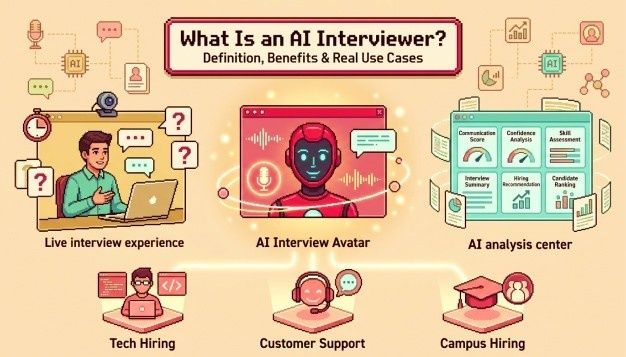
An AI interviewer is a technology-driven system that conducts job interviews autonomously, without requiring a human recruiter during the process. The AI interviewer engages candidates through a structured interview format with role-specific questions, evaluates their responses against predefined requirements, delivering consistent, bias-reduced assessments at any time of day. The consistency remains the same across every candidate, without exception.
At its core, an AI interviewer aims to remove the bottlenecks and inconsistencies that slow traditional hiring down. It gives every candidate the same quality of interview regardless of who they are or when they show up, and gives hiring teams reliable, comparable data to make faster, fairer decisions. The AI interviewer can handle the first step of hiring, from screening candidates to the final step of interviewing and shortlisting candidates.
The Practical Significance of an AI Interviewer
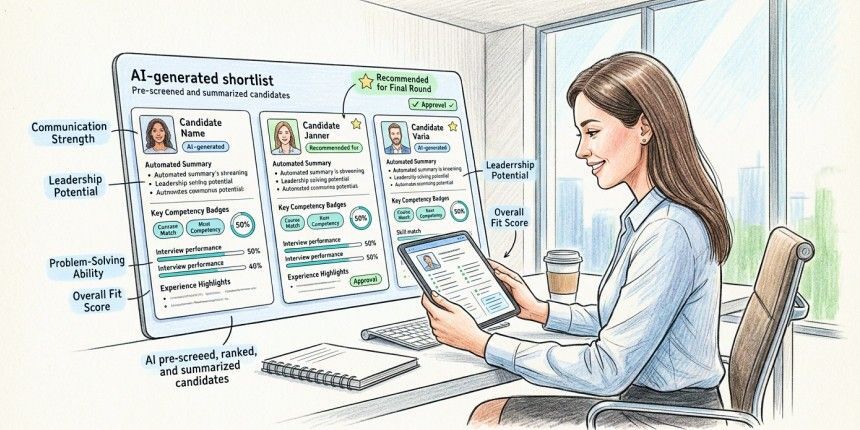
The AI interviewer handles the initial screening of hiring, while leaving the decision-making aspects to the recruiters of the hiring team. This collaborative division of labor transforms the recruitment lifecycle from a chaotic race against overflowing inboxes into an organized, data-driven selection process. Human resources professionals are no longer buried under hundreds of introductory phone screens, allowing them to focus entirely on deep cultural evaluation, strategic salary negotiations, and high-touch candidate experience mapping.
The screening with AI interviewers will ensure that all the applied candidates are evaluated, instead of leaving the best candidate slip away. In high-volume recruitment drives, human fatigue introduces massive inconsistencies. Studies indicate that manual resume screening typically carries an estimated accuracy rate of only 70%, meaning qualified prospects are frequently dropped simply because their resumes sat at the bottom of a stack of 200 applications. This shift toward autonomous hiring ensures every applicant is processed with identical focus, uncovering talent that might otherwise be overlooked.
The Core Types of AI Interviewers
To build true topical authority around automated screening, it is vital to categorize an AI interviewer by its conversational delivery mechanism. Companies utilize distinct desktop and voice architectures based on their technical requirements, target demographics, and localized corporate environments.
Phone Interviewer
The AI agent conducts a telephonic interview with the applied candidates, asking the questions fed by the employers for initial filtering. The responses of the candidate are recorded and filtered based on the answers given to the questions. This module operates efficiently over traditional telephone lines or web-audio interfaces. AI phone screening at this scale is highly valuable for high-volume frontline or hourly roles where applicants expect immediate, low-barrier engagement.
Asynchronous AI Interviewers
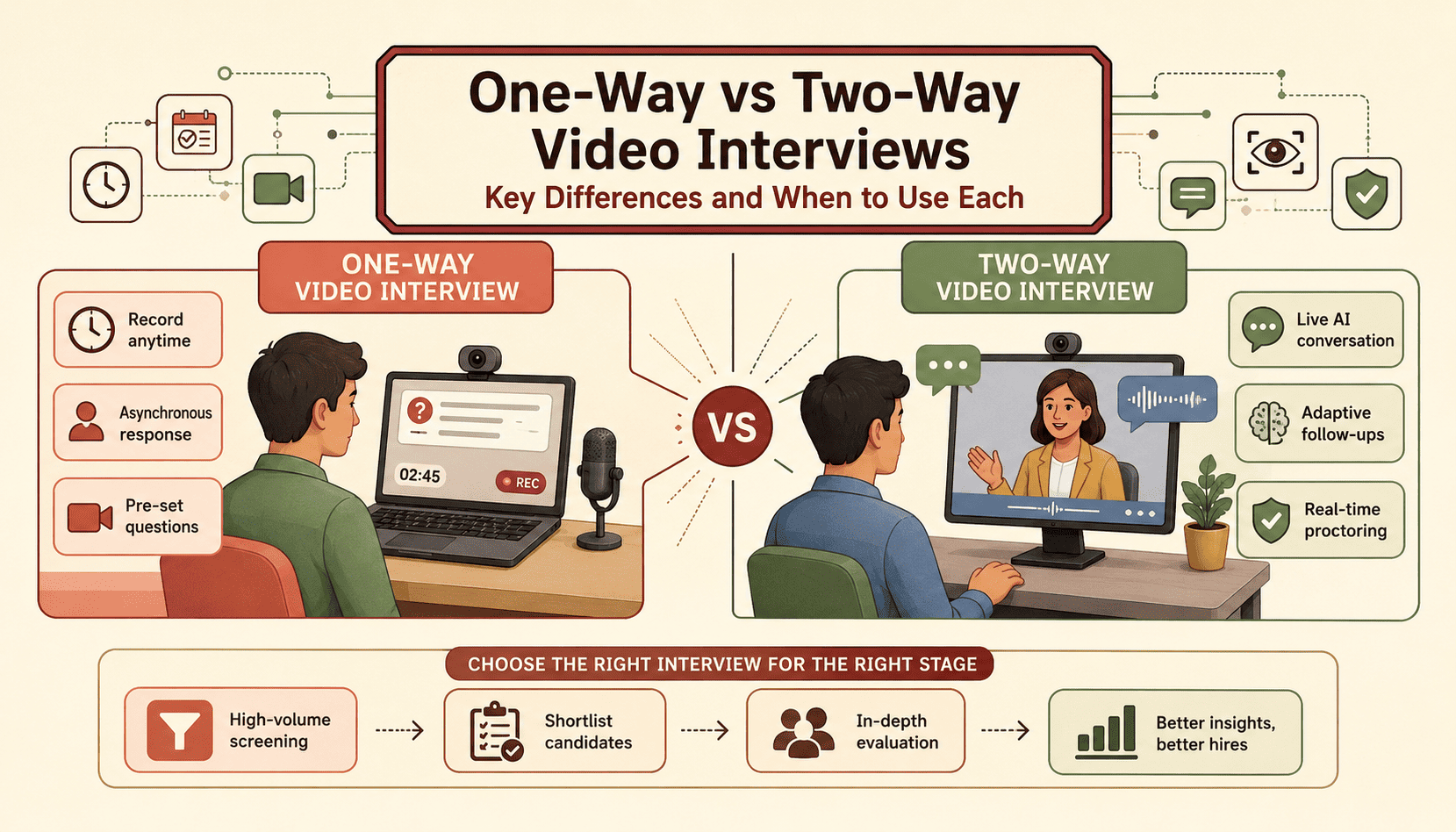
It is a one-way interview, where AI drives the interview based on the input given by the employer. The interview session is recorded, and the recording will either be reviewed by AI or by the employer upon completion. There are no spontaneous questions or interactions. It is all about preset questions in this session. This approach gives candidates the flexibility to complete assessments on their own schedules within an authorized web browser, maintaining a structured, identical format across all respondents.
Two-Way AI Interviewers
It employs a conversational AI for spontaneous and interactive sessions, where the questions are based on the candidates’ answers. The areas of assessment will be fed with relevant concepts and skills according to the designation by the employer. If a candidate mentions a specific project management methodology, the desktop system dynamically generates intelligent follow-up questions to test the actual depth of that experience, closely mirroring an organic human conversation. This is where an AI video interviewer delivers its strongest signal on candidate depth and role readiness.
Coding Assessment
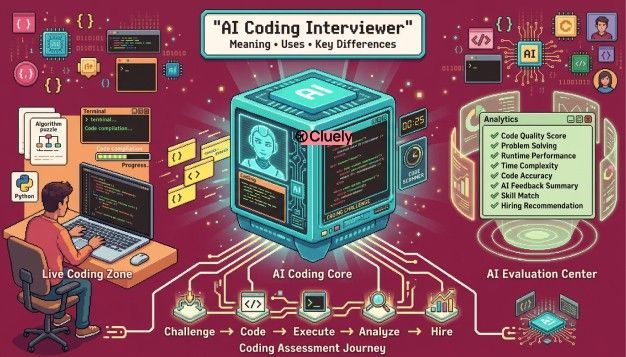
For positions that require assessing the technical aspects and strengths, the AI agent will conduct a coding assessment, where the employer can look through the recording of how the candidates take their technical test. As a dedicated coding interview tool, the platform evaluates real-time syntax execution, algorithmic logic, and structural problem-solving approaches, compiling exhaustive performance scorecards alongside the video recording.
Proctoring
Be it one-way interviews, two-way, or coding assessments, they will all be proctored by AI with recordings of the sessions for employers to review later. AI can flag and take note of instances where the candidates might need help. The AI interviewer might also have insight into candidates’ screen activity to check for any external devices or extensions. This mechanism safeguards the integrity of remote hiring, ensuring that every evaluation score reflects authentic candidate skill.
Key Benefits of Deploying an AI Interviewer
Implementing an AI interviewer significantly mitigates the structural inefficiencies that plague legacy corporate hiring funnels. Organizations transitioning away from manual workflows experience measurable gains across operational speed, fairness, and resource allocation.
Speed
Candidates have plenty of options with employers, and the best candidates get hired faster. It is important to sort candidates and assess the received applicants, and give them updates to keep them informed. When there is a delay with manual screening and other processes, it leads to candidates choosing employers who respond more quickly.
According to statistics, nearly 60% of job seekers abandon applications midway if the process takes too long.
While manual screening requires an average of 12 to 18 hours per 100 CVs, an integrated automated screening engine processes identical volumes in 10 to 15 minutes. This dramatic acceleration prevents qualified prospects from growing indifferent or accepting competing offers due to slow feedback loops.
Efficiency
The AI interviewer filters candidates based on their skills and not just based on gut feelings. Human screeners are inherently prone to unconscious biases, varying fatigue levels, and inconsistent evaluation criteria depending on the time of day. According to data compiled by the Pew Research Center and Tidio, 43% of hiring decision-makers state that removing human bias is the primary advantage of deploying AI tools in recruitment.
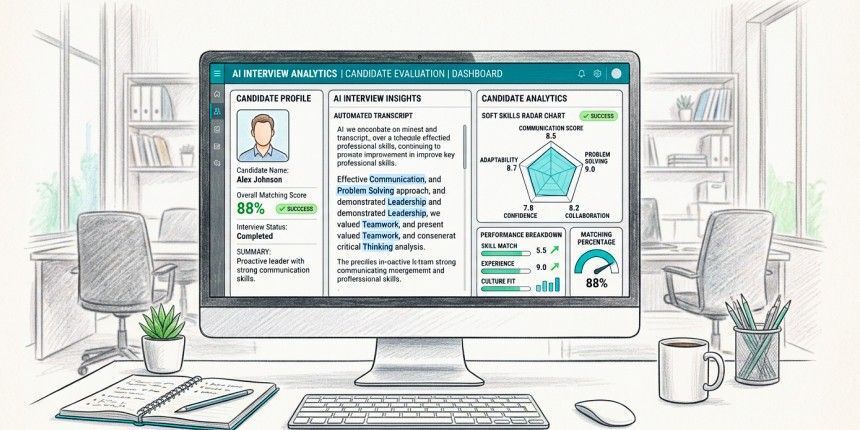
Because an AI interviewer evaluates raw competencies and verbal or written alignment against strict programmatic rubrics, it delivers highly consistent results. Academic and vendor tracking data show that utilizing well-mitigated conversational recruitment software can cut baseline hiring bias by up to 40% while pushing screening accuracy up to 95%.
The manual process takes around 12-18 Hours, creates high fatigue, and gives 70% screening accuracy.
AI Interviewer takes around 15 minutes with zero Fatigue and delivers 95% screening accuracy.
Additional Strengths
- Structured Workspace Evaluation: Enforcing desktop-only participation ensures candidates are in a focused, professional environment free from casual mobile distractions.
- Massive Cost Reduction: Automating early-stage vetting results in an average 30% reduction in cost-per-hire by minimizing administrative overhead.
- Predictive Hiring Quality: Data-driven ranking helps surface candidates who have a 14% higher likelihood of passing subsequent human final rounds.
Real Use Cases: True Impact of an AI Interviewer in Enterprise Environments
Examining real-world deployments demonstrates how global brands successfully scale talent acquisition by transitioning from legacy tracking workflows to highly structured, automated interactive screenings.
Consumer Goods Sector Optimization
Unilever historically struggled with managing over 1.8 million applications annually for its global early-career tracks, resulting in a manual screening process that stretched across four to six months. By deploying automated interactive screening engines, conversational video screening, and automated data tracking, the enterprise completely re-engineered its recruitment economics.
According to the published Unilever Early-Career AI Case Study, the organization compressed its total time-to-hire by 75%, shifting from four months down to just four weeks. Additionally, this centralized digital filtration workflow generated over £1 million in annual resource savings, reclaimed 50,000 hours of candidate evaluation time, and drove a 16% increase in hiring diversity by standardizing evaluation metrics across all applicant pools.
High-Volume Hospitality Scaling
Hilton required an agile mechanism to manage high-volume recruiting for its core customer care and reservations divisions, where a legacy 100-question application led to massive talent drop-off and a grueling 42-day average hiring cycle. The organization introduced automated conversational screening modules to replace manual coordination and transactional phone screens.
Data from the Hilton Automated Recruiting Assessment Analysis reveals that implementing structured automated screening collapsed the application-to-offer window from 42 days down to just 5 days, an 88% reduction in pipeline duration. This technological shift boosted internal recruiter productivity by 83% more offers handled per week, reduced manual administrative workloads by 23%, and secured an outstanding candidate Net Promoter Score (NPS) of 84.9.
Financial and Industrial Infrastructure Conversions
Global enterprises across financial and consumer manufacturing sectors experience similar scalability milestones when transitioning away from manual workflows. For instance, Mastercard deployed automated interview scheduling matrices to manage high-volume talent tracks, resulting in an 85% reduction in coordination overhead. In the instance of the Mastercard Talent Ecosystem Metrics, the system successfully scheduled 88% of all candidate rounds within 24 hours of application submission.
Simultaneously, home appliance manufacturer Electrolux integrated automated one-way screening workflows to streamline early evaluation paths. Their tracking reports document an 84% increase in their application conversion rate, a 51% drop in incomplete submissions, and over 20% total recruitment time saved by cutting initial phone screens.
Operational Guide: How to Use Each AI Interviewer Product
To successfully implement an AI interviewer, talent acquisition leaders must match the exact functional workflow of each automated product configuration with their internal operational steps.
AI Phone Screener
To use this recruitment software tool, employers input a core set of primary qualifying questions and define ideal answer parameters within their dashboard. The automated engine executes outbound phone calls to applicants immediately upon resume submission. The system transcribes spoken audio into structured text data, screens for mandatory requirements (such as salary alignment or relocation willingness), and logs performance markers within the central applicant tracking system (ATS).
One-Way AI Interviewer
The hiring manager configures a series of predefined text prompts or short video clips outlining specific skillsets. Candidates open a secure link via their desktop or laptop browser to record video responses within a fixed time window. The underlying evaluation models analyze the key competence patterns of the recordings, providing recruiters with an automatically ranked candidate leaderboard.
Two-Way AI Interviewer
Employers define specific technical concepts, communication criteria, and key soft skill matrices tied directly to the job designation. When the live conversational web session begins, the system listens to candidate answers and injects dynamic follow-up prompts to test depth. To maximize utility, HR teams review the real-time AI generation paths alongside the automated summary reports to understand exactly how an applicant handles unexpected problem-solving scenarios.
Proctoring Modules
Recruitment teams enable automated identity and environmental monitoring before deploying remote technical or coding tasks. The platform activates desktop webcams, captures audio signatures, and records active screen layouts. The AI proctor automatically flags specific anomalies such as external devices, copy-paste actions, tab switches, or secondary voices, enabling recruiters to quickly filter out fraudulent assessments without manually watching hours of video footage.
Strategic Matrix: When to Deploy Each AI Interviewing Modality
Selecting the right deployment framework for your conversational recruitment software depends directly on the target role profile, applicant volume, and verification requirements.
| Recruiting Use Case | Target Role Profile | Optimal AI Architecture | Key Evaluation Focus |
|---|
| High-Volume Frontline Hiring | Retail, Hospitality, Customer Support | AI Phone Screener or Asynchronous Desktop Chat | Basic eligibility, availability, and verbal communication speed |
| Enterprise Campus Sourcing | Engineering, Software QA, Data Science | Coding Assessment with Desktop Proctoring | Algorithmic logic, syntax execution speed, and identity validation |
| Mid-Market Corporate Roles | Sales Development, Operations, HR | Two-Way AI Interviewer (Conversational Web) | Conceptual depth, presentation skills, situational judgment |
| Executive Core Shortlisting | Product Management, Lead Architecture | One-Way AI Interviewer (Behavioral Desktop) | Strategic alignment, leadership frameworks, core competencies |
Key Takeaways for Modern Talent Teams
Before integrating automated screening engines into an active corporate talent infrastructure, executive teams should align on key operational principles:
- The Human-in-the-Loop Standard: An AI interviewer functions strictly as an advanced screening, data filtration, and talent intelligence asset. It does not replace the critical empathy, cultural mapping, and relationship-building capabilities of human recruiters. Instead, it empowers them to make highly informed final hiring decisions.
- Prevent Funnel Leaks: Shifting from manual resume tracking to immediate, automated candidate interaction protects talent acquisition pipelines from high applicant drop-off rates.
- Maintain Robust Evaluation Standards: Requiring stable desktop connections eliminates casual candidate drop-offs and guarantees clean, consistent video and audio capture for the grading models.
- Enforce Absolute Integrity: Leverage multi-layered automated desktop proctoring frameworks to ensure fair, verified outcomes across all remote evaluation loops.
Elevate Your Recruitment Infrastructure with Hyring
Building a high-performing corporate team requires both advanced talent intelligence and immediate access to top-tier expertise. While standalone point solutions focus exclusively on basic automated screening, Hyring delivers a comprehensive, enterprise-grade web recruitment platform designed for the modern world of work.
Hyring streamlines candidate qualification by seamlessly combining structured desktop-based one-way screening workflows, dynamic two-way interactive interviews, and deep evaluation scoring reports, built on video interview software that lets AI conduct every interview independently. Because Hyring enforces secure browser environments and does not conduct assessments over mobile phones, the platform features an incredibly stable, multi-layered remote proctoring suite powered by advanced desktop computer vision to protect the absolute integrity of your global remote hiring loops.
Automated Anti-Fraud Protocols
- Tab Change Tracking & Screen Sharing: Detects and flags when an applicant navigates away from the active browser evaluation window or accesses unauthorized secondary resources or extensions.
- Computer Vision Monitoring: Instantly identifies face-out-of-view anomalies, multiple faces within the desktop camera frame, or unauthorized external monitors through precise eye-gaze analysis.
- Audio Intelligence Matrix: Flags multiple voice signatures or unexpected vocal patterns during real-time speech responses to eliminate proxy interviewing.
Beyond providing an industry-leading AI interviewer platform, Hyring connects corporate leaders with a globally curated network of independent human capital specialists across 50+ countries. Through its centralized web dashboard, enterprise clients can configure their core criteria, launch automated custom evaluation workflows, and review rubric-based scorecards to secure top-tier talent without administrative friction.
Conclusion: Driving the Future of Sustainable Global Talent Acquisition
The rise of the AI interviewer represents far more than a temporary shift in corporate human resources technology; it signals a fundamental structural transformation in how global organizations approach talent acquisition, define, discover, and secure human capital. By moving past the operational constraints of legacy manual workflows and fragmented ATS pipelines, forward-thinking enterprises are discovering that automation does not dilute the vital human element of recruitment. Instead, it actively preserves and elevates it. When talent acquisition teams are liberated from the grinding, repetitive administrative tasks of early-stage screening, they are finally empowered to step into highly strategic organizational design roles.
Recruiters can redirect their entire focus toward cultural alignment, high-touch relationship management, offer conversion, and personalized candidate onboarding. This shift turns human resources from a reactive cost center into a proactive vehicle for enterprise growth.
Stop spending valuable hours scrolling through unverified CV pools and managing fragmented video software. Bring true order, data-driven fairness, and elite human capital expertise to your organization's talent acquisition strategy today.
Frequently asked questions
1. What exactly is an AI interviewer?
An AI interviewer is a software application that automates the early stages of the hiring process. Using artificial intelligence, it can screen resumes, conduct initial phone screens, or host asynchronous (one-way) and conversational (two-way) video interviews to evaluate candidates based on an employer's specific criteria.
2. Does an AI interviewer replace human recruiters?
No. An AI interviewer is designed to handle the time-consuming administrative and screening tasks (like checking basic eligibility or technical skills). This lifts the burden of early-stage screening of human recruiters, allowing them to focus entirely on deep cultural evaluation, strategic salary negotiations, and relationship building.
3. What is the difference between a one-way and a two-way AI interview?
One-Way (Asynchronous) Interview: The candidate is given preset questions by the employer and records their answers. There is no live interaction or spontaneous questioning. Two-Way Interview: This is a live, interactive, conversational session. The AI adapts to the candidate's answers in real time, generating intelligent follow-up questions to test the actual depth of their experience.
4. How does an AI interviewer reduce hiring bias?
Human screeners are prone to fatigue and unconscious bias. An AI interviewer evaluates every candidate against strict, predefined programmatic rubrics. By focusing solely on raw competencies and alignment with the job requirements, it can cut baseline hiring bias by up to 40%.
5. What is AI proctoring, and how does it prevent cheating?
AI proctoring safeguards the integrity of remote assessments by monitoring the testing environment. Platforms like Hyring use desktop computer vision and audio intelligence to flag anomalies such as tab switching or navigating away from the test window, multiple faces in the camera frame, or eye-gaze deviations and secondary voices or unexpected vocal signatures in the room.