What will this guide cover?
This guide explains what an AI coding interviewer does, how it works, and how it differs from other types of technical assessments.
What is an AI coding interviewer?
An AI coding interviewer runs structured coding interviews and scores developer skills using AI.
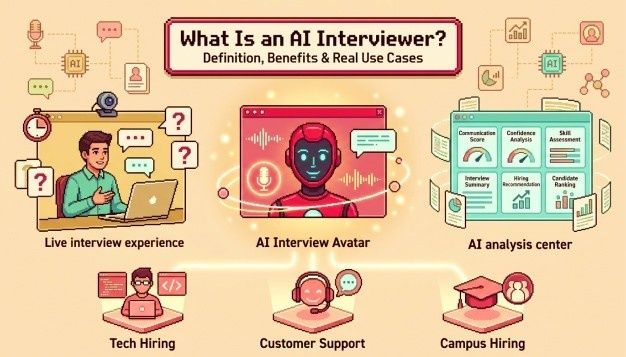
It is a technical hiring tool that runs coding interviews without needing a human on every early-stage call. It asks role-specific coding questions, gives the candidate a live coding environment, records the session, and produces a detailed report.
Good interviewing tools look beyond the final answer. They track code quality, how the candidate approached the problem, how they fixed errors, how long they took, how clearly they communicated, and whether the session looks clean from an integrity standpoint.
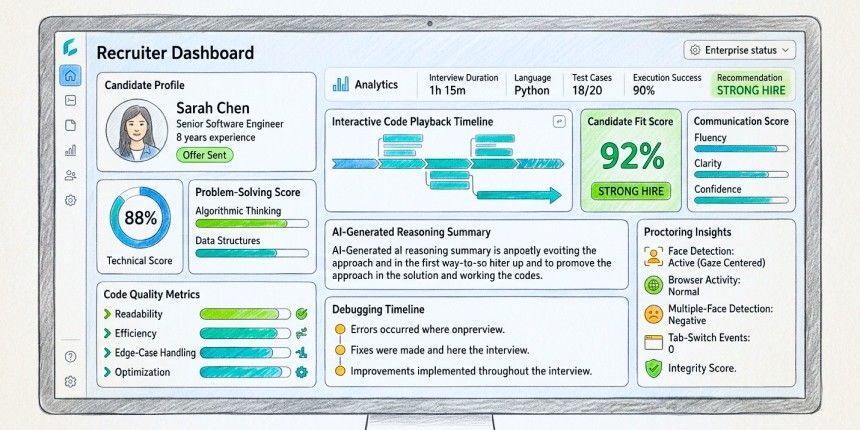
Hyring's AI Coding Interviewer is built for this. It runs live coding interviews, supports coding exercises, includes built-in proctoring, and gives recruiters detailed reports with fit score, code quality, problem-solving, benchmarking, and transcripts.
The simplest way to put it: an AI coding interviewer is a structured technical interview tool that uses AI to run and score developer interviews at scale.
Why are AI coding interviewers becoming important in technical hiring?
AI coding interviewers help hiring teams screen more developers without losing structure or quality.
Technical hiring has three ongoing problems: too many applicants, inconsistent evaluation, and not enough interviewer time. A company can get hundreds of applications for a single engineering role. Not every candidate can have a first-round interview with a senior engineer.
Most traditional technical hiring relies on:
- Resume keyword filters
- Static coding tests
- Take-home assignments
- Manual screening calls
- Live interviews with busy engineers
This creates delays. Strong candidates drop off before a company finishes reviewing. Engineering teams spend time interviewing people who are not ready. And because different interviewers evaluate differently, comparing candidates becomes inconsistent.
Gartner has noted that AI and cost pressure are shaping talent acquisition, with high-volume recruiting going AI-first and AI changing how organizations assess talent. SHRM also emphasizes that AI is already transforming how work gets done, and that HR leaders need ethical, efficient, employee-centered AI strategies.
It helps by making early technical screening faster, more consistent, and easier to review.
How does an AI coding interviewer work?
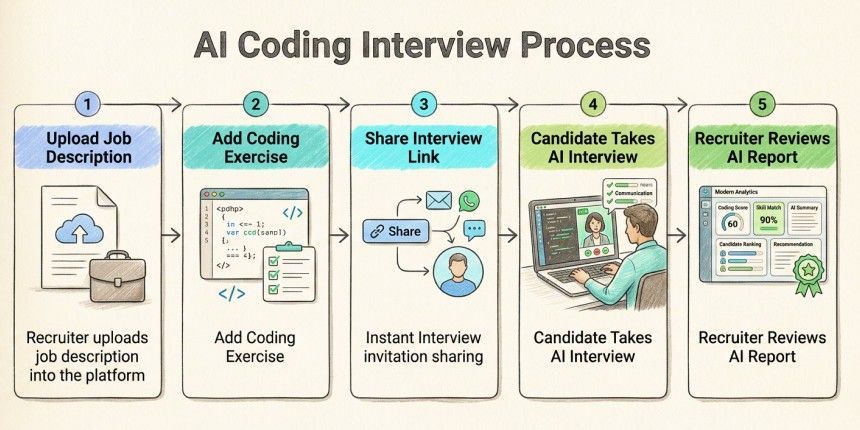
An AI coding interviewer turns a job requirement into a structured coding interview, then scores the candidate.
The process is simple:
- Upload or create the job description
- Add a coding exercise
- Share the interview link with candidates
- Candidates complete the AI-led coding interview
- Review the detailed technical report
In Hyring's workflow, recruiters can upload a job description, add a coding exercise, share the interview link, receive applications, and get a detailed report, without needing to schedule engineering panels for early screening. The tool is designed to automate technical hiring through an online coding interview platform and make recruiting faster.
A good AI coding interview tool usually includes:
- Live coding environment
- Multi-language support
- Configurable questions
- AI evaluation
- Code execution or task review
- Proctoring
- Video or screen recording
- Code playback
- Technical score
- Candidate summary
- Benchmarking and fit score
The key difference from a standard test: it captures the full interview process, not just the final answer.
How is an AI coding interviewer different from a coding test?
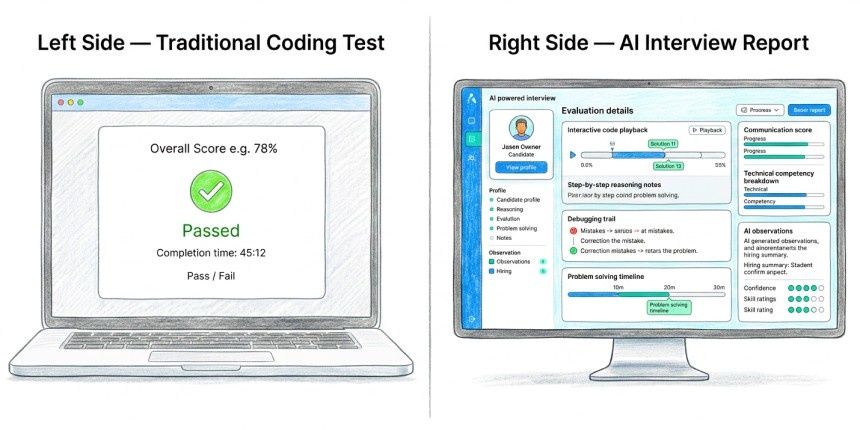
A coding test checks the final answer. An AI coding interviewer looks at the full process.
A coding test is static. The candidate gets a problem, writes code, runs test cases, and submits. The platform checks if it works. That is useful, but it does not show you much about how the candidate actually thinks.
An AI-led interview gives you more. It shows how the candidate broke down the problem, whether they thought about edge cases, how they handled errors, and how clearly they explained what they were doing.
| Evaluation area | Traditional coding test | AI coding interviewer |
|---|
| Main signal | Final code output | Coding process and final output |
| Interview style | Static assessment | Structured interview experience |
| Candidate reasoning | Usually limited | Captured through responses and behavior |
| Integrity monitoring | Basic or manual | Built-in proctoring and recording |
| Recruiter report | Score or pass/fail | Detailed technical and fit report |
| Review quality | Depends on manual review | Standardized AI-assisted evaluation |
A coding test asks: "Did the candidate solve it?" An AI coding interviewer asks: "How did they solve it, and can you trust the result?"
How is an AI coding interviewer different from a human technical interview?
An AI coding interviewer standardizes early screening. Human interviews go deeper on fit and judgment.
Human technical interviews are valuable. Experienced engineers can probe judgment, system design thinking, how someone works in a team, and whether they are ready for the seniority level the role requires. That is not something AI replaces.
The problem is not the human interview. The problem is using senior engineer time too early, on too many candidates, without a consistent structure.
A human technical interview can vary a lot based on:
- Who is interviewing
- What question do they pick
- How hard it is
- How much follow-up do they give
- Their personal biases
It reduces this variation in early rounds. Every candidate gets the same structured experience. The hiring team then reviews scores, transcripts, recordings, and code playback before deciding who goes to a human round.
The right model is not AI instead of humans; it is AI before humans. Hyring's broader AI-driven recruiting workflow keeps final hiring decisions human-led, while giving teams the data they need to make better calls.
What does an AI coding interviewer evaluate?
An AI coding interviewer looks at technical skill, how the candidate solves problems, code quality, and interview integrity.
As skills-based hiring grows, developer ability is not just about getting the right answer. A candidate might pass every test case but write messy, fragile code. Another might take longer but show strong problem-solving and clean thinking. A good tool picks up on both.
Core evaluation areas include:
- Technical score: How well the candidate met the coding requirement
- Code quality: Readability, structure, logic, and maintainability
- Problem-solving: How the candidate broke down the task
- Debugging: How they handled mistakes and errors
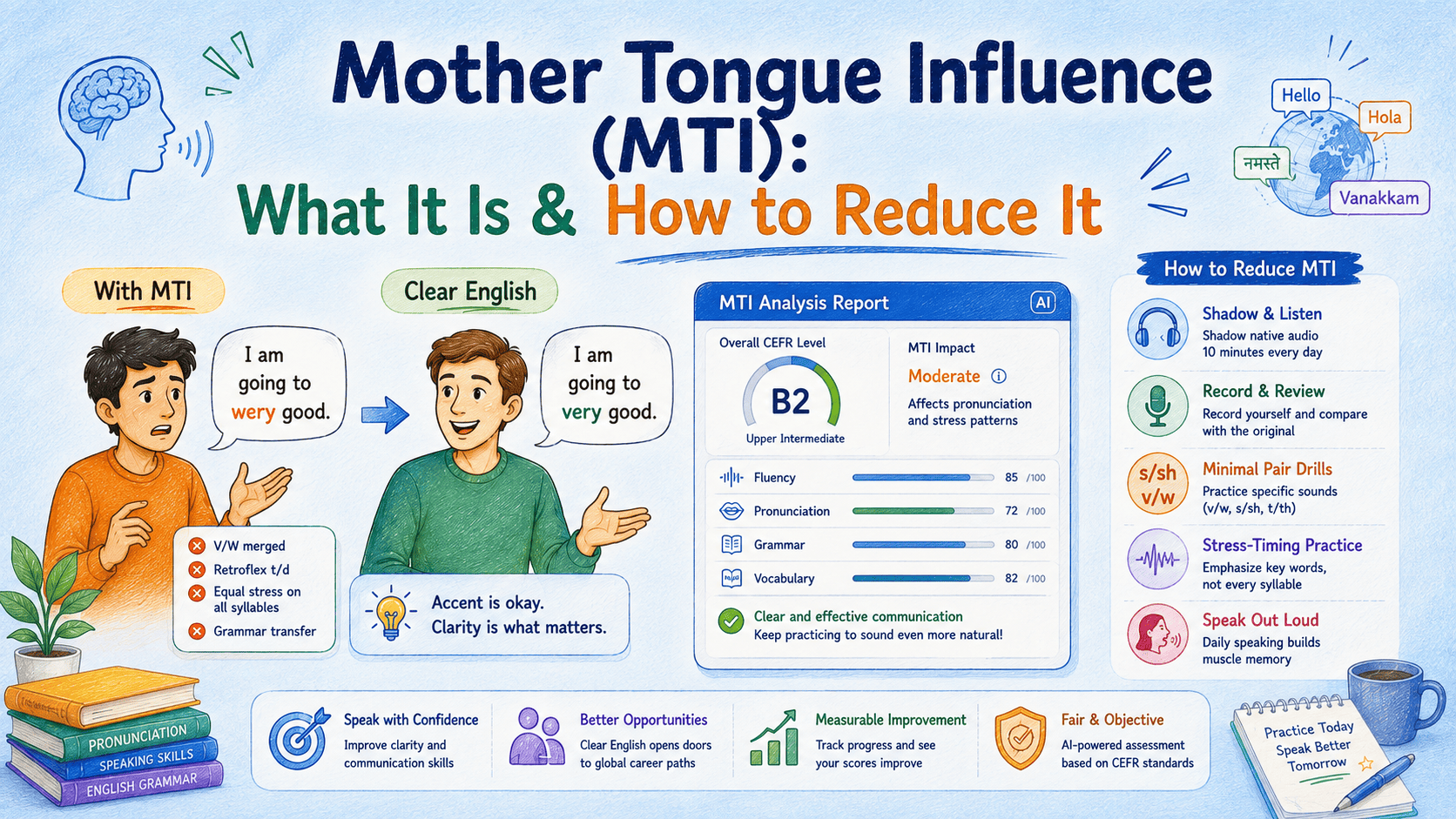
- Language proficiency: How confidently they used the chosen language
- Communication: How clearly they explained their choices
- Integrity signals: Whether the session looks clean
- Fit score: How the performance compares to the role benchmark
Hyring's AI coding interview product includes fit score, technical score, code quality, problem solving, coding languages, transcripts, AI summary, and proctoring insights, so recruiters and engineers have real context when comparing candidates.
Why does structured technical evaluation matter?
Structured evaluation makes it easier to compare candidates fairly and make better hiring decisions.
Structured interviewing is a proven best practice. Google re: Work defines it as using the same interview questions, the same grading scale, and the same criteria for every candidate applying to the same role.
In developer hiring, unstructured interviews often lead to uneven results. One candidate gets a hard dynamic programming question. Another gets an easy API task. One interviewer cares about speed. Another cares about communication. A third goes with gut feel.
An AI coding interviewer brings structure by keeping the format, exercise, rubric, scoring, and reporting consistent across every candidate.
Google re: Work also notes that structured interviews can improve how well the process predicts job performance and reduce unfair differences between candidate groups. The same applies to technical hiring: consistent process, better decisions.
What are the benefits of using an AI coding interviewer?
It helps teams hire faster, evaluate more consistently, and protect engineering time.
The real benefit is not just automation; it is a better hiring process overall.
An AI coding interviewer helps teams:
- Screen more developers without needing more interviewers
- Free up engineering panels from early unqualified rounds
- Evaluate every candidate using the same standard
- Compare candidates with consistent scorecards
- Keep better records of hiring decisions
- Flag suspicious activity in remote assessments
- Move strong candidates to human rounds faster
- Help recruiters and engineers work from the same report
This makes the whole funnel cleaner. Recruiters shortlist with stronger evidence. Engineers spend time on candidates who have already shown real ability. Hiring managers review structured reports instead of piecing together scattered feedback.
Hyring's broader platform also connects related screening layers, including AI Resume Screener, AI Phone Screener, AI Video Interviewer, and Virtual Interview Platform, so companies can connect resume screening, communication screening, coding interviews, and human review into one workflow.
What are the risks and safeguards of AI coding interviewers?
AI coding interviewers need clear rules, human oversight, and honest communication with candidates.
AI in hiring is a high-stakes use case. It affects whether people get jobs. Hiring teams should not treat it as a final decision-maker. It should be a screening layer, with humans making the final call.
Key risks include:
- Relying too much on AI scores
- Using poorly designed coding questions
- Misaligning the exercise with the role
- Candidates are not trusting the AI evaluation
- False flags from proctoring
- Algorithmic bias in how the AI scores
- No explanation behind scores
- Teams use reports inconsistently
Governance matters here. Gartner found that only 26% of job applicants trust AI to evaluate them fairly, even though many believe AI is already involved in screening. That trust gap means companies need to be transparent, communicate clearly with candidates, and make sure humans are accountable for final decisions.
NIST's AI Risk Management Framework focuses on managing risks to individuals, organizations, and society while improving trustworthiness in AI systems. SHRM also highlights the need for workplace-centered AI governance that balances innovation with accountability, safeguards, and workforce readiness.
When should companies use an AI coding interviewer?
Use an AI coding interviewer when the number of technical applicants is more than your engineering team can interview.
It works best as a structured screening step before a human engineering interview. It is not just for large companies, startups, agencies, campus hiring teams, and growing tech companies; all benefit when applicant volume is high or interviewer time is tight.
| Hiring scenario | Why an AI coding interviewer helps |
|---|
| High-volume developer hiring | Screens many candidates consistently |
| Campus engineering drives | Standardizes evaluation across large batches |
| Remote technical hiring | Adds proctoring and session recording |
| Startup hiring | Saves founder and senior engineer time |
| Recruitment agencies | Provides a technical signal before client submission |
| QA and automation roles | Tests real task execution and debugging |
| Full-stack hiring | Evaluates language, logic, and problem-solving |
| Data engineering roles | Screens coding, data handling, and technical thinking |
It is not the right fit for roles that need deep architecture discussion, leadership assessment, or final culture evaluation. Those should stay human-led.
How can hiring teams implement an AI coding interviewer?
Start with the role, not the tool. Define what matters, build the right exercise, and keep humans in the loop.
A good implementation starts with understanding what the role actually needs.
1. Define the role clearly
List must-have skills, nice-to-have skills, seniority level, and the kinds of work the candidate will actually do.
2. Choose the right coding exercise
Pick a problem that reflects the job. A backend engineer, a frontend engineer, a QA automation engineer, and a data engineer should each get a different test.
3. Set evaluation criteria
Before interviews start, decide how much weight to give code quality, completion, debugging, communication, and time taken.
4. Set proctoring expectations
Tell candidates what will be monitored before the interview begins. Surprises hurt trust.
5. Review reports with engineers
Use AI reports as structured input, not as the final word.
6. Calibrate over time
Compare who the AI shortlists with how those candidates perform in human rounds. Adjust as you learn.
7. Keep final decisions human-led
The AI coding interviewer supports the process. Humans make the final call.
This approach turns AI into a reliable screening layer, not a shortcut that creates more problems than it solves.
How does Hyring support AI coding interviews?
Hyring helps recruiters run live coding interviews, evaluate candidates, and review structured technical reports.
Hyring's AI Coding Interviewer is built for teams that want to reduce technical screening workload without losing structure. It supports live AI coding interviews, built-in proctoring, real-time coding environments, AI evaluation, detailed performance reports, benchmarking, and team collaboration.
Recruiters can upload or generate a job description, add coding exercises, share interview links, and review reports that include fit score, code quality, problem-solving, technical score, transcripts, and AI summaries.
For companies hiring across software engineering, QA, data, product engineering, and technical support, Hyring works as the first technical evaluation layer, so by the time a candidate reaches a human interview, the team already has solid data to work from.
Stop using senior engineering time for every first-round technical screen. Use Hyring's AI Coding Interviewer to run structured coding interviews, evaluate technical skills, and move the right developers forward faster.
Key takeaways
- An AI coding interviewer runs live or structured coding interviews using AI.
- It looks at code quality, technical score, problem-solving, communication, and integrity.
- It is different from a coding test because it captures the process, not just the final answer.
- It is different from a human interview because it standardizes early-stage screening at scale.
- It works best when applicant volume is high and engineering interview time is limited.
- It should be used with clear rules, transparent criteria, candidate communication, and human review.
- The best technical hiring workflows combine AI screening with human-led final evaluation.
An AI coding interviewer is not about removing humans from hiring. It is about saving human time for the moments where human judgment actually matters.
Frequently asked questions
1. What is an AI coding interviewer?
An AI coding interviewer is a tool that runs coding interviews and scores developer performance using AI. It reviews technical ability, code quality, problem-solving, and interview integrity through a structured workflow.
2. Is an AI coding interviewer the same as a coding assessment?
No. A coding assessment checks if a candidate solved a problem. An AI coding interviewer looks at the full process, how they think, code, explain decisions, debug, and complete the task.
3. Can an AI coding interviewer replace human engineers?
No. It should not replace engineering judgment at the final stage. It works best as an early screening layer, so human engineers spend time with candidates who have already shown relevant ability.
4. What roles can be assessed with an AI coding interviewer?
It can be used for software engineering, full-stack, frontend, backend, QA automation, data engineering, DevOps, and other roles that require coding or problem-solving.
5. How does proctoring work in an AI coding interview?
Proctoring monitors the session for integrity signals. Depending on the platform, this can include video recording, screen recording, tab-switch tracking, multiple-face detection, voice detection, and code playback.
6. Is an AI coding interviewer fair?
It can support fair evaluation when it uses job-relevant questions, consistent rubrics, transparent criteria, and human review. Fairness depends on how the tool is set up and used.
7. What should recruiters look for in an AI coding interviewer?
Look for a live coding environment, role-based evaluation, language support, proctoring, transcripts, code playback, detailed reports, benchmarking, team collaboration, and a human-review workflow.
8. When should a company use an AI coding interviewer?
When it has a high volume of technical applicants, limited engineering interview time, remote hiring needs, or a desire for consistent technical screening before human interviews.