Let’s say a position is listed on a job board. In no time, the recruiter will be buried in applications. The inbox becomes a mess, and half the applications might not even be relevant. The right candidate is waiting in the midst of the chaos as the candidates are chasing you for feedback.
This is what the recruitment process looks like for most teams. The need for speed without sacrificing quality is essential.
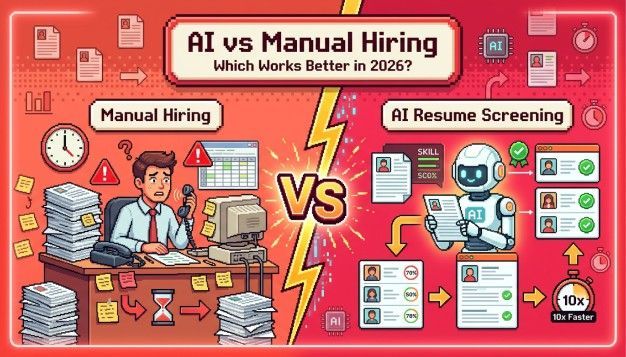
Recruiters spend about 23 hours screening resumes for a single hire, according to sources. For just one part of the process, that is a lot of time.
By taking the weight off the parts that slow you down the most, and not by taking over the process, is exactly where AI is starting to make a difference.
Here is how it actually happens and, more importantly, how you can leverage it without compromising what makes good hires good.
The Use of AI in Recruitment
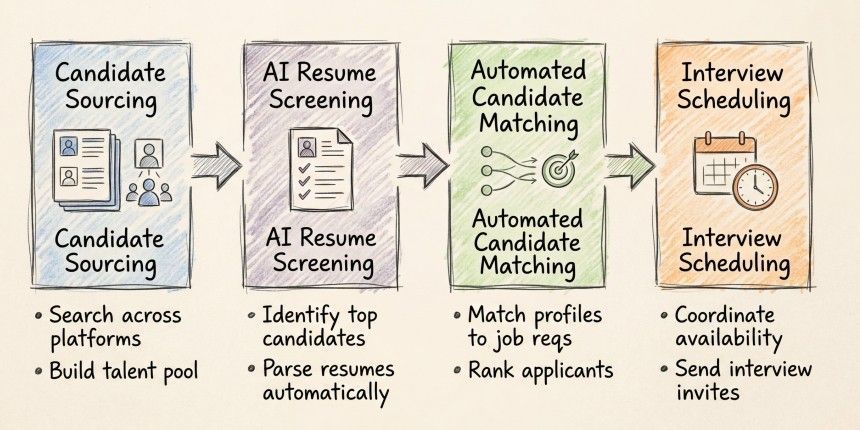
Use of AI technologies in recruitment is primarily limited to back-end activities. AI performs such routine jobs as candidate sourcing, resume screening, conducting preliminary evaluations, and interview scheduling. All these activities are repetitive in nature, so using AI allows us to complete them faster.
Thus, for example, scanning hundreds of resumes submitted in response to the open positions is done by AI resume screeners in a matter of seconds, leaving only those candidates that are compatible with what you are looking for.
AI can also help you to save a lot of time by making other types of work easier. Around-the-clock operation of recruitment bots, software that automatically identifies potential instances of bias in the wording of job advertisements, platforms analyzing statistics to find the most qualified applicants, are some examples of how AI technology may serve recruiters.
It just makes your job easier in the first place.
Why AI Works So Well for Recruitment
Hiring involves multiple steps that can be tough to manage. That is where AI comes into the picture, and it suits this process because it handles structured repetitive tasks with ease. That is the specialty of AI employment.
AI also saves time. When open jobs stay vacant, they cost money. SHRM (Society for Human Resource Management) states that the average hiring cost exceeds $4,700. By speeding up the first stages of hiring, AI helps get candidates through the system faster, keeping expenses lower.
AI also adds a point of fairness. People have off days, and everyone has some biases they might not even catch. AI evaluates every application based on the same standards. This brings structure and fairness to the process, which helps teams make smarter choices right from the start.
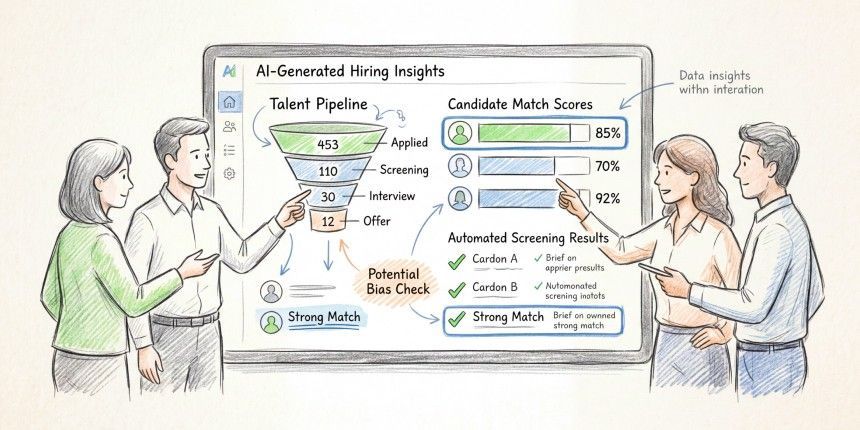
It also gives you useful data. Which job boards bring in your best hires? Where do candidates drop off? AI tracks these things so you can make smarter decisions next time.
How AI Strengthens Every Stage of Hiring
In fact, AI is not just helpful in one area of the hiring process; it can add value throughout the whole process.
In the screening part, AI can help analyze resumes quickly and accurately, giving your organization a list of the most suitable candidates in just a few minutes instead of hours spent perusing every single resume.
The candidates do not have to wait any longer or be ignored; instead, their queries are addressed, and updates are provided to ensure that no candidate feels neglected in the process, as AI drives the interview process faster.
In the interview part, scheduling does not have to be a problem because AI can find a time that is suitable for everyone and send out confirmations automatically.
In fact, AI can also be helpful in the onboarding process by automating tasks, sending reminders, and helping the new employees adjust quickly to their new roles.
Each part of the hiring process is made faster, smoother, and better with the help of AI.
How to Get Started
You do not have to change everything at once. Small steps work.
Figure out where you are losing the most time. Is it screening, scheduling, or follow-ups? Start there.
Train your team. People need to know what the tool does and what it does not do. They also need to know how to read the results it gives them.
Keep people at the centre. AI should get candidates to the interview faster. But the interviews, the conversations, the final calls? Those should always be human.
Check in on how things are going. Are you seeing better candidates? Faster hires? If something is off, adjust.
Where Hyring Fits In
As AI becomes more common in hiring, platforms that blend technology with simplicity are standing out. Hyring is one of them.
Hyring focuses on helping companies connect with qualified talent without adding complexity. The AI recruitment platform is built to make hiring faster and more straightforward while keeping the process grounded in real human interaction.
If you are looking for a way to modernise your hiring method without overcomplicating things, it is worth exploring what platforms like Hyring can offer.
What Comes Next
AI in recruitment is not going away. It is becoming the norm. The tools are getting smarter. Some can now assess soft skills through video interview software. Others predict how long a new hire is likely to stay. The technology keeps growing, and the teams using it are seeing real results.
The organisations that get the most out of AI will be the ones that treat it as a partner. The goal is not to take people out of hiring. It is to give them better tools so they can do it well.
Final Thoughts
AI uses specific criteria to screen candidates in a consistent way. It doesn’t lose focus or get distracted. It also processes data from recruiters about the role’s requirements and needed skills, which leads to better placements. This approach helps teams create stronger shortlists over time and make smarter hiring choices.
AI is transforming hiring, but the fundamentals remain the same.
You still need to understand the job. You still need to identify what excellence looks like. AI just helps remove distractions, letting you focus on what matters most. It manages the background noise so you can tune into the key details.
Stay curious. Stay flexible. Always remember that hiring is about connecting with people.
Frequently Asked Questions
1. Will AI take over recruiter jobs?
The answer is a big fat no. AI handles tasks like sorting resumes and scheduling interviews, which frees up time. The meaningful parts still require humans. Understanding cultural alignment, catching subtle cues during conversations, and making the final call all rely on people. AI speeds up the process. It doesn't replace recruiters.
2. How does AI improve the quality of hires?
AI compares candidates to the required criteria. It stays focused without losing attention or getting tired. It also reviews recruiter-provided information on needed skills and role demands, which leads to better hiring matches. This process helps teams create stronger lists of candidates over time and make smarter choices.
3. Is it expensive to use AI in hiring?
Not when you consider the return on investment. While some tools have a monthly fee, the savings usually far outweigh the cost. By reducing your $4,700 average cost-per-hire and cutting down those 23 hours of manual screening, AI pays for itself. It’s not just an expense. It’s a way to stop losing money on unfilled roles and inefficient workflows.
4. Do candidates like AI in hiring?
Candidates appreciate quicker responses and a smoother process. The best thing you can do is be upfront about how AI is used. Transparency builds trust and shows candidates that your company values their time and experience.
5. Where should we start with AI in recruitment?
Look at your biggest time drain. For most teams, that is resume screening or candidate communication. Pick one area. Find a simple tool that helps. Test it on a small scale. Learn from it. Then expand. You do not need to go all in on day one.