What is a one-way video interview (asynchronous)?
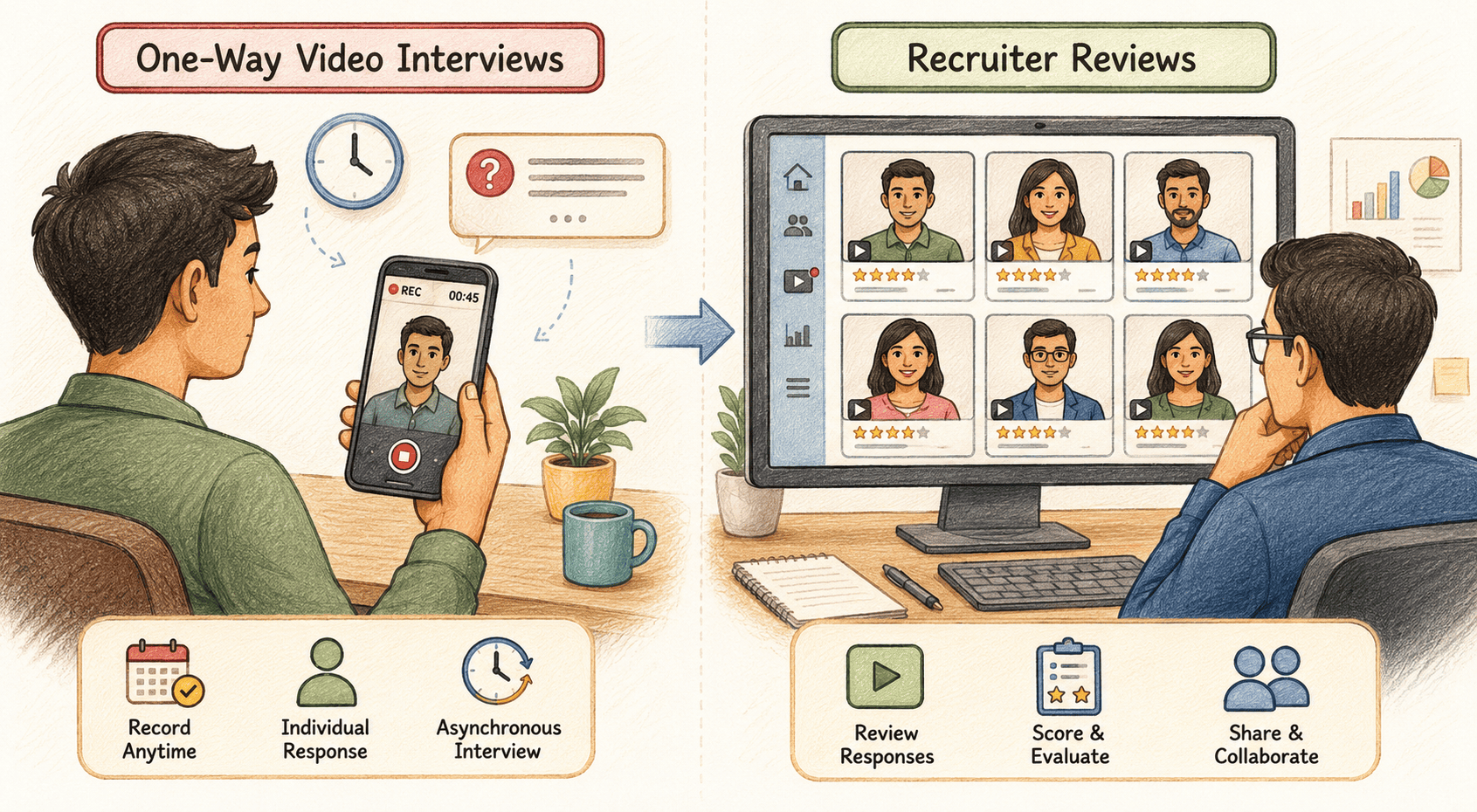
The one-way interview process is a one-sided and pre-recorded procedure. The employer inputs several questions to the interviewing software, and then the applicant records their responses via video, which can be done at their own convenience.
What is an AI-led two-way video interview (synchronous)?
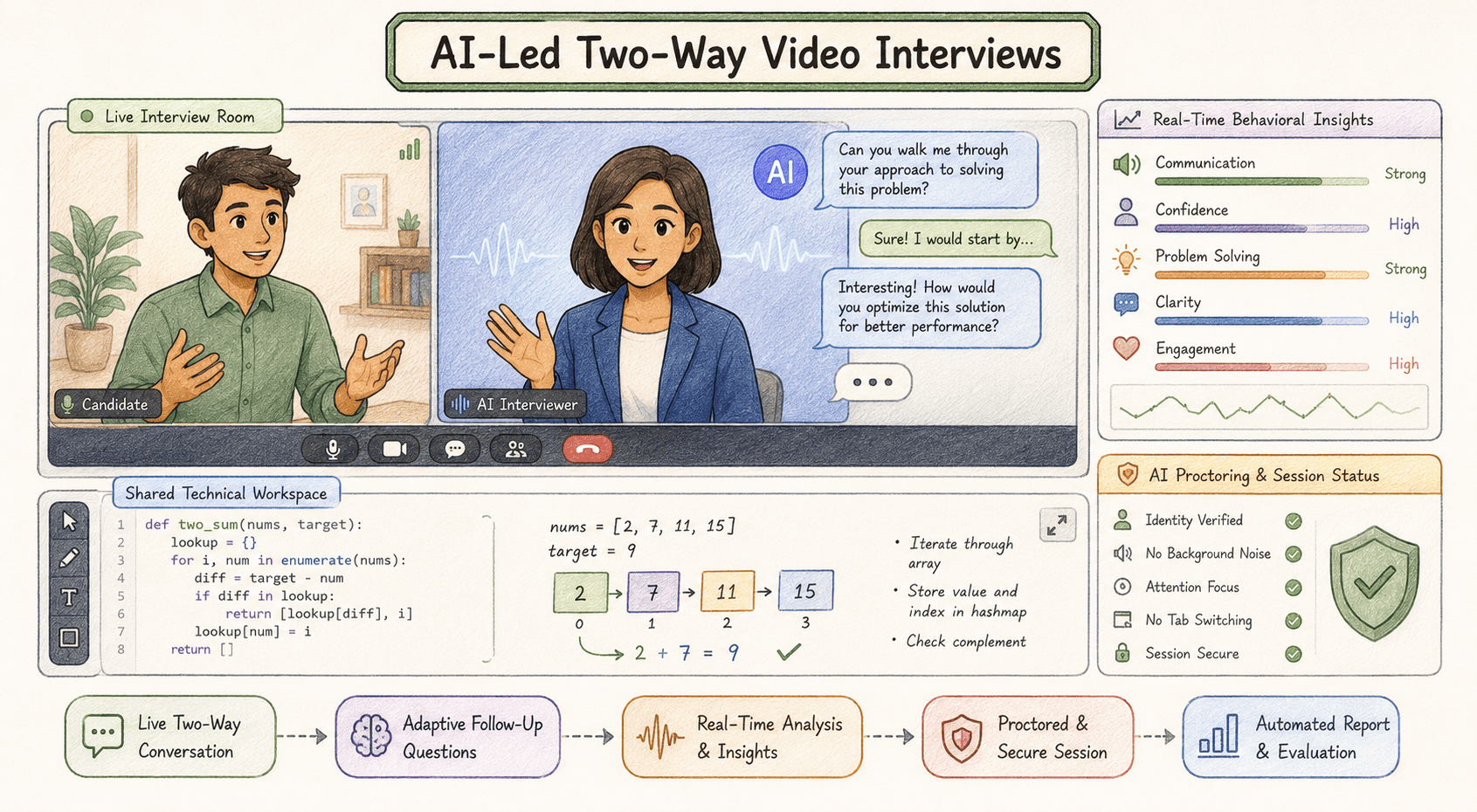
The AI-led two-way interview process is a live, real-time interactive discussion between the interviewee and an intelligent AI interviewer. Powered by conversational AI, it simulates a live human panel by asking dynamic follow-up questions and proctoring the session in real time, requiring no recruiter involvement during the live event.
The Core Differences: At a Glance
1. Interaction: Monologue vs. Dynamic AI Dialogue
- One Way: One-Sided Performance. The candidate addresses the screen, where the AI agent asks predefined questions to assess their ability to deliver an organized pitch without being provided any feedback or prompts.
- AI-Driven Two-Way: Live Dialogue. It is a live two-way interview between the AI interviewer and candidate, wherein the former is listening to the candidate’s answers and asking dynamic questions based on the candidate’s responses.
2. Time: Individual Freedom vs. Programmed Availability
- One-Way: Asynchronous. The candidate is free to record their video whenever they want, at their convenience, but within the deadline date the recruiter sets.
- AI-Led Two-Way: On-Demand Synchronous. The candidate interacts live but enjoys 24/7 flexibility; because no human recruiter needs to be scheduled, the candidate can launch the live AI interview at a time that works best for them, within the deadline date.
3. Purpose: Elimination vs. Conversational Deep-Dive
- One-Way (screening interview): It is used on a large scale to quickly identify and filter out candidates.
- AI-Led Two-Way (evaluation interview): It is used to get deep into details regarding problem-solving, critical thinking, and technical adaptation through automated, live cross-examination.
Before diving into the detailed workflows, it helps to look at how these two digital interviewing methods stack up across key operational metrics.
| Feature | One-Way Video Interviews | AI-Led Two-Way Video Interviews |
|---|
| Nature of Interaction | Asynchronous (On-Demand) | Live, Real-Time AI Conversation & Proctoring |
| Primary Hiring Stage | Early-stage screening & high-volume sourcing | Mid-to-late stage evaluation & technical validation |
| Time Commitment | Low for recruiters; fully flexible for candidates | Zero live hours for recruiters; fully flexible scheduling for candidates |
| Best Used For | Assessing basic communication & technical baselines | Assessing real-time problem-solving, live coding, & adaptive thinking |
Step-by-Step Workflow: One-Way Video Interviews
Process Flow Visual: Recruiter sets up questions -> Candidate receives link & records answers on their own time -> Recruiter reviews the submitted video dashboard asynchronously.
1. Invitation & Setup
- What happens: The recruiter initiates an automated screening campaign for early-stage applicants.
- What the candidate sees: An email invitation containing a unique, secure link to the assessment portal.
- What the recruiter sees: A live dashboard showing invite delivery success and completion rates.
- What Hyring does: Automatically generates unique assessment links and sends branded invitation sequences.
2. The Assessment Session
- What happens: The applicant completes the interview by recording video answers to pre-set text or video prompts.
- What the candidate sees: A countdown timer, reading time for the question, and a record button to log their response.
- What the recruiter sees: No live viewing; the dashboard marks the candidate status as "In Progress."
- What Hyring does: Manages the recording interface, enforces time limits, and securely uploads video files to the cloud.
3. Evaluation & Review
- What happens: The hiring team reviews the submitted responses at a convenient time.
- What the candidate sees: A completion screen thanking them, followed by automated status update emails.
- What the recruiter sees: A video playback screen equipped with scorecards, evaluation criteria, and a team sharing panel.
- What Hyring does: Transcribes audio to text, generates AI-driven soft-skill insights, and centralizes team ratings.
Step-by-Step Workflow: AI-Led Two-Way Video Interviews
Process Flow Visual: Candidate triggers the live session on-demand -> Both candidate and AI interviewer log into a live room -> Real-time, adaptive dialogue and active proctoring occur -> AI fills out a comprehensive scorecard for the recruiter.
1. Initiating the Live AI Session
- What happens: The platform invites a shortlisted applicant to launch a live, real-time deep-dive conversation with the AI interviewer.
- What the candidate sees: A launch dashboard allowing them to immediately start their live session or select an automated slot without coordinating with a recruiter.
- What the recruiter sees: An automated tracking log showing scheduled and completed automated live sessions.
- What Hyring does: Configures the conversational AI persona, provisions the live-stream environment, and syncs candidate technical tokens.
2. The Live AI Interview
- What happens: The candidate meets virtually with an interactive AI avatar that conducts a traditional, back-and-forth interview, adjusting its questions based on the candidate's live responses while continuously proctoring the exam environment.
- What the candidate sees: A high-definition, interactive video room with an avatar interviewer and an integrated conversational stream.
- What the recruiter sees: Nothing in real-time; the recruiter is completely out of the picture while the system operates autonomously.
- What Hyring does: Hosts the secure, low-latency live video stream, processes NLP (Natural Language Processing) to generate responsive follow-up questions, monitors proctoring signals, and manages interactive whiteboards.
3. Post-Interview Round-Up
- What happens: The AI system compiles the conversation performance data, structures a final evaluation report, and notifies the hiring team.
- What the candidate sees: A standardized post-interview confirmation screen displaying immediate next-step timelines.
- What the recruiter sees: An aggregated, multi-metric score breakdown, a complete transcript with marked AI follow-up points, flag logs from the AI proctor, and session playback.
- What Hyring does: Archives the session recording, tallies comprehensive AI-generated scorecard metrics, highlights proctor integrity alerts, and exports structured candidate records to the ATS.
Deploying the correct format at the right time ensures your hiring funnel remains both fast and effective.
When to Choose One-Way Auditions
Asynchronous screening shines brightest during high-volume hiring campaigns or initial applicant filtering. It allows recruiters to evaluate hundreds of applicants' communication skills, language proficiencies, and basic technical baselines without blocking off valuable calendar hours. It acts as an excellent substitute for the traditional, time-consuming phone screen.
When to Choose AI-Led Two-Way Live Sessions
Synchronous AI-led sessions are critical when deep talent evaluation is required without draining human resource hours. This format is ideal for technical screenings, engineering roles, or roles that demand real-time problem-solving, adaptive behavioral cross-examination, and active anti-cheat proctoring. It filters for talent with human-level accuracy before a recruiter ever steps in for the final cultural onboarding.
Summary: Choosing Your Best Path
Finding the right balance between one-way vs AI-led two-way video interviews does not mean choosing one over the other, and our full AI video interview software guide covers how both fit a single stack. High-performing talent teams combine both automated methods into a unified hiring funnel to optimize speed and depth. By leveraging automated asynchronous screenings early on and deploying interactive, AI-led live sessions for deeper technical evaluation, you maximize recruitment efficiency while removing scheduling friction entirely.
Key Takeaways
- One-way sessions drastically reduce early-stage screening times and eliminate initial sourcing bottlenecks.
- AI-led two-way interviews provide deep, conversational assessments and secure proctoring without consuming recruiter time.
- Hyring provides the automated infrastructure to seamlessly manage both automated formats under one centralized platform.
Frequently Asked Questions
1. What exactly does the AI analyze during an AI-led video interview?
The AI evaluates several data points depending on the platform’s settings. In a two-way setting, it analyzes the context and depth of your answers in real time to generate logical follow-up questions. It transcribes your spoken words to analyze keyword relevance, technical competency, and answer structure against the job description. It also reviews soft skills by assessing vocal characteristics (such as pacing, clarity, and tone) alongside behavioral signals to gauge confidence and engagement.
2. Can I re-record my responses if I make a mistake?
In an asynchronous (one-way) interview, candidates are often given a designated thinking time followed by a single attempt, or sometimes a multi-try feature depending on employer settings. Candidates preparing for this format can review our one-way video interview tips before recording. However, in an AI-led two-way interview, it functions like a natural conversation; you speak live with the AI, meaning you cannot rewind or re-record, though you can clarify your points dynamically just like you would with a human.
3. How does AI screening and live proctoring prevent bias?
AI screening is designed to reduce human bias by evaluating every applicant against the same rubric and set of criteria. It strips away initial subjective biases related to a candidate's background, age, or appearance by focusing strictly on the semantic content of the answers and pre-determined performance metrics. Furthermore, during live sessions, the AI proctor ensures total academic and professional integrity by monitoring secondary screens or audio anomalies uniformly for all candidates.
4. What happens if I experience a technical glitch during an AI-led session?
If your internet drops or the software freezes, built-in safeguards automatically preserve your session. The AI system typically saves your progress up to the last completed conversational exchange. Candidates can log back in using their original secure link to resume the live interaction exactly where they were cut off. Most platforms also provide real-time troubleshooting assistance on-screen.
5. Does the AI make the final hiring decision automatically?
No, the AI does not make autonomous hiring decisions. It acts as an automated screening and interviewing assistant. The system processes the video submissions, scores them based on the employer's benchmarks, and ranks the candidates on a recruiter dashboard. A human recruiter or hiring manager always reviews the top-scoring AI-led transcripts and recordings to make the final choice on who receives the official offer.