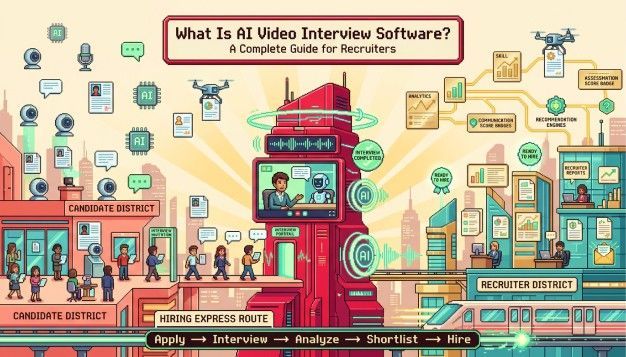
AI video interview software is designed to automate the interview process, with AI leading the session for candidates. AI video interviewer automates the early-stage hiring process by utilising artificial intelligence to independently host and guide candidate interview sessions. This shifts the recruitment paradigm from manual coordination to an on-demand, highly efficient system. It creates a seamless workflow that takes the problem of scheduling interviews completely off the charts, as candidates can take their interviews whenever and wherever they are comfortable. Because AI interviews are remote and hosted online, they operate entirely without a particular, rigid schedule.
How does the AI video interviewer work?
The AI video interviewer works in a way that captures the candidate's responses for evaluating their competence for the job role. The AI interviewer can also be an asynchronous module or a conversational two-way interviewer, based on the employer's choice and the designation. The AI video interviewer also acts as a proctor, where it monitors not just their responses but also their atmosphere and chances of any cheating. The AI video interviewer conducts the initial screening of the candidate pool.
The Ingestion and Recording Process
When a candidate logs into the system, the platform initiates a secure connection via their web browser or mobile application. The software activates the device’s webcam and microphone to capture high-definition audio and video data. As the candidate speaks, the system processes the input through several background channels:
- Audio Transcription: Real-time automatic speech recognition (ASR) converts spoken answers into structured text.
- Natural Language Analysis: Natural Language Processing (NLP) models evaluate the textual responses against structural benchmarks to check for relevant terminology and logical answer mapping.
- Visual Calibration: Computer vision frameworks monitor the physical frame to ensure consistent presence and focus.
The Evaluation of Candidate Competence
The evaluation is built around pre-configured job competencies specified by the human resource team. Rather than relying on subjective human impressions during a rapid phone screen, the AI analyzes the exact phrasing used by the candidate. It looks for behavioral proof of skills, measuring how systematically an applicant outlines a problem, details their specific actions, and highlights the quantifiable results of their work.
Active Digital Proctoring Mechanics
To protect the integrity of remote hiring, the software functions as an automated digital proctor. The system runs continuous checks throughout the active session:
- Atmosphere Monitoring: Scanning for background noise, secondary human voices, or unexpected movement within the camera's field of view.
- Tab and Window Controls: Tracking if the candidate attempts to switch browser tabs, open external search engines, or copy-paste text into the response fields.
- Gaze and Focus Tracking: Utilizing facial landmark mapping to observe if the candidate is consistently reading from an off-screen script or relying on external assistance software.
What are the types of AI video interviewers?
There are a few types of AI video interviewers deployed across modern hiring funnels, including:
Asynchronous AI video interviewer
The AI agent in the video interview does not have a dynamic, conversational session with the candidate. It delivers the preset questions and aspects, sticking to that strictly, without any spontaneous elements popping up.
The Scripted Candidate Journey
In this structural model, the candidate experience is highly linear and standardized. The user interface guides the applicant through a fixed sequence:
- Question Presentation: The question is displayed as text on the screen or read by a pre-recorded video presenter.
- Preparation Window: A countdown timer (typically 30 to 60 seconds) allows the candidate to structure their thoughts without recording.
- Submission: The camera records the response for a fixed duration (usually 2 minutes) and automatically saves the clip to the employer's dashboard upon completion.
Two-way AI video interviewer
The AI agent in the AI video interview session leads the interview in a conversational direction, and the questions are subsequent based on the candidate’s responses. The evaluation areas and skills are provided by the employer. The AI agent keeps the session engaging and keeps it conversational, as it does not just stick to a predefined set of questions. If a candidate does not have expertise in a particular area, the AI agent moves to the next concept or skill, as given by the employer. The session is recorded for employers to look back and review.
The Contextual Follow-Up Mechanism
Powered by advanced conversational language models, the two-way interviewer listens actively to the candidate's responses. When a candidate completes an explanation, the AI processes the semantic meaning of their text and constructs an adaptive follow-up prompt. For example, if a candidate mentions managing a complex cloud infrastructure migration, the AI agent might dynamically ask: "What specific security hurdles did you encounter during that data migration process?"
The Mechanics of the Adaptive Pivot
If the candidate expresses a lack of experience or struggles to answer a technical question, the AI does not create an uncomfortable roadblock. Instead, it references the employer's master competency rubric and smoothly adjusts the conversation. If a candidate for a management position struggles with advanced corporate budgeting concepts, the AI agent will move directly to team leadership or project delivery tracking. This gives the candidate an opportunity to showcase their true strengths without failing the entire assessment due to a single difficult question.
Live AI Interview
A Live AI interview introduces real-time intelligence and automated support into sessions where live interaction or human panels are actively taking place. Instead of functioning purely as an isolated, standalone screening tool, this format blends automated precision with live evaluation.
Key Aspects of Live AI Integration:
- AI-Assisted Human Panels: During a live interview conducted by a human recruiter, an enterprise AI system runs quietly in the background. It provides live, real-time transcription, suggests relevant follow-up questions based on the candidate's immediate claims, and cross-references their statements with technical requirements on the fly.
- Interactive Coding and Technical Sandboxes: For specialized engineering or analytical roles, the live AI coding interview embeds an active code editor directly into the video stream. The AI monitors the candidate's structural logic, coding efficiency, and architectural choices as they write code live, engaging with them verbally to understand their problem-solving path.
- Instant Calibration and Scoring: The moment the live session concludes, the AI synthesizes its observations into an analytical scorecard compared directly against institutional benchmarks. This allows hiring panels to conduct internal alignment meetings with objective, structured data points fresh in their minds.
Key features
The core features of modern AI interviewing tools focus on optimizing operational throughput while ensuring complete assessment integrity.
- Autonomous Agent Leadership: The video interview is led by an autonomous AI agent that can either be an asynchronous or conversational session, where the interview is recorded for employers to review later.
- Non-Deciding Authority Guardrails: The AI agent in the interview session is not the final deciding authority, and they do not replace the recruiters, but make the initial screening and assess the strengths possessed by the candidates. It helps recruiters filter the top candidates out of their long list of candidates, while looking deeper into their profiles and not just their resumes.
- Standardized Language Benchmarking: Many advanced conversational AI engines incorporate automated language evaluation models, matching candidate communication skills against international frameworks like the CEFR levels to assess fluency and clarity.
- Comprehensive Proctoring Alerts: The platform records system-level and environmental telemetry, populating a recruiter-facing dashboard with flags for potential anomalies, such as multiple faces in the camera frame, alternate background voices, or unauthorized tab switching.
- Automated Transcription and Indexing: Every recorded interview is accompanied by an accurate, timestamped textual transcript, allowing recruiters to quickly search for specific keywords or jump directly to relevant answers without watching hours of video footage.
Benefits
Implementing automated video assessments provides measurable advantages across the entire talent acquisition ecosystem.
- Hands-Free Recruiter Workflows: It gets the recruiters' hands free, and it also gives them the chance to look into every candidate who applies with the AI video interviewer. Instead of spending hours managing calendars, recruiters can focus on high-value candidate and handle high-volume hiring
- Deeper Assessment Insights: Deeper analysis of candidates and their skills with interview sessions. The platform looks beyond static resume lines to evaluate how a candidate communicates, structures their logic, and approaches real-world problems.
- Mitigation of Credentials Bias: It does not evaluate factors like the candidate’s college or previous employer name alone while filtering, when the AI is trained with the right data. It prioritizes actual, demonstrated skill and situational competence over institutional prestige.
- Drastic Reduction in Time-to-Hire: By removing the scheduling bottleneck at the top of the funnel, companies can move candidates from application to final round consideration in a fraction of the traditional time.
- Enhanced Candidate Flexibility: Applicants no longer have to take time off from their current jobs or disrupt their personal schedules to attend an introductory interview; they can complete the screening at their convenience.
According to recent talent benchmarks published by Aptitude Research, global application numbers have surged by roughly 51% across hyper-growth sectors. This sheer volume makes it physically impossible for traditional recruiting structures to review every single applicant file manually.
How to choose the right AI Video Interviewer?
Selecting the appropriate platform for your organization requires a careful balance of technical capabilities, compliance standards, and user experience considerations.
1. Evaluate ATS Integration Capabilities
An AI interviewing tool should never function as an isolated software silo. When choosing a platform, verify that it offers deep, bi-directional integration with your active Applicant Tracking System (ATS). The integration should automatically trigger interview invitations when a candidate reaches a specific milestone and push completed transcripts and scorecards directly back into the primary candidate profile.
2. Prioritize Friction-Free Candidate Experience
High candidate drop-off rates can quietly damage your employer brand. Test the vendor platform from a candidate's perspective. The ideal system should require no third-party software downloads, feature a responsive mobile interface, offer clear instructional guides, and include a safe practice environment where candidates can get comfortable before starting their formal interview.
3. Verify Global Compliance and Data Security
Because AI video interviewers process sensitive personal data, including audio and video recordings, compliance is non-negotiable. Ensure the vendor maintains rigorous security standards (such as SOC 2 Type II certification) and adheres to international regulations like GDPR and CCPA. Additionally, verify that the platform's evaluation algorithms follow EEOC guidelines for fairness and are fully auditable to avoid introducing systemic bias into your selection process.
4. Align with Your Specific Target Roles
Different job designations require different evaluation approaches. If your organization primarily focuses on high-volume customer service or retail recruitment, a standardized asynchronous platform with strong language evaluation tools is highly effective. Conversely, if you are regularly hiring technical specialists, software developers, or senior project managers, look for a vendor that provides adaptive, conversational two-way AI interviewers equipped with technical sandboxes and deep problem-solving rubrics.
How does Hyring’s AI Video Interviewer work?
Hyring’s AI video interviewer can be both one-way and two-way interviews. The one-way and two-way interviewers have options to choose an AI video interviewer representation. You can also choose an AI video interviewer to be an avatar, or a custom twin representing the human recruiter themselves.
Comprehensive Visual Representation Customization
Hyring places great emphasis on candidate comfort and brand alignment, allowing employers to customize exactly how the AI agent presents itself during a session:
- Professional Photorealistic Avatars: Candidates interact with computer-generated visual characters that maintain professional posture, and realistic conversational delivery.
- Custom Digital Twins: Recruiters can create an exact digital twin of themselves. By processing a brief video and audio sample, the system generates a custom avatar that visually and vocally represents the actual human recruiter. This preserves your unique company branding, provides a hyper-personalized touchpoint, and gives candidates a familiar face during an automated, scalable interaction loop.
- AI Voice-Only Agents: For rapid phone screening campaigns or operational positions where video is not a standard requirement, Hyring transitions smoothly into an intelligent, highly responsive verbal agent that handles phone calls with natural human cadence and tone, employing the AI phone screener.
Integrated Analytical and Security Frameworks
Hyring pairs its advanced presentation options with powerful back-end evaluation tools. The platform includes a standardized language assessment suite that measures English proficiency across the international CEFR levels (from A1 to C2) by analyzing structural fluency, vocabulary usage, and pronunciation clarity.
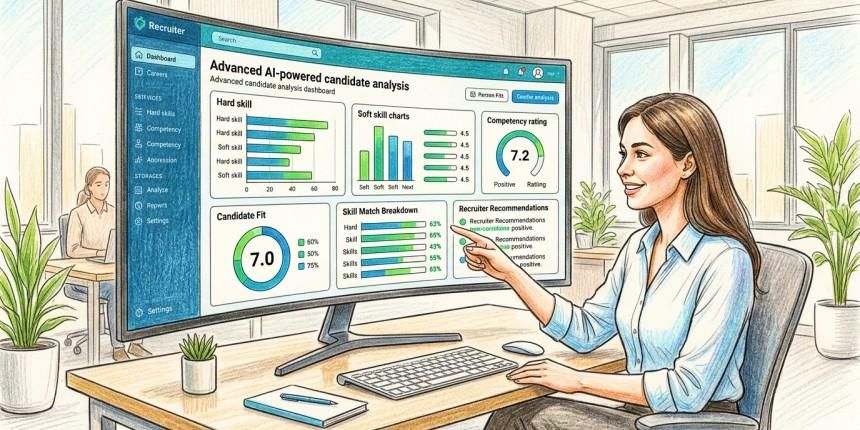
Simultaneously, Hyring’s remote proctoring AI suite continuously tracks integrity signals, identifying potential risks like external monitor connections, secondary faces, or unauthorized voices. The final output delivered to the hiring team is an actionable, highly scannable candidate scorecard. This document details topic-wise performance alongside exact video playback links, allowing human teams to bypass hours of manual review and make objective, data-backed hiring decisions quickly.
Conclusion
AI video interview software fundamentally redefines how modern businesses identify and secure top talent. By shifting the initial stages of candidate screening from rigid, calendar-dependent phone blocks to an on-demand, flexible environment, organizations can review every single applicant while keeping their recruiters' hands completely free from administrative bottlenecks.
Whether an enterprise deploys straightforward asynchronous setups for mass high-volume tracks, utilizes dynamic two-way conversational interviews to map the deep technical boundaries of specialized talent, or leverages sophisticated platforms like Hyring to deliver personalized recruiter digital twins, the results remain consistent: an objective, data-driven, and highly scalable selection process.
When implemented with clean competency rubrics, robust privacy protections, and clear human oversight, AI video interviewers do not replace the human touch of recruitment; they enhance it, allowing talent acquisition teams to look past basic resume lines and focus on what truly matters: verified competence, clear communication, and real capability.
Frequently Asked Questions
1. What is an AI Video Interviewer?
An AI video interviewer is an advanced recruitment tool which utilizes artificial intelligence for conducting preliminary screening interviews. This tool controls the interview process through asking questions, either in text or through a virtual avatar form, and also records video/audio/text responses of the candidate. The AI video interviewer then employs natural language processing (NLP) technology for assessing job competencies and skills of candidates, thereby delivering a scorecard to the recruiters.
2. Does the AI Interviewer make the final hiring decision?
No. In its core purpose, the AI video interviewer exists only to conduct initial screenings, calibration, and filtering. It ranks and sorts pools of candidates using the custom rubric set up by the employer based on the objective skills and competencies. The software lacks the power to automatically blacklist candidates and block them out of the pipeline; all the final hiring decisions, cultural fit, and job offers are managed exclusively by human HR representatives.
Platforms use a multi-layered digital proctoring solution that guarantees the integrity of the evaluation process. The software monitors various system and environmental signals during the ongoing session: detects browser tab changes to identify external searches, uses video vector analysis of webcam data to spot a candidate reading an offscreen script, and employs acoustic separation models to identify any background voices providing the answer. All the suspicious activity is automatically highlighted on the recruiting dashboard.
4. Can candidates with poor or unstable internet connections still participate?
Yes. Modern enterprise-class application systems are designed with reliable network infrastructure in mind. Interview questions are cached locally on the candidate's active web browser session. During the recording of the answer, the data is saved locally on the candidate's machine, even if there is a temporary loss of connection or some spikes in the latency. As soon as a stable internet connection becomes available again, the system automatically compresses and uploads the encrypted data packets to the cloud server without breaking the interview continuity or the candidate's score.
5. How does a conversational two-way AI handle a candidate who doesn't know an answer?
The conversational two-way AI never creates a stress-inducing and frustrating conversational loop. On the contrary, the two-way AI functions as a highly professional human interviewer. When the candidate says that he or she does not have sufficient experience in a certain field or cannot formulate an answer, the conversational AI dynamically refers to the company's competence matrix and changes its question path accordingly. The current skill gap is recorded in the technical scorecard, and the system proceeds to another core skill area.