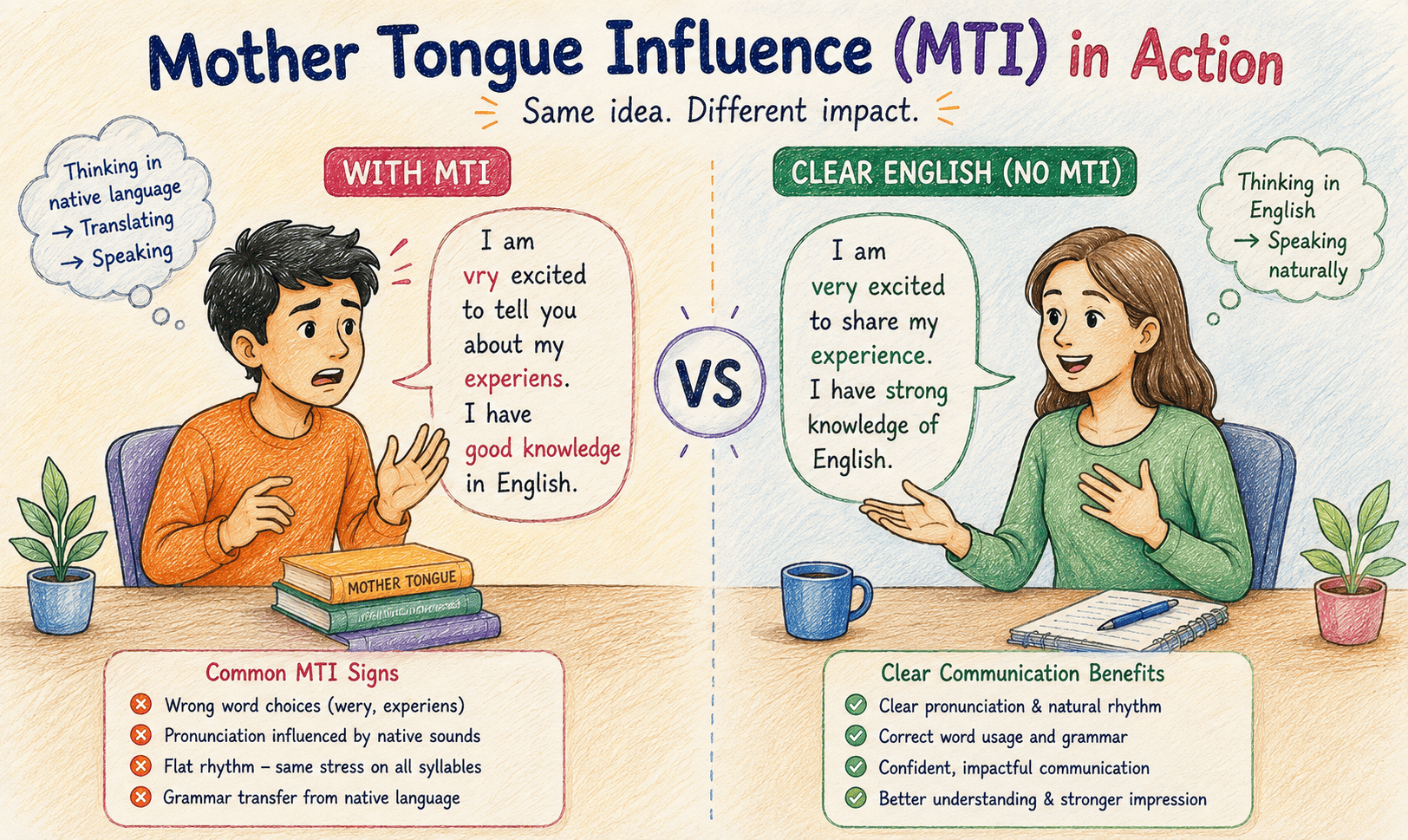
Mother tongue influence (MTI) refers to the effect that your native language has on the way you speak English, including the pronunciation, rhythm, and grammatical structure that indicate your native language. For example, the use of the word "wery" instead of "very" by a person speaking Hindi, or even putting the same emphasis on all syllables by a Tamil speaker. It can be reduced through intensive speaking and listening exercises. This guide covers the causes, the fixes, and how employers measure it.
What Is Mother Tongue Influence (MTI) in English?
Mother tongue influence (MTI) is the effect of first-language habits on your English pronunciation, stress, and grammar.
The phenomenon that linguists refer to as L1 interference involves the use of first-language structures in another language that one is learning. According to the teaching database of the British Council, one such example could be the case where Spanish speakers say “eschool” for “school”, as Spanish does not have any word beginning with an "s" followed by a consonant. Indian speakers have their own version of such speech changes.
V/w are merged into a single sound. Retroflex “t” and “d”. Stress is applied to all the syllables equally, as most of the Indian languages are syllable-timed whereas English is stress-timed.
MTI detection is not a judgment on the level of English you know. There are candidates with C1 vocabulary also having heavy MTI, and polished speakers who collapsed past small talk. Having an accent and the ability to enunciate are two entirely different things.
Why Does MTI Happen When You Speak English?
MTI happens because your ear and mouth default to the sound system your brain got wired to when you learnt your first language or ‘mother tongue’.
It then spends your entire childhood tuning itself to your first language's limited sound inventory. When English demands a sound that that inventory lacks, you substitute the nearest native one, usually subliminally, without noticing. That is the whole mechanism. Not laziness in speech but actual mental wiring.
The pattern can be detected, as was seen by a 2018 study in the Journal of English as an International Language, which followed 60 Filipino students from three language groups (Ilocano, Ibanag, and Itawes). They traced their English pronunciation and syntax errors back to each of their first languages. Different mother tongues resulted in different error fingerprints. Grammar transfers the same way - speakers of languages without articles tend to drop "the" and "a" in English much more frequently and obviously.
How Can You Reduce Mother Tongue Influence?
You can reduce your mother tongue influence through daily shadowing, self-recording, minimal-pair drills, and stress-timing practice.
Anyone asking how to reduce mother tongue influence usually wants a pronunciation course. Start with a simpler goal. Retrain your ear first, because you cannot fix a sound that you aren’t aware enough to pick up or hear.
- You have to shadow your native speech (audio) for 10 minutes a day - try playing a podcast sentence, pause, and then mimic the exact rhythm.
- Record yourself reading one paragraph and compare against the original. It may seem painfully slow and mundane, but that's where the retraining happens, and it definitely works. If a test is coming up, practice the format first.
- Practice your specific minimal pairs (v/w, s/sh, t/th) rather than generic exercises.
- One has to get the verbal stress-timing right - that is essential to remove MTI. The English language hits stressed words harder, so, for example, repeat "I WANT to GO" with proper emphasis, not just four flat words enunciated the same way.
- Speak out loud daily. Just listening to speech does not build muscle memory associated with the physiological act of speaking.
Someone had actually prepped for a voice-support role this way last year. Three weeks of self-recording had embarrassed them more than any interviewer had, but that ultimately led to cutting her filler words in half and her English improving.
How Do Employers Measure MTI in Hiring?
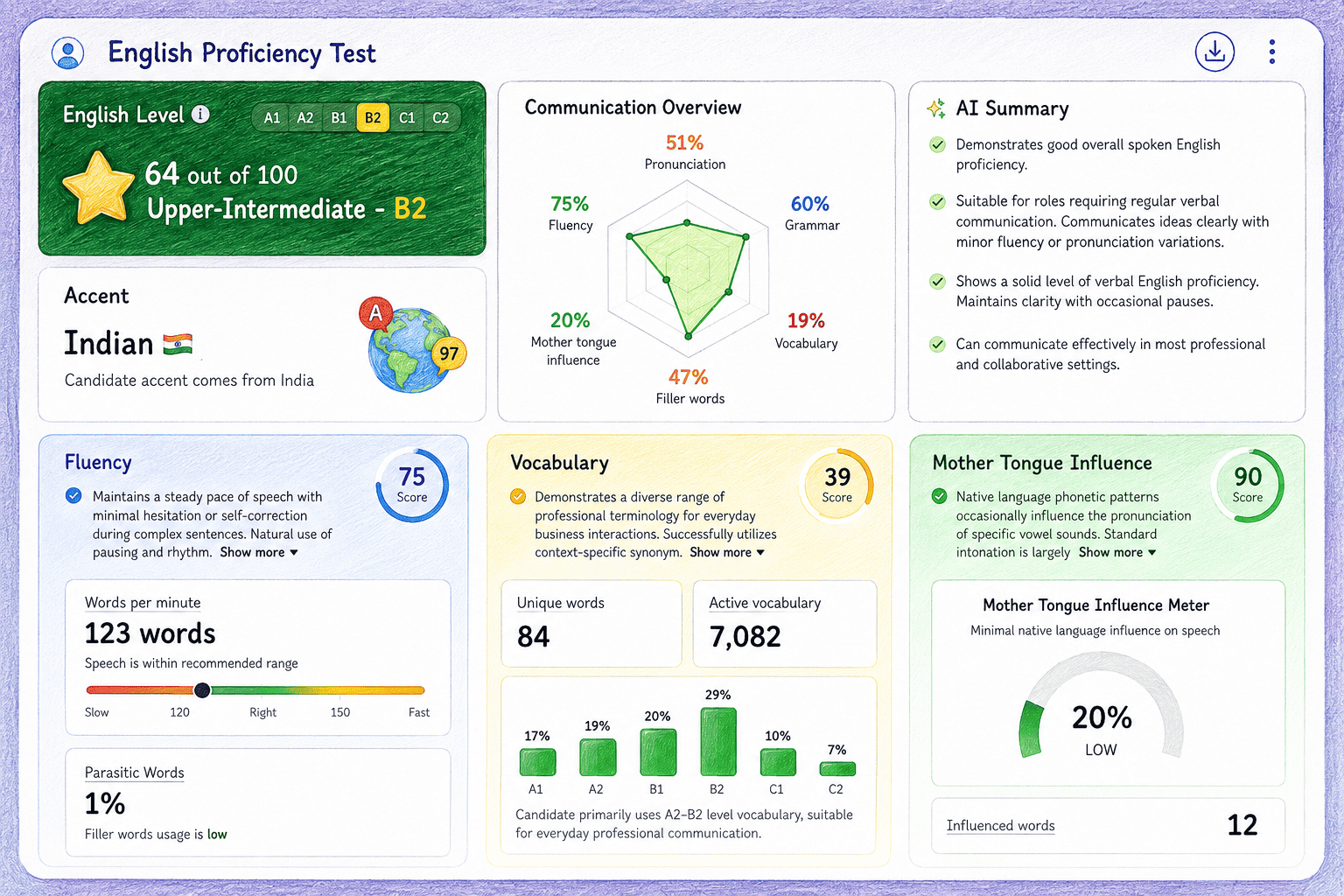
MTI is measured with an English language proficiency test that uses AI to score candidates, reporting an accent impact score alongside a CEFR fluency score.
Voice-related jobs and client-facing positions have utilized the traditional approach of the recruiter’s gut feel in the phone conversation.
It was deemed to be discriminatory and cannot be used for comparing candidates in any way.
Benchmarks have gone international - the EF English Proficiency Index assesses 2.2 million adults in 123 countries.
Hyring's English Proficiency Test runs an AI voice conversation and returns an analysis report based on the Council of Europe's CEFR scale, A1 to C2, with separate scores for fluency, pronunciation, grammar, and vocabulary.
MTI is noted in the report only as information but not as a penalty, so that a well-informed communicator having an accent will not be penalized for the latter.
Key Takeaways
- It refers to transfer from first language to English, rather than skill in speaking.
- This happens due to wiring of sounds in the brain; thus, ear training prevails over willpower.
- Through shadowing, self-recording, and minimal pairs, practice reduces it the fastest.
- The CEFR scale is used at work now to evaluate, while MTI is considered just an indication, not a flag.
Frequently Asked Questions
1. Is MTI the Same as an Accent?
No. Everyone has an accent, depending on your language and upbringing (with regards to speech development), it may either be a distinctively neutral accent (like some Indians) or can also be heavily influenced by the language that you speak. MTI is the specific set of substitutions and rhythms your first language pushes into English, and it only matters when it blurs clarity.
2. Can MTI Be Removed Completely?
In most cases, extensive training can mitigate it, however, MTI cannot be removed completely. But, you do not need to unless the way you speak is important to the way you do your job. The target is intelligibility - a B2 or C1 speaker with a light accent does fine in any workplace.
3. How Long Does It Take to Reduce MTI?
With daily shadowing and self-recording, most people hear a difference, with MTI reduction in four to eight weeks. Deep habits like stress-timing take months, so building a routine is essential. One can take their time as this is not a sprint or an overnight exercise.
4. Do Employers Reject Candidates Because of MTI?
Mature employers do not reject candidates outright. Structured tools score what you say and how clearly you say it, and how accurately AI measures spoken English has been benchmarked against human raters.