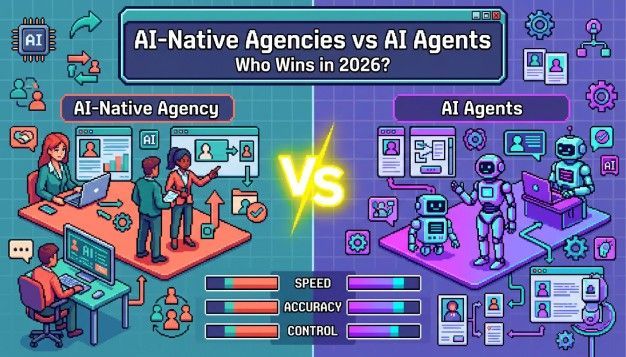
The success of AI-based recruitment agencies will exceed that of AI recruiting agents alone. This is because they use both technology and people at every step. AI agents are good at doing one task, but they struggle when empathy, culture, and negotiation are needed to hire someone successfully.
Modern recruitment is not just about automation. Rather, it has turned into a digital production line. Here is the reality check, though. 99% of Fortune 500 companies now use AI in hiring. Yet only 26% of candidates say they trust a fully automated process. That is where service providers with native AI technology come into play. Hyring is one such company. They combine semantic matching with artificial intelligence-based video interviews in their offering without losing the centrality of human skill. By 2030, it will be the players who can enhance human judgment with AI technology, rather than those who replace it, who shall emerge victorious.
How Is the Recruitment Industry Moving To AI-Native Service Models?
For the past decade, SaaS was the gold standard. You bought a tool. Your team learned it. You managed everything yourself. That model is changing fast.
In 2026, the tool is becoming the worker. Sophisticated AI agents can browse the web, send emails, and schedule meetings on their own. So why won't they just replace agencies altogether?
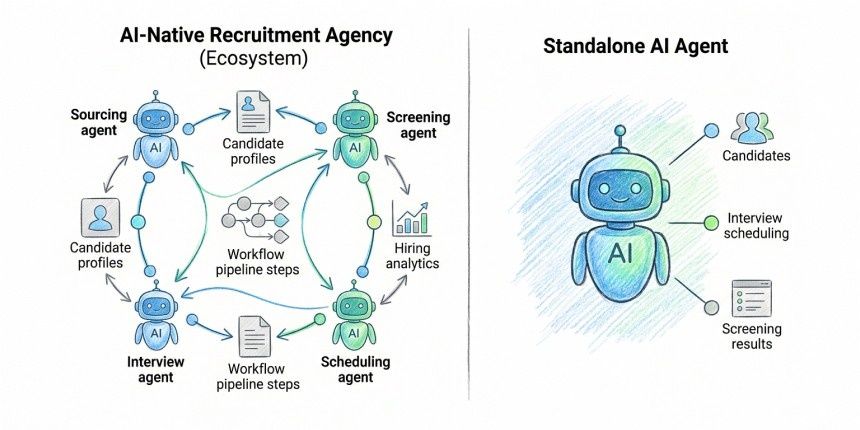
It comes down to the gap between a product and a partnership. A SaaS product hands you a hammer. An AI-native agency builds the house. These firms design their entire operational logic around artificial intelligence. They do not just plug in an API and call it innovation. They rethink how service delivery works from the ground up.
A standalone AI agent might fumble when asked to evaluate culture fit. It might miss the subtlety of a salary negotiation where timing matters more than numbers. An AI-native agency uses high-fidelity data to help its consultants make those calls faster and with more confidence. The intelligence feeds the human. The human makes the decision.
Where Do AI Agents Struggle With High-Stakes Complexity?
Let's be fair. AI agents are excellent at programmable tasks. Screening 10,000 resumes in seconds? No problem. But recruitment is rarely just a checklist of skills. It involves layers that machines still cannot navigate alone.
Contextual interpretation is one. Understanding why a candidate left a role matters. Reading between the lines of a non-traditional career path takes instinct that AI does not have.
Accountability is another. If an AI agent makes a biased hiring decision, the legal and brand fallout lands on the employer. Not the bot.
Error recovery rounds it out. Autonomous systems may hallucinate. They fail to notice when they have made a mistake. They certainly do not course-correct on their own in the middle of a sensitive conversation with a candidate.
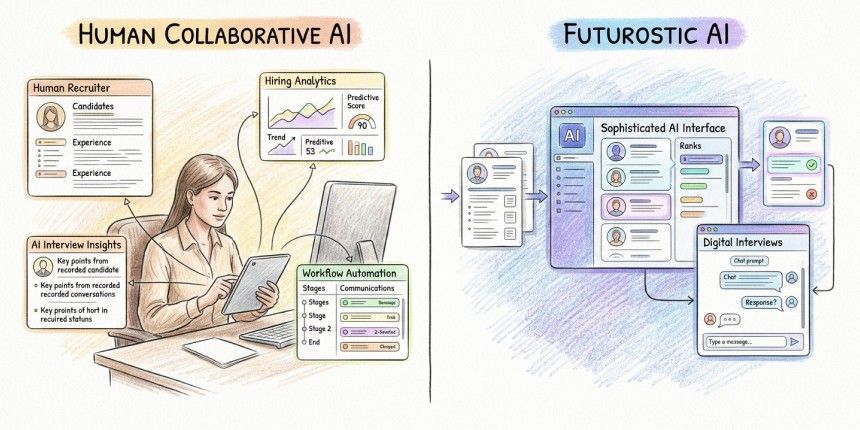
AI-native agencies solve this with a human-in-the-loop architecture. They automate the repetitive work. Resume screening, initial outreach, and scheduling. But they keep a human expert in control for the final stretch of the process. That last 20% is where empathy, ethics, and experience make or break a hire. Hyring's AI-supercharged delivery model works on this exact principle. The machine does the heavy sorting. The recruiter does the heavy thinking.
What Is the ROI of Human-AI Collaboration in Recruitment?
The financial case is getting clearer every quarter. Organizations using hybrid human-AI teams report up to 68.7% higher success rates compared to those relying on full automation alone.
Why the gap? Pure AI systems create something called verification debt. That is the time humans end up spending to fix what an unmonitored agent got wrong. A mismatched candidate who slipped through automated screening. An offer letter with the wrong terms. A scheduling conflict that no one caught because the bot assumed availability.
The total cost of errors, candidate drop-off, and damage to reputation becomes apparent when we take into account the overall expense of full automation. The hybrid model is a cheaper option because it reduces errors and produces higher-quality results initially.
How Does Hyring Bridge the Gap Between AI and Human-Led Recruitment?
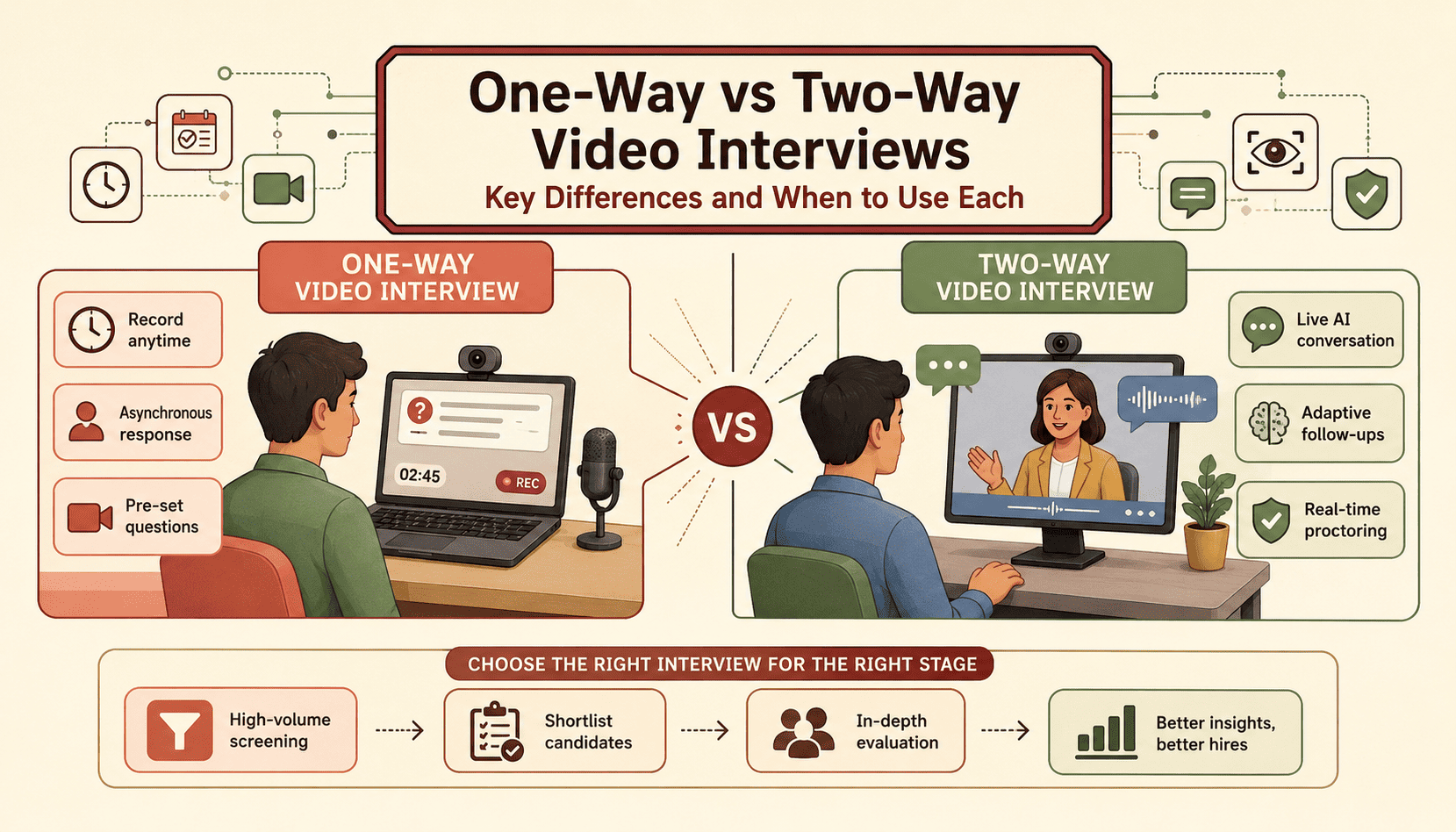
Hyring is one of the clearest examples of what an AI-native recruitment agency looks like in practice. The company was built around the idea that AI should power the process while humans guide the outcome. Their platform handles screening and candidate matching through semantic AI. Their recruiters step in for the conversations that actually close hires. They also employ one-way and two-way interview sessions, with conversational AI video interviewer that follows up with sequential questions, based on the candidate’s answer. But the human recruiter is the one to make the final call.
What sets Hyring apart is not just the technology. It is the track record behind it. Hyring is a G2 award winner, recognized for high performer status in recruitment. The company has also won an ETHR award for excellence in HR technology and a Product Hunt award, which validated its product in a global tech community. These are not vanity badges.
The leadership adds another layer of credibility. Hyring's CEO is a member of the Forbes HR and Technology Council. Both are invitation-only communities that vet members based on professional achievement and industry contribution. That kind of recognition signals that the people running the company understand both the technology side and the human side of hiring at a deep level.
For companies evaluating recruitment partners, these proof points matter. It is easy for any AI recruitment software to claim it uses AI. It is harder to earn recognition from G2 users, HR industry bodies, and Forbes councils all at once. Hyring has done that while building a platform that actually delivers on the AI-native promise.
Why Is The Agent-First Approach Not Enough For Success?
Generic AI does not have the institutional knowledge. It will not have any understanding of the corporate culture, growth stage of the organization, or what factors led to success in the previous hires. It processes data but does not contextualize it.
Why AI-based companies succeed? Because they specialize vertically. While the horizontal player can do everything, an agency specializing in recruitment will use a particular approach based on the industry. They realize that there are differences in terms of legal frameworks when it comes to hiring. They know which coding standards must be used by fintech managers.
Hyring’s semantic AI matching works exactly as mentioned above. There is real recruiting intelligence that drives this software.
What Does the Future of Hiring Look Like by Late 2026?
People have no time to switch from one software to another. The truth is that people do not want to micromanage a bunch of AI bots.
AI-native firms are turning into outcome-as-a-service organizations. The ownership of handling the AI belongs to them. They take care of their ethical practices. They make sure of its efficacy. For an expanding firm, this takes away the task of creating and sustaining the infrastructure for AI inside the organization.
The transition from traditional SaaS thinking to AI-native services is the defining shift in recruitment this year. Companies that recognize this early will hire better, faster, and with fewer costly mistakes.
Frequently Asked Questions
1. What is the difference between an AI agent and an AI-native agency?
AI agents refer to software designed to perform certain functions independently, such as resume screening and appointment scheduling. AI-native agencies are organizations that have their entire organizational structure designed using AI systems, incorporating both automated tools and human recruiters for a comprehensive recruiting experience.
2. Why do we still need human supervision in AI-enabled hiring?
AI is fast, but it struggles with ambiguity. Cultural nuances, complex salary negotiations, and ethical gray areas all require human judgment. Oversight ensures that hiring decisions stay fair, unbiased, and aligned with a company's long-term goals.
3. How does Hyring help companies shift to AI-driven hiring?
Hyring provides a platform that automates the early stages of recruitment. That includes resume screening, candidate matching, and video interviews. It then connects with expert recruiters who handle final selection, offer negotiation, and onboarding.
4. Is AI-native recruiting cheaper than traditional recruiting firms?
Yes. The automation process makes AI-native recruiting less expensive than other firms because of reduced costs and faster turnaround times.
5. Do AI-native recruiters have the ability to recruit candidates in various countries and time zones?
Yes. AI-native recruiting operates 24/7. Screenings and interviews take place according to the candidate's schedule. Recruiting networks help make sure that offers are properly made in international markets.