1,000 applications land for one open role, and even a recruiter moving fast (60 seconds per resume, if they're lucky) is looking at 16-plus hours before the first phone call goes out, more time than most hiring teams have to spare. That's the real reason AI recruiting spread as quickly as it did.
It works, in the sense that AI can pull skills and experience off a resume, line them up against a role, and sort a thousand people into rough priority groups in the time it takes to make coffee.
But a faster screening process isn't the same thing as a good one. Sloppy criteria run through a fast system reject a thousand strong candidates just as efficiently as it shortlists them, and the only sign anything went wrong is a pipeline that dries up a few weeks later, for reasons nobody can quite point to.
So AI can screen 1,000 resumes in minutes, sure, but whether that speed is actually helping you hire better people or just helping you say no to them faster is a whole different question, and it's the one most teams skip over.
TL;DR
AI is genuinely useful for the grunt work here, reading, extracting, organizing all of it at scale, but actually deciding on a candidate is still a shakier job to hand a machine. Skip the single "top 50" list if you can; let AI handle the shortlisting and let recruiters make the actual calls, with someone checking the system's work somewhere along the way. And bias and compliance shouldn't be an afterthought you bolt on once a candidate complains; it needs to be baked into how the thing gets built in the first place.
1. Can AI Really Screen 1,000 Resumes in Minutes?
People tend to talk about "screening" like it's one job, but it's actually four different jobs stacked on top of each other, and AI isn't equally good at any of them, not really.
Processing is reading the document. Extracting is pulling that content into fields: skills, job titles, years on the job. Ranking is ordering people against a set of criteria someone defined. Evaluating is the actual decision: whether this person gets an interview.
AI is strong at the first two. It doesn't get tired or skim resume #740 out of boredom, and it pulls structured data out of a messy PDF faster than a person could manage. Ranking depends entirely on the criteria it was given, so that's shakier ground. Evaluating is where a recruiter needs to be making the call, not the system.
According to SHRM's 2025 research on AI in HR, recruiting turns out to be the most common place organizations apply AI, and 44 percent of the companies using it for recruiting apply it specifically to resume screening, with 89 percent of those saying it saved time or improved efficiency, a real number that still doesn't tell you if the hiring decisions themselves got any better.
2. Step 1: Define What "Qualified" Actually Means
Most teams rush straight past this step. Which is kind of the whole ballgame honestly, since it's probably the one thing deciding whether everything downstream works. A vague job description fed into AI doesn't get fixed by the AI. It just gets applied to a thousand resumes instead of ten.
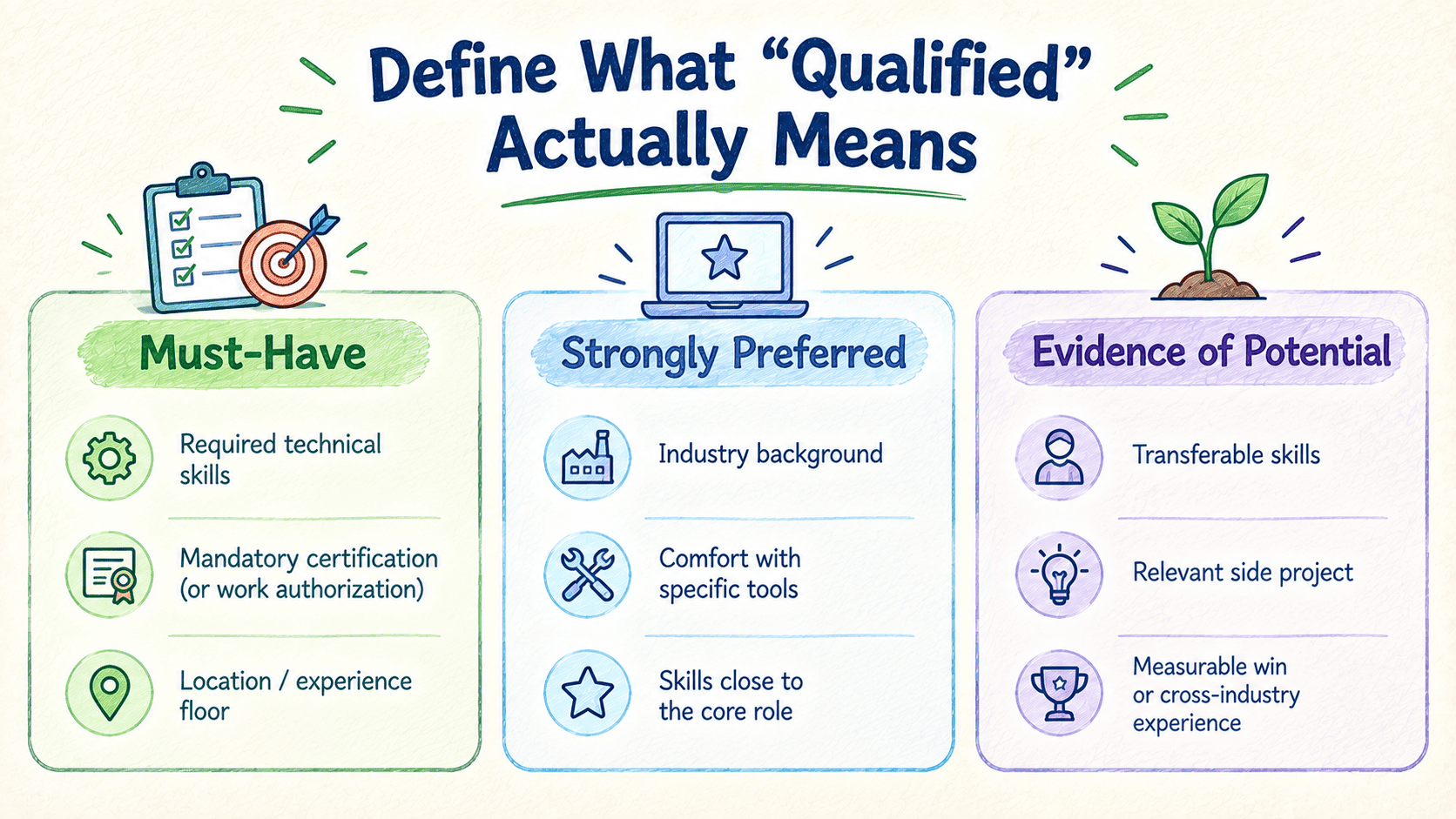
Before anyone opens an application, split the criteria into three groups.
Must-haves cover the required technical skills, any legally mandated certification, work authorization or location limits, and a real floor for relevant experience. Then there's what's strongly preferred: specific industry background, comfort with certain tools, skills that sit close to the core role. And separately, evidence of potential, things like transferable skills, a relevant side project, a measurable win, or comparable experience pulled from a totally different industry. Getting the weighting right between must-have versus nice-to-have skills is what keeps the ranking defensible later.
Once those groups exist, the question changes. You're no longer asking the tool who the best candidate is, honestly not its job to answer alone; you're asking it to lay out the evidence against criteria your team already agreed on before any of this started.
3. Step 2: Turn the Job Description Into a Screening Rubric
Once "qualified" actually means something concrete, the next move's turning it into a weighted rubric, and doing that before anyone's opened a single resume.
| Screening category | Example weight |
|---|
| Essential skills | 35% |
| Relevant experience | 25% |
| Demonstrated achievements | 20% |
| Preferred skills | 10% |
| Role-specific requirements | 10% |
Those numbers are just a starting template; honestly, nobody says every role has to inherit them exactly as-is. Timing's what actually matters more than the precise split. Weights set before candidates start showing up stay fair. Weights adjusted partway through, even with the best intentions, and suddenly a candidate reviewed on Monday is being held to a different standard than one reviewed on Thursday, just because of who else happened to land in that week's pile.
Older applicant tracking systems lean hard on exact keyword matches, and that's a pretty blunt way to judge a person, honestly. Someone who writes "built predictive models in Python" and a job post asking for "machine learning experience" are talking about the same thing, more or less, but a rigid keyword filter often can't make that connection, so a strong applicant just gets dropped and nobody notices it happened.
Newer AI tools are better at this; they read for meaning instead of exact phrasing and can connect what someone actually did to what a role needs, even when the words used are nowhere close. That's a real improvement, though it comes with its own problem. Semantic matching can drift into guessing, and it'll sometimes call two experiences equivalent when a hiring manager looking at the same two resumes would flat-out disagree. The fix is keeping the two jobs separate. Let AI surface the comparison and the evidence behind it. Let your hiring team decide what actually counts as equivalent.
5. Step 4: Structure 1,000 Resumes Into One Usable Dataset
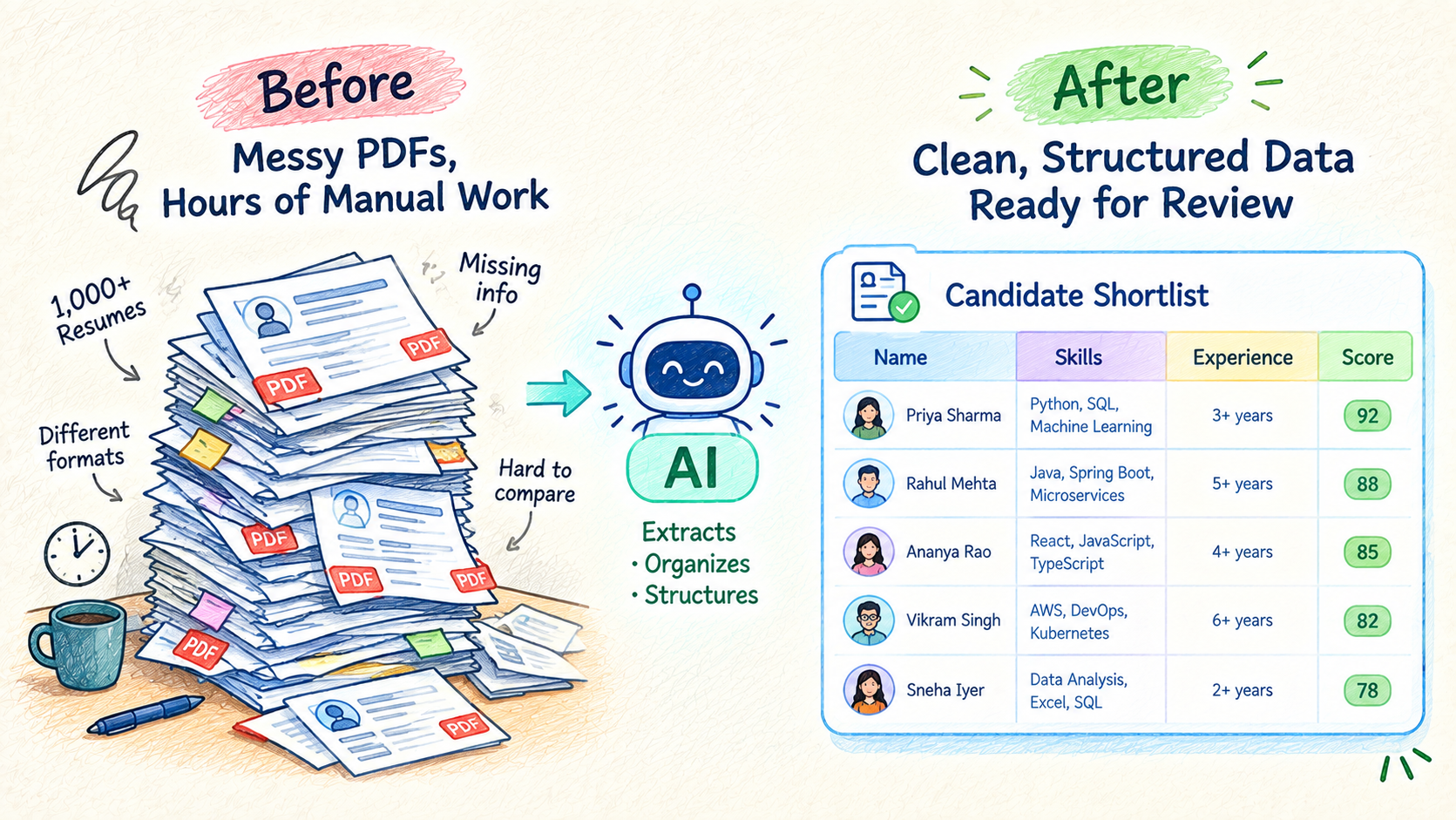
This is where AI earns its keep most literally. Instead of a recruiter opening a thousand differently formatted PDFs and Word docs one after another, a decent AI resume screener just pulls each application into the same set of fields: work history, skills, certifications, education, years of relevant experience, tools used, industries, notable achievements, location where it matters, all of it lined up the same way every time, so what used to be a thousand separate reading sessions turns into one structured, sortable table.
The AI isn't really reading resumes the way a person would, not exactly. It's converting unstructured documents into something a human can review consistently, and that's a narrower job than it sounds, but also a more useful one. It's the idea behind Hyring's AI resume screener too: score every application against your own criteria and hand back a shortlist with the reasoning attached, instead of some ranking nobody on the team can actually explain later.
6. Step 5: Sort Candidates Into Groups, Not a Single Ranked List
Small change here, pays off more than it probably should: stop asking your AI system for "the top 50" and ask it instead to sort people into three rough groups.
A strong match is the easy one, basically anyone who clearly meets most of what you defined as required. Then there's review: people with transferable experience, a resume that has some gaps in it, or a background that just doesn't fit the mold but might be worth a second look anyway. And below threshold, plainly, missing something essential.
A single ranked list implies a precision it hasn't earned. The difference between candidate #17 and candidate #18 is usually meaningless, though a numbered list convinces people otherwise. Grouping still gives you prioritization without pretending an algorithm found some exact hierarchy of human potential.
7. Step 6: Build a Review Process for Borderline Candidates
One of the quieter costs of fast, automated screening is losing candidates who don't fit a conventional resume shape, and never realizing it happened.
Make it a standing rule that certain applicants always get a human look, regardless of where the algorithm placed them: people just below the cutoff, career changers, anyone returning after time away from the workforce, candidates whose experience doesn't map onto a standard job title.
NIST's research on identifying and managing bias in AI notes that automated systems can be more consistent than human reviewers, and that consistency is exactly what lets a biased pattern lock in and scale up unnoticed. A borderline review step is what catches it.
8. Step 7: Audit What the AI Is Actually Ranking On
Most companies never get to this step, and it may matter more than any other for keeping the process defensible.
Is the system weighing job-relevant skills, real experience, certifications, measurable results? Or has it picked up on school names, employment gaps, hobbies mentioned in passing, personal details with nothing to do with the job?
EEOC guidance on employment tests and selection procedures is clear that a tool doesn't need bad intent to run afoul of the law. A test that looks neutral can still screen out a protected group at a much higher rate, and the employer carries that responsibility regardless of who built the system. The EU AI Act's employment guidance lands in roughly the same spot: tools that rank CVs to build a shortlist count as high-risk, simply because of how directly they shape who even gets a shot at a job.
Stripping names off resumes doesn't make a system bias-free by itself, not even close, since other signals scattered through the text can still stand in for whatever you were trying to screen out in the first place, a pattern known as algorithmic bias in hiring that survives even after names are removed.
9. Step 8: Measure Whether AI Actually Improved Your Hiring
Speed through a thousand resumes is easy to brag about. Whether it bought your team anything real is a harder question, and one worth revisiting on a schedule rather than asking once and moving on.
Track how many AI-flagged candidates got interviewed and hired. Track how many strong people recruiters pulled back out of the "review" group. Track how often recruiters override the AI's call, and why. Check whether any group of applicants keeps getting screened out at a noticeably higher rate than everyone else.
The metric that matters isn't resumes processed per minute. It's qualified candidates found per recruiter hour.
10. The Biggest Mistake Companies Make With AI Resume Screening
Treating the AI's ranking as the hiring decision itself.
The output is a starting point built on the criteria your team handed over, nothing more. LinkedIn's 2025 Future of Recruiting report found that 70 percent of talent acquisition professionals experimenting with generative AI point to improved hiring efficiency as the main payoff they expect. Efficiency, not better judgment. That's a useful benefit on its own, but it's a different claim than "the AI picked the right person," and mixing the two up is how a fast process turns into a bad one without anyone deciding it should.
The Bottom Line
The point of all this was never to blow through 1,000 resumes as fast as humanly possible; it was to come out the other side able to say, honestly, that you didn't lose the best candidate because a rubric was left vague, a proxy snuck into the ranking somewhere, or nobody double-checked the review pile before the req got closed out.
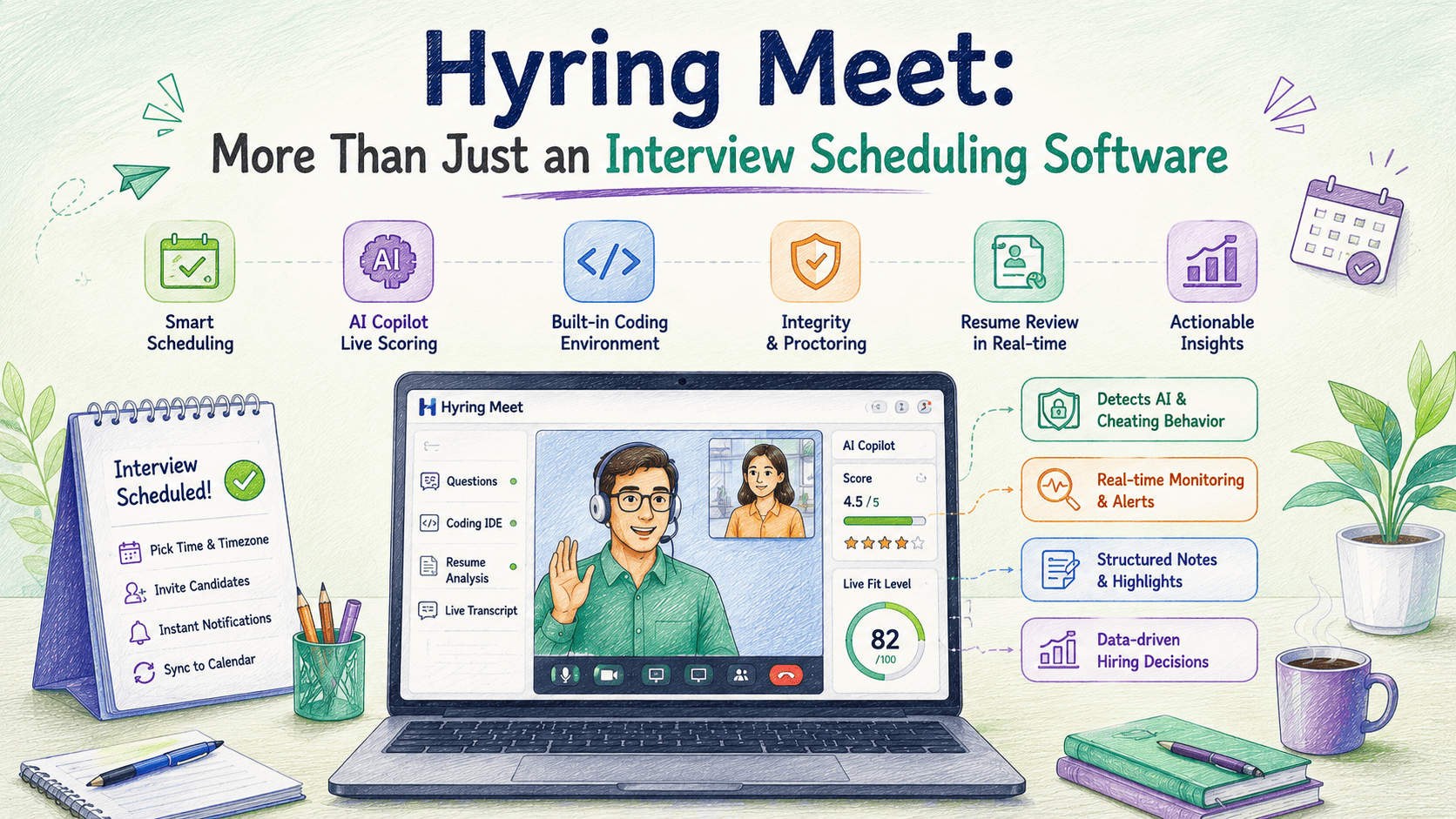
AI can carry the volume here; it extracts stuff, organizes it, sorts it, faster than any team of recruiters working by hand ever could, no contest really. But the calls that actually matter, what counts as equivalent experience, who deserves a second look, who actually gets the offer, those still belong to people, not some system. Set the system up that way from day one, and speed starts working for you instead of against you, and that's honestly the whole point. That same idea carries over once a shortlist actually exists too. Hyring's video interview software runs on the same split, AI handling volume, humans handling judgment, at the interview stage that comes right after this one.
FAQs
1. Can you just let AI screen all 1,000 resumes with no human involved at all?
Technically yes, though that's the setup most likely to rack up bias problems and compliance headaches quietly. Better to use AI for the processing and organizing, and keep an actual person accountable for the decision itself.
2. How do you screen resumes using AI?
You turn each resume into structured, comparable information, check it against whatever job requirements were predefined, and prioritize candidates for a human to review; recruiters end up holding the responsibility for the final call either way.
3. Is keyword matching the same thing as AI resume screening
Keyword matching hunts for exact word overlap and misses people who describe the same skill in different words. Newer tools read for meaning instead, though a human still needs to check its work.
4. Does removing names from resumes get rid of bias?
Not really. Plenty of other details scattered through a resume can still stand in for whatever demographic information you were trying to strip out in the first place.
5. Does an AI resume screener replace my ATS?
A traditional ATS mostly just stores and filters applications, often on exact keyword matches. An AI resume screener sits on top of that, reading for context and ranking people against your own criteria, with the reasoning attached so you can actually see why.