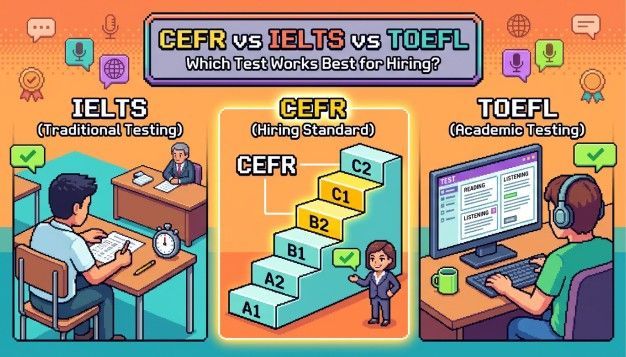
If you want to hire someone specifically for their communication skills, you need an English Proficiency Test as part of your hiring process. IELTS and TOEFL are well-known tests. They were made for schools and immigration, which is important if you have many applicants and need a quick check. A mistake here can waste your time and money.
TL;DR
CEFR is not a test; it is a scale from A1 to C2 that helps define language skills. IELTS is trusted worldwide and is a good credential, but it adds extra steps for checking skills. TOEFL iBT is good for academic needs. CEFR score conversions from ETS help make test results easier to understand. Online tests like Hyring can give CEFR scores and detailed scores.
How Does an English Test Help With Hiring?
An English proficiency test for hiring should mainly check if the person can communicate well enough for the job.
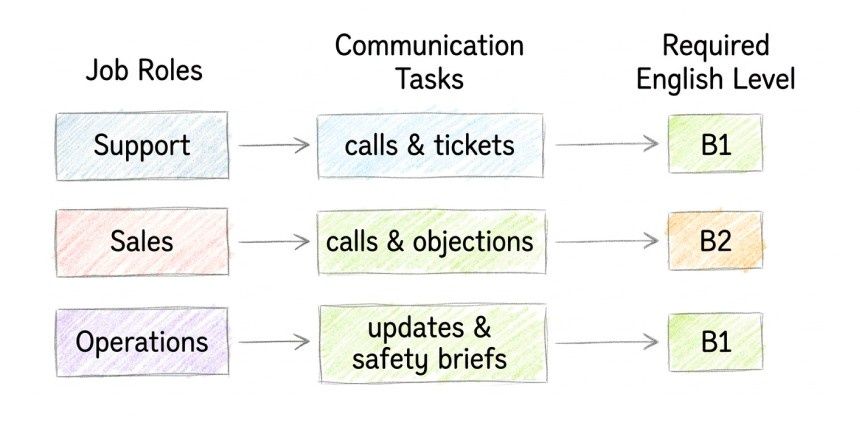
The level needed changes by job type. A backend developer needs good writing skills, while customer support agents need to handle phone calls. A sales rep must persuade others, not just speak correctly.
The right English Proficiency Test for hiring depends on the job needs. Hyring looks at fluency, vocabulary, mother tongue influence, grammar, and pronunciation.
What Is CEFR, and Why Do Employers Keep Mentioning It?
CEFR stands for the Common European Framework of Reference for Languages. It shows how well someone can use a language, from A1 (beginner) to C2 (expert).
Employers like CEFR because it gives clear levels instead of vague terms. Instead of arguing about what 'good English' means, they can say the job needs a B2 level.
CEFR is a global system that shows what learners can do at each level. It helps employers assess candidates' skills clearly during interviews.
How Does IELTS Behave in a Hiring Funnel?
IELTS is a well-known English test that is taken worldwide.
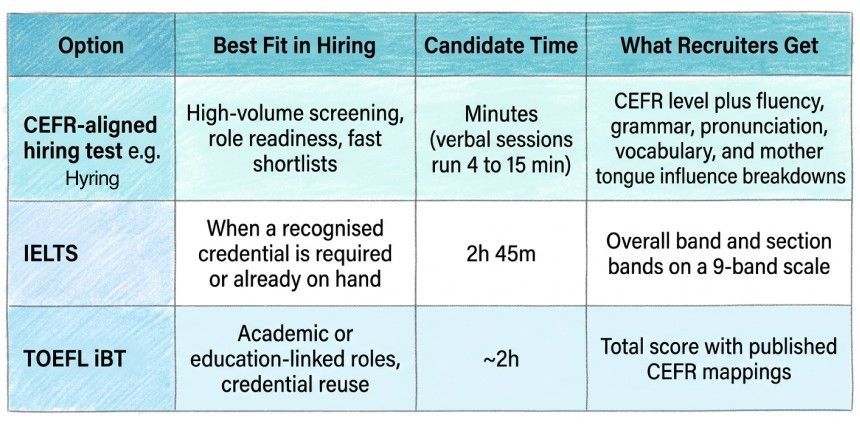
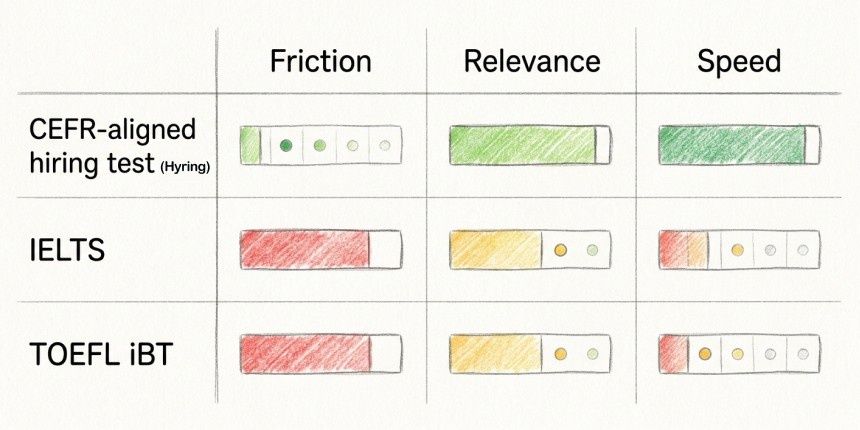
It uses a 9-band scoring system and is accepted for education, work, and migration. For hiring, the first issue is time; the test takes up to 2 hours and 45 minutes, which is a long time for initial screening.
The second issue is relevance; IELTS checks general English skills but not specific job skills like phone calls or writing reports.
While it is a valid test, it is not detailed enough for hiring. However, a valid IELTS score can still be useful.
How Does TOEFL Behave in a Hiring Funnel?
TOEFL iBT is another popular test created by ETS, focusing on academic English and providing CEFR comparisons. It takes about two hours, and scores range from 0 to 120.
ETS has a new scale from 1 to 6 that matches the 0 to 120 score.
The benefits of using TOEFL in hiring are its trustworthiness and CEFR scores. The downside is similar to IELTS; it may be too much for initial screenings. It works well for hiring people who will move internationally or work in education. However, for high-volume hiring, it slows things down.
Can You Convert CEFR vs IELTS vs TOEFL Scores Safely?
You can use conversions as a guide. You should not treat them as exact.
IELTS itself warns that CEFR was not designed for precise equating and that there is no clean one-to-one relationship between IELTS bands and CEFR levels. Borderline scores stay borderline.
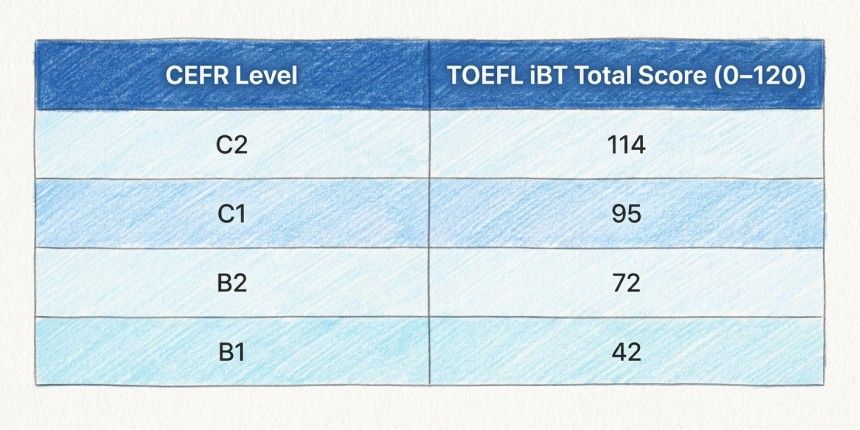
TOEFL is more straightforward here. ETS publishes a CEFR mapping table for TOEFL iBT scores:
Conversion tables can help, but they are not exact. IELTS warns that CEFR cannot perfectly match scores. 'Borderline' scores stay 'borderline.' TOEFL is easier here because there is an official table for converting TOEFL iBT scores to CEFR levels.
Which English Test Is Best for Hiring, Role by Role?
There are two types of hiring processes:
- Credential-based recruitment: Use the candidate's current IELTS or TOEFL scores.
- Workflow-based recruitment: Give a quick English test for the job. Hyring's English Proficiency Test is made for the second type.
It uses AI and CEFR standards to check workplace communication.
What Does a Recruiter-Friendly English Report Look Like?
One score is never enough.
Recruiters need useful information in order to properly evaluate a candidate. Hyring's report gives clear screening scores, voice sample options, AI analysis, and transcriptions.
It also breaks down five key skills that cause most workplace problems: fluency, vocabulary, grammar, pronunciation, and mother tongue influence.
Think of it as a full assessment of English skills, not just a pass or fail. This format helps you achieve three goals.
First, set a CEFR standard for the job. Second, find out what the candidate needs to improve. Pronunciation mistakes are very different from grammar mistakes. Third, decide what to do next: move forward, pass, or suggest a simpler communication role.
Hyring's English Proficiency Test has fair grading and gives quick results, which is useful when hiring for high-volume pipelines.
Key Takeaways
CEFR helps define language needs.
IELTS and TOEFL are accepted worldwide. They are credentials, but not the main tools for screening. Score conversions give an idea, but are not exact. IELTS says not to see CEFR levels as precise.
An online English test for hiring that gives CEFR scores and job-related scores is best in most cases.
FAQs
1. Is CEFR a test like IELTS or TOEFL?
No, it is a system that shows a person's language skills at levels from A1 to C2. CEFR is not a test but a way to relate test results.
2. Can we accept IELTS scores for hiring?
Yes, if the scores are valid. But don’t see the conversion between IELTS and CEFR as exact since IELTS says it is not.
3. Can we accept TOEFL scores for hiring?
Yes, especially for jobs needing international travel or in education. ETS gives CEFR equivalents for TOEFL iBT scores for better understanding.
4. What does Hyring's English Proficiency Test measure?
Hyring tests workplace communication using AI based on CEFR. It looks at fluency, vocabulary, mother tongue influence, grammar, and pronunciation. It gives results as transcripts, summaries, and skill analysis.
5. If we pick one approach, what should we standardize on?
Set CEFR goals for each job, then use an English test that gives results based on CEFR standards in your hiring process.