Key Takeaways
- Salespeople need English skills based on their job, not just a general requirement like "fluent in English."
- Good sales English means asking clear questions, summarizing well, and responding to objections. It doesn’t mean speaking without an accent or perfect grammar.
- Writing skills are also important, so test writing ability, not just speaking.
- Start screening candidates early with Hyring's English Proficiency Test, which measures workplace English skills using CEFR.
TL;DR
Sales teams need English skills that go beyond terms like "fluent" or "adequate."
The key is whether a sales rep can have a full sales conversation, ask the right questions, respond to objections, and write follow-up messages that clients will read.
For customer-facing jobs, a good level of English is needed to work independently. For global roles, the standards are higher because the interactions are more complex and important. Use Hyring's English Proficiency Test to filter applicants early.
The Hidden Sales Tax of 'Okay English'
Salespeople rarely get a chance to fix communication problems.
They may be skilled and motivated but still lose deals if they can’t do the following well in English:
- Keep the conversation going without pauses
- Clearly explain value without vague phrases
- Provide clear next steps without confusion
These mistakes can be costly. Poor deals, longer sales cycles, and managers having to clarify emails that should not have been written happen often. These issues are often seen as a lack of confidence or communication skills, leading to attempts to fix them with product training.
What 'Proficient Enough' Sounds Like on a Real Sales Call
Forget perfect grammar. Selling needs clear English that keeps the conversation going, even if you stray off-topic.
Here’s what you want from a good salesperson:
1. They ask clear questions, but not too many.
Buyer: "We need something simple."
Salesperson: "Simple for whom? Your users, your team, or your approval process?"
"From what you told me, the main point is to reduce handovers. The delay is due to approvals, which take three days. Cutting it to one day would work for a trial this month. Is that right?"
3. They handle objections calmly.
Buyer: "We already have a competing supplier."
Salesperson: "That makes sense. What do you like about their services, and why is it only a short-term solution?"
None of this needs fancy words. Just a bit of control.
The English Proficiency Level for Sales Teams, Based on Selling Motion
This part is often ignored by hiring teams, but it is very important.
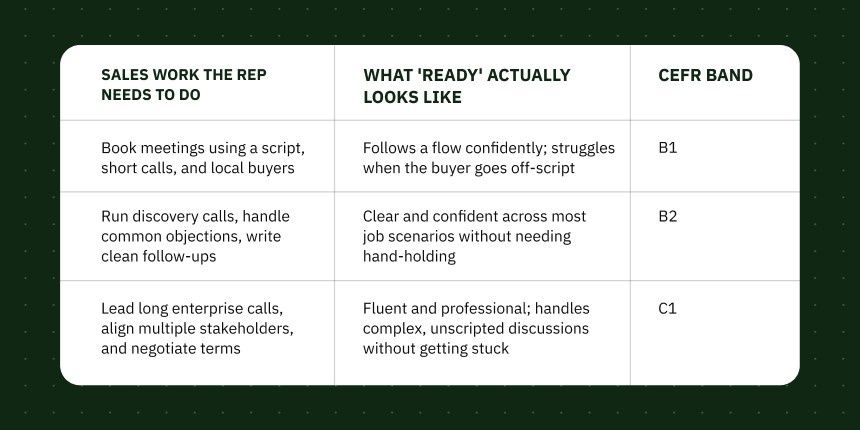
If you have a scripted sales rep and an account executive talking to a buyer, they have different jobs. So, their English skills need to be different too. Using just one standard for "good English" doesn't work here.
The CEFR (Common European Framework of Reference) is a worldwide standard for measuring language skills, from A1 (beginner) to C2 (advanced).
Hyring uses the CEFR to explain each skill level clearly, giving a fair way to judge without doubt. It’s clear that if a rep often improvises, you need someone with better English than just following a script.
If the rep needs to negotiate with important buyers, casual speaking won’t be enough.
The Follow-Up Test: Where Most Candidates Slip
Sales interviews are mostly about talking. But sales also need a lot of writing, and what sounds good on the phone might not work in an email. A good follow-up email should:
- Restate the issue using the client’s words
- Note what the client thinks is important
- Show follow-up actions with who is responsible and deadlines
- Be short enough
- Be written by a person, not a machine
A bad follow-up email might say: "Thanks for talking today. I look forward to the next steps. Please ask questions if you have any."
No one replies to this because there’s nothing to respond to.
The Hyring English Proficiency Test checks candidates on their work communication skills, looking at vocabulary, grammar, fluency, pronunciation, and how much their first language affects their English. This test is important because it shows all these skills together.
What to Assess (Without Turning Hiring Into an English Exam)
The goal is not to create a test for a language school. It is to measure English skills in a way that fits a sales rep's job.
The five signals that matter most
According to Hyring, five key skills for workplace communication are fluency, vocabulary, mother tongue influence, grammar, and pronunciation.
Here’s how they show up in sales:
- Fluency (speaking quickly and smoothly under pressure): Watch how the seller reacts when a customer interrupts. Do they respond quickly, or do they slow down?
- Vocabulary (using clear, simple words): Can they explain the product in easy terms for a non-expert buyer? Do they use fancy words when they can’t find the right ones?
- Pronunciation (getting numbers and actions right): Confusing "fifteen percent" with "fifty percent" can lead to big problems.
- Grammar (writing emails): They don’t need to be perfect, just good enough to avoid mistakes in emails.
- Mother-tongue influence (for coaching, not punishment): We’re not punishing accents; we want to see what coaching they might need.
Two practical checks you can run right now
Here are two quick tests you can do in your company right away. Make sure both tests feel like work and are short.
- Role play an objection (90 seconds): Give them a real objection you’ve heard before. Ask them to respond, then follow up with another question. This shows their fluency, calmness, and vocabulary under a little pressure.
- Recap the discovery call (6 sentences): "You just had a discovery call. Send me the follow-up email." (Keep it under 6 sentences and timed.) You’ll learn more from these two activities than from a 15-minute chat about their experience.
How to Screen English Early, Fast, and Consistently
Late language testing costs a lot for both the candidate and the company. The sales team wastes time on candidates they should have removed earlier. Hiring managers guess candidates' English skills based on feelings, not facts. A good hiring process should:
- Set clear standards for the job before posting it.
- Screen candidates early to ensure only qualified ones reach the sales interviews.
- Use the same scoring system so all interviewers evaluate candidates the same way.
Hyring's English Proficiency Test is made for early screening. It uses AI and follows CEFR standards to check candidates' workplace communication skills.
The test includes a short verbal interview and takes about four minutes, making it easy to add to the pre-screening process. This helps the sales team focus on candidates' selling skills instead of just their word usage.
Frequently Asked Questions
1. What English proficiency level should I hire for in sales?
This depends on the job, but most sales reps should be able to work independently, handle objections, and write follow-ups without help. This means they are ready for the job, not just able to chat. For enterprise sales roles, the English level needed is even higher.
2. Should I prioritise accent when assessing candidates?
No, accent doesn't matter when judging a salesperson's communication. Rather, focus on clarity. What's important is that stakeholders understand key details when the salesperson is talking.
3. What's the fastest way to test English for sales hiring?
The best way is a short role play followed by a writing task. If you want a standard way to check English skills, use a CEFR-based test like the Hyring English Proficiency Test.
4. What does Hyring's English Proficiency Test measure?
It measures workplace communication skills using AI based on CEFR standards. The test looks at five areas: fluency, vocabulary, mother-tongue influence, grammar, and pronunciation.