
TL;DR
AI, in my opinion, is more than just a ‘nice-to-have’ enhancement in recruitment; it's revolutionizing how English-language skills are assessed in job applicants. Standard English tests are tedious, non-specific, and lack real-world application and comprehension.
AI makes it all possible with its adaptive and real-time contextual assessment of language skills, as it happens in an actual working environment. And it does it exquisitely!
This affects areas of bias, objectivity, speed, and accessibility in talent scouting. With advancing AI technology in its respective models and assessment structures, intelligent English-language tests for talent recruitment tools, such as Hyring.com’s English Proficiency Test or EPT, have innumerable benefits over previous non-responsive tests.
The Problem With Traditional English Proficiency Testing
Long before AI entered the scene, employers used to use static tests or manual interviews to judge a candidate’s English language ability. Those methods are very familiar and sometimes effective, but they struggle with a few persistent blind spots.
A traditional exam might rely on fixed answer sets and paper or computer-based scoring that doesn’t reflect how language actually ebbs and flows. It tells you what the candidate knows, but not always how they use English under different situations - pressure, leisure, etc. - and consequently in meetings, email threads, or customer interactions.
These older tests can also be slow to process, costly, and inconsistent. Two human judges might score the same writing entirely differently. One of the tests might see polish while the other might detect the nuances.
That inconsistency has consequences. Hiring decisions, salary negotiations, and even immigration clearances may hinge on a single score that reflects narrow skills and not communicative competence.
How AI Changes the Game
Modern systems analyze language in context and are not just rigid checklists. They aren’t just faster but also think differently about how languages work and are used.
Rather than presenting the same questions to every candidate, an AI model can tailor the test itself based on how the person responds in real time. This is actually an adaptive language evaluation.
That means a candidate who breezes through basic questions will be challenged with more complex tasks as the evaluation progresses, and that better reflects real work scenarios. This is a leap toward dynamic assessment rather than just static grading.
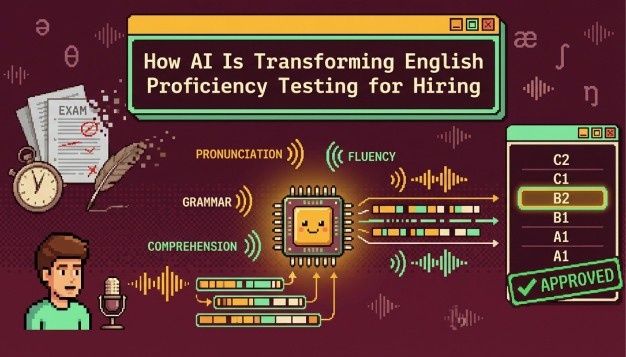
Another strength of AI is its ability to provide instant, objective scoring. Waiting days for a human evaluator to grade essays is certainly a thing of the past. AI scoring systems assess grammar, syntax, clarity, fluency, and even tonality.
This is done at scale, consistently and automatically. Automated speech recognition and natural language processing are now reliable enough that voice responses can be scored against standardized linguistic models.
Feedback Loops
If an AI system is to learn from its own errors, it must allow for feedback loops that are backed by data. This is essentially a very significant aspect of the unlearn-relearn process. In a normal report, one might read ‘Level B2’ as the classified CEFR grade. In an AI process, there might be a few areas that are identified positively or negatively according to various dimensions of speech.
This may include vocabulary range, coherence, appropriateness of context or even fluency - which could be a tremendous asset to the candidate sitting for an exam or the HR recruiter team itself.
All these parameters have direct implications during an EPT for recruitment. What’s usually needed in recruiting is something beyond just a grade or a number; a deeper understanding of what it means to be proficient in the English language also extended to determining an appropriate definition for the same, for an exam that is used to determine recruitability.
What AI-Driven English Proficiency Testing Looks Like in 2026
Suppose a candidate logs in and instead of shading out the MCQs on a piece of a paper, you have an EPT whose AI Agent begins with casual, but intentful language prompts, and then synchronizes itself as the responses keep coming. Each answer serves as a prelude to the question that succeeds it. The AI Agent isn’t random, but strategic in its approach, with a certain conversational logic and thinking that is always in the background during the entire process.
This isn’t just adaptive testing, its contextual testing with a layer of intelligence. Take an example where a client-facing role requires top-notch communication - the AI may - depending on the calibration prior to the test - simulate a mock support call to test the candidate’s abilities in the moment.
Even if it is something personal that the candidate may willingly choose to reveal, it would realign itself to that specific context and continue from there. I have seen it talk about the details of Carnatic Music and its ragas with one candidate, while casually chatting about Barcelona vs Chelsea with another who was a football fan.
This breaks the ice, even before the candidate has a chance to overthink about their performance, whilst being able to simultaneously score them on the conversation then and there using AI models trained on real-life language usage patterns. Mind-blowing!
This is not just a theory that I am proposing - but research shows AI tools designed for language assessment can improve spoken proficiency and engagement metrics in learners. That holds promise, in my opinion, when repurposed for hiring contexts too.
Another trend you’ll see in these AI systems is multimodal assessment. Spoken language, written responses, pronunciation accuracy, and even discourse coherence are all graded together. This isn’t just an English Grammar Test Pro. It’s a composite profile of communicative ability in the true sense.
Also Read: Why CEFR-Based English Testing Is Becoming the Global Hiring Standard
Benefits for Employers and Candidates
AI-enhanced English proficiency tests for hiring platforms, it was clearly observed, are helping organizations unlock a few key advantages that matter in more competitive markets.
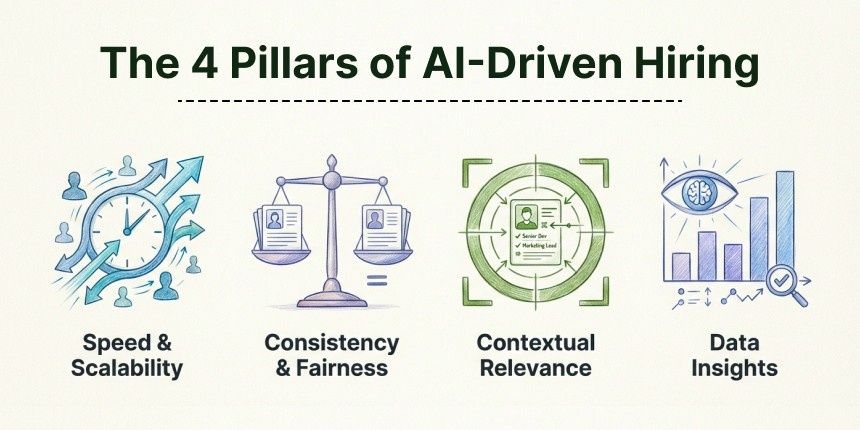
Speed and scalability: Recruiters can assess thousands of applicants with the same baseline standards and receive real-time scoring without bottlenecks from the human markers. These, I’ve seen, automatically end up fast-forwarding screening cycles.
Consistency and fairness: It is seen (through findings in various research papers) that there is a lot of bias introduced by humans in the loop. The variance introduced by mood, perception, or experience is perceptibly reduced. AI scoring models apply the same criteria across all candidates.
Contextual relevance: I've noticed that traditional tasks don’t always map to job requirements, and AI lifts that constraint by generating scenario-based tasks that reflect actual workplace communications, such as email responses, spoken interactions, and documentation tasks.
Data insights: With instant analytics, HR teams see not only scores but also patterns/trends. They see where candidates struggle with - like usage of filler words or Mother Tongue Influence (MTI) or stammers or repetitiveness - which feeds into better hiring decisions.
Studies by Duta Bangsa University on AI in language assessment research widely note that these tools can deliver real-time evaluation and generate patterns of performance that are otherwise hard to perceive at scale. I would say that this is a crucial feature in streamlining entire HR workflows.
Also, in general, I feel that the candidate experience improves, too. This means no more waiting on test results or static questions that don’t feel alive. The engagement becomes interactive, tailored, and immediate; these are traits that modern job seekers appreciate a lot.