Too Many Candidates, Too Little Time
Any large Indian company that has recruiters burning the midnight oil will rarely have the problem of having people to recruit. Usually, the problem pertains to the thousands of applications that they have stacked up, and how there is no straightforward and efficient way to go through them all.
Truth be told, a single mid-level IT opening can attract over a thousand applications. That same recruiter is probably working through 18 open positions at the same time.
Imagine that! There will be no leeway offered by leadership, who may still expect faster closures, a dip in spending, and status quo or improvement in hiring quality. Something has to change.
The scale becomes clear if one were to put a number on it. The Indian recruitment software market was pegged at around $88.82 million in 2024, with projections pointing toward $163.62 million by 2034, a 6.30% CAGR. Companies that waited too long to act are now spending to catch up.
When you look at how this plays out, businesses that revamped their hiring systems report seeing a reduction in cost-per-hire by as much as 35%. They also handle 50% more requisitions per recruiter and have managed to shorten time-to-fill by up to 60%.
What's Actually Wrong With Naukri RMS
Credit where it’s due - when Naukri RMS came onto the scene, the value proposition made sense. India's largest job portal is wired into a recruitment system that seems extremely useful, and for straightforward local sourcing, parts of that argument still hold.
The issue is that enterprise recruiting in 2025 needs far more from a platform.
Ask a recruiter who uses it daily, and he'll point out that friction shows up quickly. Scheduling an interview usually means leaving the platform behind and making something up with an external app or tool.
There's no system built for candidate follow-ups. Someone juggling 20 simultaneous requirements finds managing an array of tabs and apps just to get one candidate through the pipeline cumbersome.
Data quality is a big problem. Half of the phone numbers aren’t real. This isn’t just a small hassle during high-volume recruiting. It wastes hours every week, and no one even tracks it.
Search performance is another headache. Good Boolean logic is supposed to pull up solid results. Instead, you end up with profiles that aren’t even close to being candidates. You then have to add more filters, and the shortlist takes even longer to come together.
And let’s talk about MNCs. There’s no multi-language support at all. The platform offers nothing to handle international hiring needs. Planning a global recruitment drive that covers India, the UAE, and Singapore? This platform won’t cut it. There’s no way to configure it.
So, What Should You Be Using Instead?
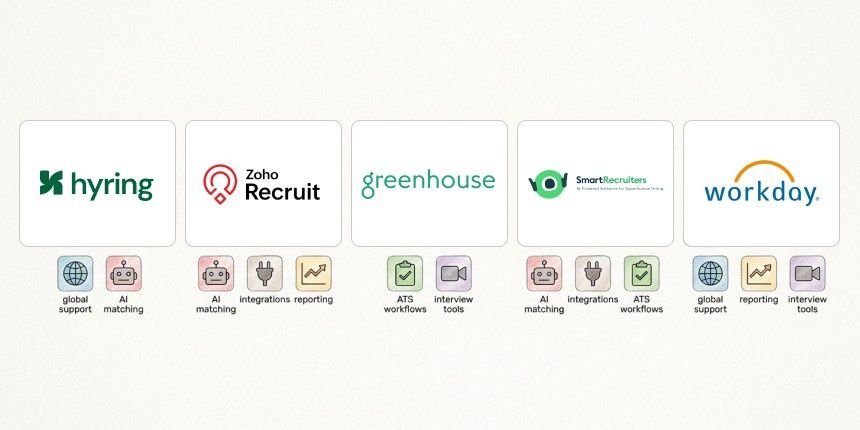
1. Hyring: The AI-Native Challenger Worth Watching
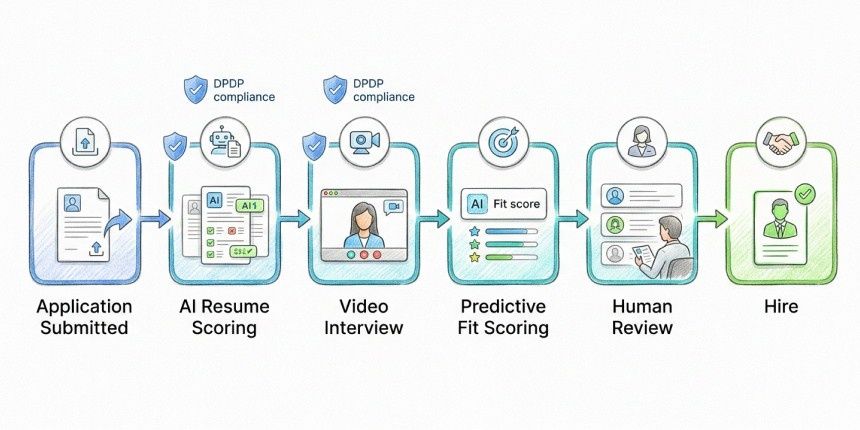
Hyring is built AI-first, not a legacy ATS with machine learning added on as an afterthought. Automated resume screening, video interviewing, and strict proctoring sit within one connected workflow. For enterprise teams buried under application volume, having that entire process automated end-to-end makes a real difference.
This is the newest platform on the list, and it also acts as an AI recruitment agency. If you can’t work without legacy integrations in your system, that’s something to consider. But for companies prioritizing AI-driven large-scale screening, this platform deserves to be in the running.
Ideal use: Businesses aiming to use AI-driven screening, handle large-scale technical recruitment, and overcome traditional ATS challenges.
2. Zoho Recruit: The Homegrown Powerhouse
Zoho Recruit might just be the hidden gem among enterprise ATS solutions in the Indian market today. It fits so well into the way Indian businesses operate because it was built with their processes in mind instead of being adapted from tools made for the US or Europe.
Zoho People, Zoho CRM, and Zoho Payroll connect. Candidate details flow through every step of hiring without needing to be re-entered along the way. The Business Process Blueprint stands out as a key feature. You decide how the process should progress, set up rules at each step, and the system takes care of everything else. Approvals happen, recruiters get updates, and stages are updated. There's no need to handle these steps.
Best for: Indian businesses of medium or large size, staffing firms, and companies already using Zoho tools.
3. Greenhouse: For Teams Who Take Structure Seriously
Greenhouse is straightforward - when every interviewer works from the same scorecard, the quality of hiring decisions automatically improves. That sounds obvious. Most companies still don't actually do it.
In large organizations where dozens of hiring managers are running their own informal processes, standards drift in ways that are hard to see until the data is already bad. Greenhouse removes that inconsistency where each stage generates logged, comparable information you can use to understand what's working and what isn't.
It connects to more than 400 third-party applications, including background checks, HRIS systems, video interview solutions, skill tests, and organizations that have moved over claim a saving of 27% on their time-to-hire process.
The diversity tracking system works at every stage of the pipeline instead of just popping up during the offer stage, which matters when management needs more than a number to show.
Best for: Tech-heavy enterprises and high-growth companies that need every hiring decision to be both fast and defensible.
4. SmartRecruiters: Built for Organizations Hiring at Real Scale
SmartRecruiters doesn't operate like a conventional ATS. The in-built CRM system enables the talent acquisition team to build their relations with prospective employees well before they publish the job listing, and by the time they have to do that, they have a few options to choose from. For companies that suddenly find themselves short on employees or conduct mass recruitment campaigns, this would be very helpful.
It is the international nature of this platform that makes it appealing for multi-national companies. Support for multiple languages, compliance across regions, and an open API for customized integration.
Best for: Large enterprises and MNCs with active hiring across more than one country.
5. Workday Recruiting: One System, No Gaps
Workday Recruiting is not just a basic tool on its own. It works as the hiring part of a bigger HCM suite that also handles onboarding, payroll, and workforce planning. Everything stays linked together.
When a candidate takes a job offer, the system creates their employee record without needing anyone to transfer the data. Nothing gets lost between teams.
But there’s a catch. Workday involves a significant implementation in cost, time, and organizational change, and changes in how a company runs to set up. Companies already using Workday in HR or Finance will find it easier to add the recruiting module as the next step. Others, however, need to ask themselves if the benefits of integration are worth the heavy investment.
Best suited to: Bigger Indian companies and global giants like those in the Fortune 500 already using Workday for their systems.
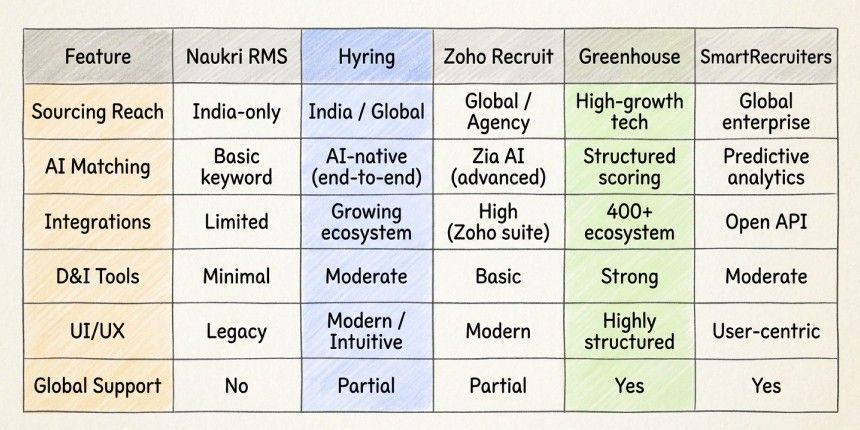
Head-to-Head Feature Comparison
AI Screening and Compliance: Two Things You Cannot Ignore
In India, where application volumes are massive, using AI to screen candidates isn't just helpful. It's a necessity. Without it, recruiters either drown in endless applications or rush through decisions, leading to poor hiring choices. Bad hires aren't cheap. The U.S. Department of Labor says a single mistake often costs at least 30% of the hire's first-year salary. When entire teams rush through hiring at scale, those losses pile up fast.
The most efficient hiring platforms fix major productivity gaps by using predictive analytics. These tools match candidates to your top performers before anyone even looks at their applications. That is how they claim to boost recruiter capacity by 50%. By cutting out repetitive tasks, they save time on what would have given the same results anyway.
Compliance is moving faster than a lot of enterprise HR teams have adjusted for. India's Digital Personal Data Protection (DPDP) Act sets real obligations around how candidate data gets collected, kept, and removed. Platforms built recently are incorporating data residency controls and proper audit infrastructure. Older tools were never designed with any of that in mind. Large candidate databases without a clear compliance position are carrying live legal risk.
For technical roles specifically, platforms with HackerEarth integration can verify coding ability before a recruiter gets involved, because a resume listing six frameworks doesn't tell you much about whether someone can actually use them.
For teams specifically evaluating AI-native options, Hyring is increasingly worth including in that shortlist, but more on that in the alternatives section above.
Almost all ATS assessments begin with demoing products before agreeing on the specific problem being addressed.
A much more practical place to start is understanding where the breakdown occurs in your existing recruiting process and which technology platform specifically solves it. The rest follows logically from there.
Location is typically the first cut-off point. International recruiting automatically excludes domestically-oriented platforms, without even requiring any customization. Technology stack compatibility is next. If your company relies on Workday or SAP, compatibility concerns will carry more weight than anything an ATS vendor's salesperson shows you on their pitch deck.
Honesty is critical when discussing the budget upfront. Hiring is the most straightforward solution, with actual functionality. Greenhouse and SmartRecruiters are expensive systems, built for enterprises with real budgets for recruiting technology. Workday is something else entirely, more like an infrastructure purchase than a subscription model.
Before putting pen to paper, demand clarity about the migration process. How your current data will be transferred. What the SLA really entails. Case studies from companies that have completed a migration, not those currently implementing one. The sales process always conveniently skips over this issue. The reality is in the implementation phase, and any vagueness in the sales call will persist post-signature.
Key Takeaways
- Enterprise hiring in India has changed significantly. Naukri RMS hasn't moved with it, and the gap becomes harder to manage as hiring volume grows.
- Hyring is the strongest AI-native option for enterprises focused on screening at scale. Zoho Recruit is the best value play for India-focused teams. Greenhouse leads on structure and consistency. SmartRecruiters and Workday serve different profiles, global scale, and full HCM integration, respectively.
- In India, AI-driven screening is a baseline. DPDP compliance is non-negotiable for any enterprise sitting on large candidate databases.
- The platforms gaining real traction are built around measurable outcomes, not just access to a large database.
FAQs
1. What is the best Naukri RMS alternative for large enterprises in India?
For AI-first hiring at scale, Hyring is worth evaluating seriously. For India-focused operations with an integrated ecosystem, Zoho Recruit is the most practical option. Greenhouse suits teams that need structured, DE&I-aligned decision-making with detailed reporting. SmartRecruiters fits a global scale. Workday makes sense if you're already running that infrastructure.
2. Does Naukri RMS support global hiring?
No, it's a domestic platform and doesn't have the infrastructure for cross-border operations. International hiring requires multi-language support, global sourcing capability, and regional compliance built into the product.
3. What is the DPDP Act, and why does it matter for recruitment?
India's Digital Personal Data Protection Act governs how personal data, including job applicant information, gets collected, stored, and deleted. Many older ATS platforms weren't built to handle these requirements. Ask any vendor you're evaluating exactly how they manage DPDP compliance before committing.
4. Can recruitment automation really reduce cost-per-hire?
Yes, enterprises using advanced recruitment automation consistently report up to a 35% reduction in cost-per-hire, driven by faster screening, less manual effort, and stronger candidate shortlists before human review begins. At scale, those savings compound fast.
5. How long does migrating away from Naukri RMS take?
Most enterprise-level migrations land somewhere between four and twelve weeks, depending on data volume and integration complexity. Vendors with specific migration SLAs and verifiable client references are worth prioritizing; those who get vague on timelines during the sales process tend to stay vague once you've signed.










![AI Engineer Salary Benchmarks: India USA Dubai [2026]](https://cdn.sanity.io/images/jaa1fgpi/production/3f037c9baf6b11efeb2bf46039c68646d8b94684-1672x941.png)