Somewhere between "we need to hire someone" and "okay, sign the contract," a lot of companies just stop asking questions.
The agency quotes a percentage. It sounds fine. You move on. And then the invoice lands and there's an 18% GST line nobody budgeted for, and the candidate you spent three months finding just quit at the 89-day mark, which is technically outside the replacement window, so congratulations, you're starting over.
Recruitment agency fees in India aren't complicated, but they have layers. And most of those layers don't come up in the first conversation. This piece is about all of them, the pricing models, the benchmarks, the costs nobody warns you about, and honestly, how to push back when the numbers don't make sense.
How Recruitment Agency Fees in India Are Actually Structured
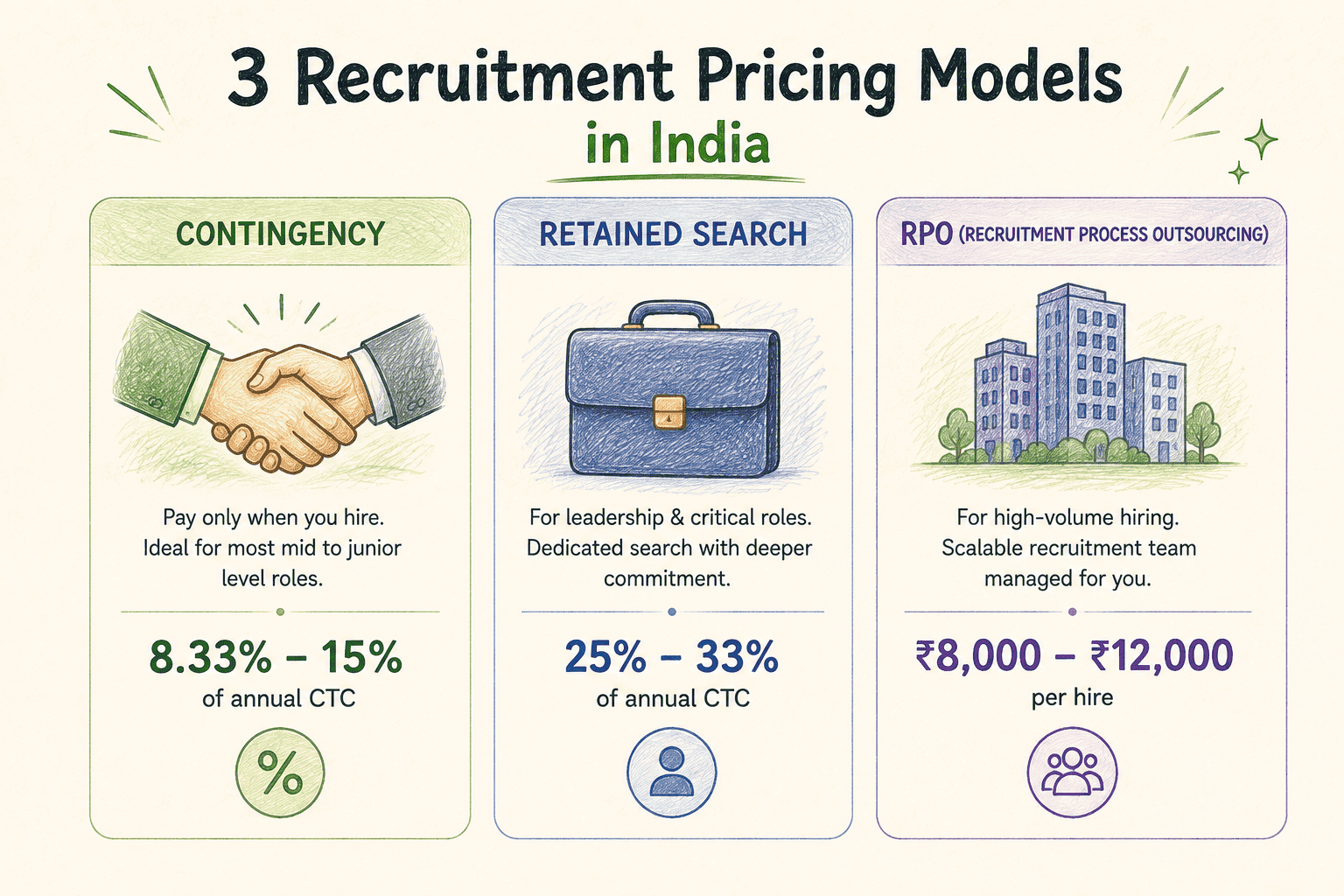
Three models. Pick the wrong one for your situation, and you'll feel it.
Contingency
You've probably dealt with this one. You pay only if you hire. Fee is somewhere between 8.33% and 15% of the candidate's annual CTC, and that 8.33% floor is just one month's salary, which is why that specific number keeps showing up everywhere.
For most roles, this works fine. For anything niche, an ML engineer, a senior cloud person, anything with "AI" in the job title right now, expect that percentage to climb. 18, maybe 20%. The market for those profiles is tight, and agencies know it.
The thing about contingency that doesn't get said enough: the agency is running your brief alongside several others. Your urgency is your urgency, not theirs. If you need someone in 30 days, contingency might not be the right call.
Retained Search
This is for leadership. CXO, VP, Board-level roles where a wrong hire is a much bigger problem than the search fee.
The range sits between 25% and 33% of annual CTC, paid in thirds: one when you engage, one when shortlists come through, and one on placement. That payment structure means the agency is genuinely committed to your search. They're not splitting attention across a dozen open roles.
Worth knowing: CXO search fees in India went up 14% year-on-year in 2024. That's not agencies being greedy, well, not entirely. There's a genuine shortage of leaders who can step into senior roles without a long ramp-up, and that scarcity gets priced in.
RPO
If you're hiring at scale, GCC hiring in India where a single centre opens 200 positions, a funded startup that needs 50 engineers before Q3, anything that looks like a volume play, RPO is worth considering seriously.
Instead of a fee per hire, you're essentially renting a recruitment function. Cost-per-hire through RPO runs around ₹8,000–₹12,000 for volume roles. Whether that beats a standard placement fee depends entirely on volume, and the trade-offs between an RPO model and a traditional agency retainer are worth working through before you commit. Building comparable internal capacity, once you count recruiter salaries, ATS tools, job boards, and everything else, costs considerably more. The math tends to be pretty clear.
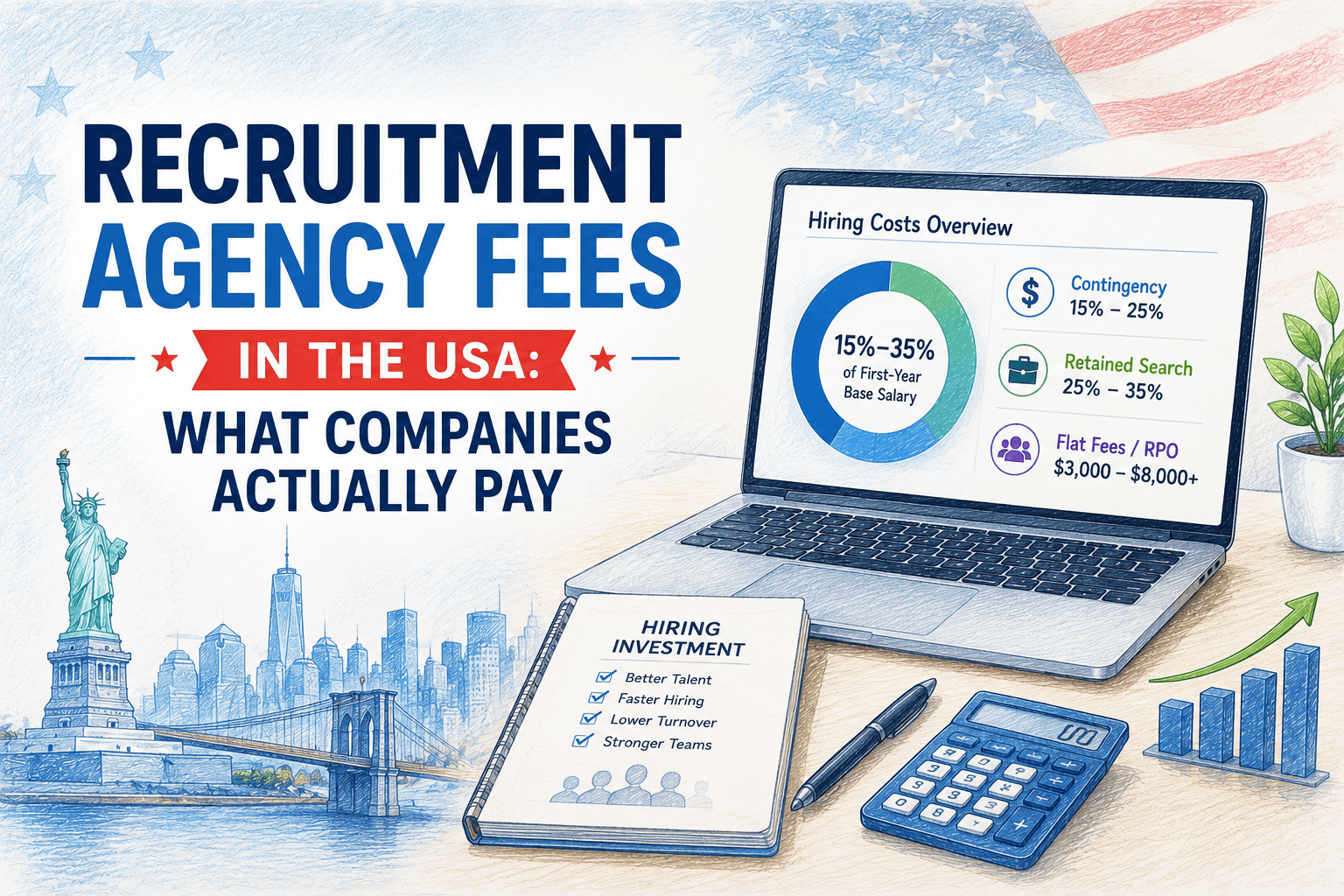
One thing worth flagging if you're hiring across borders: none of these numbers travel. In the US, agencies charge against first-year base rather than annual CTC, contingency starts at 15% instead of 8.33%, and there's no GST line at all. If that's your other market, recruitment agency fees in the USA follow a completely separate structure, and it's worth reading both before you build a global hiring budget.
What Hiring Actually Costs by Industry
The national average cost-per-hire in India lands somewhere between ₹30,000 and ₹1.5 lakh. That's a wide range, and it's wide because sector, seniority, and timing all push the number around a lot.
| Industry | Average Cost Per Hire (INR) | What's Driving It |
|---|
| IT & Tech | ₹35,000 – ₹80,000 | AI/ML profiles command premiums; bulk hiring brings costs down |
| BFSI | ₹40,000 – ₹1.2 lakh | Psychometric tests and deep background checks add real cost |
| Manufacturing | ₹20,000 – ₹45,000 | More localized hiring, lower specialization bar |
| Healthcare | ₹30,000 – ₹70,000 | Credentialing and compliance slow the process down |
| Startups | ₹20,000 – ₹80,000 | Speed pressure almost always means paying premium rates |
Tech is consistently at the upper end of its range. For anything touching AI infrastructure or data engineering, a single placement can clear ₹1 lakh without much effort.
The Stuff That Doesn't Show Up on the Invoice
This is the part that bites people.
The GST nobody mentions upfront
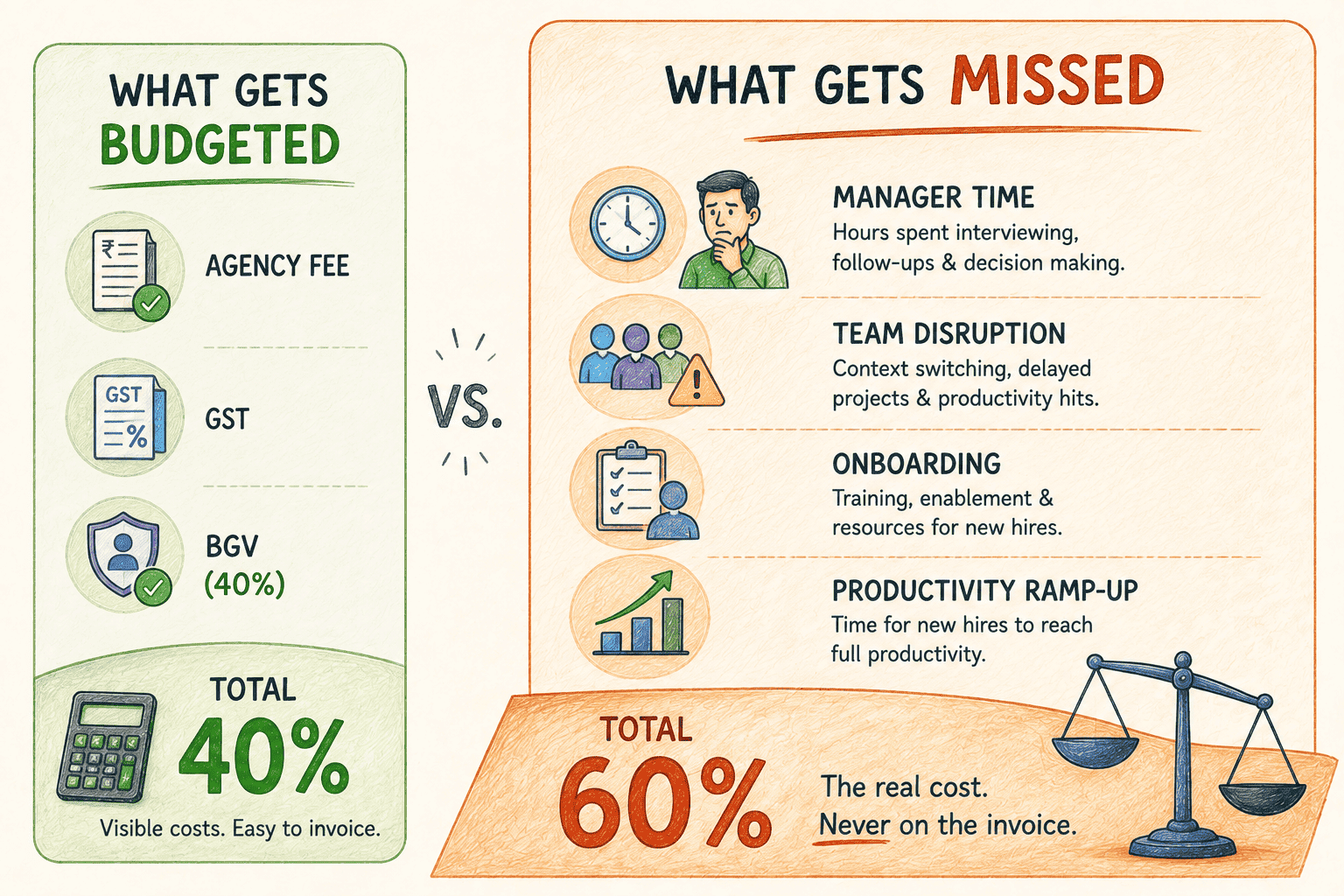
Every agency in India charges 18% GST on its fee. It's not optional, it's not negotiable, and it's almost always forgotten during the budget conversation. On a ₹1 lakh placement, that's ₹18,000 added before anything else changes. Plan for it from the start.
The replacement clause and what it actually tells you
Most agencies offer a 90-day replacement guarantee. If the hire walks before day 90, they find another candidate at no extra charge. That sounds reassuring, and it is, but it also exists for a reason. First-year attrition among freshers in India sits at 20–25%. Agencies built this clause in because early exits aren't rare. For senior hires specifically, push for 180 days instead of 90. It's not an aggressive ask.
Background verification
BGV in India, employment history, education checks, criminal records, and references, typically adds ₹1,500–₹3,000 per candidate. Some agencies include it. Some don't mention it until billing. Ask in the first meeting which situation you're in.
The soft costs, and this is the big one
Hard costs, meaning agency fees, ads, and BGV, account for about 40% of what hiring actually costs. The other 60% is soft costs: manager hours in interviews, team disruption while a role sits empty, onboarding time, productivity ramp-up.
None of that shows up anywhere. But it's all real spending.
Quick illustration: a panel of three senior interviewers going through four candidates costs roughly ₹18,000 in payroll per interview round in a mid-to-large company. A good agency, or AI resume screening at volume, sends you the top 3% before anyone's calendar gets touched. That's fewer rounds, less disruption, and it's the soft-cost line you actually have control over.
The Real Math of Agency vs. In-House
Everyone asks, "What does the agency cost?" The more useful question is "what is the empty seat costing me right now?"
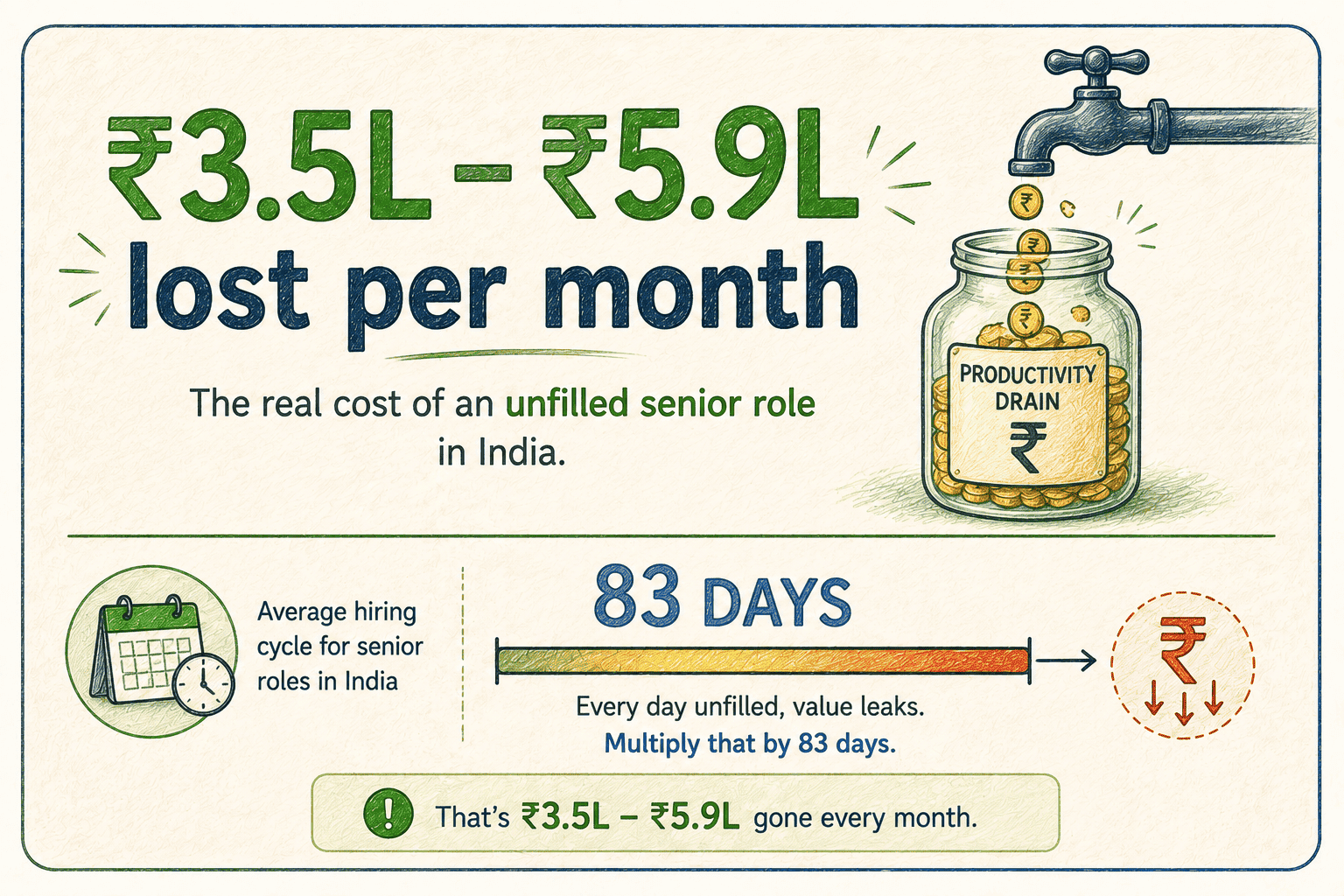
The average leadership hiring cycle in India runs 83 days internally. During those 83 days, an unfilled mid-senior role is bleeding somewhere between ₹3.5 lakh and ₹5.9 lakh per month in lost productivity, delayed decisions, stretched team members, slipping timelines. Over the full 83-day cycle, you're looking at ₹10–17 lakh gone before you've sent a single offer letter.
A retained search fee on a ₹40 lakh CTC role comes to ₹10–13 lakh. Those two numbers are very close to each other. Which is the point?
There's also a reach problem worth understanding. Around 90% of senior candidates in India are passive; they're employed, not looking, definitely not seeing your LinkedIn job post. The recruiter who's been building a relationship with that person for two years gets a call back. Your job listing doesn't.
India's offer acceptance rate is at 78% right now, down from 83% in 2022. Candidates are harder to close than they used to be. Good agencies earn their fee partly through knowing how to shepherd someone past a competing offer, and that's genuinely hard to replicate in-house.
Where You Actually Have Room to Negotiate
Agency fees aren't fixed. There's real room to move if you know where to push.
Volume. Multiple roles over a defined period are worth a tiered rate. Don't treat each hire as a separate transaction if you're bringing consistent business.
Exclusivity. Giving an agency a 30-day exclusive on a role meaningfully reduces their risk. That's worth asking for 1–2% off. Most will agree.
Extended replacement windows. Push 90 days to 180 on senior hires. If the role is well-defined and compensation is competitive, it's not a hard sell.
BGV clarity. Confirm in your first conversation whether verification costs are bundled or separate. You want to know this before the invoice, not after.
Negotiating well also means coming in with data. Platforms like Hyring, winner of the ETHR Future Skills Award and recognized across G2 and Product Hunt, give hiring teams real visibility into the recruitment metrics that actually matter: screening quality, time-to-shortlist, conversion rates. When you can show what good looks like in numbers, fee conversations go differently. Hyring's CEO sits on both the Forbes Technology Council and the Forbes Human Resources Council, which shape how the platform thinks about making cost transparency a core part of how companies hire.
Key Takeaways
- Recruitment agency fees in India work across three models: contingency (8.33%–15%), retained search (25%–33%), and RPO (₹8,000–₹12,000 per hire).
- 18% GST is always additional. It's never folded into the percentage.
- Soft costs are 60% of total hiring spend and appear on no invoice.
- An unfilled senior role costs ₹3.5–5.9 lakh per month. The agency fee often earns back through faster closure.
- Volume, exclusivity, and extended replacement windows are where you negotiate.
Once the full cost picture is on the table, vacancy bleed, soft costs, tax, BGV, the agency fee tends to look a lot more reasonable than it does on first glance. The question was never whether it costs money. It's whether what you're getting back is worth more.
FAQs
1. What's the standard recruitment agency fee in India?
Contingency hiring runs 8.33%–15% of annual CTC. For CXO and leadership roles under retained search, expect 25%–33%, paid in three tranches.
2. Is GST included in the agency fee?
No, 18% GST is always separate and always on top of the professional fee. Budget for it from day one.
3. What's the cost-per-hire benchmark for tech roles?
₹35,000–₹80,000 on average. AI/ML and niche engineering profiles push past the upper end of that range regularly.
4. How long does leadership hiring take in India?
About 83 days on average when managed internally. Agencies typically cut that by 30–40%.
5. When does RPO make more sense than contingency?
When you're filling 15 or more roles in a concentrated period. Cost-per-hire under RPO drops to ₹8,000–₹12,000, much lower than individual contingency fees at that volume.