Can you justify a $200,000 agency investment in hiring candidates (on perceived quality) based on nothing more than a gut feeling? Wouldn’t that be unfair and pretty uncomfortable!? I recall that there was a situation last year at a boardroom meeting with a Talent Acquisition lead, who was still struggling to justify this.
In 2026, gut feelings just do not cut it anymore. If you are not measuring your recruitment partner on hard data, then you are essentially flying a plane without a dashboard.
Not only is it important to consider the recruitment agency you are using, but it is equally important to consider the precision and efficiency of the recruitment engine behind them.
While you are choosing a recruitment agency, you are choosing a recruitment engine behind the scenes. You need a standardized set of metrics to ensure you are getting a return on investment. Let’s walk you through the metrics that actually move the needle.
The Core Efficiency Metrics: Speed vs. Cost
In my experience, the two most common reasons companies engage an agency are to save time or to find someone they could not find themselves. Therefore, your first set of metrics must focus on the hiring velocity and the financial burden of each seat filled.
1. Time-to-Fill vs Time-to-Hire
There is a subtle but vital difference here we are missing. Time-to-Fill measures the total days a job is open until a candidate accepts. Time-to-Hire tracks how quickly the agency does the job once a candidate enters their funnel.
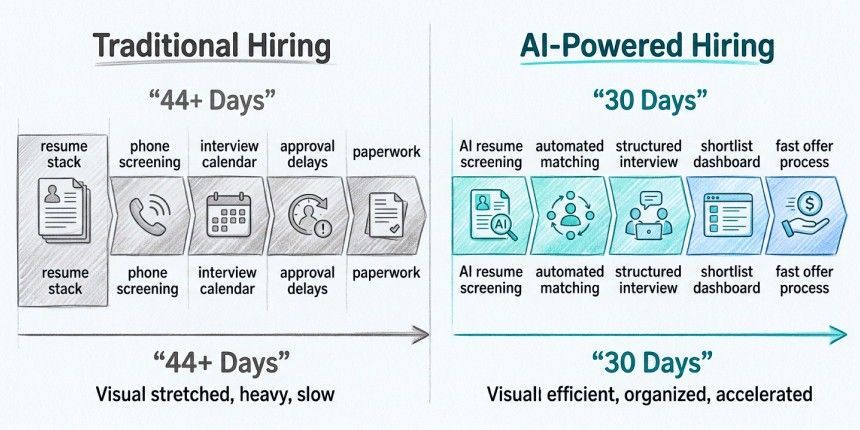
Currently, the global average time to fill a position is roughly 42 days. Assuming that your agency takes 50+ days to fill positions of the middle level, the loss of revenue due to vacant positions would be much higher than the fees you pay to such recruitment firms. In my experience, some agencies have used the concept of Automated Phone Screening Technology to minimize their time in the first week from weeks to hours.
2. Cost-Per-Hire (CPH)
The equation is very straightforward – all you have to do is divide your overall recruitment costs by the number of hires made. The average CPH in the USA for 2026 is high due to the specialized nature of many job positions.
There is a lot more to consider apart from the price of the bill. In fact, a cheaper firm that provides you with ten bad candidates for every good one may end up costing you more money. They waste time of your HR. Always remember to account for wasted time on interviewing bad applicants. With good quality software for AI recruiting, CPH will continue falling.
The Litmus Test of Hiring Quality
Volume creates a false signal. You can have a thousand applicants, but if none of them can do the job, your progress is zero. Quality of Hire is the most difficult metric to track because it requires post-hire data, but it is the only one that truly matters to the CEO.
1. First-Year Attrition
If the agency hires someone who leaves within six months, then there must be something wrong with the vetting process. If there is high turnover within the first few months, then this suggests the recruiter is too sales-oriented in their approach or has not identified the potential cultural issues.
2. Hiring Manager Satisfaction Rating
This is a straightforward questionnaire that you send out internally once the recruitment for the position has been completed. How well did the agency grasp the job description? Were the applicants ready for the job?
There was once a hiring manager whom I knew who refused to work with a certain recruitment agency because none of their applicants ever knew what his company was all about.
3. Placement Rate (Shortlist-to-Hire)
This is your agency’s batting average. It is the ratio of candidates submitted to candidates hired. A healthy target is around 45% or higher. If an agency has to submit 20 people to get one hire, their AI Resume Screener is not calibrated to your needs.
The AI Efficiency Ratio: Measuring Modern Tech
Since most companies now use AI in their recruitment process, you have to evaluate the tech stack of your agency. A modern agency should not just say they use AI. They should show you how it improves your specific metrics.
1. Screening Accuracy and Bias Mitigation
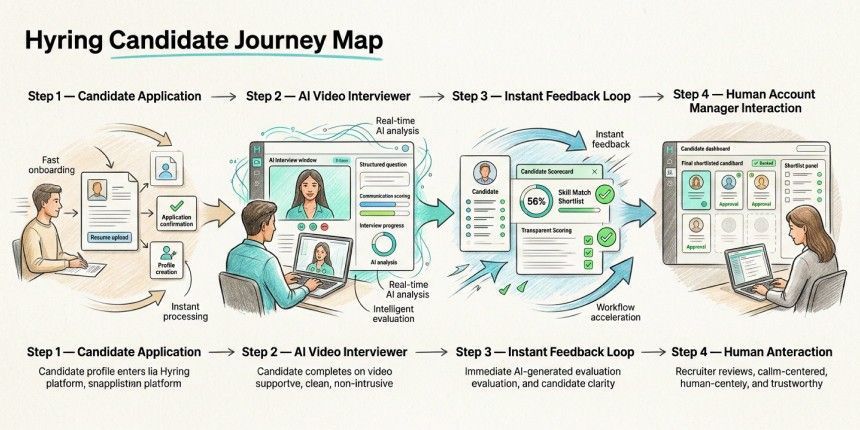
Ask your agency how their AI interviewer handles diverse accents or non-linear career paths. In 2026, leading agencies use an AI Video Interviewer to ensure every candidate gets the exact same set of questions.
This removes the unconscious bias of a tired human recruiter. You should see a direct correlation between the use of AI recruitment software and an increase in the diversity of your final shortlists.
2. Technical Validation Efficiency
For engineering roles, you should not be the one doing the first technical screen. A high-performing agency will use an AI Coding Interviewer to verify a candidate's skills before they ever reach your team.
Similarly, for global roles, an English proficiency assessment test automated at the top of the funnel ensures that communication barriers do not surface during the final interview.
| AI Tool Type | Primary Benefit to You | Target Metric Improvement |
|---|
| AI Resume Screener | Eliminates manual keyword hunting | 80% reduction in unqualified apps |
| AI Phone Screener | Replaces the initial 30-min intro call | 10x faster screening speed |
| English Proficiency Test | Standardized (CERF based) language benchmarking | Global hiring at scale |
| AI Video Interviewer | Consistent, unbiased initial screening | Replacement of phone screens |
Candidate Experience and Branding Impact
Your agency is the first face a candidate sees. If they are rude, slow, or disorganized, it reflects on your company.
This measures how likely a candidate is to recommend your company based on the hiring experience. A negative experience can damage your reputation faster than a bad product review.
I have found that candidates actually prefer a fast, transparent AI recruiter experience over a black hole human process where they never hear back. If your agency uses recruitment automation software to send instant feedback or status updates, your cNPS will naturally climb.
Real-World Nuance: The Human Account Manager
Let us be honest for a second. Technology is incredible, but if you have ever tried to explain a complex culture fit to a machine, you know its limitations. A high-performing agency in 2026 is one that pairs its AI recruiting tools with a human account manager who actually listens to you.
I recently spoke with a CTO in Chennai who was frustrated because his previous agency kept sending "technically perfect" candidates who were personal nightmares.
No amount of AI tools for recruitment can fully replace the human intuition required to negotiate a final offer or handle a candidate's sudden cold feet.
You should measure how often your account manager proactively solves problems before they land on your desk. If the agency only speaks to you when they have a bill to send, that is a red flag regardless of how much tech they claim to have.
Beyond the Placement Fee - Financial ROI
At the end of the quarter, your Finance team wants to see a return. ROI in recruitment is not just about the fee you paid. It is about the value generated.
ROI (%) = [(Revenue from Placements − Agency Cost) ÷ Agency Cost] × 100
If you’re an agency that leverages AI technology to source candidates 30% faster, then your new employee starts earning money for you 30% sooner than without the help of AI technology. This is how the math behind hiring really works. Hiring, for example, has done 200,000+ AI interviews.
This gives them an enormous database for training their AI interview tool to be not only efficient but highly predictive.
Top 8 FAQs for Agency Evaluation
1. What is the most important KPI for 2026?
Quality of Hire remains king, but the ratio of Offers Extended to Confirmed Starts is becoming a critical metric to track market volatility.
It is recommended that a monthly deep dive into the dashboard and a quarterly strategic review be conducted to adjust the ideal candidate profile.
3. Does using an AI interviewer hurt our brand?
Actually, the data shows that candidates value speed and fairness. An AI interviewer provides a consistent, professional experience that most hiring managers agree reduces administrative friction.
4. What is a good placement rate?
The target should be 45% or better. Otherwise, the recruiting agency has employed "spray and pray" techniques instead of more efficient AI-based recruiting strategies.
5. How do we measure the hidden cost of the agency?
Count the number of hours spent by your team interviewing applicants who have little chance of success. If the amount is significant, then the agency has failed its first task of filtering.
6. Can AI algorithms tell whether a person will stay?
When supplied with sufficient historical data, AI recruiting software can detect the subtle patterns characteristic of successful hiring.
7. What is the Time-to-Fill benchmark in the tech industry?
For 2026, tech and engineering roles are averaging around 42 to 50 days due to the niche skills required.
8. Should we use multiple agencies or a single partner?
In 2026, more companies are moving toward a single partner who uses a deep AI recruiting software stack. This ensures data consistency and a unified candidate experience.