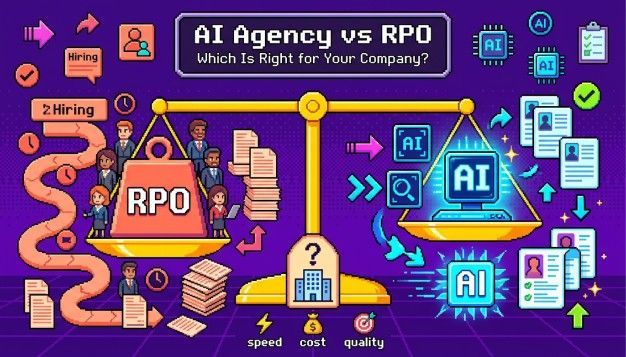
What Is Recruitment Process Outsourcing (RPO)?
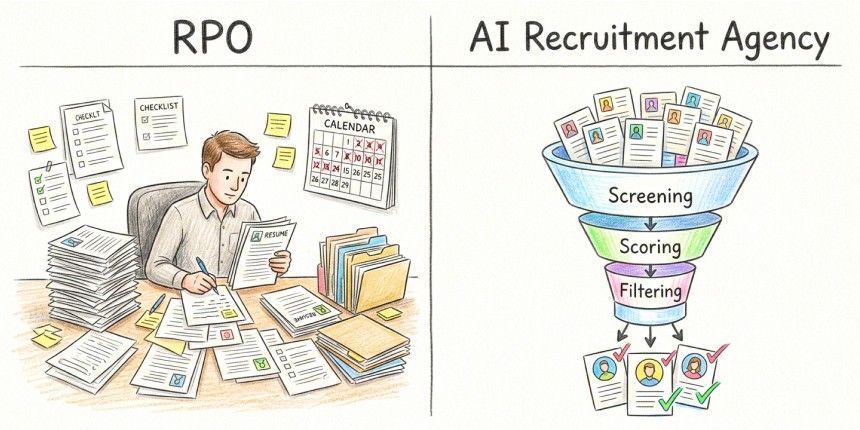
RPO means Recruitment Process Outsourcing. It is when you hire another company to help with some of your hiring.
The RPO Association acts like your own recruiting team for some or all of your open jobs. They work under your brand and alongside your HR team. This service has clear benefits. The provider has a network to find candidates, knows the rules to follow, and can hire more people than your team alone.
When you need to hire many people quickly, RPO services can help manage the workload. But RPO also has some limits that might be overlooked. It can take four to eight weeks before you see smooth RPO services. Your hiring needs must be high and steady. If you suddenly need fewer hires, there may be extra costs. Each hire adds to your expenses since the process needs more workers.
How an AI Recruitment Agency Operates
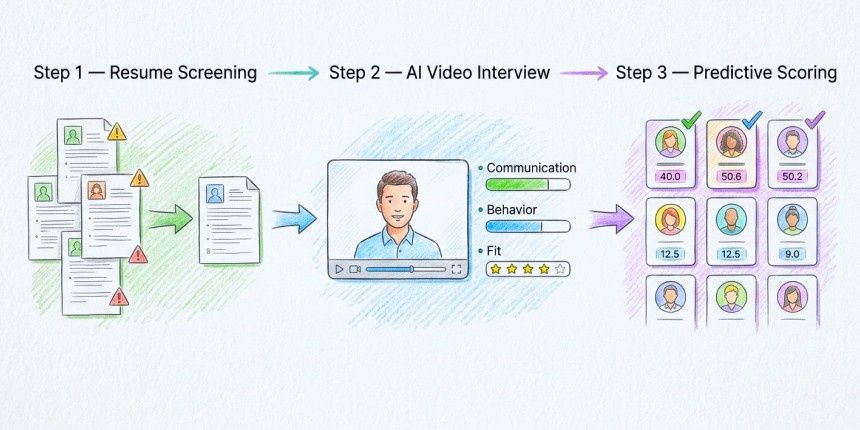
The automated part of hiring includes checking resumes, assessing candidates, and scoring them using machine learning. Here’s how it works: A candidate applies, and Hyring’s AI resume screener looks at their experience, work history, and skills to see if their skills match the job requirement.
This is not just a keyword search; it checks for gaps in work, how long they worked at jobs, their skills, and the reputation of their past employers. Applications are handled one by one or in groups and sorted before any recruiter looks at them.
This is important because Surveys show that 64.2% of Americans lie on their resumes. So, only a small number of resumes are honest, and traditional methods don’t catch the lies well.
Candidates who pass the resume check have structured video interviews. They get the same questions and follow-ups. Hyring’s AI Video Interviewer looks at their communication skills, behavior, and answer quality, giving scores and transcripts for recruiters to review.
Proctoring technology checks for unusual eye movements, switching tabs, multiple faces or voices, and background noise. For jobs with many applicants, an AI Phone Screener does the first phone interviews, asking job-related questions.
For technical jobs, a coding interview tool gives real-time coding tests in over 20 programming languages. Every candidate goes through the same careful process. It doesn’t matter if they are reviewed at 8 PM or 9 AM; they get the same evaluations. This consistency is hard to achieve with traditional hiring, which is why companies like IBM, Uber, and Tata Consultancy Services use this method.
Where the Two Models Actually Diverge
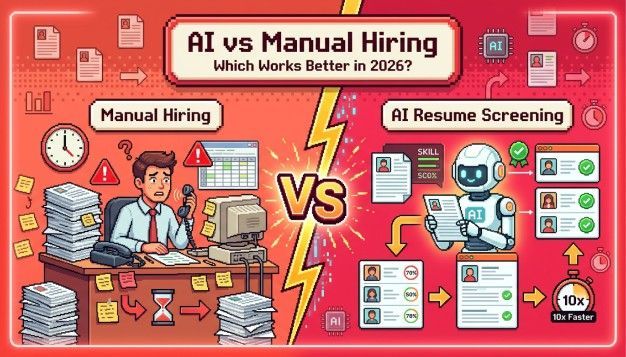
Humans and automation are not in direct competition. They work at different parts of hiring.
RPO means getting deeply involved, talking to candidates, building a strong company image, and having important discussions. This needs skilled people.
AI recruiting helps with earlier problems like high numbers of applicants, inconsistency, and bias. Research shows that unstructured human judgment is often not good for finding successful employees. RPO brings order to hiring, while AI helps reduce human inconsistency.
However, for jobs that need a personal touch, RPO is better than AI. Experienced recruiters can share the company’s message during interviews, which machines cannot do. When RPO fails, it leads to slow hiring, higher costs, and varying candidate quality. If AI doesn’t work well, it’s often due to wrong candidate profiles.
The Hidden Cost of Each Approach
According to SHRM, the average cost to hire someone is $4,700, and it goes up for technical and management jobs.
RPO usually charges more than this per hire. With AI services, hiring the 300th person costs about the same as the first. For example, Hyring’s basic plans start at $99 a month and offer options for teams that hire a lot without raising costs for each new hire. Hiring the wrong person is costly.
The U.S. Department of Labor says a bad hire can cost at least 30% of their yearly salary. So, if someone earns $90,000 a year, a bad hire could cost $27,000. Over 95% of companies admit to making at least one bad hire each year.
But RPO doesn’t fix this problem since it also depends on human choices, just like a company’s own hiring process.
Which One Fits Your Company's Hiring Profile?
In both cases, the answer is clear. A medium-sized SaaS company needs 35 software engineers in five months. It’s important to be precise while giving technical skills importance.
Good communication and team fit are also important. Hiring a bad engineer can be very costly for a small team.
Using AI to hire helps create organized shortlists and keeps costs low. Onboarding a hundred candidates through an RPO process won’t work here.
A logistics company hires 400 workers for warehouses. Time is crucial, while following rules is hard. Recruiters are already overwhelmed. RPO takes care of these challenges.
AI helps with early recruiting stages, but RPO is needed to onboard many people on time. Both methods can work together. Using AI tools with RPO processes is becoming more common. This helps narrow down candidates while letting people make the final choice.
Hyring was made for this reason. It allows recruitment agencies and RPO companies to work together, managing hiring pipelines and creating organized shortlists for clients without changing how they work.
Key Takeaways
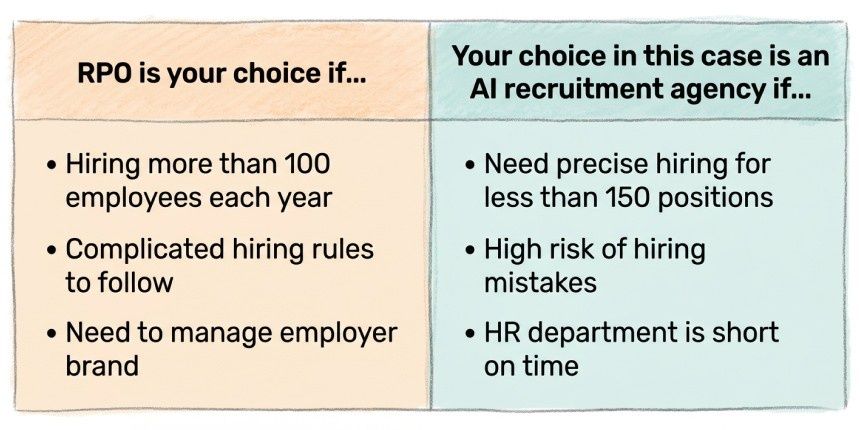
- RPO is good for high-volume, long-term hiring where following rules is important and personal contact is valued.
- An AI recruitment service is best for precise hiring, where accuracy and avoiding mistakes matter most.
- Predictive hiring fits well with AI but has no match in RPO. The two methods can work together.
- AI makes the process smoother, and RPO takes care of the rest. For moderate hiring, AI platforms are often cheaper than traditional outsourcing.
Frequently Asked Questions
1. What is the core difference between an AI recruitment agency and an RPO?
RPO can add to or take the place of your recruiting team with people. It is meant for big and regular hiring needs. AI recruitment agencies automate the early steps like screening and interviewing, before anyone looks at a resume. Both methods help at different stages of hiring, so it's better to ask where your hiring process is failing.
2. Which model is more cost-effective?
It depends on how many jobs you need to fill. RPO fees often start at about $4,700 per hire for special talent. AI recruitment agencies charge a flat fee based on a subscription, no matter how many hires you make. AI works best for 20-150 jobs a year.
3. Can a company use both an AI recruitment agency and RPO at the same time?
Yes, both can work together in the hiring process. Hyring handles the early steps like screening resumes and conducting video interviews. Recruitment agencies and RPOs will take care of final interviews, offer talks, and onboarding. The hiring platform Hyring helps with this teamwork and allows the sharing of candidate lists.
4. Which model is better for high-volume hiring?
RPO was made for large hiring projects and is good for cases needing strict rules or onboarding. However, AI is faster and more reliable for early steps. An AI Phone Screener can do many interviews at once and prepare summaries for recruiters to review.
5. How do I know which model my company actually needs?
Start by checking if your hiring process has problems. Long hiring times, uneven candidate quality, and too many bad candidates at the start show issues that AI can fix. If your recruiters can’t manage a big project, you should think about using RPO.