Let us start by taking one incident in which a recruiting team found the perfect candidate. They possess great energy, great skills, and everyone on the team was excited. But the process dragged on for a while. Scheduling fell apart. Approvals took too long. By the time you sent the offer, they had already accepted somewhere else.
It is a process problem. It is not a talent problem. It is the exact kind of problem AI was built to solve. AI removes the friction that gets in the way of good hiring. The bottlenecks, the busywork, and the manual steps that eat up time without adding value.
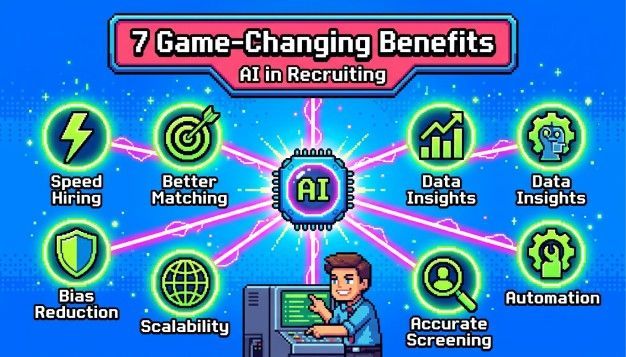
Here are seven benefits that show what that looks like in practice.
1. Hiring Faster, Without Cutting Corners
Time destroys deals, and it does the same with hiring. When your process drags on, you lose more candidates. Robert Half discovered that 62% of professionals lose interest if they don't hear back within 10 business days. That gives recruiters a tight window before top candidates start searching elsewhere.
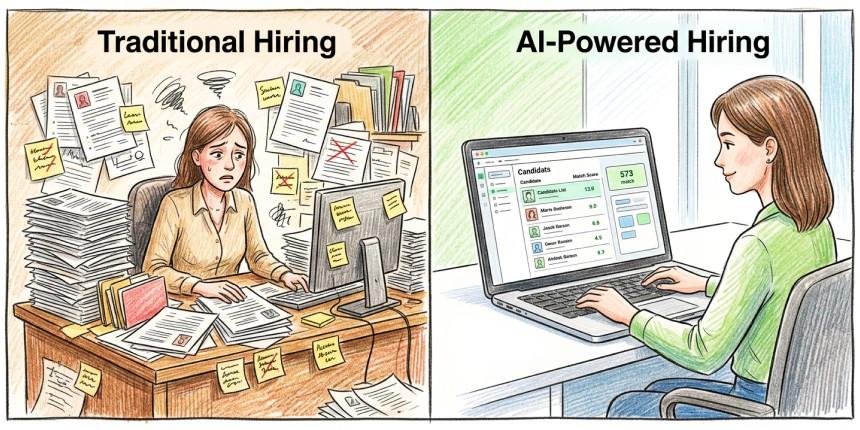
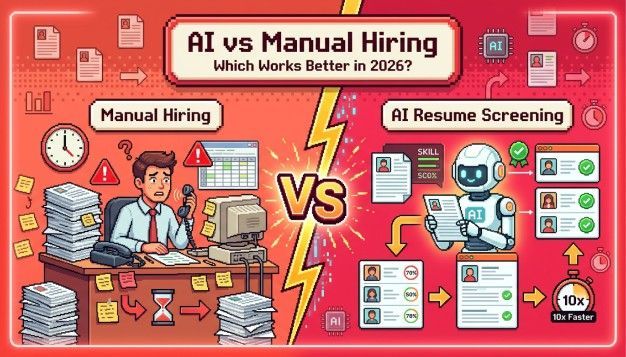
AI speeds up every part of the hiring process. Tasks like resume screening, which once took days, now take minutes with an AI resume screener. Tools handle interview scheduling. Follow-ups get sent without anyone lifting a finger.
This isn't about rushing. It's about cutting out the wasted time that slows things down. Your team works more quickly. Candidates stay interested. Offers reach them while their enthusiasm is still fresh.
2. You Find People You Would Have Missed
LinkedIn data shows that 70% of the global workforce is passive talent. They are not scrolling job boards. But they might be exactly right for your role. You just have no way of reaching them through a traditional post.
This is changed by AI sourcing tools. They scan databases, networks, and profiles to surface people who match your criteria. People you would never have found otherwise. Your candidate pool gets wider, and the quality goes up.
3. Your Hiring Decisions Get Backed by Data, Not Gut Feel
A hundred micro-decisions are made by recruiters during a single hiring cycle. They think about the aspects of who gets a callback, which resume they should read first, and who moves to the next round. Most of these decisions happen fast, and most of them are shaped by instinct.
Decisions based on instinct are not bad, but they can be inconsistent. Two recruiters can look at the same resume and reach different conclusions depending on their mood, time of the day, or workload.
AI brings structure to that process. It scores candidates against the same criteria every time. Qualifications, experience, and skills are the standard criteria with no variation based on who is reviewing or when.
Human judgment is not removed from the equation. It means giving it a stronger foundation while also being backed with valid data. When your gut says yes, the data either backs it up or gives you a reason to look closer. The result is decisions you can defend, explain, and repeat.
4. Candidates Actually Enjoy Applying
This one gets overlooked. The hiring process gives candidates their first glimpse of your company. For a lot of businesses, that glimpse isn't very good. Recruiters often go silent for weeks, leaving candidates feeling lost. It’s like throwing them into a black hole.
AI flips this experience around. Candidates get quick confirmations and regular updates on their status, and never have to guess what’s going on.
5. Small Teams Punch Way Above Their Weight
You need the right tools, not a team acquisition of 20 members, to get the best candidates.
AI takes care of the tedious stuff. It manages tasks like screening, reaching out, scheduling, giving updates, and all those repetitive chores that take up a lot of time in your team's day.
According to LinkedIn, 64% of recruiters agree that AI has an impact on removing bottlenecks in their process. For small teams, this is not just a small upgrade. It can mean the difference between staying ahead and falling behind.
You do not have to spend like a big company to get these benefits. Many platforms adjust to meet your requirements. It is easier than ever to scale up. A recruiting pair with the right AI tools can work as a team ten times bigger.
6. You Can Hire Globally Without Hiccups
Gartner states that 58% of organizations now hire talent where employees live in one country and work for companies in another. This trend shows remote work is becoming a permanent part of how businesses operate. It opens doors to a huge global talent pool.
Hiring across various time zones and finding vendors in foreign markets brings logistical headaches. Teams spread over different locations make smooth communication harder, adding more layers of complexity to managing workflows.
AI helps handle these challenges. It uses advanced sourcing systems to target specific regions. Time zone differences get managed through smart scheduling software. Automated communication tools update candidates no matter where they are. This simplifies processes and keeps operations running.
You can access talent from around the world and skip dealing with all the tricky details yourself.
7. You Scale Hiring Without Scaling Your Team
Until your hiring team becomes the bottleneck, growth is great.
When requisitions jump, everything multiplies. More resumes, more interviews, and more coordination, without support, quality drops. Candidates fall through the cracks, and your team burns out.
This is not about doing more with less. It is about doing more without breaking. AI gives you breathing room.
Your standards stay high, your team stays lean, and your hiring keeps pace with your growth.
How Hyring Delivers on These Benefits
Hiring teams need tools that work without adding complexity. Every benefit above comes down to one thing.
That is what Hyring does. No steep learning curve, bloated dashboards. Just an intuitive platform, making it better, cleaner, and fitting into your existing workflow.
Matching is built on skills and relevance. Not legacy patterns. Communication tools keep candidates engaged at every stage, and your team can get started in days, not weeks.
Whether you are a startup hiring your first ten people or a scaling company opening roles across markets, Hyring adapts to you. It sharpens the one you have. It does not force a new process.
Hyring is a great place to start for teams that want AI that is fair, fast, and human-first.
Wrapping It Up
AI in recruiting is not a future trend. It is already here, and teams using it are pulling ahead.
Automation is not a real benefit for its own sake. The benefits that come along include faster outcomes, fairer decisions, better candidates, and a great experience that works great for the company as well.
The benefits that matter most to your team should be the starting point. Finding the tool that delivers without overcomplicating things comes next in line.
AI just clears the path so people can do it well. Great hires are made by people to date.
Frequently Asked Questions
1. AI recruiting is only useful for big companies; is that true?
The answer is no. It often sees even more impact because every hour saved matters to even smaller teams. You do not need high volume to benefit. Even a team of two can automate screening, scheduling, and follow-ups. That frees up hours every week to focus on the work that actually needs a human touch.
2. Can AI evaluate soft skills?
AI is best at structured criteria like experience and skills. Human judgment matters where real evaluation happens for candidates mostly. AI is the tool that gets you faster to the right candidates. Once the candidates' list is sorted, the conversation and experience of human recruiters.
3. Can AI filter out a good candidate?
The chance of AI filtering out a good candidate. But that is why AI is kept as the initial filter, and humans become the final one. A human checkpoint in your process and reviewing your criteria regularly reduces the chance. AI should be treated as a partner, not a gatekeeper. The field is narrowed, and human recruiters make the final call.
The right platform, technical skills are not a necessity. Good tools are built for recruiters, not engineers. It is the wrong tool when the setup takes a few weeks. Most modern AI recruitment platforms are designed for teams to onboard in days. The teams can start seeing results almost immediately. No coding and no IT support needed.
5. How do we keep candidate data safe?
The candidate data can be kept safe with platforms that comply with GDPR or equivalent standards. Transparency about data collection and usage is non-negotiable. When AI is involved, candidates should always be informed. While choosing a tool, ask how long it is retained, data is stored, and who has access. If the vendor cannot answer those questions clearly, move on.