
Blog Header Background

AI Proctoring

The Real Cost of Not Proctoring Your Job Interviews: Data on Fraudulent Hires

Published on: 27 Jul 2026

Last updated: 27 Jul 2026

Clock7 mins read

Share now:

logo

Written by

Surya N

fact checker avatar

Fact Checked by

Shabnam Sruthi

The last time you hired somebody who wasn’t the right fit for your company, it was not because they lied on the resume, but because there was no oversight during the screening and interview process.

Fraudulent hires are rarely discovered during resume screening. They're caught three months down the line, when a client gives feedback, a performance review brings up a red flag, or the team quietly asks why this person keeps getting stuck on tasks they claimed to have done before. By then, the damage is done and already compounding.

One must take into consideration the cost involved when the candidate who passed your test did not possess the necessary skill set that was being tested for. This is a whole new ball game. This blog post is targeted towards HR managers who have to justify the budget requirements for proctoring to their CFOs.

What Does a Bad Hire Actually Cost?

The U.S. Department of Labor says that almost 30% of one year's salary goes towards covering the cost of a poor hiring decision. This would be the cost of recruitment efforts, onboarding time, training costs, and the loss in productivity that becomes clear when you try to replace someone. In other words, for a job worth $60,000, that is $18,000, and that is not in severance packages but in all of the above cases.

CareerBuilder's survey of 2,500 hiring managers found that 74% of employers had been affected by a bad hire. 41% said that a single bad hire cost them more than $25,000. For one in four, the damage cleared $50,000. One hire.

That's the baseline. And it assumes your bad hire at least had the qualifications they said they had.

A more risky situation occurs when you have an applicant who has a good résumé, does well on the interview, and successfully passes your screening process because someone else answered the technical questions.

Also Read: What Is AI Proctoring? How It Works, What It Detects, and How to Use It for Hiring

How Interview Fraud Is Happening Right Now

Remote hiring has only been getting more popular due to a variety of benefits and conveniences that it brings to hiring in general. In June 2022, the FBI issued a formal public service announcement warning employers about impostors who are using deepfakes and stolen identities to masquerade as others during job interviews, especially for remote technical roles.

In any case, the techniques have become more systematized and more common. “Ghost coding” services – which involved candidates paying people to perform live technical assessments on their behalf – got to be prominent enough that both the Wall Street Journal and Bloomberg covered the trend in 2023. The candidate remains in front of the camera, with a second individual solving the challenge behind the scenes and relaying the answers via a second device. Some charge for remote technical interviews, some charge per session.

Then comes the infusion of AI tech in this whole scheme. There are now several ways candidates cheat using AI, and real-time cheating devices mean a single candidate can attempt screening calibrated to filter out people who can't perform at that level.

It is evident from the HireRight annual reports regarding the Employment Screening Benchmarking that resume fraud, credential discrepancy, and misrepresentation by the candidates are some of the major concerns for businesses.

The difference between “we verified the résumé” and “we verified the person in the interview” is what constitutes remote interview fraud.

Which Industries Are Getting Hit Hardest

Coding interviews are structured, predictable, and have now become easy targets for proctoring proxies. A candidate usually handles the face-to-face portion while a second person solves the technical problem elsewhere and passes answers through.

However, in finance and healthcare, credentialing takes center stage as the issue at hand. In finance, an incorrect credential exposes you to risk from a regulatory standpoint, not one that involves poor performance.

Compliance risk related to individual credentials is one that is very tangible, verifiable, and costly to address. In healthcare, a false credential exposes you to clinical risk, not just for yourself but for others as well.

Even mid-market roles in operations and project management face this. Any position with a structured screening round has a point where interview cheating can happen.

The difference with non-technical roles is that the skills gap often takes longer to be discovered, which tends to make the total damage higher, not lower.

What Does Each Fraudulent Hire Cost? : The Math Nobody Runs

Most HR teams track only cost per hire. Very few actually track the cost per fraudulent hire, because the fraudulent nature usually isn't confirmed until months have already elapsed.

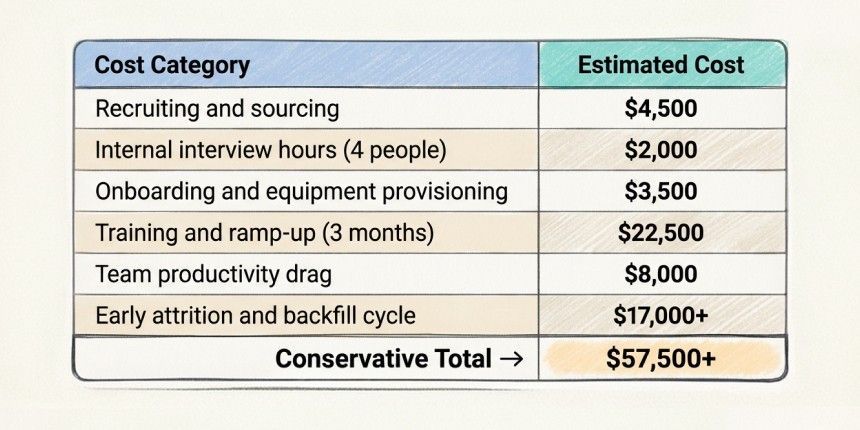
Here's a conservative estimate for a mid-level engineering hire at a $90,000 annual salary:

That's for a hire who completes their probation period before the skill gap becomes irrefutable. At a senior level, or in a role with direct client exposure, the numbers are even higher. The $17,000 bad hire average that gets cited in HR reports is a floor, not a ceiling. Fraudulent hires seldom hit the floor.

What Proctoring Actually Saves

A CFO’s case for AI proctoring is simply the ratio between the risk and the proctoring costs.

If your current system catches 60% of fraud cases, adding automated proctoring can push detection to 90%, which translates into 30% more fraudsters caught compared to before.

This works out to savings of $230,000 a year based on the cost of $57,500 per case of fraudulent hiring (once every three months).

The AI interview proctoring provided by Hyring involves behavioral analysis, identity verification, and real-time detection of AI assistance directly within the interview process itself. It doesn't need a separate vendor or an out-of-process review manifest. The cost is easily under $100 per session (in fact, much lower) for all but a handful of very high volume levels, pennies on a $57,500 loss.

The spend-versus-risk math becomes very simple very quickly. What takes longer is accepting that the problem is real. Statistics surrounding bad hires have always looked abstract until they've got a specific someone to link them to. Fraudulent hires are worse because the person has effectively passed the process, thereby gaming the system, wherein the failure feels more personal, and the cost is higher.

Fraud in the hiring funnel does not make itself known, whereas proctoring does.

Frequently Asked Questions

1. What is the average cost of a bad hire in 2024?

The average cost of a bad hire ranges from $17,000 to over $50,000 per bad hire, depending on the role level. The U.S. Department of Labor has determined a baseline of about 30% of the first-year salary. For roles with technical dependencies or direct client exposure, the actual number is essentially well above that once you have accounted for backfill, productivity loss, and ramp time on the replacement hire.

2. How common is interview fraud in remote hiring?

It is common enough that the FBI issued a formal alert about it in 2022 in the US, calling out deepfake and impersonation fraud in remote video interviews for technical positions. Ghost-coding and AI-assisted answer delivery are well-documented by major publications as organized phenomena and not just edge cases.

3. What does AI proctoring detect during a job interview?

AI proctoring detects behavioral anomalies such as sustained gaze deviation, secondary devices, off-screen activity, more than one person in frame, screen sharing, real-time AI-answer delivery, and identity mismatches between the applicant on file and the person on camera. This all happens seamlessly within the AI Interviewer framework as far as Hyring is concerned.

It is absolutely legal to use AI proctoring in most places, provided there is a disclosure of the same to the candidates prior to the exam. It is important for HR departments to have language in the invite that contains consent to ensure that they do not run into any kind of legal trouble. This has to be written in the interview invitation and must confirm whether or not their service providers comply with the data protection laws in their jurisdiction.

5. How do I make the proctoring ROI case to a CFO?

The ROI case can be made with your organization's estimated bad hire cost. The 30% of first-year salary, as mentioned above, is a defensible number to start with. Estimate how many hires per year could plausibly involve credential misrepresentation or interview assistance, using industry data.

Then compare that risk exposure against your per-interview proctoring cost. The gap between the two should serve as reason enough for them to be convinced.

Written by

Co-founder & CTO, Hyring

6+ years of experience

Surya N is the Co-Founder and CTO of Hyring, where he architected the AI interviewing engine that has now conducted over 900,000 interviews for companies ranging from early-stage startups to the Fortune 500. A mechanical engineer who moved into artificial intelligence, he spent 6 years building AI applications inside a technology consultancy before co-founding Hyring, and wrote the first version of its AI interviewer from scratch: a system that listens, adapts its questioning in real time, and flags fraud rather than following a fixed script.

Expertise

AI Interview SystemsConversational AIInterview Fraud DetectionPlatform ArchitectureMachine Learning EngineeringApplied AISpeech and Voice AIBias Testing and Model Evaluation