When scaling high-volume candidates, choosing the right remote invigilation method is critical. Comparing AI proctoring vs live proctoring for hiring reveals that AI-driven proctoring solutions offer cost-effectiveness, while human invigilation provides high accuracy in nuanced situations. For most modern tech recruitment workflows, automated anti-cheating software delivers the best balance of speed, budget optimization, and security.
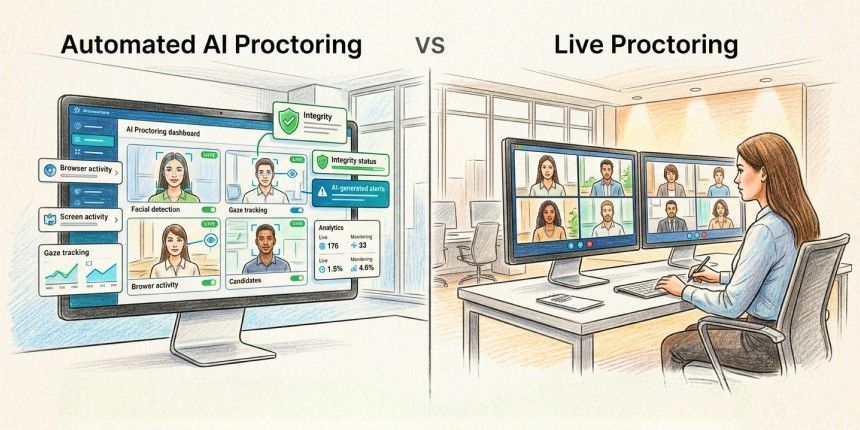
Selecting between these two methods depends on the volume, tech stack, and budget. Automated systems leverage computer vision and audio analytics, whereas live setups rely on real-time human oversight.
Understanding Remote Invigilation Methods
Evaluating remote assessment requires looking closely at how tech platforms detect cheating. Automated anti-cheating software relies on sophisticated machine learning models. These algorithms continuously monitor the candidate’s webcam, microphone, and browser desktop activity.
Conversely, live human invigilation uses trained professionals to monitor candidate and video feeds in real time. While highly reliable for catching complex behavior, it faces significant challenges when scaling to hundreds of applicants simultaneously.
Also Read: Who is a better proctor? AI or human?
AI Proctoring vs Live Human Proctoring: 5-Dimension Comparison
To help you choose the right approach, this table compares automated assessment security against human-led monitoring across five critical operational dimensions.
| Dimension | AI Proctoring for Recruitment | Live Human Proctoring |
|---|
| Cost per Candidate | Low ($2 – $5 average) | High ($15 – $35 average) |
| Scalability | Handles thousands simultaneously | Limited by available proctor headcounts |
| Cheating Detection Accuracy | 92%–95% (Excellent flag rate for technical anomalies) | 75% (Good for behavioral nuances) |
| Candidate Experience | Seamless, asynchronous, less intrusive even when it is two-way | Higher anxiety due to direct observation |
| Time-to-Hire Impact | Reduces cycle time by automating verification | Increases cycle time due to scheduling delays |
Accuracy vs Cost-Effectiveness: The Final Verdict
When analyzing accuracy, human proctors excel at identifying subtle, contextual cheating methods. However, automated systems catch technical infractions, like background browser tabs, second monitors, or copy-pasting code, much faster than a human eye can.
From a cost-effectiveness perspective, automated remote invigilation is the clear winner for early and mid-stage technical assessments. It eliminates human labor costs and removes scheduling bottlenecks entirely, allowing your talent acquisition team to focus strictly on qualified candidates.
When to Choose Each Proctoring Approach
Use AI Automated Proctoring When:
- You are managing high-volume tech hiring or internship drives.
- You need to screen thousands of developers simultaneously without scheduling delays.
- Budget optimization per applicant is a core operational metric.
Use Live Human Proctoring When:
Scale Your Tech Recruitment Safely with Hyring
If you want to maximize your recruitment budget while maintaining bulletproof test integrity, Hyring offers the ultimate automated evaluation platform. Hyring’s advanced AI engine flags suspicious browser behavior, secondary devices, and unauthorized audio patterns without adding friction to the developer experience.
By automating the initial screening phases, Hyring cuts assessment costs by up to 70% compared to live human alternatives.
Summary of Key Takeaways
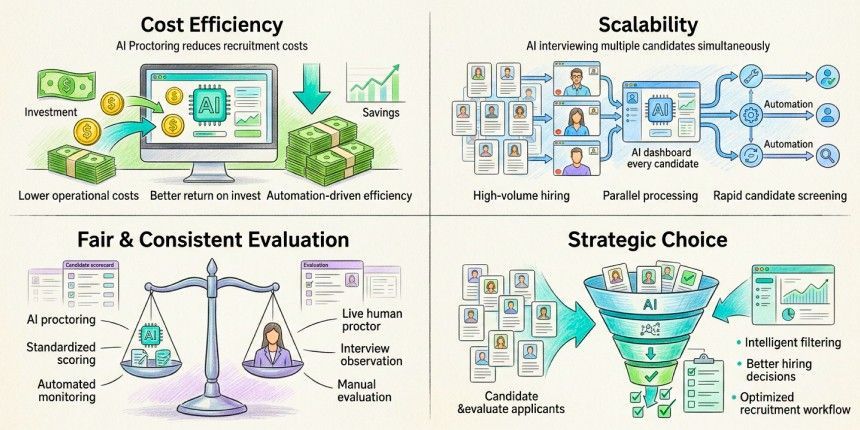
- Cost Efficiency: Automated anti-cheating software drastically lowers the cost per candidate compared to hiring live human monitors.
- Scalability: Automated systems scale to a large number of candidates, eliminating scheduling friction during massive hiring drives.
- Accuracy Balance: While live humans catch subtle behavioral cues, algorithms excel at spotting technical non-compliance like copy-pasting.
- Strategic Choice: Use automated tools like Hyring for top-of-funnel tech, reserving live oversight for high-stakes final rounds.
Conclusion
Finding the sweet spot between AI proctoring vs live proctoring for hiring ultimately depends on your organizational scale. For modern tech teams aiming for fast growth, automated tools offer the perfect blend of precision, speed, and affordability.
Frequently Asked Questions
1. Does AI proctoring violate candidate privacy or data security laws (like GDPR)?
This is a significant issue for global talent acquisition teams. The best AI proctoring solutions are created based on compliance frameworks such as GDPR and CCPA. In contrast to live proctoring, when a stranger sees the candidate's private space during the process, data is always encrypted at once, and only certain technical or behavioral anomalies are flagged by AI tools. In order to comply with regulations, employers need to have candidate consent before the test.
2. How does AI proctoring handle false positives?
AI proctoring systems do not automatically reject the candidate but only raise red flags for suspicious actions that happen along the timeline. For instance, if the candidate is reading the question aloud or looking up to the ceiling while pondering something, this will be marked by the AI system as a possible violation. In any case, the ultimate decision-making authority lies with the recruiting team. The recruiters can jump directly to the suspicious timestamps to confirm whether it was just a habit or a violation.
3. Can tech-savvy candidates bypass or trick AI automated proctoring software?
Despite the fact that there cannot be an absolutely flawless security system, modern proctoring by means of artificial intelligence systems is practically impossible to bypass, at least from the point of view of technical offenses. Such systems track all background processes to prevent any attempts to use virtual machine, secondary screen connections, cut-and-paste features and even analyze audio to spot any background sounds. What is more, AI is much more effective than a live proctor watching video.
4. Does AI proctoring negatively impact the candidate experience or cause test anxiety?
AI proctoring causes much less anxiety compared to the live form of proctoring. The live form of proctoring involves an invasive sign-in procedure in which a stranger asks the candidate to show his/her identity proof and the room through webcams and is also accompanied by the stress of being observed in real time. In contrast, artificial intelligence proctoring takes place behind the scenes, providing complete freedom to take the test asynchronously.
5. Can we integrate AI proctoring software directly into our existing Applicant Tracking System (ATS)?
Yes, because most enterprise AI-based proctoring software comes equipped with automatic API integration with leading ATS platforms, like Greenhouse, Lever, Workday, Ashby, and the like, along with assessment platforms. In this way, recruiters are able to schedule proctored tests on completion of a particular stage in the recruitment pipeline and access the integrity score or flags from within the candidate's profile itself.